SEO
Summarize this blog post with:
TL;DR
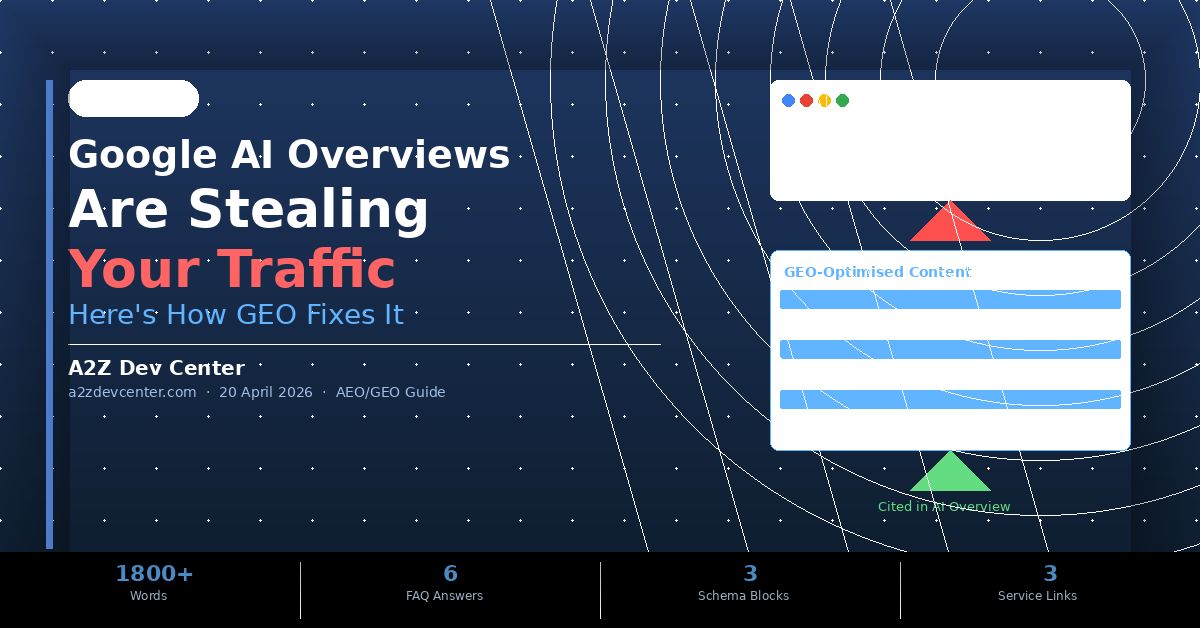
- Google AI Overviews now appear for a large and growing share of searches, especially informational and local service queries. They answer the user’s question before showing organic results, which means your page one ranking no longer guarantees a click if an AI Overview appears above it.
- GEO, Generative Engine Optimisation, is the practice of structuring content so AI systems cite it rather than bypassing it. The core mechanic is answer-first formatting: stating the direct answer in the first sentence of each section so AI can extract it cleanly.
- The businesses currently cited in AI Overviews did not get there through keyword density or domain authority alone. They got there because their content is structured to answer questions directly, is marked up with FAQPage schema, and cites authoritative sources that AI systems trust.
- A2Z Dev Center applies GEO SEO strategy to Michigan and US business websites through content restructuring, schema implementation, and entity signal building that aims to make existing content easier for AI systems to cite.
What is GEO SEO Strategy?
GEO SEO strategy, where GEO stands for Generative Engine Optimisation, is the practice of structuring website content, schema markup, and entity signals so that AI-powered search systems including Google AI Overviews, ChatGPT, and Perplexity cite your content as the source when answering user queries, producing visibility in AI-generated summaries that appear above traditional organic results.
You check your Google Search Console on a Monday morning and organic clicks are down eleven percent month over month despite your keyword rankings holding. You search one of your primary terms and see why: a Google AI Overview now answers the question in full before the first organic result loads. Your page one position is still there. Nobody is clicking it. The traffic is not going to a competitor. It is being answered by Google itself, and right now your content is not the source being cited.
This guide covers exactly what a geo seo strategy is, how it works mechanically, and what the businesses currently cited in AI Overviews did differently with their content structure. Every tactic here is implementable on existing content without rebuilding from scratch.
Why Google AI Overviews Are Reducing Organic Clicks, and Why Standard SEO Does Not Fix It
Google AI Overviews reduce organic clicks by answering search queries in full before displaying the ten blue links, meaning users who get a satisfactory answer from the Overview have no reason to click through to any source. Standard SEO optimises for ranking position, not for citation in the AI-generated summary that appears above rankings.
The following is an illustrative scenario, not a client case. Imagine a B2B software company in Michigan that had spent eighteen months building page one rankings for fourteen informational keywords. Their organic traffic from those keywords peaked in October 2024 and declined every month after. Their rankings did not change. What changed was that Google began showing AI Overviews for those queries in their target market. The Overview answered the question the page was ranking for. Users read the answer and moved on. The page one rankings became largely decorative for those specific queries.
The company’s content was excellent. Comprehensive, well-written, properly optimised for keywords. But it was written for human readers who would read top to bottom, not for AI systems that scan for the direct answer to a specific question. The content answered questions, but buried the answers in context-building paragraphs after three or four sentences of setup. AI systems skip those setup sentences and find nothing to extract.
The Mechanical Difference Between Traditional SEO and GEO
Traditional SEO builds relevance signals through keyword presence, backlink authority, and content depth. These signals determine whether a page appears in the ten blue links. GEO builds citation signals through content structure, schema markup, and entity recognition. These signals determine whether a page is cited in the AI-generated summary above the ten blue links.
A page can have strong traditional SEO signals and weak GEO signals simultaneously. This is exactly the situation most established businesses are in: good rankings, declining clicks, because their content is optimised for the old system but not for the AI layer now sitting above it. Research from SEO platforms such as Semrush shows AI Overviews appearing for a meaningful and growing share of queries, with higher rates for informational and local service queries.
Traditional SEO vs GEO SEO Strategy
Traditional SEO optimises for
Keyword relevance, backlink authority, content depth, meta titles, page speed. Goal: rank in the ten blue links below any AI Overview that appears.
GEO SEO strategy optimises for
Answer-first structure, FAQPage schema, entity signals, statistics citation, standalone answer completeness. Goal: be cited in the AI Overview that appears above the ten blue links.
The GEO SEO Strategy Tactics That Get You Cited in AI Overviews
The five GEO tactics that produce AI Overview citation are: answer-first content formatting, question-based section headings, FAQPage schema with 80-150 word standalone answers, authoritative statistics citation, and entity signal consistency across the website and schema markup.
Tactic 1
Answer-First Formatting on Every Section
Every section heading implies a question. The first sentence of that section must answer it directly. “How long does local SEO take?” followed by “Local SEO typically takes four to six months to produce meaningful Local Pack ranking improvements.” That sentence is extractable. It stands alone. AI systems pull it as the answer to the query. Compare that to “Local SEO is a long-term investment that involves many interconnected factors including…” This sentence provides no extractable answer and generates no citation. Restructuring every H2 and H3 section on your key pages to answer-first format is the single highest-impact GEO change available. Our content marketing service includes a GEO content audit that identifies every section on your highest-traffic pages that is structured for human narrative rather than AI extraction.
Tactic 2
Question-Based Section Headings
AI systems scan page structure to identify which sections are answering questions. A heading that is a question gives the AI system a clear signal about what the following content answers. “Our Services” is a label. “What SEO services does A2Z Dev Center provide for Michigan businesses?” is a question that tells the AI exactly what answer follows. This does not require rewriting every heading. Prioritise your most important content sections and service pages first. The pages that already rank well for informational queries are the highest-value GEO restructuring targets because they already receive traffic from the type of query that triggers AI Overviews.
Tactic 3
FAQPage Schema With Substantive Answers
FAQPage schema explicitly labels each question and its corresponding answer for Google’s systems, reducing the AI’s reliance on inferring question-answer pairs from content structure. Each answer in a FAQPage schema block should be 80 to 150 words, structured to answer the question completely without requiring any surrounding context to make sense. Answers shorter than 80 words are often too thin for AI extraction. Answers longer than 200 words reduce extractability because the AI cannot use the full answer in a summary. Implement FAQPage schema on every page with FAQ content, every service page with a Q&A section, and every blog post with question-based headings. A comprehensive technical SEO audit of your schema implementation typically identifies five to fifteen pages where FAQPage schema is absent or incorrectly structured.
Tactic 4
Cite Authoritative Statistics in Every Key Claim
AI systems assess source authority partly through whether a piece of content cites authoritative external sources rather than only making unsupported claims. Content that includes a statistic from a recognised research source with attribution signals to the AI that the content is grounded in verifiable information rather than assertion. For every major claim your content makes, add a citation with “According to [Source], [statistic].” format. Use recognisable authority sources in your industry: government data, academic research, established industry publications. This does not require adding citations to every sentence. Three to five well-placed external citations per piece of content is typically sufficient to produce the authority signal without disrupting readability. According to Google’s helpful content guidance, content that demonstrates first-hand expertise and cites original research is consistently rated more highly by quality evaluators.
Tactic 5
Build Entity Recognition Through Consistent Signals
AI systems are more likely to cite content from sources they can clearly identify as specific entities with established expertise. For a business, entity recognition means Google can reliably identify your company name, location, service specialisation, and author credentials across your website, schema markup, and external mentions. Consistent entity signals include: your business name used consistently across all pages and schema; author attribution on content with named credentials; service area and specialisation stated clearly in your About and Service schema; and external mentions of your business in credible local sources. A2Z Dev Center’s approach to local SEO for Michigan businesses includes entity signal building as a standard component because local entity recognition directly affects both Local Pack rankings and AI Overview citation for local queries.
According to
>BrightLocal’s AI Overviews and Local SEO research,
AI Overviews appear for a growing proportion of local service queries and
businesses cited in those overviews receive measurably higher brand
recognition in subsequent search sessions compared to businesses that
only appear in the traditional organic results below the Overview.
The GEO SEO Mistakes That Keep Businesses Out of the Answer Box
Mistake 1: Writing Content for Linear Readers Instead of AI Extraction
Content written for human readers who will read top to bottom builds context before delivering the answer. Content written for AI extraction delivers the answer in the first sentence and supports it afterward. These are fundamentally different writing structures. The most common GEO mistake is applying traditional content writing principles to pages that need AI citation, producing comprehensive, well-researched content that AI systems cannot extract a clean answer from. Reformatting existing content to answer-first structure does not reduce its quality for human readers. Most readers skim content the same way AI does: they look for the answer first and then decide whether to read the detail. Answer-first structure serves both audiences simultaneously.
Mistake 2: Installing FAQPage Schema With Placeholder or Thin Answers
FAQPage schema with answers shorter than 60 words, generic answers that could apply to any business, or answers that reference other parts of the page rather than standing alone produces no meaningful GEO signal. The schema tells Google there is a question-answer pair. The answer content determines whether Google’s AI uses it. A schema answer that says “This depends on many factors, contact us to learn more” is technically valid schema but produces zero AI citation value. Every answer in every FAQPage schema block must be substantive, specific, and complete on its own. If writing comprehensive schema answers for every page feels like too much work, prioritise your ten highest-traffic pages first and build from there.
Mistake 3: Treating GEO as Identical to Traditional SEO
Adding more keywords, building more backlinks, and publishing more content are the standard responses to declining organic traffic. None of these directly address AI Overview citation. A page with 300 backlinks and perfect keyword optimisation but narrative content structure will not be cited in AI Overviews. A page with fifty backlinks and answer-first content structure with complete FAQPage schema may be cited consistently. The ranking factors and the citation factors are different systems with some overlap. Businesses that recognise this distinction and allocate a portion of their SEO investment specifically to GEO content restructuring are the ones building AI Overview presence before their competitors understand the difference. The broader SEO service capability at A2Z Dev Center now integrates GEO as a standard component of every content strategy engagement rather than treating it as a separate service.
Mistake 4: Not Monitoring AI Overview Appearances for Your Target Queries
Standard rank tracking tools report keyword positions in the ten blue links. Most do not yet reliably track whether an AI Overview appears for a given query or whether your content is cited within it. Without monitoring, you cannot know whether your GEO work is producing citation results or needs adjustment. The minimum GEO monitoring practice is a weekly manual search of your ten to twenty most important queries from an incognito browser in your target geographic market, recording whether an AI Overview appears, whether you are cited, and which competitors are cited if you are not. This takes twenty minutes per week and provides the data needed to identify which content restructuring is working and which pages still need adjustment.
Frequently Asked Questions
Your Content Is Ranking. Google’s AI Is Answering. Let’s Change That.
If your organic rankings are holding but your clicks are declining, you are experiencing exactly the AI Overview traffic displacement this guide describes. The fix is not building more backlinks or publishing more content in the same format. It is restructuring what you already have so that Google’s AI cites you instead of answering around you.
A2Z Dev Center applies GEO SEO strategy to business websites across Michigan and the US through content audits, answer-first restructuring, and FAQPage schema implementation that aims to improve how often AI Overviews cite your content. Timelines vary by site and topic. We start with a free strategy call where we search your ten most important queries in incognito mode, show you which are triggering AI Overviews, identify whether you are being cited, and tell you exactly what restructuring your content requires. Specific queries. Specific gaps. Specific plan.
Book Your Free GEO SEO Strategy Call →Related reading: what generative engine optimisation is.
Schedule a call
Talk to a subject-matter expert
Web development, SEO, or digital marketing — tell us about your project and we'll get back within one business day. No obligation.
- Free scope & strategy session
- A senior specialist, not a sales rep
- Your details stay confidential