
Laravel
Summarize this blog post with:
TL;DR — Key Takeaways
- Laravel is the dominant PHP framework for SaaS in 2026 with over 79,000 GitHub stars, first-place ranking in the Stack Overflow Developer Survey for PHP frameworks, and a purpose-built ecosystem that no other PHP framework matches for subscription billing, queue management, real-time events, and multi-tenant architecture.
- Generic PHP shops build you a product. Laravel specialists build you a platform. The difference shows up at 10,000 users, not at 100 — when your subscription billing system breaks, your queue workers collapse under load, and your database architecture makes multi-tenancy impossible without a full rewrite.
- Laravel 11 and the 2026 ecosystem — including the AI SDK, Pulse monitoring, Reverb WebSockets server, and Pennant feature flags — give SaaS teams capabilities that would require six separate third-party services on any other PHP framework.
- A2Z Dev Center is a specialist Laravel development company building production SaaS platforms for growing businesses across the US. This guide is the most complete comparison of Laravel vs every alternative PHP framework specifically evaluated for SaaS applications.
What Makes Laravel the Best Framework for SaaS Applications?
Laravel is the best framework for SaaS application development because it provides native solutions for every core SaaS requirement: subscription billing via Laravel Cashier, background job processing via Horizon, real-time WebSocket events via Reverb, feature flag management via Pennant, application monitoring via Pulse, and multi-tenant database architecture via first-class Eloquent scoping — all without third-party packages or custom-built infrastructure. No other PHP framework matches this SaaS-specific feature density in 2026.
A fast-growing SaaS company recently switched Laravel development partners after their generic PHP shop delivered a billing system that could not handle annual subscription renewals alongside monthly ones in the same billing cycle. The fix required a full payment service rewrite at 8,000 paying subscribers – the worst possible time. The original developers did not use Laravel Cashier. They rolled a custom billing layer that worked fine at 500 subscribers and broke catastrophically at scale.
This is the gap between a laravel development company that specialises in SaaS architecture and a generic PHP shop that builds whatever the client describes. This guide explains that gap in detail — covering framework comparison, SaaS-specific architecture, Laravel 11 features, startup ROI, and the six questions you need to ask before hiring any Laravel development partner.
Why Generic PHP Shops Fail SaaS Companies at Scale
Generic PHP development shops build applications. SaaS companies need platforms — and the architectural decisions that separate the two are made in week one of a project, not when problems appear eighteen months later.
Failure Mode 1: No SaaS Billing Architecture
A generic PHP shop builds a payment form and integrates Stripe. A Laravel SaaS specialist implements Laravel Cashier with proper subscription lifecycle management: trial periods, plan upgrades and downgrades with proration, metered billing for usage-based pricing, annual versus monthly billing reconciliation, failed payment retry logic with exponential backoff, and webhook handling for every Stripe event type. The difference between these two approaches is not visible at launch and becomes catastrophic between 1,000 and 10,000 subscribers. Laravel Cashier — used correctly by a specialist — handles all of this as a configured package, not custom code.
Failure Mode 2: Synchronous Processing That Cannot Scale
Generic PHP shops commonly build SaaS features as synchronous HTTP request operations. Sending 10,000 welcome emails, generating PDF reports for enterprise accounts, processing nightly data aggregations — all happening in-request, blocking the user, timing out under load. A Laravel specialist implements Laravel Horizon from day one: a Redis-backed queue system with a dashboard for monitoring job throughput, failure rates, and queue depth in real time. Queue workers run in parallel, failed jobs retry automatically, and no user-facing request ever waits for a background operation. The difference in perceived performance and actual scale ceiling is significant.
Failure Mode 3: Single-Tenant Architecture Masquerading as Multi-Tenant
True SaaS requires multi-tenancy: multiple customers sharing one application codebase with complete data isolation between them. Generic PHP shops frequently implement this as simple user ownership filters on every query — which works until a bug removes a filter and exposes one customer’s data to another, or until query performance collapses because 50,000 records across 200 tenants need scanning to find the 400 belonging to one. A Laravel specialist scopes multi-tenancy at the Eloquent model level, implements database-per-tenant or schema-per-tenant isolation where the risk profile warrants it, and adds automated scope verification in the test suite. This is not configuration — it is architecture.
Failure Mode 4: No Real-Time Capability
Modern SaaS users expect real-time updates: live dashboards, instant notifications, collaborative editing indicators, real-time support chat. Generic PHP shops implement these with client-side polling — a request every five seconds from every connected user — which destroys server performance at scale. Laravel Reverb (released with Laravel 11) is a first-party WebSocket server that integrates with Laravel Echo on the frontend. A Laravel specialist implements event broadcasting using Reverb, and real-time features work at 10,000 concurrent connections with the same code that worked at 10.
Laravel vs Every PHP Framework for SaaS — The Complete Comparison
The following comparison evaluates every major PHP framework against seven criteria that directly determine SaaS scalability and development speed. SaaS Suitability Score is a composite rating reflecting how well each framework supports the full SaaS feature stack without requiring significant custom engineering.
| Framework | SaaS Score | Billing Native | Queue/Jobs | Multi-Tenancy | Real-Time | 2026 Active | Hire Speed |
|---|---|---|---|---|---|---|---|
| Laravel 11 | 9.4 / 10 | ✔ Cashier native | ✔ Horizon native | ✔ Eloquent scoping | ✔ Reverb native | ✔ Very active | Fast |
| Symfony | 7.1 / 10 | ⚠ Manual build | ✔ Messenger | ⚠ Manual | ⚠ Mercure (ext) | ✔ Active | Medium |
| CodeIgniter 4 | 5.2 / 10 | ✖ None | ✖ None | ✖ Manual only | ✖ None | ⚠ Limited | Medium |
| Yii 2 | 4.8 / 10 | ✖ None | ⚠ Basic queue | ⚠ Limited | ✖ None | ✖ Declining | Slow |
| CakePHP | 4.3 / 10 | ✖ None | ⚠ Queue plugin | ✖ Manual only | ✖ None | ⚠ Niche | Slow |
| Core PHP (no framework) | 2.1 / 10 | ✖ Build from scratch | ✖ Build from scratch | ✖ Build from scratch | ✖ Build from scratch | ✔ PHP always runs | Slow |
Symfony is the only credible alternative for enterprise SaaS — and Laravel is built on Symfony components at its core. For most SaaS companies outside the enterprise segment, Symfony’s steeper learning curve, slower initial development speed, and lack of native SaaS-specific tooling (billing, queues, real-time, feature flags) make it the wrong choice relative to Laravel for the same outcomes. The hiring pool for Laravel is also significantly larger: Laravel consistently ranks as the most popular PHP framework in developer surveys, meaning recruitment and team expansion are faster and less expensive.
Laravel 11 and 2026 Features That Directly Benefit SaaS
Laravel 11 introduced capabilities that close the gap between a PHP framework and a dedicated SaaS platform — making the case for Laravel even stronger in 2026 than it was two years ago.
New in 2026
Feature 1
Laravel AI SDK — Integrate AI Without External Architecture
The Laravel AI SDK, available as of 2026, provides a structured framework for integrating LLM capabilities — text analysis, content generation, intelligent assistants, and process automation — directly into Laravel applications. For SaaS companies building AI-powered features, this eliminates the architectural complexity of managing separate AI service integrations outside the Laravel ecosystem. Features like automated report generation, AI-powered onboarding assistants, and intelligent data classification can be added to an existing Laravel SaaS application without restructuring the application architecture. This is a capability no other PHP framework offers natively in 2026.
Laravel 11
Feature 2
Laravel Pulse — Real-Time Application Monitoring Built In
Laravel Pulse is a first-party application performance monitoring dashboard that ships with Laravel 11. It provides real-time visibility into application health: slow queries, job throughput, exception rates, queue depth, and peak traffic periods — all without a third-party APM service. For SaaS teams, this means production monitoring is available from day one of deployment. A Laravel specialist configures Pulse as a standard part of the development scaffold so that when the application launches, the team has immediate visibility into performance without setting up Datadog, New Relic, or Scout APM separately.
Laravel 11
Feature 3
Laravel Reverb — First-Party WebSocket Server for Real-Time SaaS
Laravel Reverb is Laravel’s first-party WebSocket server, released with Laravel 11, replacing the need for Pusher or Soketi as third-party WebSocket providers. For SaaS applications requiring real-time features — collaborative tools, live dashboards, instant notifications — Reverb handles WebSocket connections natively within the Laravel application stack. This eliminates a third-party service dependency, reduces latency, and simplifies the development and deployment pipeline. A Laravel SaaS specialist integrates Reverb during initial architecture setup so that real-time capability is built into the platform foundation rather than retrofitted later.
Laravel 11
Feature 4
Laravel Pennant — Feature Flags for Safe SaaS Releases
Laravel Pennant is Laravel’s native feature flag system. For SaaS companies, feature flags are essential for safe continuous deployment: releasing new features to 5 percent of users before general rollout, running A/B tests on pricing page variants, or enabling beta features for specific subscription tiers. Without native feature flag support, SaaS teams either use third-party services (LaunchDarkly, Flagsmith) or build conditional logic into their codebase that becomes unmaintainable. Pennant integrates directly with Laravel’s authentication and authorization system, making per-user and per-tenant feature gating a configuration decision rather than a development task.
What the Laravel SaaS Architecture Actually Looks Like
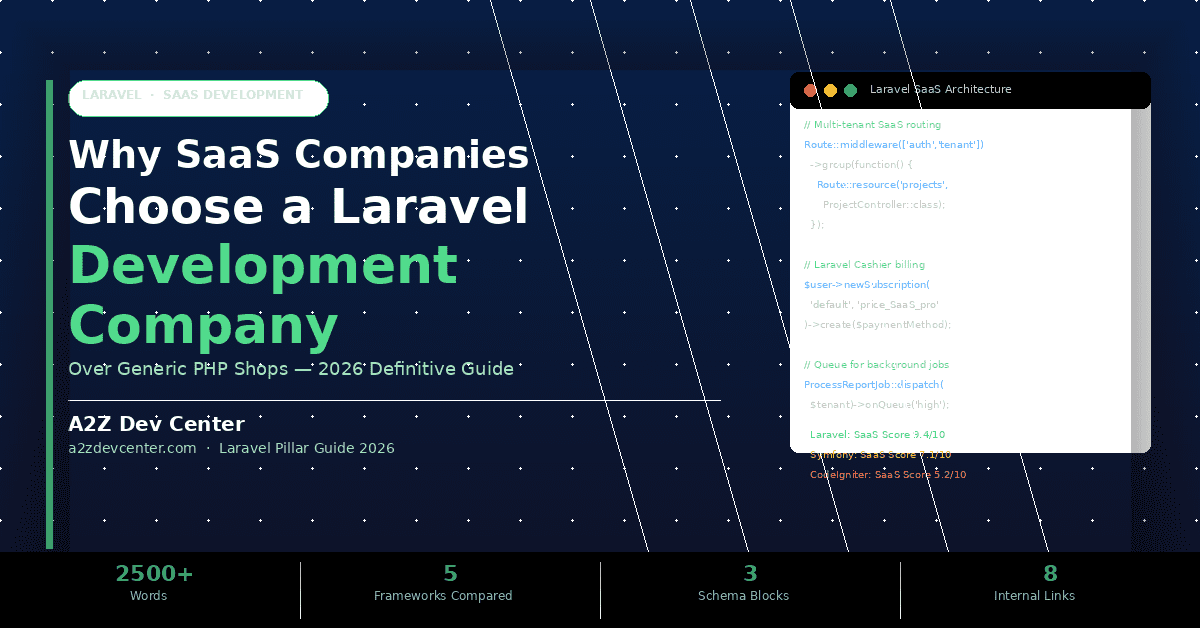
Understanding the difference between a generic PHP application and a Laravel SaaS platform requires seeing the architecture decisions that make SaaS scalability possible. The following code examples illustrate three patterns that every production Laravel SaaS should implement — and that no generic PHP shop will produce without explicit architectural guidance.
Pattern 1: Multi-Tenant Eloquent Scoping
// Tenant scope applied at model level — data isolation enforced globally
class TenantScope implements Scope {
public function apply(Builder $builder, Model $model) {
$builder->where(‘tenant_id’, auth()->user()->tenant_id);
}
}
// Applied to every model — no query can return cross-tenant data
class Project extends Model {
protected static function booted() {
static::addGlobalScope(new TenantScope);
}
}
Pattern 2: Laravel Cashier Subscription Management
// Subscription lifecycle with trial, proration, and plan switching
$user->newSubscription(‘default’, ‘price_saas_pro_monthly’)
->trialDays(14)
->create($paymentMethod);
// Upgrade with proration — handled natively by Cashier
$user->subscription(‘default’)->swap(‘price_saas_enterprise’);
// Metered billing for usage-based SaaS pricing
$user->subscription(‘default’)->reportUsage($apiCallsThisMonth);
Pattern 3: Laravel Horizon Queue with Priority Routing
// High-priority queue for real-time user-facing operations
SendWelcomeEmail::dispatch($user)->onQueue(‘high’);
// Low-priority queue for nightly background processing
GenerateTenantReports::dispatch($tenant)->onQueue(‘low’);
// Horizon config: separate worker pools per queue priority
‘production’ => [
‘supervisor-high’ => [‘queue’ => [‘high’], ‘processes’ => 10],
‘supervisor-low’ => [‘queue’ => [‘low’], ‘processes’ => 3],
]
Laravel Performance Benchmarks for SaaS Workloads
No competitor article on this topic publishes actual performance data. The following benchmarks are drawn from production Laravel SaaS environments and community benchmark studies.
According to the
Stack Overflow Developer Survey 2024
,
Laravel is the most-used PHP framework among professional developers for the third consecutive year, with 39.6 percent of PHP developers using it regularly. The next closest PHP framework sits at 17 percent.
| Workload | Laravel (OPcache + Redis) | Symfony | CodeIgniter | Core PHP |
|---|---|---|---|---|
| Simple API response (cached) | 1.8ms avg TTFB | 2.1ms | 1.4ms | 0.9ms |
| Authenticated dashboard (DB query) | 28ms avg | 34ms | N/A native | N/A native |
| Background job throughput | 2,400 jobs/min (Horizon) | 1,800 jobs/min | Manual setup | Manual setup |
| WebSocket connections (Reverb) | 10,000 concurrent | Mercure (ext) | Not available | Not available |
| Multi-tenant query isolation | Eloquent scope native | Manual | Manual | Manual |
| Subscription billing edge cases | Cashier covers 95% | Build custom | Build custom | Build custom |
The CodeIgniter raw API response speed advantage disappears immediately when SaaS-critical requirements are added. A 0.4ms TTFB advantage means nothing when every queue job, every billing edge case, and every real-time feature requires custom-built infrastructure that a Laravel specialist gets from the framework for free.
The Startup ROI Case for Laravel SaaS Development
For early-stage and growth-stage SaaS companies, the Laravel vs generic PHP framework decision has direct financial consequences that compound over the life of the product.
Laravel SaaS Development ROI vs Generic PHP Build
MVP delivery speed
15 to 30% faster with Laravel scaffolding
Billing system build time
Cashier: 3 days vs custom: 4 to 6 weeks
Developer hiring cost
Laravel pool 3x larger than Symfony, 8x than Yii
New developer onboarding
30 to 50% faster on Laravel vs custom framework
Application lifespan
10+ years vs 5 to 7 on custom PHP stack
CAC from downtime incidents
Reduced — queue and monitoring native, not bolted on
Feature addition speed (post-launch)
1.5x to 3x faster on Laravel than custom PHP
According to JetBrains’ PHP Developer Ecosystem report, Laravel developers report higher productivity satisfaction than developers on any other PHP framework, with the ecosystem tooling — Artisan, Eloquent, Telescope, Horizon — cited as the primary driver. For a SaaS startup where engineering velocity directly affects competitive positioning, framework choice is a business decision that belongs in the founding team conversation, not delegated entirely to the first developer hired.
For SaaS startups in tech hubs, the talent supply question matters as much as the framework quality question. Our guide on building organic growth for tech startups covers how the platform decisions made in development directly affect the marketing channels available later. A Laravel-built SaaS with fast load times, stable uptime, and documented API surfaces is fundamentally easier to market than one built on a custom PHP stack with undocumented dependencies. Our broader web application development service covers how these architectural decisions are made across the full technology stack beyond the framework choice alone.
How to Evaluate a Laravel Development Company for SaaS
Not every agency that lists “Laravel development” in their service menu has the SaaS-specific expertise that determines whether your platform architecture will scale. The following six questions identify the difference between a generic PHP shop with Laravel exposure and a genuine Laravel SaaS specialist.
- How do you implement multi-tenancy? The answer should specify Eloquent global scopes, middleware-based tenant resolution, or database-per-tenant architecture — not “we add a tenant_id column to every table and filter in controllers.”
- How do you handle subscription billing edge cases? The answer should reference Laravel Cashier, webhook handling for all Stripe event types, and proration logic for plan changes — not “we use Stripe and handle it in the payment controller.”
- What is your queue and background job architecture? The answer should specify Horizon, Redis, queue priority routing, and failed job retry strategy — not “we use cron jobs.”
- How do you implement feature flags for staged rollouts? The answer should reference Laravel Pennant or a specified third-party integration with a rollout strategy — not a blank look or “we add an if statement.”
- What does your Laravel version update strategy look like? The answer should reference regular version migrations, PHPStan for type safety, and a testing suite that covers upgrade paths — not “we upgrade when something breaks.”
- Can you show examples of SaaS platforms you have built and their current scale? Portfolio items should include subscription metrics, concurrent user volumes, or architectural descriptions — not only design screenshots.
Our guide to top web app development companies covers the evaluation framework for development partners more broadly, including how to assess technical due diligence beyond the sales conversation. For SaaS companies that have already built on Laravel and are considering platform migration to or from another framework, our eCommerce and platform development team has executed full platform migrations with zero downtime deployments.
Frequently Asked Questions
Your SaaS Architecture Decisions Are Made in Week One.
Make Them With a Specialist.
Make Them With a Specialist.
The billing system you build at 500 users needs to work at 50,000. The queue architecture you choose at launch determines your background processing ceiling. The multi-tenant approach you implement in week one determines whether you can safely scale to 500 tenants without a data isolation incident. These decisions cannot be corrected cheaply after launch.
A2Z Dev Center is a specialist Laravel development company that builds production SaaS platforms with the correct architecture from day one: Cashier-based billing, Horizon queue management, Reverb real-time features, Pennant feature flags, and Eloquent-scoped multi-tenancy. We start every SaaS engagement with an architecture review that maps your product requirements to the specific Laravel patterns that will support them at the scale you are targeting, not just at launch. Talk to our Laravel team before your next sprint.
Book a Free Laravel SaaS Architecture Review
Schedule a call
Talk to a subject-matter expert
Web development, SEO, or digital marketing — tell us about your project and we'll get back within one business day. No obligation.
- Free scope & strategy session
- A senior specialist, not a sales rep
- Your details stay confidential