
B2B Content Marketing Services: Proven Tactics for Lead Generation
 By Heena Soni
·
📅 Published: March 12, 2026
·
🔄 Updated: March 26, 2026
·
⏱ 15 min read
By Heena Soni
·
📅 Published: March 12, 2026
·
🔄 Updated: March 26, 2026
·
⏱ 15 min read
B2B lead generation through content sounds straightforward in theory. Create useful content, attract the right audience, convert them into leads. In practice, most B2B companies find themselves with a blog that generates respectable traffic and a pipeline that barely reflects it.
The gap is almost never a content quality problem. It is a strategy and structure problem. B2B buyers do not convert on the first visit, do not respond to generic educational content, and do not fill out contact forms because an article was well written. They convert when content meets them at the right stage of a complex, multi-stakeholder decision process with information that is specifically useful to where they are in that process.
Understanding what B2B content marketing services actually involve, which tactics are producing pipeline in 2026, and how to connect content activity to revenue outcomes is what separates programs that generate leads from programs that generate traffic reports.
This guide covers the full picture.
Quick Answer: What Makes B2B Content Marketing Generate Leads?
What B2B content marketing tactics actually drive lead generation in 2026?
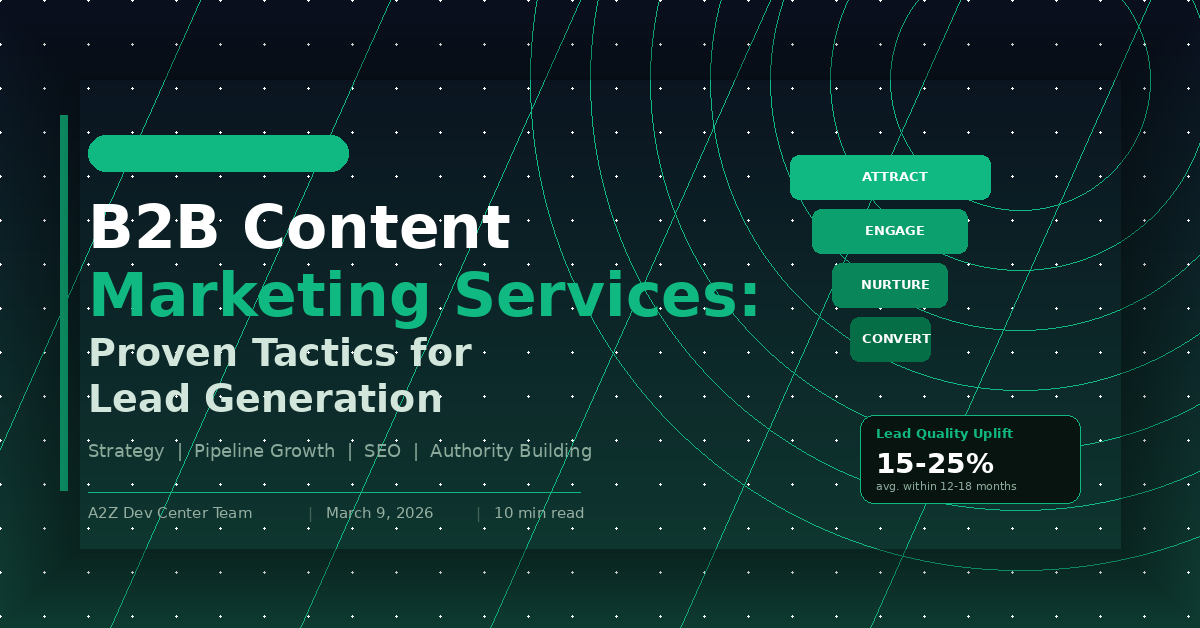
B2B content marketing generates leads when it targets specific buyer personas at each stage of the decision journey, integrates SEO to reach buyers during active research, uses gated and ungated content strategically to capture contact information, and nurtures leads through email sequences tied to demonstrated content interests. Programs built around these principles consistently see 15 to 25% improvements in organic lead quality and meaningful pipeline contribution within 12 to 18 months of consistent execution.
Key Takeaways
- B2B content marketing requires a longer-term commitment than B2C because B2B buying cycles are longer, involve multiple stakeholders, and demand more trust-building before a purchase decision
- The most effective B2B content tactics in 2026 combine SEO-optimized long-form content with intent-specific distribution across email, LinkedIn, and organic search
- Gated content, used strategically at the right funnel stage, remains one of the highest-ROI lead capture mechanisms in B2B content programs
- Topic cluster architecture builds the topical authority that earns both traditional search rankings and AI answer engine citations in competitive B2B categories
- Content that speaks to specific industries, roles, and pain points consistently outperforms generic content targeting broad audiences
- Connecting content to pipeline requires a measurement framework that goes beyond traffic metrics to track lead source, lead quality, and revenue influence
Why B2B Content Marketing Is Different From B2C
The tactical differences between B2B and B2C content marketing are significant enough that treating them as the same discipline consistently produces underperforming programs.
B2B buying decisions involve multiple stakeholders. A software purchase at a mid-market company might involve an end user, a department head, a procurement manager, and a C-suite approver, each with different information needs and different objections. Content that speaks only to one of these stakeholders leaves the others without support during the evaluation process.
B2B buying cycles are longer. Research from Gartner consistently shows that B2B buyers spend the majority of the purchase process in independent research before engaging with a vendor. The content that is present during that research phase shapes the consideration set. Businesses without strong content programs are absent from the consideration set at the most critical point in the buyer journey.
B2B content requires more credibility signals. A B2C purchase decision might be made on an emotional response to a well-designed product page. A B2B purchase decision involving a significant budget commitment requires evidence of expertise, demonstrated results, and specific answers to technical or operational questions. This is why thought leadership content, case studies, and data-backed guides carry disproportionate weight in B2B content programs.
Understanding these differences is the starting point for building a content marketing strategy that actually works in a B2B context rather than applying B2C tactics to a fundamentally different buying dynamic.
Tactic 1: Build Persona-Specific Content for Each Buying Stage
Generic B2B content performs generically. The businesses generating consistent pipeline from content have made a deliberate choice to create content for specific people at specific stages of a specific decision process.
This starts with a detailed mapping of the buying committee. For most B2B products and services, the committee includes at least three distinct stakeholder types: the end user who evaluates functional fit, the decision maker who evaluates business case and ROI, and the procurement or finance stakeholder who evaluates risk and cost. Each persona needs content that addresses their specific questions and concerns, not a single article trying to speak to all three simultaneously.
Within each persona, content needs to address three journey stages. At the awareness stage, the content answers the questions the persona is asking before they know your solution exists. At the consideration stage, it helps them evaluate your approach against alternatives. At the decision stage, it gives them what they need to justify the investment to internal stakeholders.
Mapping this out before creating content produces a clear picture of which combinations of persona and stage are well-served by existing content and which represent gaps where the business is invisible during the buyer journey. Filling the highest-value gaps first is where content investment generates the fastest pipeline impact.
The content marketing services framework covers how persona-specific content planning fits into a complete program structure, including how to prioritize production when resources are limited.
Tactic 2: SEO-Driven Topic Clusters for Organic Pipeline
Organic search is one of the most cost-efficient B2B lead generation channels available because it reaches buyers during active research, at exactly the moment they are looking for solutions. Building a content program around SEO-optimized topic clusters is how businesses earn organic pipeline that compounds over time rather than requiring continuous paid spend.
A topic cluster for a B2B service organizes content around a central pillar page covering the broad topic, surrounded by cluster pages each addressing a specific subtopic in depth. The internal linking structure between pillar and cluster pages builds topical authority that earns rankings for competitive terms that individual articles targeting isolated keywords cannot reach.
For a business offering B2B content marketing services, the pillar page covers content marketing comprehensively. Cluster pages cover content strategy, B2B-specific content tactics, SEO content writing, content marketing for specific industries, content distribution, and measurement frameworks. Each piece links back to the pillar and to relevant cluster pages, creating a network of content that reinforces the business’s authority across the entire topic.
Keyword research for B2B topic clusters must account for the full range of intent signals relevant to the buying journey, including informational queries from early-stage researchers, comparison queries from consideration-stage evaluators, and specific solution queries from decision-stage buyers. The connection between AI-driven SEO and how it is reshaping search optimization is especially relevant in B2B categories where AI answer engines are increasingly the first stop in research journeys.
Regional B2B businesses benefit from adding location-specific content clusters to their organic strategy. A business serving clients in Michigan benefits from content targeting local SEO in Michigan, Detroit, Grand Rapids, and Ann Arbor audiences, capturing high-intent local searches that national-only content misses.
Tactic 3: Gated Content as a Lead Capture Mechanism
Gated content sits at the intersection of content value and lead capture. When executed well, it offers something genuinely useful enough that a prospect will exchange their contact information to access it. When executed poorly, it forces people to fill out a form to receive content they could have found freely elsewhere, which produces low-quality leads and damages brand trust.
The content types that work best as gated assets in B2B programs share a common characteristic: they go deeper than freely available content. Original research and benchmark reports that share data buyers cannot find elsewhere. Detailed implementation guides that save buyers significant research time. ROI calculators or assessment tools that help buyers quantify the business case for a solution. Comparison frameworks that structure an evaluation process the buyer would otherwise have to build themselves.
The gate itself matters too. Asking for a company email address, name, and job title is reasonable for a high-value asset. Asking for ten fields including phone number and annual revenue for a general interest guide creates friction that reduces conversion rates significantly and suggests the goal is sales qualification rather than content value delivery.
After the form submission, what happens next determines whether the lead actually moves through the funnel. A gated asset download without a follow-up email sequence is a missed nurture opportunity. A thoughtfully designed email sequence triggered by the download, delivering related content progressively matched to the asset topic, is what turns a content download into a pipeline opportunity. The 7 ways to generate more sales leads for your business covers the broader lead generation ecosystem that gated content feeds into.
Tactic 4: LinkedIn as a B2B Content Distribution Channel
LinkedIn is the only major social platform where B2B content reaches an audience that is professionally contextualized. People use LinkedIn in a professional mindset, which means content about business challenges, industry trends, and professional development resonates in a way it simply does not on other platforms.
Effective LinkedIn content distribution for B2B programs operates at two levels. At the company page level, it amplifies long-form content pieces, shares original insights, and builds brand visibility among followers. At the personal profile level, it is significantly more powerful. Posts from individual executives and subject matter experts consistently reach larger audiences than company page posts, because LinkedIn’s algorithm favors personal content over brand content.
Encouraging and equipping key people within the business to share content and original perspectives on LinkedIn is one of the highest-ROI distribution tactics in B2B content marketing. It requires making it easy for them to share, which means providing draft copy, relevant images, and brief guidance on the platform, rather than expecting them to create content independently on top of existing responsibilities.
LinkedIn also supports paid content amplification that is remarkably precise for B2B targeting. Sponsoring top-performing organic content to reach job title, industry, and company size targets lets businesses put their best content in front of exactly the decision-maker personas they want to reach. The performance marketing service capabilities that handle this paid amplification work best when the organic content it amplifies is already strong.
Tactic 5: Case Studies That Do the Selling Without Selling
Case studies are the most underutilized high-value content asset in B2B marketing. Most businesses either do not produce them, produce them too infrequently, or produce versions that read like product brochures rather than genuine evidence of results.
A case study that generates pipeline has a specific structure. It names the client (ideally) and describes their situation before working with the business, with enough specificity that prospects in similar situations immediately recognize the relevance. It describes what was done and why, including decisions that were made and the reasoning behind them, which signals expertise rather than just capability. It quantifies the results with specific numbers wherever possible. And it ends with a statement from the client that speaks to the experience of working with the business, not just the outcome.
The distribution strategy for case studies matters as much as the content itself. Case studies should be accessible from service pages, referenced in relevant blog content, included in email nurture sequences when a prospect has demonstrated interest in a related topic, and made available to the sales team as conversation support. A case study that exists only in a PDF on a resource page reaches a fraction of the audience it could. The digital marketing service context covers how case studies integrate into the broader marketing mix across channels.
Tactic 6: Email Nurture Sequences Tied to Content Interest
Email remains the highest-converting channel in B2B marketing when used to deliver relevant content to people who have already expressed interest. The key phrase is “relevant content to people who have already expressed interest.” Generic email newsletters sent to undifferentiated lists produce the engagement rates that explain why many B2B marketers have given up on email as a lead generation channel.
Behavior-triggered email sequences that deliver content related to what a prospect has already engaged with are a different thing entirely. A prospect who downloaded a guide on B2B content strategy is a clear candidate for a sequence delivering related content on content distribution, B2B SEO tactics, and content measurement frameworks. The sequence builds a picture of their interests and challenges over multiple touches, and positions the business as a resource before any sales conversation is initiated.
Segmentation is the enabling capability that makes this work. Email lists segmented by industry, company size, job title, content topic interest, and buying stage produce significantly higher engagement and conversion rates than unsegmented lists. The investment in building and maintaining clean segmentation pays back in pipeline contribution that is traceable directly to specific email sequences.
B2B Content Marketing Tactics: Comparison by Funnel Stage
| Tactic | Best Funnel Stage | Lead Generation Mechanism | Timeline to Impact |
|---|---|---|---|
| SEO topic clusters | Awareness to consideration | Organic search visibility | 6 to 12 months |
| Gated research reports | Consideration | Direct lead capture | 1 to 3 months |
| LinkedIn organic distribution | Awareness | Brand visibility, referral traffic | 2 to 4 months |
| Case studies | Consideration to decision | Trust building, sales support | 1 to 2 months |
| Email nurture sequences | Consideration to decision | Pipeline acceleration | 1 to 3 months |
| Webinars and live content | Consideration | Direct lead capture, engagement | 1 to 2 months |
| Paid content amplification | Awareness to consideration | Accelerated reach | Immediate |
Tactic 7: Thought Leadership Content That Builds Category Authority
The B2B content landscape in most industries is dominated by generic educational content that covers well-known topics in well-worn ways. The businesses that earn genuine category authority produce content that has a genuine point of view, draws on proprietary experience or data, and offers insight that the reader could not have assembled from existing sources.
Thought leadership content means taking positions, not just covering topics. It means saying that a common approach does not work as well as practitioners believe, or that a trend everyone is excited about has a significant limitation the industry is not discussing, or that the conventional wisdom on a particular question is missing a critical variable. Content that has this quality earns shares, citations, and backlinks that general educational content does not.
Original research is the most reliable mechanism for producing thought leadership content at scale. Conducting a survey of industry practitioners, analyzing proprietary data, or compiling observations from client work into a benchmark report creates a content asset that is inherently unique and inherently citable. Other businesses writing about the same topic will cite your research, which builds both backlinks and topical authority simultaneously.
The advanced cross-selling and upselling strategies for SaaS content is a good example of the type of specific, audience-targeted content that earns authority in a defined B2B segment rather than trying to speak to everyone at once.
Measuring B2B Content Marketing Performance
The measurement challenge in B2B content marketing is that the buying cycle is long enough that content touchpoints at the beginning of a journey are rarely visible in last-touch attribution models. A prospect who reads four blog posts over three months before requesting a demo will typically be attributed entirely to the demo request channel, making the content program look like it had no impact.
Multi-touch attribution models that distribute credit across all touchpoints in the buying journey give a more accurate picture of content’s contribution to pipeline. First-touch attribution credits the channel that first brought a prospect to the site. Linear attribution distributes credit equally across all touchpoints. Time-decay attribution weights recent touchpoints more heavily. Each has tradeoffs, and the right model depends on the business’s sales cycle and attribution infrastructure.
At minimum, content performance reporting should cover organic traffic by content cluster, keyword ranking movement for priority B2B terms, lead volume and lead quality by content source, email sequence open and click-through rates by segment, and pipeline opportunities where content was a documented touchpoint. Connecting these metrics to revenue outcomes is what makes the business case for continued content investment defensible at the leadership level.
The digital marketing agency in Michigan context covers how measurement frameworks for B2B content programs are structured within a broader digital marketing reporting environment.
Frequently Asked Questions


Ready to Get Started?
Your Details will be Kept confidential. Required fields are marked *


