
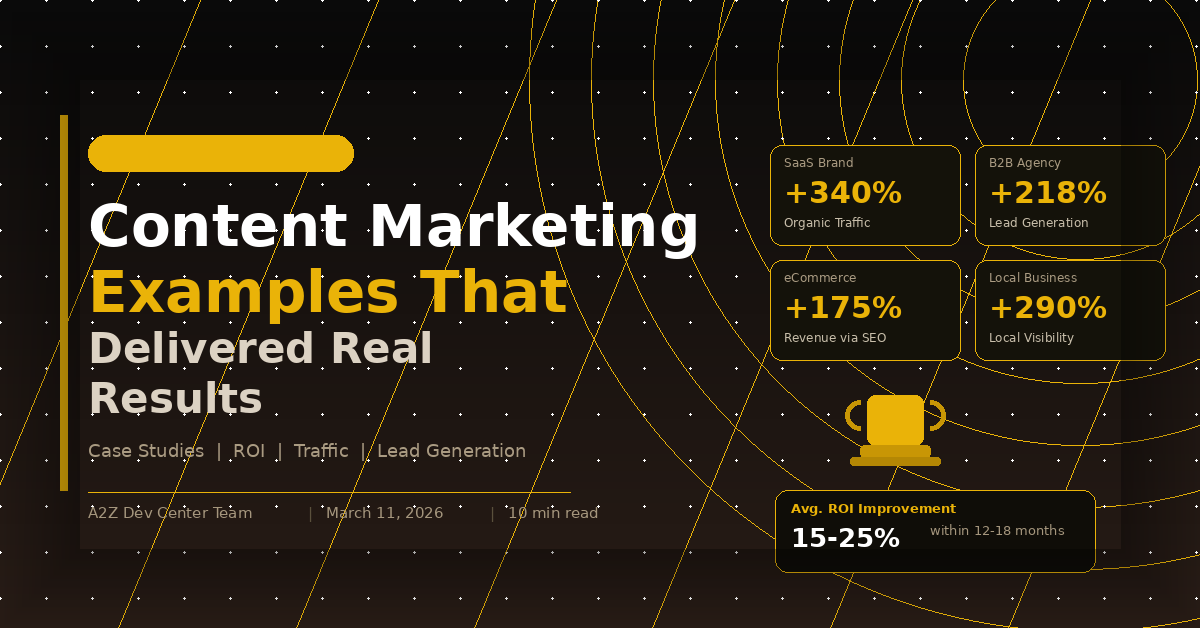
Content Marketing Examples That Delivered Real Results
Talking about content marketing strategy in the abstract is easy. Finding content marketing examples that show exactly what was done, what results it produced, and why it worked is significantly harder.
Most case studies either lack specificity or present results without context, leaving readers with inspiration but no actionable understanding of what actually drove the outcome. A traffic increase of 300% sounds impressive until you realize it started from 50 monthly visitors. A lead generation improvement sounds significant until the methodology turns out to be unrelated to the content itself.
This guide takes a different approach. Each example covers a specific business context, a specific content strategy, and the specific results that strategy produced with enough detail to understand the mechanism. The goal is not to provide a highlight reel but to give decision-makers a concrete picture of how content marketing works across different business types, budgets, and timelines so they can apply the right lessons to their own situation.
Quick Answer: What Do Real Content Marketing Examples Show Us?
What do successful content marketing examples have in common and what results can businesses realistically expect?
Successful content marketing examples consistently share three characteristics regardless of industry or business size. They start with a documented strategy built around specific audience research and keyword data. They invest in content depth and quality over volume. And they connect content activity to business outcomes through a measurement framework that goes beyond traffic metrics. Businesses following these principles see 15 to 25% improvements in organic lead quality and meaningful pipeline contribution within 12 to 18 months of consistent execution.
Key Takeaways
- The most successful content marketing examples are not the most viral. They are the most strategically consistent over 12 to 18 month periods
- Topic cluster architecture appears in virtually every high-performing content marketing case study because it builds topical authority faster than isolated article publishing
- B2B content marketing examples show the highest ROI when gated assets are combined with email nurture sequences tied to content interest signals
- eCommerce content marketing examples demonstrate that informational content targeting pre-purchase research queries drives significant revenue when conversion paths are properly connected
- Local business content marketing examples consistently show that geographic intent content converts at higher rates than generic national content, often with lower competition
- Content distribution investment matching content creation effort is the differentiating factor between examples that plateau early and those that compound over time
Example 1: SaaS Company Builds Organic Pipeline Through Topic Cluster Strategy
A project management SaaS company was generating most of its pipeline through paid search at a cost per acquisition that was making the economics of growth increasingly difficult to sustain. The marketing team had been publishing blog content for two years but without a coherent strategy, producing articles across a wide range of loosely related topics with no internal linking architecture connecting them.
The content strategy reset started with a full audit of existing content, which revealed that 68% of published articles were targeting keywords with minimal commercial intent and that none of the existing content was organized into topic clusters. The team identified three core topic areas central to their product category and restructured existing content into cluster architecture, adding a pillar page for each topic area and creating new cluster pages to fill identified gaps.
The results over 14 months were significant. Organic sessions grew from 8,400 per month to 38,200 per month. More importantly, organic trial signups, which had been generating roughly 12 per month from content, grew to 94 per month by month 14. The cost per acquisition from organic content fell to roughly 18% of the paid search equivalent, fundamentally changing the growth economics of the business.
The mechanism was straightforward. Organizing existing content into topic clusters with proper internal linking allowed search engines to evaluate the site’s expertise on the core topics holistically rather than as isolated articles. New cluster pages filling identified gaps created entry points for commercial intent queries that previously had no content to serve them. The how to build a content marketing strategy that works guide covers the topic cluster restructuring process this example demonstrates in practical detail.
Example 2: B2B Professional Services Firm Generates Leads With Gated Research
A mid-market management consulting firm was struggling with a common B2B content marketing problem. They had strong thought leadership content on their blog but minimal lead capture mechanism. Traffic was growing steadily but the conversion rate from content visitor to qualified lead was below 0.2%.
The strategy change involved producing two original research reports per quarter, each based on surveys of practitioners in the industries the firm served, and gating them behind a form requiring name, company email, job title, and company size. The reports were promoted through LinkedIn organic and paid amplification, email to the existing subscriber list, and outreach to industry publications that had covered related topics.
Each report download triggered a six-email nurture sequence delivering related insights over four weeks, with a soft invitation to a 30-minute strategy conversation at email five. The sequence was designed around genuinely useful content rather than sales messaging, which kept unsubscribe rates below 3%.
Within three quarters, the firm was generating 140 to 180 qualified lead form fills per month from content, compared to 22 per month before the strategy change. The nurture sequence was converting 14% of report downloaders into discovery call bookings, a rate the sales team had not seen from any other channel. The B2B content marketing services proven tactics guide covers the gated content and email nurture mechanics this example demonstrates.
Example 3: eCommerce Brand Drives Revenue Through Pre-Purchase Content
An online specialty retailer in the outdoor equipment category was spending heavily on Google Shopping and paid social but seeing diminishing returns as competition in those channels increased. The brand had no organic content strategy beyond product descriptions.
The strategy was built around a specific insight from customer research: most buyers in the category spent two to four weeks researching before purchasing, and the research phase included informational queries that had nothing to do with specific products. Queries like “how to choose a camping tent,” “best sleeping bag temperature rating for beginners,” and “hiking gear checklist for first-timers” were being searched by the brand’s exact target customer at the beginning of the buying journey.
The team created comprehensive informational guides targeting each of these pre-purchase research queries, with internal links from each guide to relevant product category pages and specific products mentioned in the context of the guide. The content was optimized for both traditional search and featured snippets, with clear structured answers to common questions included in each piece.
Over 16 months, organic traffic grew from 3,200 to 19,400 monthly sessions. Revenue attributed to organic search grew by 210%, driven primarily by visitors who arrived through informational content and followed the internal links to product pages. Average order value from organic content visitors was 22% higher than from paid channels, likely because buyers who researched thoroughly before purchasing were making more confident, higher-value decisions. The top 10 features your eCommerce mobile app must have covers the product experience layer that converts this kind of research-stage traffic effectively.
Example 4: Local Service Business Dominates Regional Search
A commercial cleaning company serving a mid-sized metro area was competing against national franchise brands in local search results and losing consistently. Their website had minimal content beyond service pages, and their Google Business Profile was incomplete.
The local content strategy combined three elements. First, location-specific service pages for each city and suburb in the service area, optimized for the specific geographic keywords those areas generated. Second, a blog content program targeting questions specific to commercial cleaning in the local market, including content about local regulations, seasonal cleaning requirements relevant to the regional climate, and case studies featuring local business clients. Third, a Google Business Profile optimization program that connected content topics to the Q&A and service sections of the profile.
Within 12 months, the business was ranking in the top three local results for 23 of its 30 target geographic keywords. Inbound inquiry volume grew by 178% year over year. The average cost per new client acquisition fell by 64% compared to the Google Ads program the business had been running previously.
The mechanism was geographic specificity. National franchise brands competing in local search optimize for generic national terms and produce no location-specific content. A local business that creates genuine geographic depth in its content consistently outperforms national competitors in local results even with a fraction of the domain authority. The local SEO services in Michigan context covers how this geographic content strategy connects to the technical local SEO signals that amplify its effect, and the digital marketing agency in Michigan overview explains how local businesses can replicate this approach across the Michigan market specifically.
Example 5: Technology Startup Earns Authority Through Original Research
A cybersecurity startup with limited brand recognition in a crowded market needed a content strategy that could earn genuine topical authority rather than competing for generic keywords against established vendors with significantly more domain authority.
The strategy was built around original research. The team surveyed 400 IT and security professionals quarterly on their security posture, technology priorities, and incident experience. Each quarterly report was published as a free gated asset, promoted through LinkedIn, PR outreach, and email, and the underlying data was repurposed into dozens of individual blog posts and social content pieces over the following quarter.
The research reports earned 340 backlinks from industry publications, security blogs, and news outlets in the first 18 months. Domain authority grew from 18 to 44 in that period. Organic traffic grew from essentially zero to 28,000 monthly sessions. The brand moved from unknown to frequently cited in its category, and sales team conversations began with prospects who had already consumed multiple pieces of the research content rather than cold outreach.
The specific mechanism that produced the backlink growth is worth noting. Security publications and news outlets needed current data to cite in their own content. The startup was producing that data regularly and making it freely available. This created a sustained backlink acquisition program that required no outreach budget, only research investment. The advanced cross-selling and upselling strategies for SaaS piece covers how original research assets continue to drive pipeline value well beyond their initial publication date.
Example 6: Regional Professional Services Firm Builds Pipeline With SEO Content
A digital marketing agency serving Michigan businesses was generating most of its new clients through referrals and direct outreach. The firm had no organic search visibility for the service category terms its target clients were searching for.
The content program built over 18 months covered four content layers. Service pillar pages optimized for primary category terms. Location-specific pages targeting search queries from Detroit, Grand Rapids, Ann Arbor, Sterling Heights, and Lansing. Educational blog content targeting the informational and commercial intent queries their target clients searched during the agency evaluation process. And case study content documenting specific results produced for named local clients.
The result at the 18-month mark was first-page rankings for 41 target keywords, 2,800 monthly organic sessions from relevant traffic, and 18 to 22 inbound inquiries per month from organic search, compared to zero at the start of the program. More importantly, the inquiries from organic content arrived with a demonstrated understanding of the firm’s approach and services, making them significantly more efficient for the sales team to convert. The SEO service provider page covers how a structured SEO content program like this is structured and executed.
What These Content Marketing Examples Have in Common
Looking across these six content marketing examples, several consistent patterns emerge that apply regardless of business type, size, or market.
Every example started with documented strategy before content creation. None of the successful outcomes came from intuitive content publishing. Each started with audience research, keyword mapping, or competitive gap analysis that defined where to focus before production began.
Every example built toward topical authority rather than isolated keyword wins. Topic clusters, research-based content series, and geographic content depth all represent deliberate authority-building strategies rather than one-off article production.
Every example connected content to a conversion mechanism. Pillar pages linking to service pages, gated research triggering email nurture, informational content linking to product pages, local content driving inquiry form submissions. Content that has no conversion path converts at the rate of no conversion path, regardless of traffic volume.
And every example measured the right outcomes. Not just traffic. Leads, pipeline, revenue, backlinks, brand mentions, cost per acquisition. The measurement framework in each case was connected to business outcomes that justified the investment at the leadership level.
Content Marketing Examples: Results by Business Type
| Business Type | Primary Tactic | Key Metric Improved | Timeframe |
|---|---|---|---|
| SaaS | Topic cluster restructure | Organic trial signups +683% | 14 months |
| B2B Services | Gated research plus nurture | Qualified leads +536% | 9 months |
| eCommerce | Pre-purchase content | Organic revenue +210% | 16 months |
| Local Services | Geographic content depth | Local search inquiries +178% | 12 months |
| Tech Startup | Original research program | Domain authority +144% | 18 months |
| Regional Agency | Multi-layer SEO content | Inbound inquiries from zero | 18 months |
Frequently Asked Questions
{ “@context”: “https://schema.org”, “@type”: “FAQPage”, “mainEntity”: [ { “@type”: “Question”, “name”: “What do the best content marketing examples have in common?”, “acceptedAnswer”: { “@type”: “Answer”, “text”: “The most successful content marketing examples share three characteristics: documented strategy built on audience research and keyword data, investment in content depth and topical authority over volume, and connection to specific conversion mechanisms measured against business metrics rather than traffic alone.” } }, { “@type”: “Question”, “name”: “How long do content marketing results typically take based on real examples?”, “acceptedAnswer”: { “@type”: “Answer”, “text”: “Initial ranking improvements appear within three to four months. Meaningful organic traffic builds over six to nine months. Pipeline-level contribution from organic content generally reaches meaningful volume at 12 to 18 months. Programs with strong strategy and technical SEO integration reach these milestones faster than those that begin with content production and add strategy retrospectively.” } }, { “@type”: “Question”, “name”: “What content marketing tactics produce the best ROI based on real examples?”, “acceptedAnswer”: { “@type”: “Answer”, “text”: “The highest-ROI tactics based on documented examples are original research reports that earn backlinks while serving as gated lead assets, topic cluster architecture building systematic topical authority, pre-purchase informational content connecting research-stage traffic to product pages, and local SEO content capturing high-converting geographic intent searches.” } }, { “@type”: “Question”, “name”: “Can small businesses achieve results similar to these content marketing examples?”, “acceptedAnswer”: { “@type”: “Answer”, “text”: “Yes, with proportionally smaller absolute numbers but comparable percentage improvements and ROI ratios. Strategy quality and execution consistency matter more than budget size. A small business with a focused, well-executed content program consistently outperforms a larger competitor with a scattered, unfocused one.” } }, { “@type”: “Question”, “name”: “How important is content distribution in these examples?”, “acceptedAnswer”: { “@type”: “Answer”, “text”: “Content distribution is critical in every high-performing example. In no example did content succeed through publication alone. The distribution plan for each piece was designed before writing, not added after publication. Distribution channels varied by business type but always included multiple owned, earned, and paid mechanisms.” } }, { “@type”: “Question”, “name”: “What role did SEO play in these content marketing examples?”, “acceptedAnswer”: { “@type”: “Answer”, “text”: “SEO was a foundational element in every example, manifesting as topic cluster architecture for SaaS, informational content optimization for eCommerce, geographic keyword targeting for local businesses, and backlink-earning research content for startups. In each case SEO was integrated into content strategy, not a separate parallel activity.” } }, { “@type”: “Question”, “name”: “How do you measure content marketing results like the examples above?”, “acceptedAnswer”: { “@type”: “Answer”, “text”: “The measurement frameworks tracked both leading indicators (keyword rankings, organic traffic trends, engagement metrics) and business outcomes (leads from organic content, pipeline influenced by content, revenue attributed to organic search, cost per acquisition vs paid channels). The key was connecting content activity to revenue impact, not just reporting traffic.” } }, { “@type”: “Question”, “name”: “How does local SEO content marketing differ from other content marketing examples?”, “acceptedAnswer”: { “@type”: “Answer”, “text”: “Local content marketing applies the same strategic principles but uses geographic specificity as the primary differentiating mechanism. Instead of competing for generic national keywords, local content targets geographic intent signals that national competitors consistently underproduce. Results typically materialize faster than national programs because geographic intent competition is lower.” } } ] }

Ready to Get Started?
Your Details will be Kept confidential. Required fields are marked *


