
How Michigan Businesses Can Appear in Google AI Overviews for Local Searches Before Competitors Do
 By Rahul Solanki
·
📅 Published: April 3, 2026
·
⏱ 15 min read
By Rahul Solanki
·
📅 Published: April 3, 2026
·
⏱ 15 min read
TL;DR
- Google AI Overviews now appear for a significant portion of local service searches in Michigan, and the businesses cited in those overviews are getting the call before the customer ever scrolls to the map pack or organic results below it.
- Getting cited in AI Overviews requires a specific content structure called answer-first formatting, where each section of your content states the direct answer before explaining it. AI systems pull these summaries preferentially over content that buries the answer in paragraphs of context.
- Local SEO Michigan businesses that combine AEO content structure with strong Google Business Profile signals are getting cited in both AI Overviews and Local Pack results, creating double visibility that compounds lead generation significantly.
- The window to get ahead of competitors in AI Overviews is currently open. Most Michigan businesses have not yet structured their content for AI citation. The businesses that do it now will hold that position when competitors eventually catch up.
What is Local SEO Michigan?
Local SEO Michigan is the practice of optimizing Michigan businesses’ online presence to appear in Google’s local search results, Local Pack, and increasingly in Google AI Overviews for location-specific queries, covering Google Business Profile management, local citation building, technical SEO, and answer-first content structuring to generate inbound calls and leads from Michigan customers actively searching for local services.
Your competitor just appeared in a Google AI Overview for the exact service you offer in your Michigan city. You searched it yourself and saw their business name, their website, and a summary of why someone should call them, all before the map pack even loaded. You did not appear anywhere on that screen. This is not a fluke.
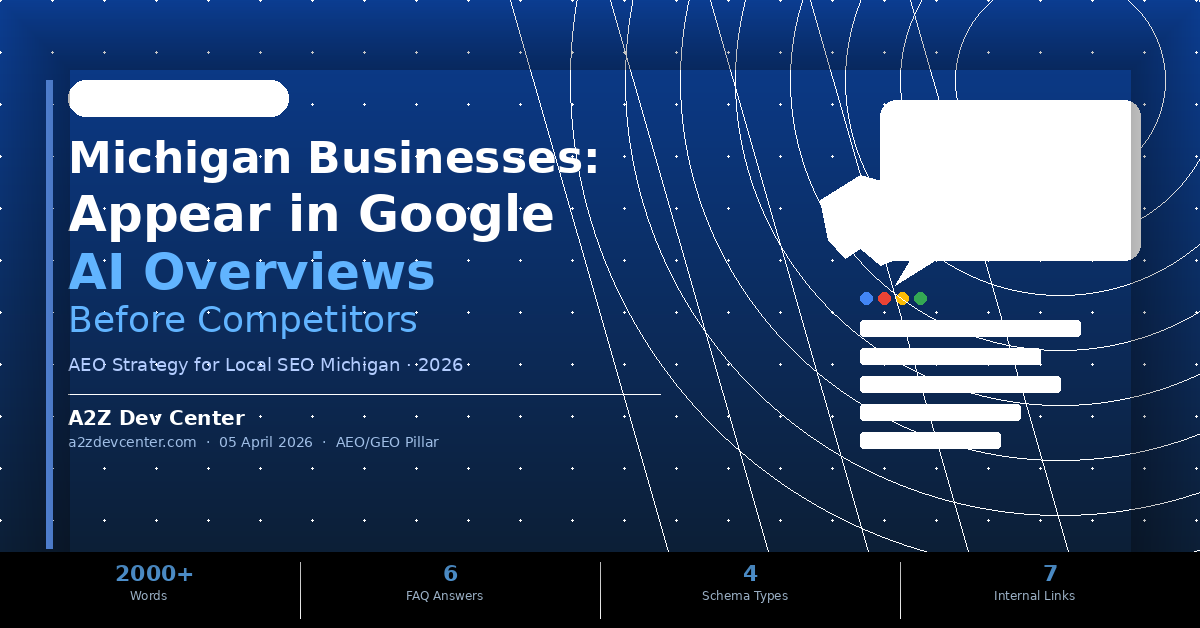
Google AI Overviews are becoming the first thing local searchers see for service queries in Michigan, and the businesses appearing in them are capturing attention before the traditional Local Pack rankings even matter. This guide covers exactly how local seo michigan businesses can structure their content and online presence to get cited in AI Overviews before their competitors do.
Why Michigan Businesses Are Missing From Google AI Overviews Right Now
Most Michigan businesses are missing from Google AI Overviews because their website content is structured to inform readers rather than to directly answer questions, and AI systems priorities content that states the answer in the first sentence of each section rather than building to it through explanation.
Think about how most service business websites are written. A plumbing company’s service page says something like “With over fifteen years of experience serving the Detroit metro area, our team of licensed plumbers is committed to delivering high-quality work at competitive prices.” That sentence tells the reader about the company. It does not answer a question. Google’s AI system is looking for content that answers the question someone just asked, not content that describes the company answering it.
A Grand Rapids roofing company was getting consistent organic traffic to their services page but never appeared in AI Overviews for roofing-related local searches. Their competitor, half their size and with far fewer reviews, appeared in AI Overviews for three separate roofing queries because their content was structured around direct questions and answers. “How long does a roof replacement take in Michigan?” followed immediately by “A standard roof replacement in Michigan takes one to three days depending on the size of the home and the complexity of the roofline.” That is the format AI systems pull. The roofing company with fifteen years of experience and better reviews was invisible in AI Overviews because they never wrote content that way.
The Three AI Overview Triggers for Local Searches
Google AI Overviews for local searches are triggered by three main query types: service category plus location queries, comparison queries about local service providers, and how-to or process queries related to local services. Understanding which of these applies to your Michigan business determines the content structure you need to build.
Service category plus location queries like “best HVAC company Grand Rapids” or “emergency plumber Detroit” trigger AI Overviews that pull from GBP data and website content simultaneously. Comparison queries like “should I hire a roofer or DIY Michigan” trigger Overviews that pull from educational content. Process queries like “how much does a bathroom remodel cost in Michigan” trigger Overviews that pull from cost guide and FAQ content. Each requires a different content structure to generate citations.
How to Structure Local SEO Michigan Content for AI Overview Citations
Michigan businesses get cited in Google AI Overviews by structuring web content with answer-first formatting, using question-based headings that match natural language search queries, and ensuring each answer section is complete and standalone enough that it makes sense when extracted without surrounding context.
This is the AEO/GEO content model, and it works differently from traditional SEO content. Traditional SEO content is built for a reader who will read the page from top to bottom. AEO content is built for an AI system that will extract a specific paragraph to answer a specific question, without necessarily reading anything before or after it. Both can coexist in the same piece of content, but the structure must be designed with both audiences in mind.
Step 1: Convert Section Headings to Direct Questions
Every major section heading on your service pages and blog content should be a question that your target customer would actually type into Google. “Our Services” becomes “What HVAC services do we provide in Grand Rapids?” “About Us” becomes “How long has this plumbing company served Detroit?” “Pricing” becomes “How much does furnace replacement cost in Michigan?” These question-based headings are what AI systems scan when deciding whether a page contains a relevant answer to a search query.
Our content marketing services restructure existing Michigan business web content around question-based headings and answer-first paragraph structures rather than rebuilding content from scratch, which significantly reduces the time to AEO citation readiness.
Step 2: Write the Answer in the First Sentence of Every Section
The first sentence of every section must state the direct answer to the section heading question. Not context. Not qualification. The answer. “Furnace replacement in Michigan typically costs between $2,800 and $6,500 depending on the size of the home, the furnace brand, and whether ductwork modifications are required.” That is a first sentence AI systems can extract, quote, and cite. “Furnace replacement costs vary depending on many factors” is a first sentence that provides no extractable value and will not generate an AI Overview citation.
Step 3: Build a Dedicated FAQ Page With Standalone Answers
A dedicated FAQ page with genuine, specific, standalone answers to the questions your Michigan customers ask most frequently is one of the highest-value AEO investments available. Each answer on the FAQ page should be 80 to 150 words, structured to answer the question completely without requiring the reader to have read anything else on the page, and paired with FAQPage schema markup that signals to Google exactly what each question and answer is.
The technical SEO audit process includes a review of existing FAQPage schema implementation and recommendations for restructuring FAQ content to match the answer length and specificity that AI Overviews preferentially cite. A thorough audit of why Michigan businesses are currently invisible on Google is covered in our guide on why Michigan businesses are invisible on Google.
Step 4: Add E-E-A-T Signals That AI Systems Trust
Google’s AI Overviews preferentially cite content from sources that demonstrate Experience, Expertise, Authoritativeness, and Trustworthiness. For a Michigan local business, E-E-A-T signals include specific mention of years in business in Michigan, named team credentials and certifications, specific service areas mentioned by city and neighbourhood name, customer case studies with specific outcomes rather than generic testimonials, and references to local licensing or industry association membership.
According to Google’s helpful content guidance, content that demonstrates first-hand experience with the topic is rated more highly than content written from a general knowledge perspective. For a Michigan service business, this means writing content that references specific Michigan conditions, regulations, building codes, and customer scenarios rather than generic service descriptions that could apply in any market.
Step 5: Align GBP and Website Entity Signals
AI Overviews are more likely to cite businesses whose Google Business Profile and website are clearly associated with the same entity through consistent name, address, phone number, and service category signals. A business whose GBP shows one service name and whose website uses a different service category label creates entity confusion that reduces AI Overview citation likelihood. Consistent entity signals across your GBP, website, and local citations form the trust foundation that AI systems use to identify your business as a reliable source. Our Michigan Digital Marketing Service cover full entity alignment as part of every Michigan program.
Common Mistakes Michigan Businesses Make With AEO and Local SEO
Mistake 1: Writing Content for Readers Instead of AI Extraction
Content written purely for human readers buries answers in context, uses transitional language that makes sentences dependent on preceding paragraphs, and organises information in a narrative flow that makes sense when read sequentially but provides no extractable value to an AI system scanning for a specific answer. Converting to AEO structure does not mean making content worse for human readers. It means making the first sentence of every section a complete, direct answer that a human reader also finds immediately useful. Both goals are compatible, but traditional content writing instincts consistently produce content that fails AEO extraction.
Mistake 2: Treating FAQPage Schema as Optional
FAQPage schema is structured data that explicitly tells Google which content on your page is a question and which is the corresponding answer. Without this markup, Google’s AI has to infer this structure from the content itself, which it does with less reliability than when schema explicitly labels it. Every Michigan business website with FAQ content should have FAQPage schema implemented. Every service page with a Q&A section should have it marked up. This is not a technical nice-to-have. It is a prerequisite for reliable AI Overview citation of FAQ content.
Mistake 3: Having Consistent Local SEO Without AEO Content Structure
A Michigan business with strong Google Business Profile signals, good citation consistency, and solid local pack rankings can still be entirely absent from AI Overviews if their website content is not structured for AEO citation. The Local Pack and AI Overviews draw from different signals. GBP and proximity dominate Local Pack. Content structure, E-E-A-T signals, and schema markup dominate AI Overview citations. A business visible in the Local Pack is not automatically visible in AI Overviews. Both require separate investment to achieve simultaneously. The Detroit-specific version of this gap is covered in our guide on why Detroit competitors get the Google calls.
Mistake 4: Using Generic Content That Could Apply to Any Market
AI systems are increasingly able to distinguish between content written with specific expertise about a local market and content written generically and then localised with a city name insertion. A Michigan plumber whose content discusses the specific pipe freeze risks of Michigan winters, references the Michigan Plumbing Code, and addresses the specific concerns of customers in communities with older housing stock is producing content that signals genuine Michigan expertise. A page that says “We provide plumbing services in Detroit, Michigan” without any Michigan-specific context is producing content that AI systems evaluate as low local authority.
Mistake 5: Not Monitoring AI Overview Appearances
Most Michigan businesses do not know whether they are being cited in AI Overviews for their target queries because they are not monitoring it. Standard Google Search Console data does not separately identify AI Overview impressions from standard organic impressions in all cases. Manually searching your target queries from an incognito browser in your target Michigan city once per week and recording which results appear, including AI Overviews, is the minimum monitoring practice for any business investing in local SEO Michigan strategy. Without this monitoring, there is no way to know whether the content changes and schema additions are producing AI citation results. Our overview of the Grand Rapids local search landscape covers how this monitoring practice applies specifically to West Michigan markets.
Michigan AEO Readiness Checklist
Every major service page section has a question-based heading that matches a natural language query Michigan customers would type into Google rather than a generic section title like “Our Services” or “Why Choose Us.”
The first sentence of every section states the direct answer to the section heading question completely, without requiring the reader to have read the preceding content to understand it.
FAQPage schema is implemented on every page with FAQ content, with question and answer fields explicitly marked up and answers between 80 and 150 words in length.
Content references Michigan-specific context including local conditions, regulations, or market-specific information that distinguishes it from generic content with a location name inserted.
E-E-A-T signals are explicitly stated including years of operation in Michigan, named credentials, specific service areas, and outcome-based case studies from Michigan customers.
Target queries are monitored weekly in incognito mode from within the target Michigan city to track AI Overview appearances, Local Pack positions, and competitor visibility simultaneously.
Frequently Asked Questions

Ready to Get Started?
Your Details will be Kept confidential. Required fields are marked *


