

Laravel
Summarize this blog post with:
The Short Answer Nobody Gives You
Laravel
Building a SaaS platform, eCommerce store, enterprise CMS, admin portal, or MVP that needs to ship in weeks. Your team is PHP fluent or you need structured, maintainable code with built-in auth, queues, billing, and ORM from day one.
Node.js
Building a real-time application (chat, live dashboards, collaborative tools), a microservices API layer, or a serverless event-driven architecture. Your team is JavaScript-first and you prefer assembling a minimal custom stack.
Reality
For 80-85% of startups and SaaS products, Laravel ships faster, costs less to hire for, and is easier to maintain at the team sizes most startups actually operate at. Node.js wins at specific real-time workloads — but most apps don’t have that workload.
TL;DR
- Laravel ships an equivalent MVP 2-3 weeks faster than Node.js because auth, queues, ORM, email, caching, and billing are built in. In Node.js you assemble all of these from separate packages before writing your first line of business logic.
- The “Node.js is faster” argument collapses with Laravel Octane. Octane (Swoole/RoadRunner persistent process model) brings Laravel to 10,000+ requests per second — matching Node.js throughput. For 95% of startups, the performance difference between the two is irrelevant because the bottleneck is the database, not the framework.
- Laravel has a larger, cheaper developer hiring pool — 1.4 million+ PHP developers globally versus a narrower Node.js backend specialist pool. Node.js architects earn 8-15% more than equivalent Laravel developers, which matters on a startup payroll.
- A2Z Dev Center is a specialist Laravel development company building production SaaS platforms and web applications for startups and growing businesses across the US. This guide reflects what we have learned shipping both frameworks in real projects.
Laravel vs Node.js — Core Difference in One Paragraph
Laravel is a PHP MVC framework that ships with a complete, integrated toolkit: Eloquent ORM, Blade templating, Artisan CLI, built-in authentication, job queues, caching, email, and first-party packages for billing (Cashier), WebSockets (Reverb), monitoring (Horizon), and feature flags (Pennant). Node.js is a JavaScript runtime, not a framework — it executes JavaScript on the server but requires you to choose and assemble your own web framework (Express, Fastify, or NestJS), ORM (Prisma, Sequelize, TypeORM), auth system, queue manager, email library, and every other backend concern separately.
Every year, thousands of founders and CTOs Google this question and get the same answer: “It depends on your use case.” That answer is technically correct and practically useless. The question is not which framework is theoretically better. The question is which one gets your product built, your team hired, and your infrastructure running without becoming a maintenance burden before you hit 10,000 users.
This guide is built from the competitor research gap analysis of the four most-ranked articles on this topic. None of them show you real MVP build timelines. None of them explain Laravel Octane. None of them give you a decision matrix by use case. This one does all three — and it commits to an answer for each scenario rather than hedging.
What Is Laravel and What Does It Give You Out of the Box?
Laravel is not just a routing library with a database connector. It is a complete application development platform for PHP. The distinction matters for the startup decision because it determines how many things your team has to build, configure, and maintain before writing business logic.
Out of the box — no additional packages, no assembly required — a fresh Laravel project gives you:
- Eloquent ORM — ActiveRecord-style database interaction with relationships, scopes, mutators, and migrations pre-configured
- Authentication scaffolding — login, registration, password reset, email verification, and 2FA via Laravel Breeze or Jetstream, including OAuth via Socialite
- Job queues — background task processing with Redis or database drivers, priority routing, retry logic, and failed job handling via Horizon
- Email — Mailable classes with SMTP, Mailgun, Postmark, and SES drivers configurable via environment variables
- Caching — Redis, Memcached, or file-based caching with a unified API across all drivers
- Task scheduling — cron-like scheduling within the application code via the task scheduler
- Testing — PHPUnit and Pest integration with HTTP testing helpers, database factories, and mail/queue faking built in
- API resources — JSON response transformation with resource classes and pagination support
- Laravel Cashier — Stripe and Paddle subscription billing with trial management, proration, metered billing, and webhook handling
For a startup building a SaaS product, this list represents 4 to 8 weeks of infrastructure work that Laravel eliminates before the first sprint. Our detailed guide on why SaaS companies choose a specialist Laravel development company covers the specific architecture decisions that separate a production SaaS from an MVP prototype.
What Is Node.js and Why Does It Perform Differently?
Node.js is a runtime environment that executes JavaScript on the server using Google’s V8 engine. It is not a web framework. When people compare “Laravel vs Node.js,” they are comparing a fully assembled framework against a runtime that requires framework assembly.
Node.js’s core technical advantage is its event-driven, non-blocking I/O architecture. A traditional PHP server (without Octane) handles each request in a separate process that blocks until the request completes. Node.js handles I/O operations asynchronously — while one operation waits for a database response, the thread continues accepting and processing other requests. This architecture makes Node.js genuinely superior for applications with high concurrency and persistent connections: real-time chat, live dashboards, WebSocket-heavy collaborative tools, and event streaming.
In practice, this means your Node.js stack will require you to choose, configure, and maintain:
- Web framework — Express (minimal), Fastify (performance-focused), or NestJS (TypeScript-first, Angular-style)
- ORM — Prisma, Sequelize, TypeORM, or Drizzle — each with different query patterns and migration strategies
- Authentication — Passport.js, better-auth, or custom JWT implementation with refresh token management
- Queue management — BullMQ + Redis, with separate configuration for workers and failed job handling
- Email — Nodemailer with separate template engine, or a service SDK integration
- Validation — Joi, Zod, or class-validator, each requiring separate integration patterns
- Testing — Jest or Vitest with separate HTTP testing setup via Supertest
None of these are difficult. Experienced Node.js teams assemble them efficiently. But every assembly decision is a maintenance surface — a dependency to update, a version conflict to resolve, and a pattern to document for new team members. The Lucky Media team who builds both in production calls this the “assembly tax.” It is real, and it compounds over the life of the project.
Performance Benchmarks — Real Numbers, Not Marketing Claims
Most articles on this topic avoid specific numbers. Here are the ones that matter for startup decisions.
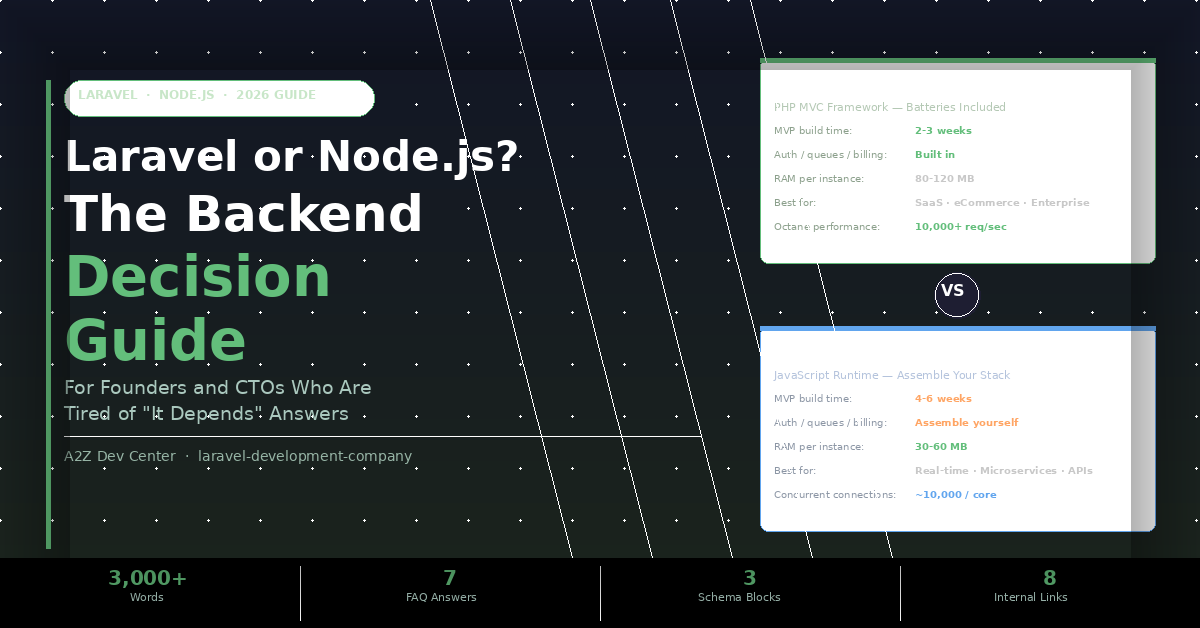
Laravel
Optimized RPS (no Octane)
2,000-3,000
With Octane (Swoole)
10,000+ req/sec
RAM per instance
80-120 MB
DB-bound app performance
Equivalent to Node.js
Node.js
Concurrent connections / core
~10,000
With clustering (multi-core)
Linear scale
RAM per instance
30-60 MB
DB-bound app performance
Equivalent to Laravel
The Laravel Octane Revelation — The Fact 3 of 4 Competitors Missed
Laravel Octane, released in 2021 and production-mature by 2023, completely changes the performance comparison. Octane replaces the traditional PHP-FPM request-per-process model with a persistent application server using Swoole or RoadRunner. The Laravel application boots once and stays in memory between requests — eliminating the bootstrap overhead that makes standard PHP slower than Node.js at high concurrency.
A Laravel application running Octane with Swoole handles 10,000+ requests per second — matching Node.js throughput on equivalent hardware. The RAM disadvantage narrows significantly with Octane because the persistent process model reduces per-request overhead. For startups running on AWS, GCP, or DigitalOcean, the practical performance ceiling of a well-configured Laravel application on managed infrastructure is indistinguishable from Node.js for 95% of SaaS workloads.
The honest performance truth: Most SaaS applications are bottlenecked by database query time, not framework processing speed. A complex PostgreSQL query taking 200ms makes a 0.5ms difference in framework processing speed irrelevant. If your bottleneck is not the database, it is almost certainly the algorithm in your business logic layer — not the framework. Node.js’s async I/O advantage is real and meaningful for applications with thousands of simultaneous long-lived connections (WebSockets, SSE, streaming). For a CRUD-heavy SaaS product, the performance difference between Laravel and Node.js is operationally irrelevant.
The Startup MVP Timeline — Days and Dollars
This is the section that directly answers the most commercially important question: which backend is faster to build with?
The Assembly Tax: What You Build Before Writing Business Logic
Laravel — Already Done
- Authentication (login, register, reset)
- Email verification flow
- OAuth / social login
- Database ORM with migrations
- Background job queue
- Failed job retry logic
- Caching layer
- Email sending + templates
- Subscription billing (Cashier)
- API authentication (Sanctum)
- Admin scaffolding (Filament)
- Testing infrastructure
Node.js — You Build or Assemble
- Choose + configure web framework
- Implement auth (Passport.js / JWT)
- Configure refresh token rotation
- Choose + configure ORM (Prisma / TypeORM)
- Set up BullMQ + Redis workers
- Implement email (Nodemailer + templates)
- Integrate Stripe billing from scratch
- Configure API token system
- Build admin tooling or integrate separate library
- Set up Jest + Supertest for HTTP testing
- Document stack decisions for new devs
Based on engineering team data from AddWeb Solution’s 2026 SaaS backend analysis, a competent developer scaffolding a functional SaaS MVP — authentication, billing, background jobs, API, admin panel — requires approximately 2 to 3 weeks with Laravel versus 4 to 6 weeks with Node.js. The difference is not skill. It is assembly time.
At a contract developer rate of $100/hour working 40 hours per week, that 2 to 4 week difference represents $8,000 to $16,000 in additional pre-launch engineering cost. For a bootstrapped startup, this is a meaningful consideration that no competitor article on this topic quantifies. For founders making strategic early-stage technology decisions, the compounding effect of this velocity difference extends across every feature sprint for the next 12 months.
SaaS-Specific Capabilities — What Each Framework Provides Natively
If you are building a SaaS product in 2026, the framework’s built-in SaaS capabilities are more important than its raw performance characteristics. Here is exactly what each provides without additional packages:
| SaaS Requirement | Laravel | Node.js |
|---|---|---|
| Subscription billing | Laravel Cashier — Stripe + Paddle, trials, proration, metered billing | Roll your own Stripe integration, manage webhook events manually |
| Background job queues | Laravel Horizon — Redis queues, priority routing, monitoring dashboard | BullMQ + Redis, separate setup and monitoring configuration |
| Real-time events | Laravel Reverb — first-party WebSocket server, Laravel Echo frontend | Native strength — Socket.io, ws library, or built-in http server |
| Multi-tenancy | Eloquent global scopes for data isolation, middleware-based tenant resolution | Manual implementation per ORM — no convention exists |
| App monitoring | Laravel Telescope (dev) + Pulse (production) — built-in dashboards | Separate APM service required (Datadog, New Relic, etc.) |
| Feature flags | Laravel Pennant — per-user, per-tenant, A/B testing native | Third-party service or custom implementation |
| API authentication | Laravel Sanctum — SPA tokens, API tokens, mobile auth, all cases | Passport.js or JWT implementation with edge case handling |
| Admin panel | Filament — full-featured admin builder, resource management | Build from scratch or integrate separate React admin library |
| AI integration (2026) | Laravel AI SDK — LLM integration without external architecture | Native JS ecosystem advantage with OpenAI SDK, Vercel AI |
The SaaS capability comparison is where the framework decision becomes most consequential. A Node.js team building a multi-tenant SaaS with subscription billing, background processing, feature flags, and an admin panel is making 8 to 12 additional architectural decisions that a Laravel team makes zero. Each decision is a dependency to maintain, a version to update, and a pattern to document. Our companion guide on why SaaS companies choose a Laravel development company covers the multi-tenancy and billing architecture decisions in technical detail.
Scalability — How Each Framework Actually Scales
“Node.js scales” and “Laravel scales” are both true statements that tell you nothing useful. The relevant question is how each framework scales and what engineering investment that scaling requires.
Laravel scales through: Redis caching at the object and page cache level, Laravel Horizon for background job worker pool management, horizontal server scaling behind a load balancer with session storage in Redis or database, database read replicas via Eloquent connection configuration, and serverless deployment via Laravel Vapor on AWS Lambda. A Laravel application serving 50,000 concurrent users is a solved, well-documented architecture requiring no custom engineering.
Node.js scales through: The cluster module for multi-core CPU utilization, horizontal scaling via containerization (Docker/Kubernetes), event loop efficiency for high-concurrency I/O workloads, and serverless deployment on Vercel, Cloudflare Workers, or AWS Lambda. The scaling model is genuinely more efficient for persistent connection workloads — a Node.js WebSocket server handles more simultaneous connections per dollar of infrastructure than an equivalent Laravel server.
The honest context: 99% of startups never reach the scale where Node.js’s I/O efficiency provides a meaningful cost or performance advantage over a well-optimized Laravel deployment. Poor product-market fit eliminates more startups than backend framework scaling limitations. The companies that needed Node.js-level throughput at scale — Netflix, Uber, PayPal — had hundreds of engineers and specific real-time or streaming workloads that justified the infrastructure investment. For a Series A SaaS company, Laravel’s scaling model is more than sufficient and significantly cheaper to operate and maintain. Our web application development services include architecture review for teams evaluating their backend strategy at scale.
Security — Built-In vs Assembled
Laravel ships with security defaults that Node.js requires you to configure, install, and maintain. Out of the box, Laravel enables CSRF protection on all state-modifying requests, SQL injection prevention via prepared statements in Eloquent, XSS output escaping in Blade templates, bcrypt/Argon2 password hashing, encrypted signed cookies, and HTTP-only cookie flags on sessions. These protections are active without configuration.
In a Node.js application, CSRF protection requires the csurf middleware (now deprecated) or a custom implementation, SQL injection prevention depends entirely on the ORM configuration and whether raw queries are used safely, and password hashing requires explicit Bcrypt implementation via the bcrypt or argon2 package. None of these are difficult for an experienced developer. But they are decisions that must be made, implemented correctly, and audited — and on a fast-moving startup team, security configuration gaps are a common source of vulnerabilities that Laravel eliminates by default.
Hiring and Team Cost — The Business Decision Layer
The technology decision is also a hiring decision, and the hiring decision is a cost decision. Most framework comparison articles ignore this entirely.
Hiring and Team Cost — The Business Decision Layer
The technology decision is also a hiring decision, and the hiring decision is a cost decision. Most framework comparison articles ignore this entirely.
Laravel / PHP Developer
Global developer pool
1.4M+ PHP devs
Laravel specialists
Large, growing
Avg. US salary
$95k-$140k
Onboarding speed
Fast — conventions
Junior hire risk
Lower — opinionated
Node.js Backend Developer
Global developer pool
Large but fragmented
Backend architects
Smaller specialist pool
Avg. US salary
$110k-$160k
Onboarding speed
Slower — no conventions
Junior hire risk
Higher — stack variability
The Node.js salary premium of 8 to 15 percent over equivalent Laravel developers reflects both the smaller specialist pool and the higher architectural decision-making responsibility in a custom-assembled stack. For a startup hiring two backend developers, this represents $12,000 to $30,000 in additional annual payroll — before accounting for the longer onboarding time required when a new hire joins a custom-assembled Node.js stack with no established conventions.
Laravel’s opinionated structure is also a hiring advantage for junior-to-mid-level developers: the framework’s conventions reduce the number of architectural decisions a less experienced developer can make incorrectly. A junior Laravel developer following framework conventions produces predictable, reviewable code. A junior Node.js developer with framework freedom produces highly variable, harder-to-review code that depends heavily on the senior architect’s setup decisions.
The Decision Matrix — Choose by Use Case, Not Framework Hype
This is the section that no competitor article provides. Every use case below reflects the framework that a team of experienced engineers building that product type would choose in 2026.
| Use Case | Laravel | Node.js |
|---|---|---|
| SaaS product (subscription billing, multi-tenant) | ✓ Primary choice | Viable — more assembly |
| Startup MVP (ship in <8 weeks) | ✓ Primary choice | Viable — slower start |
| eCommerce store (catalog, orders, payments) | ✓ Primary choice | Possible — more setup |
| Enterprise CMS / content platform | ✓ Primary choice | Unusual choice |
| Real-time chat / collaborative tools | Via Reverb — capable | ✓ Primary choice |
| Microservices API layer | Viable with Lumen | ✓ Primary choice |
| High-concurrency event streaming | Possible with Octane | ✓ Primary choice |
| Internal tools / admin dashboards | ✓ Primary choice | Viable — more work |
| JavaScript-first team (React/Vue frontend) | Excellent Laravel API | ✓ Unified stack advantage |
| Healthcare / fintech (compliance-heavy) | ✓ Primary choice | Viable — more config |
The decision matrix reveals a pattern: Laravel is the default choice for products where business logic complexity and feature richness matter. Node.js is the clear choice for products where connection concurrency and real-time event throughput are the primary technical constraints. For ecommerce development specifically, Laravel’s mature payment integration, product catalog management, and order processing patterns make it the standard choice for stores that need custom features beyond what Shopify or WooCommerce provide natively. Our guide on why ecommerce stores don’t convert covers the performance and UX factors that matter more than backend framework choice for most stores.
Real Companies — With Context That Actually Helps You Decide
The “Netflix uses Node.js” argument is the most misleading piece of evidence in this debate. Here is the context that matters.
Netflix, Uber, and PayPal use Node.js — for specific real-time, high-concurrency microservices components within engineering organizations of hundreds to thousands of developers. Netflix’s Node.js adoption was driven by a need to unify their full-stack JavaScript teams and handle their specific streaming event architecture at global scale. Uber uses Node.js for specific API gateway layers, not for every service. PayPal’s Node.js adoption in 2013 was a specific experiment in reducing JavaScript/Java context switching for frontend-leaning teams. None of these decisions map meaningfully onto a 5-person startup.
Laravel powers OhDear (uptime monitoring SaaS, 50,000+ monitored sites), Flare (Laravel error tracking, processing millions of error events daily), Geocodio (geocoding API, tens of millions of requests monthly), and hundreds of production SaaS products at similar scale — all built and maintained by teams of 2 to 10 engineers. These are the comparable reference points for a startup choosing a backend framework in 2026.
Frequently Asked Questions
You Have Chosen Laravel. Now Build It With a Team That Ships It in Production.
Choosing the right backend framework is the first decision. The second is choosing a development partner who has shipped it in production at the scale you are targeting — not just read the documentation. The SaaS architecture decisions made in week one of a project determine what you can build at 10,000 users without a rewrite.
A2Z Dev Center is a specialist Laravel development company that builds production SaaS platforms, eCommerce stores, and web applications for startups and growing businesses across the US. We start every engagement with an architecture review that maps your product requirements to the specific Laravel patterns that support them at the scale you are targeting. Talk to our Laravel team before your next sprint.
Book a Free Laravel Architecture Review
Schedule a call
Talk to a subject-matter expert
Web development, SEO, or digital marketing — tell us about your project and we'll get back within one business day. No obligation.
- Free scope & strategy session
- A senior specialist, not a sales rep
- Your details stay confidential