
Digital Marketing
Summarize this blog post with:
TL;DR
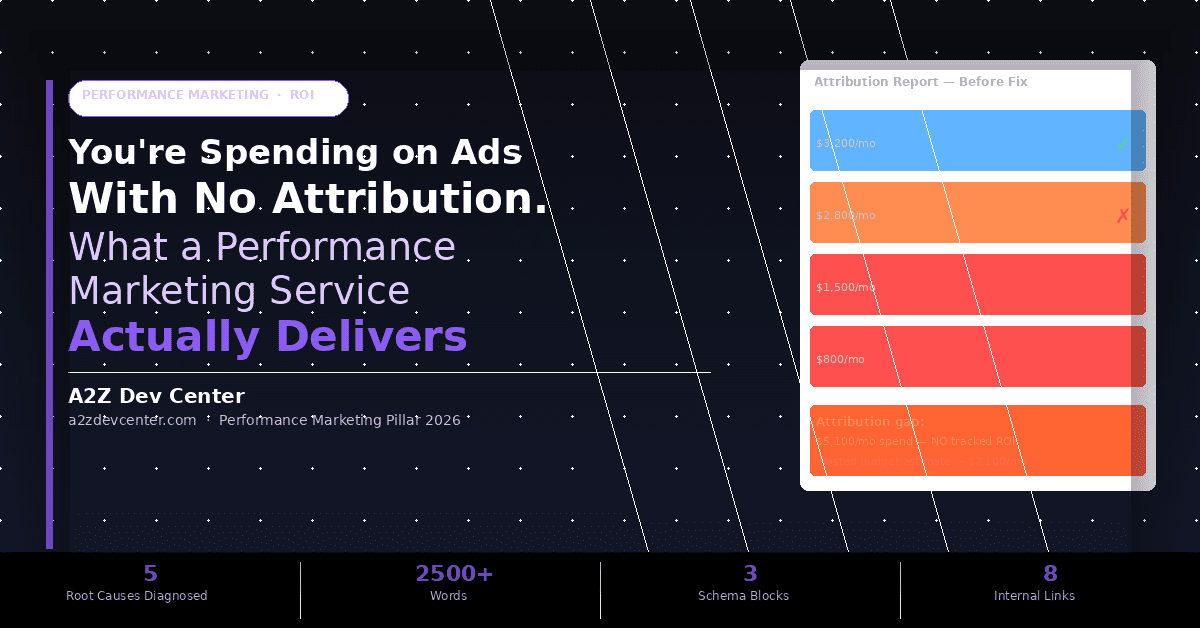
- Your ads are running, your budget is spending, but the revenue signal is broken. In 2026, the average business wastes approximately 26 percent of its ad budget on spend that cannot be attributed to any measurable outcome, not because the ads are not working, but because the tracking infrastructure underneath them is broken. Every week that passes without fixing attribution is a week of decisions made on incomplete data.
- Performance marketing is not a channel. It is a system. A performance marketing service builds the measurement infrastructure, selects channels based on your specific revenue goals and audience, manages paid spend across those channels, and optimises continuously against real tracked outcomes. The “performance” is not in the ads, it is in the accountability layer that connects ad spend to business results.
- Zero of the four major competitor articles on this topic diagnose why ROI is invisible even when campaigns are running, show real industry benchmarks for ROAS and CPL, or explain the iOS14 and GA4 attribution failures that have made standard tracking unreliable since 2021. This guide covers all three, and what a specialist service partner actually does about each one.
- A2Z Dev Center provides performance marketing services and digital marketing services for growing businesses across the US, covering paid media management, conversion tracking infrastructure, attribution setup, and campaign optimisation against measurable revenue outcomes.
What Is a Performance Marketing Service?
A performance marketing service is a managed digital marketing engagement in which every dollar of ad spend is tied to a trackable, measurable outcome, a click, lead, or sale, rather than a flat fee for ad placement or impressions. A performance marketing service provider builds the measurement infrastructure (tracking, attribution, analytics), manages paid media across relevant channels (SEM, paid social, programmatic, affiliate), and optimises continuously based on real cost-per-outcome data. The defining characteristic is accountability: payment and effort are tied to results, not activity.
You are spending $9,000 per month on Google Ads and Meta. Your campaigns are active. Your agency sends a monthly report showing impressions, clicks, and click-through rates. But when your sales team asks which campaigns produced last month’s 23 enterprise inquiries, nobody can answer the question. The CRM shows “direct” as the source for 14 of them. This is not a campaign performance problem. This is an attribution infrastructure problem, and it is more common than any agency will volunteer.
A performance marketing service’s first job is not to run ads. It is to build the system that makes ad spend measurable. This guide explains what that system looks like, why it breaks, what it costs when it does, and what a specialist performance marketing service actually delivers that a generic agency does not.
What Is a Good ROAS, CPL, and CPA? (Industry Benchmarks)
Before diagnosing your performance marketing problems, you need the right benchmarks for your specific industry, channel, and business model. Most businesses compare themselves to the wrong number, and most competitor articles on this topic publish none.
| Segment / Channel | Metric | Good (Top 20%) | Average | Below Benchmark |
|---|---|---|---|---|
| Ecommerce (Google Shopping) | ROAS | 6-10x | 3-5x | <2x |
| Ecommerce (Meta/Instagram) | ROAS | 4-7x | 2-4x | <1.5x |
| B2B SaaS (LinkedIn) | CPL | $75-$150 | $150-$300 | $300+ |
| B2B Lead Gen (Google Search) | CPL | $40-$100 | $100-$250 | $250+ |
| D2C Subscription | CPA vs LTV | CPA <25% LTV | CPA 25-40% LTV | CPA >40% LTV |
| Google Search (all sectors) | CTR | 6-10% | 3-5% | <2% |
| Email marketing (all sectors) | ROI | $42 per $1 spent | $20-$30 | <$10 |
| Paid social (Meta, TikTok) | CVR | 1.5-3% | 0.7-1.5% | <0.5% |
| Organic search | CVR | 3-5% | 2-3% | <1.5% |
If your ecommerce ROAS on Google Shopping is below 2x, you have a structural campaign problem, audience targeting, landing page relevance, or bid strategy, that is costing you more in ad spend than you are recovering in revenue. If your B2B LinkedIn CPL is above $300, the issue is typically audience specificity: targeting “marketing professionals” instead of “VP of Marketing at B2B SaaS companies with 50-500 employees.” Both of these are fixable with a performance marketing service that manages at the campaign architecture level, not just the budget level.
A note on benchmarks: figures like these vary widely by industry, audience, offer and season, and published averages differ between sources. Use them as a rough guide, then compare each campaign with your own history and margins.
Why Your Ads Are Running But Not Converting, 5 Root Causes
A business spending $10,000 per month on ads and seeing weak ROI is almost always experiencing multiple simultaneous failures, not one. Fixing the most visible one, usually creative or budget, without addressing the others produces minimal improvement.
Root Cause 1: Tracking and Attribution Is Broken at the Infrastructure Level
The iOS14 privacy update in April 2021 removed the IDFA (Identifier for Advertisers) that Meta used to track users across apps and websites. Meta advertisers immediately lost 15 to 20 percent of their attributable conversions, sales that happened but could no longer be connected to the ad that drove them. In the years since, browser privacy changes, cookie deprecation, and GA4’s different attribution model from Universal Analytics have compounded this tracking gap. A business still using the same tracking setup it had in 2020 is operating on systematically incomplete data. The Aggregated Event Measurement (AEM) setup for Meta, the Conversions API (CAPI) server-side tracking, and proper GA4 migration are all technical infrastructure tasks, not campaign tasks, and most generic agencies do not execute them.
Root Cause 2: Wrong Traffic Source Matched to the Wrong Offer
Paid social traffic (Meta, TikTok, LinkedIn) reaches users who are not in active purchase mode, they are scrolling, not searching. The average Meta conversion rate of 0.7 to 1.5 percent reflects this cold-audience dynamic. Paid search (Google, Bing) reaches users who are actively searching for a solution, conversion rates of 3 to 5 percent are achievable because intent is pre-established by the search query itself. A B2B company spending the majority of its budget on Meta for a high-consideration product is matching a cold-intent channel to a high-consideration offer. A specialist performance marketing service matches budget allocation to channel intent and offer complexity. Most generic agencies manage the channel they are most comfortable billing for, not the channel that best fits the offer.
Root Cause 3: Landing Page Misalignment Destroys Conversion After the Click
The ad gets the click. The landing page loses the conversion. A user who clicks a Google Search ad for “accounting software for freelancers” and lands on a homepage that shows enterprise pricing plans, a contact form, and a generic value proposition is experiencing a relevance mismatch between what the ad promised and what the landing page delivers. The landing page has one job: continue the specific conversation the ad started, for the specific audience segment the ad targeted. A performance marketing service treats landing page testing as a core function, not an afterthought. Every campaign needs a matched landing page. Our guide on what makes a conversion-focused landing page work covers the specific architecture decisions that determine whether the click converts. If your store specifically is losing conversions after paid traffic arrives, our analysis of why ecommerce stores don’t convert covers the technical and UX factors that compound this problem.
Root Cause 4: Audience Targeting Too Broad to Generate Profitable CPL
Broad audience targeting produces volume at high cost. A LinkedIn campaign targeting “Marketing” as a job function reaches 50 million people. A campaign targeting “Director of Demand Generation at B2B SaaS companies with 100-1,000 employees in North America” reaches 180,000 people. The second audience is smaller and more expensive per thousand impressions, but converts at 3 to 5 times the rate and produces a CPL that is actually below the threshold where the campaign is profitable. Most businesses running their own paid social campaigns default to broad targeting because narrow targeting feels like it limits reach. A performance marketing service builds audience strategy around the cost-per-qualified-lead target, not the reach number.
Root Cause 5: Budget Allocation Ignoring ROAS and LTV by Channel
A business spending 70 percent of its paid budget on the channel that generates the most clicks is making a vanity metric budget decision. Clicks are not revenue. A channel generating 400 clicks at $0.50 each with a 0.3 percent conversion rate produces fewer customers at higher total cost than a channel generating 40 clicks at $8 each with a 12 percent conversion rate. The first channel looks better in a clicks-based report and worse in a ROAS-based analysis. A performance marketing service allocates budget against the metric that measures business outcomes, cost per acquisition, return on ad spend, or revenue contribution, and rebalances spend toward the channels that produce the best outcomes, not the most activity.
The Hidden Wasted Ad Spend Problem, The Dollar Math Nobody Shows You
Approximately 26 percent of digital ad spend is wasted on audiences that will never convert, traffic from click fraud bots, and campaigns running on channels poorly matched to the offer. For a business spending $10,000 per month on paid media, that is approximately $2,600 per month in budget producing zero measurable revenue, $31,200 annually. The Lunio 2024 research on invalid clicks and the Association of National Advertisers’ studies on ad quality consistently find this 20 to 30 percent waste range across digital ad platforms.
Estimated Monthly Wasted Ad Spend at Common Budget Levels
$3,000/mo ad budget (26% waste)
~$780/mo wasted = $9,360/yr
$5,000/mo ad budget (26% waste)
~$1,300/mo wasted = $15,600/yr
$10,000/mo ad budget (26% waste)
~$2,600/mo wasted = $31,200/yr
$25,000/mo ad budget (26% waste)
~$6,500/mo wasted = $78,000/yr
$50,000/mo ad budget (26% waste)
~$13,000/mo wasted = $156,000/yr
The waste categories are specific and fixable: invalid clicks from bot traffic (IP exclusion lists, brand safety settings), irrelevant search terms triggering broad match keywords (negative keyword management), ads serving to audiences who have already converted (audience exclusion logic), and budget spending outside business hours or in geographies that never purchase (dayparting and geo-targeting hygiene). A performance marketing service implements all of these as standard campaign hygiene. Most DIY campaigns and generic agencies manage none of them systematically.
Why ROI Is Invisible Even When Your Ads Are Working
The attribution gap, conversions that happened but cannot be traced to their source, has grown from a minor measurement nuisance to a major strategic problem since 2021. Three technical changes have compounded this gap simultaneously.
The iOS14 update removed cross-app and cross-site tracking for users who opt out of App Tracking Transparency (ATT). Approximately 60 to 80 percent of iOS users opt out, meaning a large fraction of iPhone users who click a Meta ad and make a purchase on a website generate a conversion signal that Meta cannot receive through its standard pixel. The result is that Meta’s reported conversions are systematically lower than actual conversions, and businesses making budget allocation decisions based on Meta’s reported ROAS are under-investing in a channel that is performing better than the data suggests.
The GA4 migration from Universal Analytics changed the default attribution model from last-click to data-driven. A campaign that previously received 100 percent credit for a conversion in UA may receive 40 percent credit in GA4’s data-driven model, with the remaining credit distributed across earlier touchpoints. Without understanding this model change, businesses reading GA4 data interpret it as campaign performance declining when in reality the measurement methodology changed.
UTM parameter hygiene is the third gap: campaigns running without consistent UTM tagging (or with inconsistent tagging where some links have UTM parameters and others do not) produce traffic that lands in GA4 as “direct” even when it originated from a specific campaign. A business where 40 percent of GA4 sessions show as “direct” almost certainly has UTM coverage gaps across email, social, and offline campaigns, not 40 percent of visitors who typed the URL directly. Our SEO services team integrates UTM audit as a standard component of any analytics engagement because organic and paid attribution share the same infrastructure. Fixing attribution is not a creative task, it is a technical and analytical one.
The Core Channels of Performance Marketing Services
A specialist performance marketing service does not recommend channels in the abstract, it selects channels based on your specific offer type, sales cycle, audience intent level, and ROAS target.
Channel 1
Highest Intent
Paid Search (Google Ads, Microsoft Ads)
Paid search reaches users expressing active purchase intent through their search query. A user searching “buy CRM software for small business” has expressed intent that no other channel can match at scale. Google Search conversion rates of 3 to 6 percent for well-matched campaigns reflect this intent quality. Paid search is highest ROI for high-consideration B2B products, local services, and ecommerce categories with high purchase-intent search volume. A specialist performance marketing service structures campaigns around match type hierarchy (exact, phrase, broad match modifier), negative keyword lists, quality score optimisation for lower CPCs, and landing page relevance scoring. Our ecommerce SEO guide covers how organic and paid search share keyword intent data that can be used to optimise both channels simultaneously.
Channel 2
Scale + Targeting
Paid Social (Meta, LinkedIn, TikTok)
Paid social reaches users based on demographic and behavioral data rather than active search intent. The conversion rates (0.7 to 1.5 percent on Meta, 0.4 to 0.9 percent on LinkedIn) are lower than search, but the audience scale and targeting precision are unmatched for cold audience prospecting, brand building at scale, and retargeting users who have previously visited your site or engaged with your content. Post-iOS14, Meta advertising requires Conversions API (CAPI) server-side event tracking to recover the attribution gap. A specialist sets up CAPI integration, Aggregated Event Measurement (AEM), and Advantage+ campaign structures rather than running standard pixel-only campaigns that are systematically misattributing conversions downward.
Channel 3
Scale + Automation
Programmatic and Display Advertising
Programmatic advertising uses real-time bidding to place ads across thousands of publisher sites, reaching audiences based on behavioral data at scale. For performance marketing, programmatic is most effective for retargeting (reaching users who have already visited your site or engaged with your brand) and prospecting against lookalike audiences derived from your existing customer data. A performance marketing service uses demand-side platforms (DSPs) with brand safety targeting, invalid traffic filtering, and contextual placement controls, preventing your ads from appearing on content that damages brand perception while ensuring reach quality over reach volume.
Channel 4
Commission-Based
Affiliate and Partner Marketing
Affiliate marketing is the purest form of performance marketing: payment occurs only when a conversion happens, and the conversion model (CPL, CPA, revenue share) is agreed before the campaign launches. A specialist performance marketing service builds an affiliate program architecture that recruits partners relevant to your audience, sets commission structures that are profitable relative to your customer LTV, and implements tracking that correctly attributes conversions to the referring partner. Affiliate fraud (commission theft through cookie stuffing or fake leads) requires technical controls that generic affiliate setups rarely implement.
Channel 5
Content-Native
Native Advertising
Native advertising places ads in the format and context of the surrounding content, typically on news and publisher sites. Native converts at lower rates than search but at higher rates than standard display because the ad experience matches the content consumption mindset rather than interrupting it. Native is most effective for content-led performance campaigns: driving clicks to long-form content that continues the purchase consideration journey, rather than direct-response product ads. A performance marketing service tests native as a prospecting channel for audiences that are not active searchers and not reachable through social targeting at scale.
What a Performance Marketing Service Does That You Cannot DIY
Builds the Attribution Infrastructure Before Running a Single Ad
A specialist performance marketing service audits and rebuilds the tracking stack before allocating budget: GA4 setup verification, Conversions API implementation for Meta, Google Tag Manager container audit, UTM parameter standardisation across all campaigns, and cross-channel attribution model selection. This infrastructure work produces accurate data that every subsequent campaign decision depends on. A DIY advertiser or generic agency typically assumes the existing tracking is correct and builds campaign optimisation decisions on data that is 20 to 40 percent incomplete.
Manages Budget at the ROAS and LTV Level, Not the Activity Level
A specialist treats budget allocation as a continuous portfolio management exercise: comparing ROAS by campaign, audience segment, and channel; identifying underperforming spend that should be reallocated; and scaling budget into the channels and campaigns generating profitable returns. A DIY campaign typically allocates budget at the channel level (spend X on Google, Y on Meta) and adjusts based on impression volume or click cost, activity metrics that have no direct relationship to revenue outcomes.
Tests Campaign Variables Systematically, Not Randomly
A/B testing in performance marketing is not about testing button colors. It is about testing audience segment performance (persona A vs persona B), offer framing (price anchoring vs value-led vs pain-led), match type efficiency (exact vs phrase for specific keyword sets), and bidding strategy (target CPA vs maximize conversions vs target ROAS). A specialist performance marketing service builds a structured testing roadmap where each test isolates one variable, runs until statistical significance, and produces a learnable insight that improves every subsequent campaign. Random A/B testing produces noise rather than learning.
Connects Ad Performance to Revenue Outcomes in the CRM
The ultimate performance marketing measurement connects ad spend to closed revenue, not just to leads or conversions. A specialist integrates ad platform data (Google Ads, Meta Ads Manager) with CRM data (Salesforce, HubSpot) to answer the question: which campaigns produce leads that close, at what average deal size, at what sales cycle length? This closed-loop measurement reveals that the Meta campaign producing 50 leads per month at $90 CPL is generating $2,400 in monthly ad spend for $35,000 in closed revenue, a calculation that a platform-level report showing 50 leads will never produce. For businesses building organic growth strategies alongside paid media, CRM-connected attribution is the only way to understand the relative contribution of each channel to the revenue pipeline.
Performance Marketing vs Brand Marketing, Which Does Your Business Need?
Performance marketing is not the right tool for every marketing objective, and a specialist will tell you that, a generic agency selling performance marketing services will not.
| Factor | Performance Marketing | Brand Marketing | Both (Optimal) |
|---|---|---|---|
| Primary goal | Immediate measurable conversions | Awareness, trust, category ownership | Full funnel coverage |
| Timeline | Results within days to weeks | Results over months to years | Performance now + brand long-term |
| Budget efficiency | High, pay for outcomes | Lower, pay for reach | 60% performance / 40% brand (Binet & Field) |
| Measurement | Directly trackable | Indirect (brand lift, surveys) | Mixed model required |
| Best for | Products with clear intent signals | New categories, brand building | Established businesses scaling |
| Risk | Turns off with budget | Compounds over time | Diversified |
The Binet and Field research on marketing effectiveness – the most cited study in the field recommends a 60 percent performance marketing, 40 percent brand marketing budget split for established businesses seeking both immediate revenue and long-term category growth. Pure performance marketing maximises short-term revenue but creates a dependency on paid spend that stops generating revenue the moment budget is cut. Pure brand marketing builds the category authority that makes performance marketing more efficient, but cannot be measured in the quarterly cycle that most marketing budgets operate on. A specialist performance marketing service is honest about which part of your budget should drive immediate conversion and which should build the brand that makes conversion cheaper over time. Our ecommerce development services covers how technical platform decisions interact with performance marketing efficiency, a slow, poorly converting store makes every ad dollar more expensive regardless of campaign quality.
Frequently Asked Questions
Your Attribution Is Broken. Your Budget Is Leaking. Let’s Find the Exact Gap.
Every business spending on paid media without proper attribution infrastructure is making budget allocation decisions on incomplete data. The questions, which campaign drove last month’s best customers, what is your actual ROAS by channel, and how much of your budget is going to audiences that will never convert, are all answerable with a proper technical audit before a single new ad dollar is spent.
A2Z Dev Center provides performance marketing services for growing businesses across the US. We start every engagement with a free technical audit covering your current attribution infrastructure, channel ROAS by campaign, wasted spend categories, and UTM coverage gaps. You receive a specific analysis of where your ROI is invisible, where your budget is being wasted, and what a properly configured performance marketing program would deliver at your current spend level, before any campaign contract is signed.
Book Your Free Performance Marketing Audit
Schedule a call
Talk to a subject-matter expert
Web development, SEO, or digital marketing — tell us about your project and we'll get back within one business day. No obligation.
- Free scope & strategy session
- A senior specialist, not a sales rep
- Your details stay confidential