SEO
Summarize this blog post with:
TL;DR
- “Near me” searches have grown by over 500 percent in the past seven years and now represent one of the highest-intent search behaviors available to any business. A person searching “accountant near me” or “lawyer near me” is ready to contact someone. The only question is whether that someone is you or your competitor two blocks away.
- Near me search results are governed by three factors Google weights above everything else: the relevance of your business to what was searched, your physical proximity to the searcher, and the prominence of your business in Google’s eyes — built through your GBP, reviews, citations, and website authority.
- The 6 fixes in this guide address every failure point that keeps businesses invisible in near me searches, in the order that produces the fastest measurable improvement. Fix 1 alone — Google Business Profile correction — has moved businesses from invisible to Local Pack position three within four weeks.
- A2Z Dev Center provides near me search optimization services for businesses across the US. Every fix in this guide reflects what we implement on every local SEO engagement from day one.
What is a Near Me Search?
A “near me” search is a Google query that includes explicit or implicit geographic intent — either the literal phrase “near me,” a city name, or a location-implied context from the user’s device GPS — triggering Google to return the three-business Local Pack map result above organic listings. Google uses three signals to rank near me results: relevance (how closely your business matches the search), distance (physical proximity to the searcher), and prominence (how well-known and trusted your business is across the web).
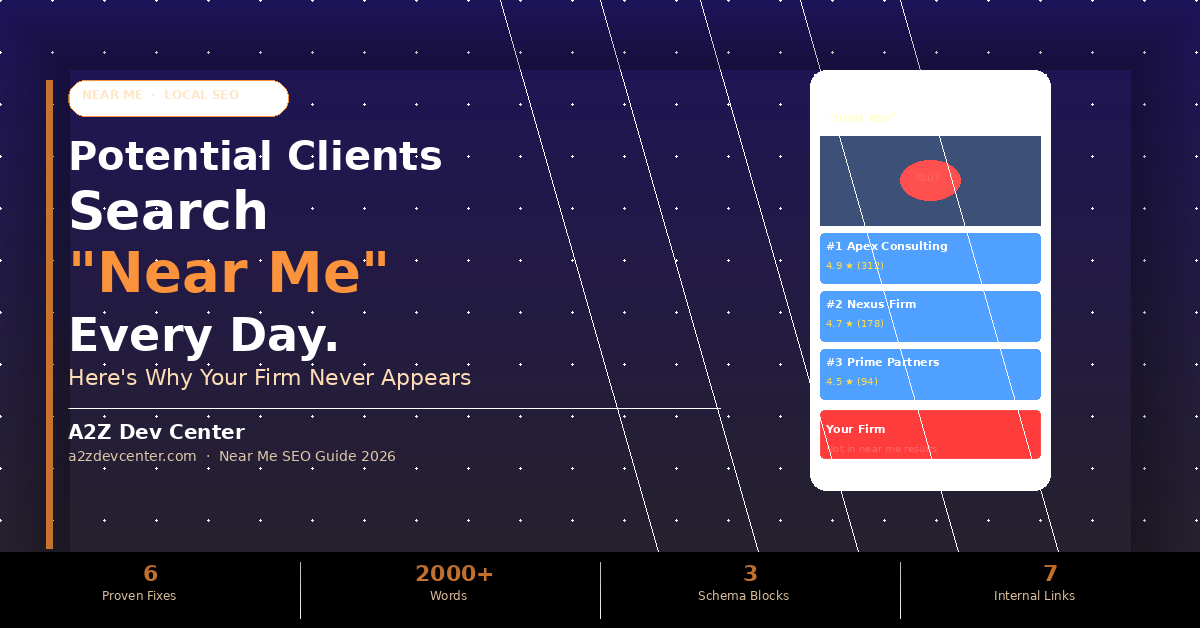
Right now, someone in the same neighbourhood as your office is typing your exact service into Google followed by “near me.” Google returns three businesses. Yours is not one of them. That person calls the first result. They do not scroll further. They do not know you exist. This is not a brand awareness problem. It is a near me search optimization problem with specific, identifiable causes and specific, implementable fixes.
According to Google’s own consumer research, searches including “near me” have grown more than 500 percent over the past seven years, with mobile near me searches growing even faster. The vast majority of those searches result in a business contact within 24 hours. This guide covers exactly how near me search optimization works, why your business is not appearing, and the 6 fixes that change it — starting this week.
Why Your Business Does Not Show Up in Near Me Searches
Near me search invisibility is almost always caused by the same five root problems operating simultaneously. Google’s algorithm for near me results is simpler than most business owners assume — it is not a mystery. It is a scoring system, and you are losing on every category.
Reason 1: Google Cannot Clearly Identify What Your Business Does
The relevance signal in near me search starts with your Google Business Profile primary category. A firm that has selected “Professional Services” instead of “Accounting Firm,” “Personal Injury Attorney,” or “Family Law Attorney” is telling Google almost nothing useful about what kind of searches should trigger it. Google matches near me queries to the most specifically relevant businesses first. Every degree of specificity you fail to provide in your GBP category selection is a degree of relevance you lose to competitors who got it right.
Reason 2: Your Google Business Profile Is Inactive or Incomplete
An inactive GBP — one with no posts, no photos updated in over a year, no Q&A responses, and hours that have not changed since the profile was claimed — signals low engagement to Google. Google treats GBP activity level as a proxy for business reliability. A competitor posting twice a week, uploading new photos monthly, and responding to every review signals an active, engaged business. Between two otherwise equivalent businesses, the more actively managed GBP consistently wins the Local Pack position. Most businesses claim their GBP and never return to it. That inertia is visible to Google and penalised in near me rankings.
Reason 3: You Have No Recent Reviews or No Review Response Pattern
Review recency is weighted more heavily than total review count in Google’s near me ranking algorithm. A business with six new reviews in the past 30 days consistently outranks one with 200 total reviews and none in the past quarter. More importantly, review response rate is an independent ranking signal — Google can see whether a business responds to reviews and uses that as an engagement quality indicator. A business that responds to every review within 48 hours signals active customer engagement that Google rewards with better near me placement.
Reason 4: Your Business Name, Address and Phone Are Inconsistent Across the Web
Google cross-references your NAP (Name, Address, Phone) data across dozens of external directories to verify that your business is a real, consistent local entity. The confidence Google has in your business entity directly affects your near me ranking. A firm listed as “Smith & Associates” on Google but “Smith and Associates LLC” on Yelp, with a different phone format on Yellow Pages and an outdated address on an industry directory, generates inconsistency signals that suppress your near me ranking regardless of how well everything else is optimized.
Reason 5: Your Website Sends No Local Signals
Google reinforces GBP data with signals from your website. A website that never mentions the city or neighbourhood you serve, has no LocalBusiness schema markup, no service area page, and no local content gives Google no geographic confirmation of your relevance to local near me searches. The GBP and the website work together to establish local relevance. A business with a strong GBP but a website that looks like it serves everyone, everywhere, and no one in particular is leaving a significant near me ranking signal on the table.
Expected result after all 15 fixes applied:
According to BrightLocal’s 2026 Local Consumer Review Survey, 98 percent of consumers read online reviews for local businesses before making contact. 87 percent say Google is their primary platform for evaluating local businesses. A business invisible in near me results is invisible to this entire decision-making process.
| Near Me Ranking Signal | Google Weight | Most Common Gap | Fix Speed |
|---|---|---|---|
| GBP primary category specificity | Very High | Too broad (e.g. “Business” not “Dentist”) | Same day |
| Distance from searcher | Very High | Cannot change — fixed by location | N/A |
| GBP completeness and activity | High | Set up once, never updated | 1–2 days |
| Review recency and volume | High | No review acquisition process | 4–8 weeks |
| Review response rate | Medium–High | Reviews ignored entirely | Immediate |
| NAP consistency | Medium–High | Inconsistent across directories | 1–2 weeks |
| Website local signals + schema | Medium | No city name, no LocalBusiness markup | 1 week |
| Local citation volume | Medium | Few citations on relevant directories | 2–4 weeks |
6 Fixes That Get Your Business Into Near Me Search Results
These 6 fixes target every near me ranking signal Google weighs, in the order that produces the fastest visible improvement in your Local Pack position.
FIX 1
Do Today
Fix Your Google Business Profile Category and Complete Every Field
Open your GBP right now and check your primary category. It should be the most specific description of your business that Google offers. “Accounting Firm” beats “Financial Services.” “Personal Injury Attorney” beats “Law Office.” “General Dentist” beats “Health Service.”
Then check every other field: are your hours current including any holiday changes? Is your service area set at the city and neighborhood level rather than just your state? Does your business description use your primary service and city name naturally?
Do you have at least 15 photos including exterior, interior, team, and work examples? Our full Google Business Profile optimization guide covers every field with specific configuration instructions.
A complete, correctly categorised GBP is the highest-impact single action for “near me” search visibility — and it costs nothing except 45 minutes of your time.
FIX 2
Do Today
Post to Your GBP Weekly and Respond to Every Review
GBP activity level is a direct input into Google’s near me ranking algorithm. An inactive profile tells Google your business is low-engagement. A profile receiving weekly posts and prompt review responses tells Google your business is actively serving customers. Posts do not need to be elaborate: a completed project photo with the service and location named, a seasonal service reminder, a team update, or a client outcome description. Two posts per week takes 30 minutes and produces measurable near me ranking improvement within 6 to 8 weeks of consistent activity. Responding to reviews within 48 hours with a specific, personalized acknowledgment rather than a generic template is an independent ranking signal that most competitors are not executing. Both actions are free, available today, and compounding in effect.
FIX 3
This Week
Build a Review Acquisition System Focused on Recency
Review recency outweighs total review count in Google’s near me algorithm. The goal is not 200 reviews accumulated over five years. The goal is a consistent flow of new reviews that maintains Google’s freshness signal month over month. Generate your direct Google review link from your GBP dashboard, create a QR code, and place it wherever customers interact with you at the point of service. Send a follow-up message within 24 hours of a positive interaction with the direct review link. Train every team member to mention the review link naturally at service completion. A business generating four new reviews per month consistently outranks one with 180 total reviews and no new reviews in the past quarter in near me search results for competitive local search terms in most markets.
FIX 4
This Week
Audit and Correct Your NAP Consistency Across All Directories
Search your business name and phone number on Google and open every listing that appears. Your Name, Address, and Phone Number must be identical across every source: Google Business Profile, Yelp, Apple Maps, Bing Places, Facebook, Yellow Pages, your industry’s primary directories, and your chamber of commerce listing. Even trivial variations reduce Google’s entity confidence and suppress near me ranking. Use Moz Local or Bright Local to scan your full citation landscape and identify every inconsistency. Fix them in order of directory authority, starting with Google, Yelp, Apple Maps, and Bing before moving to secondary directories. Our near me search optimization program includes a full NAP audit as the first week deliverable because it directly sets the baseline for every other ranking signal that follows.
FIX 5
This Month
Add Local Signals and Schema Markup to Your Website
Your website needs to explicitly confirm to Google the geographic area your business serves. Add your city and primary service area to your homepage title tag, H1, and first paragraph. Create a “Service Areas” page listing every location you serve with a brief service description for each. Implement LocalBusiness schema markup with your exact NAP data, hours, service categories, and service area — this gives Google machine-readable confirmation of your geographic relevance for near me searches. A local content strategy that adds one location-specific page per month compounds your near me authority faster than any other on-site action. A technical SEO audit of your current site identifies every missing schema, broken markup, or indexation issue that is preventing your website from reinforcing your GBP near me relevance signals effectively.
FIX 6
This Month
Build Local Citations on High-Authority Directories
Local citations are the third pillar of near me ranking after GBP signals and proximity. Google uses the volume and consistency of your business NAP mentions across the web to assess how established and trustworthy your business is in its local market — the “prominence” signal. Every business should have consistent citations on: Yelp, Bing Places, Apple Maps, Yellow Pages, BBB, Foursquare, and every industry-specific directory relevant to your category. Law firms need Avvo, FindLaw, and Justia. Accounting firms need CPAdirectory and AccountingToday. Medical practices need Healthgrades and Zocdoc. Beyond universal directories, local citations from your city’s Chamber of Commerce, local newspaper business directories, and local business associations provide geographic authority signals that national directory citations cannot replicate. Building 25 consistent citations in your first month of near me optimization typically produces measurable Local Pack position improvement within 8 to 12 weeks. Our guide on small business local search visibility covers the full citation building process in detail.
Near Me Search Quick Audit — Do This Right Now
- Open a private browser window and search your primary service followed by “near me.” Note which position your business appears in — or whether it appears at all.
- Open your GBP dashboard and check: specific primary category, 15+ photos, current hours, service area at city level, and at least one post in the past 7 days.
- Search your business name on Google and check the first five directory listings for NAP consistency with your GBP data.
- Open your website homepage and check whether your city name appears in the title tag, the H1, and the first paragraph of body text.
- Check your last Google review date in your GBP dashboard. If it is more than 30 days ago, your review recency signal is already working against you.
Frequently Asked Questions
Your Clients Are Searching. Right Now. Let’s Make Sure They Find You.
Every near me search that returns your competitor instead of you is a client who made a decision without knowing you existed. The fixes are specific, implementable, and in most cases free. What they require is a systematic audit of exactly where your near me search signals are failing and a prioritised plan to fix each one.
A2Z Dev Center provides near me search optimization and local SEO audits for businesses across the US. We start with a free strategy call where we run your primary service plus “near me” in an incognito browser from your service area, audit your GBP against the top three Local Pack results, identify every gap in relevance, activity, and prominence signals, and tell you exactly what each fix requires and how long it should take to move you into the Local Pack. Specific diagnosis. No generic advice.
Book Your Free Near Me SEO Audit
Related reading: how to choose the right SEO provider.
Schedule a call
Talk to a subject-matter expert
Web development, SEO, or digital marketing — tell us about your project and we'll get back within one business day. No obligation.
- Free scope & strategy session
- A senior specialist, not a sales rep
- Your details stay confidential