
React Native vs Flutter: Which Should You Choose for Your App in 2026?
 By Akash Patel
·
📅 Published: March 28, 2026
·
⏱ 15 min read
By Akash Patel
·
📅 Published: March 28, 2026
·
⏱ 15 min read
TL;DR
React Native is the better choice for teams with JavaScript and React experience, projects requiring fast developer onboarding, and apps that benefit from platform-native UI components. Flutter is the better choice for teams prioritizing pixel-perfect UI consistency across platforms, animation-heavy or graphically intensive apps, and projects where Dart’s performance ceiling matters. Both are production-proven and used by major companies in 2026. The decision should be based on your team’s existing skills first, app requirements second. Neither framework is universally superior.
React Native vs Flutter: which is better in 2026?
React Native and Flutter are both excellent cross-platform frameworks in 2026. React Native wins for JavaScript teams, faster onboarding, and platform-native component feel. Flutter wins for UI consistency, animation performance, and Dart’s ahead-of-time compilation advantages. For most business apps, the framework your team knows best will produce the better outcome, because team expertise has more impact on delivery quality than any technical difference between the frameworks.
The React Native vs Flutter debate has been running since Google launched Flutter in 2018, and in 2026 it is more competitive than ever. Both frameworks have matured significantly. Both are used by large companies in production. Both have active communities and rich package ecosystems. The gap that once made one clearly superior for specific use cases has narrowed to the point where the choice is genuinely contextual rather than obvious.
This comparison covers every meaningful technical and practical dimension, gives a clear verdict for each category, and ends with a definitive recommendation framework based on your specific situation. If you are still deciding whether to build a mobile app at all, the mobile app development guide for 2026 covers the full build-vs-buy and platform decision context. For cost implications of your framework choice, the mobile app development cost breakdown covers how framework selection affects total project budget.
Key Takeaways
- React Native uses JavaScript and renders native platform components. Flutter uses Dart and renders its own components via a custom graphics engine. This architectural difference drives most of the practical distinctions between them.
- Flutter’s Impeller rendering engine, the default in 2026, delivers consistently smooth 60fps and 120fps animations without the JavaScript bridge overhead that historically affected React Native performance.
- React Native’s New Architecture with JSI has significantly improved performance and closed much of the gap with Flutter. Both frameworks are suitable for the vast majority of business app requirements.
- React Native has a larger developer talent pool due to its JavaScript foundation. Finding and hiring React Native developers is easier and typically less expensive than finding Flutter or Dart specialists.
- Flutter’s UI looks identical on iOS and Android by design. React Native’s UI adapts to each platform’s native components, producing a more platform-specific feel but requiring more platform-specific testing.
- Both frameworks support iOS, Android, and web targets. Flutter additionally supports desktop targets including macOS, Windows, and Linux from a single codebase, making it the stronger choice for multi-platform including desktop coverage.
Background: What Are React Native and Flutter?
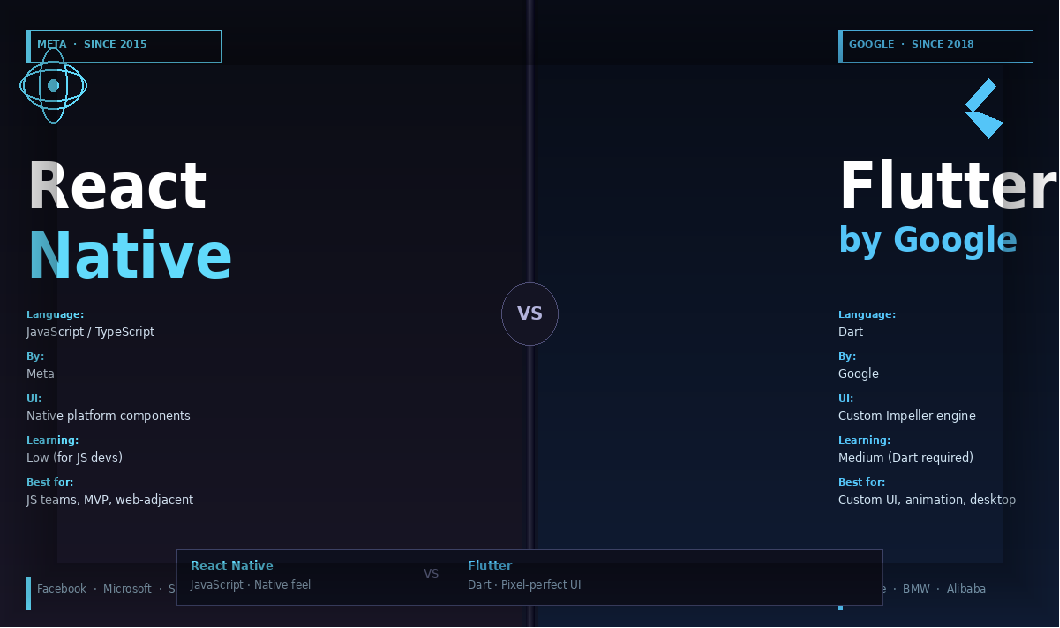
React Native is an open-source cross-platform mobile development framework created by Meta and released in 2015. It uses JavaScript and React to build mobile apps that render native platform UI components. A React Native button on iOS looks like an iOS button. The same button on Android looks like an Android button. React Native achieves this by bridging JavaScript code to native platform components through a communication layer.
Flutter is an open-source cross-platform UI framework created by Google and released in 2018. It uses the Dart programming language and renders its own UI components using a custom graphics engine rather than using native platform components. A Flutter button looks identical on iOS and Android because it is drawn by Flutter’s own rendering engine rather than being a native platform element. Flutter’s Impeller rendering engine, the default since Flutter 3.10, replaced the older Skia engine and delivers significantly improved animation smoothness and reduced jank.
Both frameworks compile to native ARM code for the app logic layer. The difference is in how the UI is rendered: React Native defers to platform-native components while Flutter draws everything itself. This distinction underlies most of the practical trade-offs between the two frameworks.
React Native vs Flutter: At a Glance
| Factor | React Native | Flutter |
|---|---|---|
| Created by | Meta (2015) | Google (2018) |
| Language | JavaScript / TypeScript | Dart |
| UI rendering | Native platform components | Custom Flutter engine (Impeller) |
| Platforms | iOS, Android, Web | iOS, Android, Web, Desktop |
| Learning curve | Lower for JS devs | Higher (requires Dart) |
| Performance | Good (New Architecture) | Excellent (Impeller) |
| UI consistency | Platform-native per OS | Pixel-perfect cross-platform |
| Developer pool | Larger (JS ecosystem) | Smaller but growing fast |
| Package ecosystem | npm, very large | pub.dev, large and growing |
| Desktop support | Limited | Full (macOS, Win, Linux) |
| Hot reload | Yes | Yes |
| Open source | Yes | Yes |
| Enterprise adoption | Meta, Microsoft, Shopify | Google, BMW, Alibaba |
Performance: React Native vs Flutter
Performance has historically been Flutter’s strongest advantage over React Native and, in 2026, it remains a genuine but narrower difference than it once was.
React Native’s original architecture used a JavaScript bridge to communicate between the JavaScript thread running app logic and the native thread rendering UI components. This bridge introduced asynchronous communication overhead that caused performance issues in apps with complex animations or heavy UI updates. React Native’s New Architecture, now stable and increasingly the default, replaces the bridge with JSI (JavaScript Interface), enabling synchronous communication between JavaScript and native code and eliminating the primary source of the old architecture’s performance limitations.
Flutter has never had a bridge. Dart code compiles to native ARM code ahead of time, and the Flutter graphics engine renders every pixel directly using the GPU without delegating to platform UI components. This produces consistently smooth animation performance, particularly for complex UI transitions and custom graphics. Flutter’s Impeller rendering engine improves on the older Skia engine by pre-compiling shaders, which eliminates the shader compilation jank that affected Flutter apps in earlier versions.
For most business app types in 2026, including forms, lists, navigation, and standard UI patterns, both frameworks deliver smooth 60fps performance that users cannot distinguish. The performance difference becomes meaningful in apps with complex custom animations, real-time graphics rendering, or heavy concurrent UI updates. For these use cases, Flutter maintains a genuine advantage.
Verdict: Performance
Author Name
Flutter edges ahead for animation-heavy and graphics-intensive apps. For most standard business apps, both frameworks deliver equivalent performance that users cannot distinguish in practice.
Developer Experience: React Native vs Flutter
Developer experience covers the ease of setting up a development environment, the quality of tooling, the debugging experience, and how productive developers feel building and iterating on an app.
React Native’s developer experience benefits enormously from its JavaScript foundation. Developers who know React can build React Native apps with minimal framework-specific learning. The npm ecosystem provides access to thousands of JavaScript packages that can be used directly. Hot reloading, where code changes are reflected in the running app without a full restart, is fast and reliable. Debugging uses familiar JavaScript debugging tools including Chrome DevTools. The React Native CLI and Expo, a popular React Native toolchain, provide streamlined setup and build processes. React Native’s official documentation has improved significantly and is now comprehensive for most common tasks.
Flutter’s developer experience is rated highly by developers who have learned Dart and adapted to Flutter’s widget-based UI model. Flutter’s hot reload is fast and reliable. The flutter CLI is well-designed and the build toolchain is generally consistent across platforms. Dart’s strong typing and Flutter’s widget tree structure produce fewer runtime surprises than JavaScript’s dynamic nature. The Flutter documentation is considered one of the best in the mobile development ecosystem. The primary developer experience friction point is Dart itself: developers without Dart background require an onboarding period before reaching productivity.
Verdict: Developer Experience
React Native wins for JavaScript teams due to lower onboarding friction and the familiarity of the JavaScript ecosystem. Flutter wins on tooling quality and IDE integration once developers are past the Dart learning curve. Overall, React Native has a faster time to productivity for most development teams.
UI Consistency: React Native vs Flutter
UI consistency refers to how consistently the app looks and behaves across iOS and Android. This is one of the most philosophically distinct differences between the two frameworks.
React Native renders native platform components by design. An iOS React Native app uses UIKit components that look and behave like native iOS elements. An Android React Native app uses Material Design components. This means the same React Native codebase produces an app that feels appropriately native on each platform. The trade-off is that achieving a specific custom design consistently across both platforms requires more platform-specific code and testing, since the underlying components behave differently per platform.
Flutter renders every pixel itself using its own engine. The result is pixel-perfect identical UI on iOS and Android from the same codebase. A custom button design looks exactly the same on an iPhone and a Samsung Galaxy. This makes Flutter the stronger choice when brand consistency across platforms is a primary requirement, when the app has a highly custom design system, or when the team wants to minimize platform-specific testing and debugging.
The trade-off is that Flutter apps do not automatically adopt platform-specific UI conventions. A Flutter app on iOS does not automatically use iOS navigation patterns or iOS-specific controls unless explicitly built to do so. For apps where the native platform feel is important to user expectations, this requires deliberate design work to replicate. Our React mobile app development guide covers this design philosophy in more depth for teams evaluating the platform feel trade-off.
Verdict: UI Consistency
Author Name
Flutter wins for cross-platform visual consistency. React Native wins for platform-native feel and automatic adoption of platform UI conventions. The right choice depends on whether your app prioritizes brand consistency across platforms or platform-appropriate native behaviour.
Community and Ecosystem: React Native vs Flutter
Both frameworks have large, active communities in 2026. The nature of each community differs in ways that matter for practical development decisions.
React Native’s community is anchored in the JavaScript and React ecosystem, which is one of the largest developer communities in the world. This means React Native developers have access to the full npm ecosystem, the React community’s knowledge base, and a very large pool of Stack Overflow answers and tutorials. The React Native community on GitHub, Discord, and the React Native subreddit is large and responsive. The trade-off is that React Native’s community has historically produced more package fragmentation and variable package quality than Flutter, because the lower barrier to npm package publication means more lower-quality options exist alongside the quality ones.
Flutter’s community on pub.dev is more curated than npm. The Flutter team maintains a list of officially verified packages, and pub.dev’s scoring system provides quality signals that help developers evaluate packages before adopting them. The Flutter community has grown rapidly and the pub.dev ecosystem covers most common development needs. According to the Stack Overflow 2024 Developer Survey, Flutter ranks among the most-used cross-platform frameworks and consistently achieves high developer satisfaction scores among its users.
Verdict: Community and Ecosystem
Author Name
React Native wins on total community size due to the JavaScript ecosystem advantage. Flutter wins on package ecosystem quality and curation. For most projects, both ecosystems cover the required functionality adequately.
Cross-Platform Reach: React Native vs Flutter
Both frameworks target iOS and Android as their primary platforms. The difference in cross-platform reach becomes meaningful when desktop or web targets are part of the requirement.
Flutter supports iOS, Android, Web, macOS, Windows, and Linux from a single codebase. This makes Flutter the clear choice for teams building a single codebase that needs to run across mobile and desktop environments. Flutter’s desktop support has matured significantly and is production-ready for most use cases. Flutter Web exists but is generally considered less competitive with dedicated web frameworks for standard web applications.
React Native’s primary targets are iOS and Android. React Native for Web exists through the react-native-web package but is primarily used for code sharing between React Native and React web apps rather than as a full web development solution. React Native does not have mature desktop support comparable to Flutter’s, making it the weaker choice for projects requiring a single codebase across mobile and desktop platforms.
Verdict: Cross-Platform Reach
Flutter wins clearly for projects requiring iOS, Android, and desktop coverage from a single codebase. React Native is the stronger choice for iOS and Android only projects, particularly those with web counterparts built in React.
Hiring and Team Considerations
The availability of developers in each framework is a practical consideration that affects both hiring timelines and development cost, particularly for businesses building or growing a mobile development team.
React Native developers are more abundant than Flutter developers because React Native’s JavaScript foundation means any experienced React developer can transition to React Native development with relatively low friction. The global pool of JavaScript and React developers is enormous, making React Native developers easier to find, hire, and onboard at competitive market rates.
Flutter developers are less abundant because Dart is a less widely known language than JavaScript. The supply of experienced Flutter developers is growing rapidly but remains lower than React Native developer supply. This can affect both the time to hire and the cost of Flutter development talent, particularly in markets with high developer demand. Our dedicated developer cost guide for 2026 covers how framework specialization affects developer market rates across different regions.
React Native vs Flutter: Full Comparison Table
| Category | React Native | Flutter | Winner |
|---|---|---|---|
| Language | JavaScript / TypeScript | Dart | RN (wider familiarity) |
| Learning curve | Low for JS devs | Medium (Dart required) | React Native |
| Runtime performance | Good (New Arch) | Excellent (Impeller) | Flutter |
| Animation performance | Good | Excellent | Flutter |
| UI consistency | Platform-native | Pixel-perfect | Depends on goal |
| Native platform feel | Automatic | Manual effort required | React Native |
| Developer pool size | Very large | Growing, smaller | React Native |
| Package ecosystem | npm, massive | pub.dev, curated | Both adequate |
| Desktop support | Limited | Full (mac, win, linux) | Flutter |
| Web support | Via react-native-web | Flutter Web | Both limited |
| Code sharing with web | High (React shared) | Limited | React Native |
| Hot reload speed | Fast | Fast | Both excellent |
| Startup time | Good | Excellent (AOT) | Flutter |
| App size | Moderate | Larger (engine included) | React Native |
| Best for | JS teams, MVP, web-adjacent | Custom UI, animation, desktop | Context-dependent |
Who Should Choose React Native
Choose React Native if:
- Your development team has JavaScript and React experience. Onboarding to React Native will take days rather than weeks.
- You are building an MVP and need to move fast. React Native’s JavaScript ecosystem enables rapid prototyping and iteration.
- Your web product is built in React and you want to share logic, types, and components between web and mobile codebases.
- Platform-native UI feel is important to your users. React Native’s automatic adoption of platform UI components produces apps that feel genuinely native on each platform without extra design work.
- You need to hire developers quickly and the React Native talent market in your region is more accessible than Dart or Flutter specialists.
- Your app has standard UI patterns including lists, forms, navigation, and settings without heavy custom animations or graphics requirements.
For teams choosing React Native for a business app, our React Native mobile app development guide covers the framework’s production advantages in detail, and the mobile app development service page covers the engagement models available for React Native projects.
Who Should Choose Flutter
Choose Flutter if:
- Your app has a highly custom visual design that needs to look identical on iOS and Android without platform-specific design variations or adjustments.
- Your app is animation-heavy, has complex UI transitions, or requires smooth 120fps rendering on high-refresh-rate displays.
- You need to target iOS, Android, and desktop (macOS, Windows, or Linux) from a single codebase. Flutter’s desktop support is significantly more mature than React Native’s.
- Your team already has Dart experience or is willing to invest in learning it. Flutter’s developer experience, once past the Dart learning curve, is highly regarded.
- App startup time is a priority. Flutter’s ahead-of-time compiled Dart code produces consistently fast startup performance compared to React Native’s JavaScript engine initialization.
- You are building a consumer app in a visually competitive category where pixel-perfect UI differentiation matters to user perception and retention.
For businesses evaluating Flutter as part of a broader mobile strategy, the native vs cross-platform development guide covers where Flutter and React Native both sit relative to fully native iOS and Android development, including the cases where neither cross-platform framework is the right choice. The mobile app development trends for 2026 post covers how both frameworks are evolving and what new capabilities are relevant to the framework decision this year.
React Native vs Flutter for Specific App Types
| App Type | Recommended Framework | Reason |
|---|---|---|
| eCommerce app | React Native | Native feel, large ecosystem, fast MVP |
| Fintech / banking app | Flutter | Custom UI, consistent branding, AOT performance |
| Social media app | React Native | Used by Meta in production, native media components |
| Gaming / animation app | Flutter | Impeller rendering engine, custom paint canvas |
| Enterprise internal tool | React Native | Larger dev pool, faster onboarding, web code sharing |
| On-demand delivery app | Either | Both handle maps, real-time, and payments adequately |
| Health and fitness app | Flutter | Custom UI design, smooth animations, charts |
| Multi-platform (mobile + desktop) | Flutter | Mature desktop support, single codebase |
For teams building eCommerce mobile apps specifically, the top 10 features for eCommerce mobile apps covers the specific functionality requirements that influence framework selection for commerce use cases. The cross-platform vs native app development guide provides broader context on where both React Native and Flutter sit relative to fully native development when performance and platform integration requirements are at their most demanding.
Frequently Asked Questions

Ready to Get Started?
Your Details will be Kept confidential. Required fields are marked *


