
Still on Magento 1 or 2.4.6? Here’s Exactly What Delaying Your Magento 2.4.8 Upgrade Is Costing You Monthly
 By Akash Patel
·
📅 Published: April 26, 2026
·
⏱ 15 min read
By Akash Patel
·
📅 Published: April 26, 2026
·
⏱ 15 min read
TL;DR
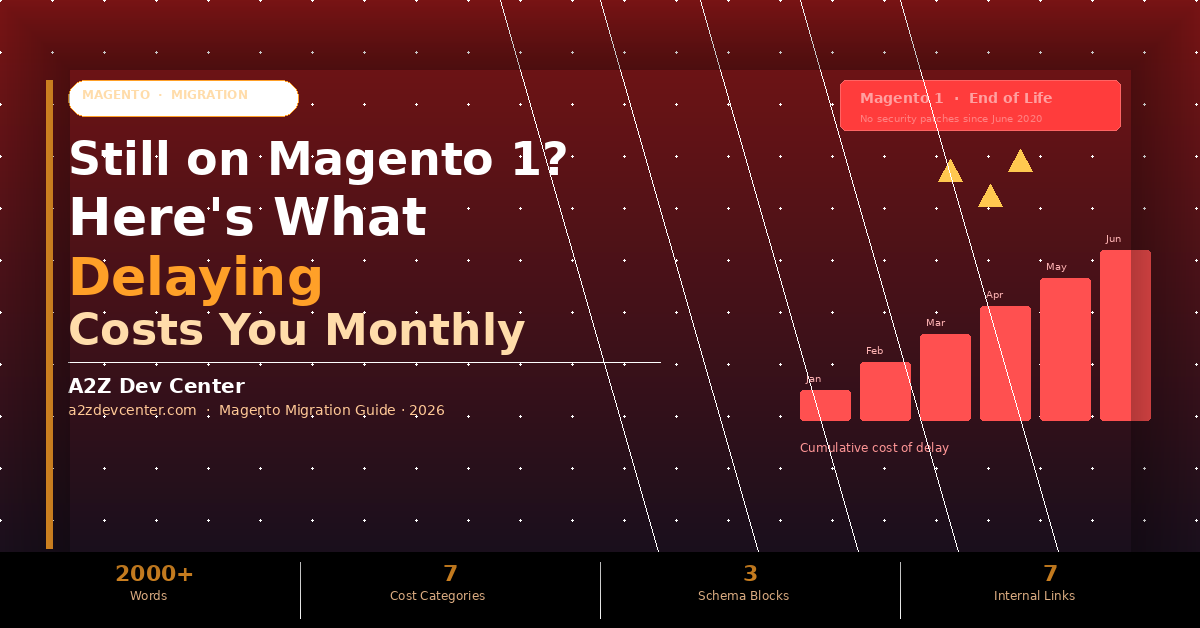
- Two groups of merchants are at immediate risk in 2026: Magento 1 merchants (EOL since June 2020, no patches for six years) and Magento 2.4.6 merchants (EOL August 11, 2026 — four months away). Both need to act now, and the monthly cost of inaction compounds across the same seven categories.
- The current production-ready version is Magento 2.4.8-p4 (March 10, 2026), running PHP 8.4, MySQL 8.4, and OpenSearch 2.19. This is the version you should be on today. Magento 2.4.9 GA is expected in May 2026 and will require PHP 8.5.
- The monthly cost of staying on an end-of-life Magento version is not a single line item. It is the sum of seven overlapping cost categories: security liability, performance revenue loss, SEO decay, developer premium, compliance exposure, extension obsolescence, and opportunity cost.
- A2Z Dev Center provides Magento 1 to Magento 2.4.8 migration and Magento 2 upgrade services for eCommerce businesses across the US. This guide puts real numbers on what the delay is costing you each month so you can make the decision with data, not vendor pressure.
What is Magento 1 to Magento 2 Migration Cost?
Magento 1 to Magento 2 migration cost refers to both the investment required to migrate a Magento 1 store to Magento 2.4.8 (typically $15,000 to $80,000 depending on scope) and the compounding monthly costs of delaying that migration, including security incident risk, revenue loss from performance gaps, SEO ranking decline, developer premium rates, and conversion rate deficits that accumulate from remaining on an unsupported or end-of-life platform. The same cost structure applies to Magento 2.4.6 merchants facing their August 2026 end-of-support deadline.
Your Magento store is still running. Orders are still processing. So the upgrade keeps getting pushed to next quarter. But every month that passes, the actual cost of running an end-of-life Magento version is silently compounding across your entire operation. Not in a way that shows up on a single invoice, but in the aggregate of slower page loads, declining organic rankings, higher developer rates, and growing security exposure.
This guide breaks down exactly what the magento 1 to magento 2 migration cost of delay looks like month by month, across seven cost categories. These figures apply whether you are still on Magento 1 or whether you are on Magento 2.4.6 and have four months before your version hits end of support in August 2026. Our Magento development services team compiled these from real migration and upgrade projects.
The Version Landscape — Where You Are vs. Where You Should Be
Understanding your current position relative to Adobe’s active support window determines the urgency and scope of action required.
| Version | Status (April 2026) | Security Patches | Action Required |
|---|---|---|---|
| Magento 1.x | ✖ EOL since June 2020 | ✖ None for 6 years | Migrate to 2.4.8 immediately |
| Magento 2.4.4 / 2.4.5 | ✖ Outside support window | ✖ No patches | Upgrade to 2.4.8 now |
| Magento 2.4.6 | ⚠ EOL August 11, 2026 | ⚠ Final patches in Aug | Upgrade before August |
| Magento 2.4.7 | ✔ Supported | ✔ Active | Upgrade to 2.4.8 |
| Magento 2.4.8-p4 | ✔ Current stable | ✔ Monthly patches | You should be here |
| Magento 2.4.9 (beta) | ⚠ Beta only (March 2026) | ⚠ GA expected May 2026 | Do not deploy to production |
Adobe changed its release cadence starting January 2026: monthly isolated security patches as needed, one major release per year in May, and aggregated security patch bundles twice yearly in May and November. This means the gap between your version and the latest supported release now grows faster than the old quarterly cycle allowed.
What Magento 2.4.8 Actually Delivers Over Older Versions
Magento 2.4.8-p4 is the first version to fully support PHP 8.4, MySQL 8.4, and OpenSearch 2.19 — the current production-recommended technology stack. Beyond compatibility, it includes 150 core code fixes from the April 2025 release plus four subsequent security patches through March 2026.
Key improvements over Magento 1 and older 2.4.x versions include: native PHP 8.4 compatibility delivering 10 to 20 percent performance improvements over PHP 8.1 at equivalent infrastructure; B2B multi-company storefront switching and quote templates not available in any Magento 1 version; PWA Studio for progressive web app frontend builds; GraphQL API for headless commerce architecture; Varnish 7.x and Redis 7.x compatibility; and the Adobe Commerce AI merchandising features available to Adobe Commerce licence holders. Magento 2.4.9, expected in May 2026, will add PHP 8.5 support, native PHP MVC, HugeRTE rich text editor, and Symfony Cache — but is currently beta only and not suitable for production deployment.
The 7 Monthly Costs of Staying on an Unsupported Magento Version
Each cost category below stacks independently — they do not cancel each other out. Whether you are on Magento 1 or Magento 2.4.6, the cost structure is the same. The severity differs by version: Magento 1 carries the maximum exposure across all categories; Magento 2.4.6 is approaching the same exposure level on the security and compliance categories after August.
Magento 1 has had no official security patches since June 2020. Magento 2.4.6 will join it in this category from August 11, 2026. Known vulnerabilities include payment skimming injection points, remote code execution vectors, and admin panel bypass exploits actively targeted by automated attack tools.
A credit card skimming incident typically costs $15,000 to $80,000, including forensic investigation, customer notification, PCI DSS non-compliance fines, and remediation work. The current secure production stack is Magento 2.4.8-p4, which received its latest security patch on March 10, 2026.
Our broader guide on Magento store performance and security issues explains the vulnerability patterns affecting unpatched Magento versions.
Magento 1 stores without dedicated performance engineering consistently fail Google’s Core Web Vitals “Good” threshold on mobile. Magento 2.4.8, with proper Varnish full-page cache, Redis session and cache storage, PHP 8.4 runtime, and a competent CDN setup, achieves LCP under 2.5 seconds on the same hosting infrastructure.
According to Google’s Core Web Vitals research, pages loading under 2.5 seconds convert significantly better than those loading over 4 seconds.
The revenue difference between a 68% and 74% checkout completion rate on a $250,000/month store is approximately $15,000 per month.
The PHP 8.4 runtime in Magento 2.4.8 delivers an additional 10–20% performance improvement over PHP 8.1, compounding infrastructure-level gains. The UX and conversion rate relationship further amplifies these gains across checkout and product interactions.
Google’s Core Web Vitals are a confirmed ranking signal. Magento 1 and older Magento 2 versions that fail these thresholds — particularly on mobile — experience ranking suppression relative to competitors on faster, updated platforms.
Magento 2.4.8’s PHP 8.4 performance improvements and native support for current Elasticsearch/OpenSearch versions strengthen technical SEO signals, including crawlability and indexation.
Our eCommerce SEO guide explains why platform architecture decisions are among the highest-leverage SEO factors for any eCommerce business.
A Magento 1 store losing just two organic ranking positions per quarter across high-intent product keywords creates compounding revenue loss that typically does not appear in monthly reporting — but significantly impacts long-term growth.
The pool of qualified Magento 1 developers shrinks every month. Developers who specialised in Magento 1 have largely moved to Magento 2, shifted platforms, or exited eCommerce development entirely.
Those still available for Magento 1 work command a 40–80% rate premium due to limited supply and niche expertise in an obsolete platform.
A task that costs $3,000 in Magento 2.4.8 typically costs $5,000–$6,000 in Magento 1 — driven by both higher rates and the inefficiencies of older architecture.
Magento 2.4.6 will begin experiencing a similar, though less severe, premium after its August 2026 EOL as developers deprioritise end-of-life versions.
The prudent action is to migrate to Magento 2.4.8 while the 2.4.6 developer pool is still active and priced at standard rates.
PCI DSS requires all software to be maintained with current security patches. Magento 1’s patch stream ended in June 2020, and Magento 2.4.6 will reach the same state after August 11, 2026.
Running either version beyond these cutoff dates creates a documented PCI DSS violation. Payment processors and acquiring banks may respond by increasing processing fees, imposing reserves, or terminating your merchant account.
PCI DSS non-compliance fines range from $5,000 to $100,000 per month depending on violation tier, in addition to costs for remediation, forensic investigation, and long-term brand impact.
Our eCommerce development team includes PCI compliance review as a standard component of every Magento migration and upgrade engagement.
Magento 1 extension vendors stopped releasing updates in 2020, and most have ceased support entirely.
Extensions that worked in 2020 are increasingly breaking due to PHP 8.x incompatibilities, MySQL conflicts, and API changes from third-party services such as payment gateways, shipping carriers, and ERP systems.
Magento 2.4.6 extension vendors are already beginning to deprioritise compatibility testing ahead of its August 2026 end-of-life. In contrast, Magento 2.4.8 maintains a fully active Marketplace ecosystem with continued vendor support and compatibility updates.
A Magento 1 store running 20+ extensions can expect 3–5 functionality failures by 2026, each requiring custom developer intervention to maintain.
Magento 2.4.8 includes native B2B functionality with multi-company storefront switching and quote workflows, PWA Studio for progressive web apps, GraphQL APIs for headless architecture, and OpenSearch 2.19 for advanced catalog search.
Magento 2.4.8 also delivers PHP 8.4 performance improvements and AI-driven merchandising capabilities for Adobe Commerce license holders — features not available in Magento 1 or fully supported in Magento 2.4.6.
As competitors adopt these capabilities to improve conversion rates, mobile performance, and B2B buying experiences, the competitive gap widens each month.
For businesses evaluating whether Magento 2 or an alternative platform is the right migration path, our Shopify development service outlines when Shopify Plus may be a more suitable option based on business model and catalog complexity.
Magento 1 vs Magento 2.4.8 vs Magento 2.4.6 — Full Comparison
| Capability | Magento 1 (EOL) | Magento 2.4.6 (EOL Aug 2026) | Magento 2.4.8-p4 (Current) |
|---|---|---|---|
| Security patches | ✖ None since June 2020 | ⚠ Final patch Aug 2026 | ✔ Monthly patches active |
| PHP version | ✖ PHP 7.x only | ⚠ PHP 8.1–8.2 supported | ✔ PHP 8.4 (recommended) |
| MySQL version | ✖ MySQL 5.6–5.7 | ⚠ MySQL 8.0 | ✔ MySQL 8.x supported |
| Search engine | ✖ MySQL search only | ⚠ Elasticsearch 7.x | ✔ OpenSearch 2.19 |
| PCI DSS compliance | ✖ Non-compliant | ⚠ Non-compliant after Aug 2026 | ✔ Compliant with proper config |
| Core Web Vitals (Good) | ✖ Rarely achievable | ⚠ Achievable with effort | ✔ Achievable, PHP 8.4 helps |
| Native B2B features | ✖ Extension only (unmaintained) | ⚠ Partial | ✔ Full — multi-company, quote templates |
| GraphQL / headless API | ✖ Not available | ✔ Available | ✔ Improved |
| PWA Studio | ✖ Not available | ✔ Available | ✔ Full support |
| Adobe Commerce AI | ✖ Not available | ✔ Available (AC licence) | ✔ Full (AC licence) |
| Extension marketplace activity | ✖ Largely abandoned | ⚠ Declining ahead of EOL | ✔ Fully active |
| Support until | ✖ Ended June 2020 | ⚠ August 11, 2026 | ✔ April 2028 |
Why Merchants Keep Delaying (And Why Each Reason Gets More Expensive)
Working and optimal are not the same thing. A store processing orders without visible errors can still be accumulating security exposure, paying developer premiums, losing organic ranking positions, and converting at a lower rate than a Magento 2.4.8 equivalent.
For Magento 2.4.6 merchants in particular, the four months remaining before August 2026 is not a long runway. A standard Magento 2.4.6 to 2.4.8 upgrade typically takes two to six weeks.
If you start in July, you are cutting margins dangerously thin. If something goes wrong during the upgrade, you have no buffer before the EOL deadline.
The correct comparison is migration investment vs the cumulative monthly cost of not migrating.
A $40,000 Magento 2.4.8 migration for a store with $150,000 monthly revenue accumulating $12,000 per month in delay costs has a break-even period of under four months. After that, every month of continued Magento 1 operation represents $12,000 in net loss compared to the post-migration baseline.
For Magento 2.4.6 merchants, a version upgrade is significantly less expensive than a full migration — typically $5,000 to $25,000 depending on extension compatibility testing — making the break-even even faster.
According to Adobe Commerce’s platform data, Magento 2 merchants see an average 20% improvement in conversion rates compared to Magento 1 baselines post-migration.
Custom functionality in Magento 1 must be rebuilt for Magento 2 regardless — Magento 1 extensions cannot be ported directly.
For Magento 2.4.6 merchants upgrading to 2.4.8, extension compatibility testing is required but is typically far less extensive than a full platform migration.
Most Magento 1 stores discover during migration audits that 30–50% of their custom extension stack can be replaced by Magento 2.4.8 native functionality, significantly reducing actual rebuild scope.
A planned upgrade or migration gives you control over this process. A reactive upgrade forced by a security incident or payment processor action removes that control entirely.
Frequently Asked Questions
Ready to Get Started?
Your Details will be Kept confidential. Required fields are marked *


