Hubspot
Summarize this blog post with:
The HubSpot Maturity Model—When Standard Features Stop Working
Every scaling B2B company follows a predictable trajectory with HubSpot. Phase one: enthusiasm. The platform consolidates tools, automates workflows, and delivers quick wins. Phase two: expansion. Teams add contacts, build campaigns, create landing pages, and integrate basic apps. Phase three: the wall.
The wall arrives when business complexity exceeds platform simplicity. Marketing needs customer segmentation that standard properties can’t support. Sales requires tracking relationships that don’t fit into Deals. Operations demands integrations that marketplace apps can’t deliver. The website needs functionality that themes can’t accommodate. Workflows break under volume. Reports can’t answer critical questions. Data silos emerge.
This is the HubSpot Maturity Model inflection point—the transition from platform user to platform architect. Organizations recognize that managing HubSpot themselves is no longer sustainable. Technical debt accumulates. Workarounds multiply. Revenue opportunities slip through architectural cracks.
The strategic question then becomes: How do we solve this?
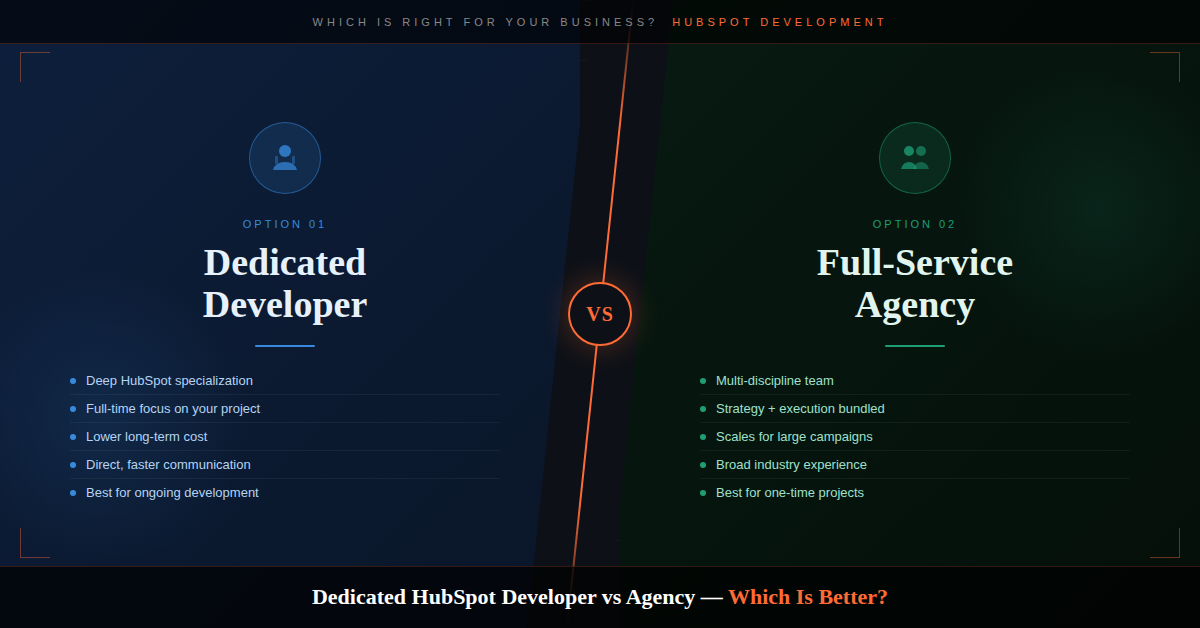
Two primary paths emerge: hire a dedicated HubSpot developer who becomes an embedded team member, or engage a HubSpot development company that provides comprehensive services. Each approach offers distinct advantages. Each presents specific trade-offs.
The dedicated developer brings depth—institutional knowledge, business context, immediate availability, and long-term data continuity. They understand the nuances of internal processes, speak the company’s language, and integrate into daily operations. For businesses prioritizing ownership, control, and deep platform expertise aligned with specific business logic, this path delivers compelling benefits.
The agency brings breadth—multidisciplinary teams, diverse experience, scalable capacity, and zero single-point-of-failure risk. They’ve solved similar problems across hundreds of portals, maintain cutting-edge technical capabilities, and provide bench strength that individual developers cannot match. For organizations prioritizing speed, comprehensive expertise, and risk mitigation, agencies offer powerful advantages.
This guide examines both paths through strategic, operational, and financial lenses. The goal isn’t declaring a universal winner—it’s providing the framework for making informed decisions based on specific business context, growth trajectory, and strategic priorities. For additional context on the value of dedicated expertise, exploring why dedicated HubSpot developers deliver superior results offers valuable perspective.
The Case for a Dedicated HubSpot Developer
Institutional Knowledge as Competitive Advantage
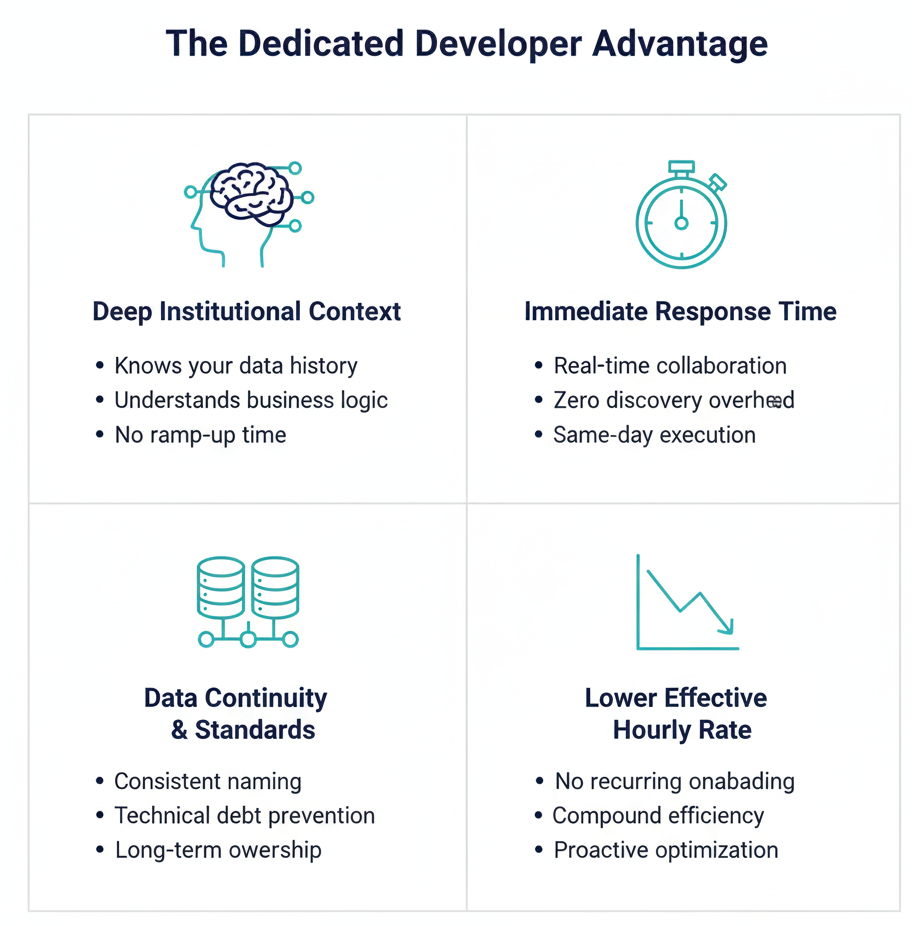
The most powerful argument for hiring a HubSpot expert as a dedicated team member centers on institutional knowledge. A dedicated developer doesn’t just understand HubSpot—they understand your HubSpot, your business model, your customer journey, your data quirks, your technical debt history, and your strategic priorities.
Deep contextual understanding manifests in multiple dimensions:
Business Logic Fluency: Understanding why the subscription renewal workflow has seven conditional branches, what each custom object represents in the actual business process, why certain data fields get updated through specific workflows, and how different teams use CRM data differently
Data Architecture Intimacy: Knowing the complete history of custom properties—which are deprecated but can’t be deleted due to historical data, which workflows depend on which calculated fields, where data quality issues originated, and how different systems sync into HubSpot
Political and Cultural Context: Understanding interdepartmental dynamics, why certain processes exist (often for non-obvious historical reasons), who the key stakeholders are for different initiatives, and how to navigate internal approval processes
Technical Debt Awareness: Recognizing which shortcuts were taken under pressure, which integrations are fragile, which templates need refactoring, and which systems require careful handling
This depth of knowledge translates directly into operational velocity. When marketing requests a new landing page template, the dedicated developer immediately understands brand guidelines, existing module library, performance requirements, and integration touchpoints. For organizations needing specialized HubSpot landing page development, this contextual understanding accelerates delivery. No discovery phase. No context gathering. No learning curve. Instant execution.
Zero Discovery Time and Immediate Pivots
Agencies bill for discovery. Every new project begins with context gathering, stakeholder interviews, portal audits, and documentation review. This overhead is necessary—they don’t have continuous context. But it’s expensive and slow.
A dedicated HubSpot developer eliminates this friction entirely. Projects that would require two weeks of agency discovery take two hours. When revenue operations needs an urgent report for tomorrow’s board meeting, the dedicated developer builds it that afternoon. When a campaign requires last-minute landing page adjustments at 4 PM before a major launch, changes deploy by 5 PM.
Operational advantages of immediate availability:
- Real-time collaboration: Participating in daily standups, sprint planning, and strategic discussions—influencing decisions with technical perspective before they become requirements
- Proactive optimization: Continuously monitoring portal health, identifying improvement opportunities, and implementing optimizations without formal project requests
- Institutional continuity: Maintaining consistent naming conventions, coding standards, documentation practices, and architectural patterns across all implementations
- Cross-functional integration: Building relationships across marketing, sales, operations, and product teams—understanding needs before they become formal tickets
The velocity difference compounds over time. Agencies complete discrete projects efficiently, but dedicated developers accumulate continuous improvements that agencies would never be engaged to deliver. Understanding when and why to hire a HubSpot developer helps clarify these operational advantages.
Technical Debt Protection Through Consistent Standards
Every HubSpot portal accumulates technical debt—inconsistent property naming, duplicate workflows, deprecated modules, fragmented templates, and undocumented customizations. When multiple agencies, freelancers, or internal admins make changes over years, architecture degrades into chaos.
A dedicated HubSpot developer serves as the guardian of technical standards. They enforce:
Naming Conventions: Consistent property naming (e.g., contact_lifecycle_stage vs. Lifecycle Stage vs. lc_stage), systematic custom object structure, and standardized workflow nomenclature
Code Quality Standards: HubL best practices, modular CSS architecture, JavaScript performance patterns, and documentation requirements for all custom development
Data Governance: Rules for when to create new properties versus using existing ones, custom object design reviews, and integration data flow documentation
Deprecation Management: Systematic sunset of outdated features, migration of legacy implementations to current best practices, and prevention of zombie workflows
This stewardship prevents the architectural erosion that plagues portals managed by rotating external resources. The long-term cost savings from avoiding technical debt often exceed the salary investment in dedicated expertise.
The Case for a HubSpot Agency
Bench Strength: Multidisciplinary Expertise on Demand
The fundamental limitation of any individual developer—no matter how talented—is bounded expertise. A HubSpot developer excels at HubL, API integration, and CRM architecture. But sophisticated projects require skills beyond development: UX design, conversion optimization, SEO strategy, content architecture, visual design, and revenue operations strategy.
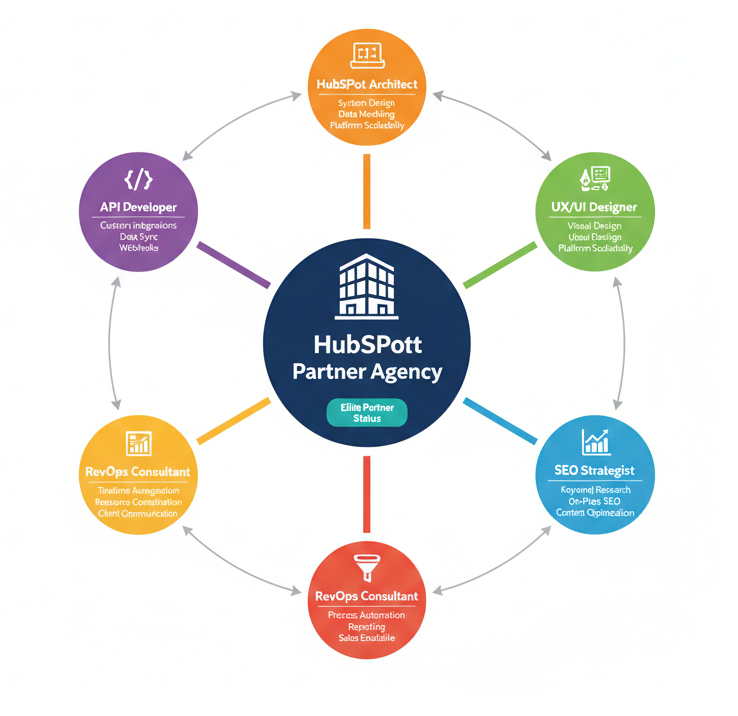
HubSpot partner agencies provide assembled teams spanning complementary disciplines. A website redesign project doesn’t just get a developer—it gets:
UX/UI Designer: Creating wireframes, user flows, and visual designs that convert visitors while maintaining brand consistency
Front-end Developer: Implementing responsive designs, accessibility standards, and performance optimizations specific to HubSpot’s CDN architecture
Back-end Developer: Building custom integrations, serverless functions, and API middleware handling complex business logic
SEO Strategist: Ensuring technical SEO compliance, implementing structured data, optimizing page speed, and maintaining search visibility through migrations. For businesses comparing platforms, understanding HubSpot’s SEO marketing software capabilities provides valuable context.
Content Strategist: Architecting information hierarchy, developing messaging frameworks, and ensuring content aligns with buyer journeys
Revenue Operations Consultant: Designing workflows, attribution models, and reporting dashboards that connect marketing activities to revenue outcomes
This multidisciplinary firepower enables agencies to deliver comprehensive solutions that individual developers cannot match. The website doesn’t just function technically—it drives business results through strategic design, optimized user experience, and coordinated implementation.
Cross-Portal Experience and Pattern Recognition
An individual developer, even over a decade-long career, might work deeply with 5-10 HubSpot portals. A HubSpot partner agency exposes teams to hundreds of implementations across diverse industries, business models, and complexity levels.
This breadth generates invaluable pattern recognition:
Problem-Solution Library: Having solved complex subscription management for a SaaS company, multi-location tracking for a franchise, and contract renewal for enterprise services—agencies recognize patterns and adapt proven solutions rather than reinventing approaches
Architecture Blueprints: Understanding which custom object structures scale effectively, which integration patterns remain maintainable, and which workflow designs avoid common pitfalls. For technical leaders, reviewing a comprehensive HubSpot development guide for scaling your tech stack offers strategic insights.
Platform Evolution Insight: Tracking how HubSpot’s product roadmap affects implementation strategies, which beta features deliver genuine value, and how platform updates impact existing customizations
Industry Best Practices: Recognizing what works specifically for manufacturing companies versus professional services firms versus e-commerce operations
Agencies leverage this accumulated wisdom to avoid costly mistakes that dedicated developers might make once. They’ve already learned—on other clients’ time and budgets—which approaches create long-term headaches.
Zero Single-Point-of-Failure Risk
The nightmare scenario for companies with dedicated developers: the developer gives two weeks’ notice. Suddenly, the organization faces catastrophic knowledge loss. Nobody else understands the custom integrations. The serverless functions are undocumented. The HubL templates use patterns only the departing developer knows. Critical workflows might break, and nobody can fix them.
HubSpot partner agencies eliminate this existential risk through institutional knowledge distribution:
Documentation Standards: Formal requirements for technical documentation, code commenting, and architectural decision records that any team member can reference
Code Review Processes: Multiple developers reviewing each other’s work, ensuring knowledge spreads across the team and maintaining code quality standards
Team Rotation: Rotating team members across client accounts to prevent single-person dependencies and maintain broad familiarity
Onboarding Frameworks: Systematic processes for bringing new team members up to speed on client accounts, ensuring continuity despite personnel changes
When an agency developer leaves, the client’s work continues uninterrupted. The institutional knowledge resides in the organization, not the individual.
Speed to Market Through Dedicated Project Teams
Individual developers manage workload sequentially. They can focus on one major initiative at a time. A website redesign consuming 200 hours means six weeks of the developer’s calendar—during which other priorities queue.
Agencies deploy parallel resources. The website redesign gets a dedicated project team—designer, front-end developer, back-end developer, and project manager—working concurrently. What would take a solo developer four months completes in four weeks.
This velocity advantage proves critical for:
Time-sensitive launches: Product releases, rebrandings, or market entries with fixed deadlines that can’t slip
Competitive responses: Rapid deployment of campaigns, features, or capabilities responding to market moves
Seasonal optimization: E-commerce preparation for Black Friday, tax services preparation for filing season, or education enrollment campaigns
Capital event support: M&A due diligence, fundraising preparations, or IPO readiness requiring rapid platform optimization
For organizations where speed creates competitive advantage, agency bench strength delivers capabilities that dedicated individual contributors cannot match. Understanding when to hire HubSpot developers versus agencies depends heavily on these velocity requirements.
Cost-Benefit Analysis—The Financial Reality
HubSpot Development: Financial & Operational Comparison (2026)
| Feature | Dedicated HubSpot Developer (In-House/Contract) | HubSpot Partner Agency (Managed Services) |
| Annual Investment | $110k – $165k+ (Salary + Benefits + Taxes) | $60k – $180k+ (Annual Retainer) |
| Technical Depth | Deep. Specialist in your specific business logic and data schema. | Broad. Access to Full-stack Devs, Architects, and Designers. |
| Response Time | Instant. Integrated into your Slack/Teams and daily standups. | SLA-Based. Usually 24–48 hour turnaround for non-emergencies. |
| Tool/Skill Access | Limited to that individual’s specific skill set (e.g., HubL/JS). | Access to proprietary agency tools and “Elite” partner support. |
| Scalability | Fixed. Capacity is limited to 40 hours per week. | Elastic. Can scale up for a website launch or down for maintenance. |
| Risk Factor | High. “Single point of failure” if the developer leaves. | Low. Institutional knowledge is shared across a team. |
| Onboarding | 30–60 days to reach full productivity. | 14–30 days (Agencies use proven frameworks). |
Understanding True Costs Beyond Base Numbers
The financial comparison extends beyond simple salary versus retainer calculations. Total cost of ownership includes hidden factors that shift economic analysis:
Dedicated Developer Hidden Costs:
- Recruitment expenses: $15k–$30k in recruiter fees, job posting costs, and hiring team time
- Benefits and taxes: 25–35% above base salary (health insurance, 401k matching, payroll taxes, paid time off)
- Equipment and software: $5k–$8k annually (computer, monitors, software licenses, HubSpot seat)
- Training and development: $3k–$10k annually (certifications, conferences, continuing education)
- Management overhead: Director/VP time spent on performance reviews, project planning, and career development
- Redundancy planning: Cross-training other team members or maintaining documentation for knowledge continuity
Agency Hidden Costs:
- Project management overhead: Time spent in status meetings, reviewing deliverables, and providing feedback
- Context transfer friction: Effort required to communicate business requirements, review work, and request iterations
- Coordination complexity: Managing multiple stakeholders, approval workflows, and timeline alignment
- Scope creep management: Distinguishing included work from additional billable services
- Knowledge retention: Ensuring agency-built systems remain documented and transferable
The effective hourly rate calculation requires factoring these elements. A $140k dedicated developer consuming 1,800 billable hours annually (accounting for meetings, admin work, and vacation) costs approximately $78/hour all-in. A $120k annual agency retainer providing 600 hours of work costs $200/hour—but those 600 hours deliver multidisciplinary expertise and zero overhead management.
Break-Even Analysis by Project Volume
When dedicated developers prove more economical:
- Organizations requiring 1,000+ hours annually of HubSpot work (roughly 50%+ of full-time capacity)
- Projects heavily dependent on institutional knowledge and business context
- Continuous optimization, maintenance, and incremental improvements as primary needs
- Technical work concentrated in narrow specialization (CRM customization, workflow automation)
When agencies prove more economical:
- Organizations requiring <500 hours annually with sporadic intensity (major projects quarterly)
- Projects demanding diverse skill sets (design, development, strategy, SEO)
- Time-sensitive initiatives requiring parallel team deployment
- Organizations unwilling to accept single-point-of-failure risk
For context on HubSpot development costs and what to expect from different engagement models, reviewing comprehensive HubSpot development services provides market benchmarks.
The Hybrid Middle Ground—Enterprise Best Practice
Combining Internal Ownership with External Firepower
Many enterprise organizations avoid binary choices by implementing hybrid models that capture advantages from both approaches. The pattern typically involves:
In-house dedicated HubSpot developer serving as:
- Platform owner: Maintaining institutional knowledge, enforcing standards, managing day-to-day operations
- First-line support: Handling routine updates, workflow adjustments, report building, and troubleshooting
- Strategic liaison: Translating business requirements into technical specifications and managing external partner relationships
- Quality assurance: Reviewing agency deliverables for alignment with internal standards and business logic
HubSpot partner agency engaged for:
- Major platform initiatives: Website redesigns, CMS migrations, complex integration buildouts
- Specialized expertise: Advanced serverless development, custom app building, sophisticated UX design
- Capacity overflow: Handling workload spikes during product launches, rebrands, or strategic initiatives
- Knowledge transfer: Training internal teams on new capabilities and emerging best practices
This model delivers institutional continuity through the dedicated developer while accessing specialized expertise and scalability through agency partnerships. The dedicated developer prevents knowledge loss, maintains consistent standards, and ensures agency work integrates properly into existing architecture. For CTOs evaluating this approach, reviewing key considerations before hiring HubSpot developers from India provides additional strategic context.
Operational workflow pattern:
- Internal developer scopes project and documents business requirements
- Agency team executes development with regular internal developer review
- Agency delivers completed work with comprehensive documentation
- Internal developer validates quality, manages deployment, and handles ongoing maintenance
The economic viability of hybrid models depends on total HubSpot investment volume. Organizations spending $200k+ annually on HubSpot development often find that $120k dedicated developer + $80k agency retainer delivers superior results compared to $200k fully outsourced or fully in-house approaches.
For businesses exploring this balance, understanding options to hire HubSpot developers provides starting points for building internal capabilities.
The Decision Framework—Choosing Your Path
Choose the Dedicated HubSpot Developer If:
✅ Annual HubSpot development needs exceed 800–1,000 hours (roughly 50% of full-time capacity)
✅ Business model complexity requires deep institutional knowledge—unique processes, complex data relationships, or highly customized workflows that take months to understand
✅ Immediate response time is critical—fast-moving organization where waiting 24–48 hours for changes creates business impact
✅ Budget supports $120k–$165k annual investment in salary, benefits, and supporting infrastructure
✅ Primary needs center on CRM customization, workflow automation, and incremental optimization rather than major platform initiatives. Understanding how HubSpot CRM helps lead generation strategy clarifies these operational benefits.
✅ Organization has technical leadership capable of managing, mentoring, and directing a developer effectively
✅ Long-term platform ownership and knowledge retention are strategic priorities
✅ Acceptable risk tolerance for single-point-of-failure scenarios with appropriate documentation and knowledge transfer plans
Choose the HubSpot Partner Agency If:
✅ Annual HubSpot development needs are <500 hours or highly variable—major projects quarterly rather than continuous work
✅ Projects require multidisciplinary expertise—design, development, strategy, SEO, content all necessary for success
✅ Speed to market is critical and projects benefit from parallel team deployment
✅ Zero tolerance for single-point-of-failure risk—business continuity requires institutional knowledge distribution
✅ Organization lacks technical leadership to effectively manage and direct developer work
✅ Access to HubSpot Elite partner benefits valuable (beta features, priority support, strategic guidance)
✅ Need cross-industry expertise and pattern recognition from diverse portal experience
✅ Budget flexibility allows for variable monthly costs aligned with project intensity
Strategic Considerations Beyond the Checklist
The framework provides starting guidance, but strategic nuances often prove decisive:
Company growth trajectory: Rapidly scaling organizations often start with agencies for velocity, then transition to dedicated developers as workload volume justifies in-house expertise
Technical debt current state: Portals with significant technical debt benefit from agency cleanup projects before transitioning to dedicated maintenance
M&A activity: Companies acquiring businesses need agency firepower for consolidation projects, then dedicated developers for unified platform management
Industry regulation: Highly regulated industries (finance, healthcare, legal) may require in-house expertise for compliance and audit requirements
For comprehensive context on engagement options, exploring definitive hiring guides for CEOs and CTOs clarifies different partnership models.
Conclusion: Growth Stage Determines Optimal Strategy
The question “Dedicated HubSpot developer vs agency—which is better?” lacks a universal answer because the optimal choice depends entirely on growth stage, strategic priorities, and operational context.
Early-stage companies (0–50 employees, <$10M revenue) typically lack sufficient workload volume to justify dedicated hires. Agencies provide access to expertise without fixed overhead, enabling platform sophistication that wouldn’t otherwise be affordable.
Growth-stage companies (50–250 employees, $10M–$50M revenue) face the most complex decision. Workload volume approaches full-time, but major initiatives still require multidisciplinary teams. Hybrid models often emerge as optimal—dedicated developer for daily operations, agency for major projects. For businesses at this stage, understanding how to choose between HubSpot and WordPress or Webflow versus HubSpot helps inform broader platform decisions.
Growth-stage companies (50–250 employees, $10M–$50M revenue) face the most complex decision. Workload volume approaches full-time, but major initiatives still require multidisciplinary teams. Hybrid models often emerge as optimal—dedicated developer for daily operations, agency for major projects. For businesses at this stage, understanding how to choose between HubSpot and WordPress or Webflow versus HubSpot helps inform broader platform decisions.
Enterprise companies ($50M+ revenue, mature HubSpot usage) typically maintain dedicated in-house HubSpot developers or small teams, engaging agencies for specialized initiatives, capacity overflow, and strategic consulting.
The decision is not permanent. Many successful organizations evolve their approach as needs change. Starting with an agency to establish solid foundations, then hiring a dedicated developer to maintain and optimize, then re-engaging agencies for major platform evolutions represents a common and effective progression.
Critical success factors regardless of path chosen:
- Clear ownership and accountability: Whether individual or agency, someone must own platform health and strategic development
- Documentation standards: Institutional knowledge must be captured regardless of who holds it
- Strategic alignment: Technical development must connect to business objectives and ROI
- Continuous optimization: Platforms require ongoing investment, not just periodic projects
For organizations exploring the strengths of dedicated internal expertise, reviewing why dedicated HubSpot developers deliver superior long-term value provides additional strategic context.
Not Sure Which Path Is Right for Your Organization?
A2Z Dev Center helps growing companies navigate this critical decision through comprehensive platform audits, workload analysis, and strategic planning. Our team has experience both as dedicated developers embedded in high-growth companies and as agency specialists delivering major initiatives.
Our strategic services include:
- HubSpot Resource Planning Analysis: Quantifying current and projected workload to determine economically optimal resourcing strategy
- Portal Health Audit: Identifying technical debt, optimization opportunities, and capability gaps requiring specialized expertise
- Hybrid Model Design: Architecting combined internal/external resource strategies that balance ownership with specialized capabilities
- Dedicated Developer Placement: Connecting organizations with vetted HubSpot specialists for full-time or contract roles
- Managed Development Services: Providing agency-level comprehensive support for organizations preferring external partnerships
Make the resourcing decision that aligns with your growth trajectory, not industry assumptions.
Frequently Asked Questions (FAQ)
Schedule a call
Talk to a subject-matter expert
Web development, SEO, or digital marketing — tell us about your project and we'll get back within one business day. No obligation.
- Free scope & strategy session
- A senior specialist, not a sales rep
- Your details stay confidential