Content Marketing
Summarize this blog post with:
A lot of businesses invest in content marketing without really knowing what they are buying. They sign up for a blog package, get a few articles a month, and wonder six months later why nothing is moving. Traffic is flat, leads are thin, and the content feels disconnected from everything else the business is doing.
That is not a content problem. It is a service scope problem. Real content marketing services are not a writing subscription. They are a coordinated system of strategy, creation, optimization, distribution, and measurement built to move a specific business outcome. Understanding what that system includes and why each component matters is what separates marketing decisions that compound into growth from ones that produce a folder full of content nobody reads.
This guide breaks down exactly what professional content marketing services include, what you should expect from each component, and how to connect the investment to results your business actually cares about.
Quick Answer: What Are Content Marketing Services?
What do content marketing services include and why do they matter for business growth?
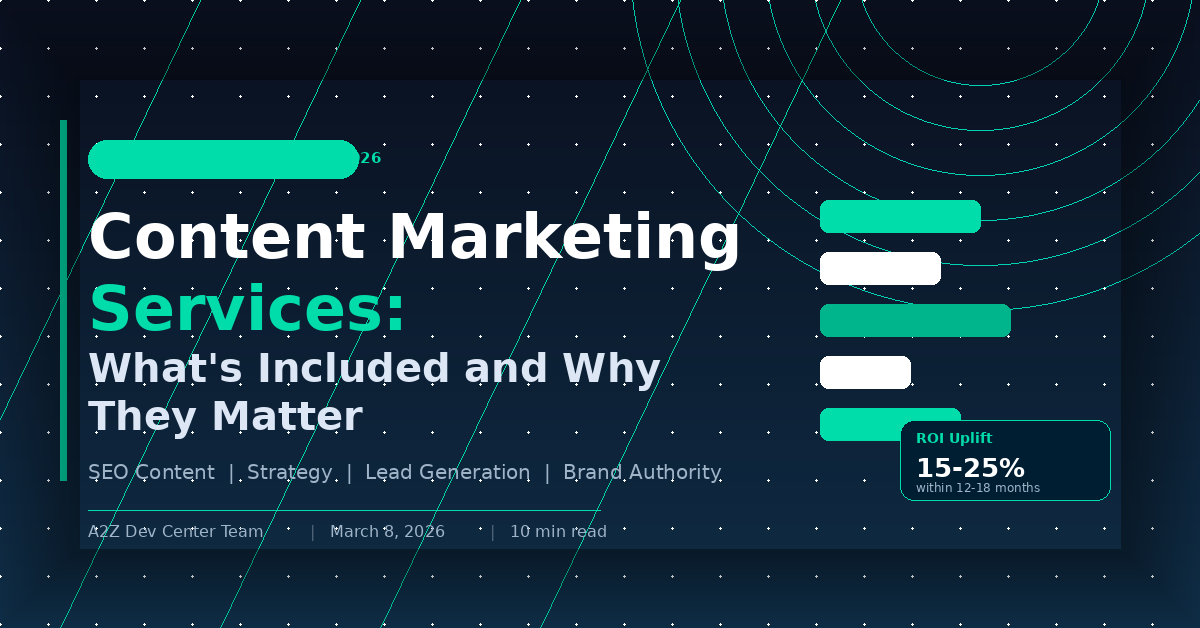
Content marketing services encompass the full range of activities required to plan, produce, optimize, distribute, and measure content that attracts, educates, and converts a target audience. This includes strategy development, keyword research, content creation across formats, on-page SEO optimization, distribution across channels, and performance reporting. Businesses that run coordinated content marketing programs typically see 15 to 25% improvements in organic lead quality and measurable pipeline contribution within 12 to 18 months of consistent execution.
Key Takeaways
- Content marketing services go far beyond writing articles. Strategy, SEO, distribution, and analytics are equally important components of a complete program
- A content strategy built on audience research and keyword data consistently outperforms one built on topics the business finds interesting
- SEO and content marketing are inseparable in 2026. Content that is not optimized for search and AI answer engines does not reach the people it was created for
- Distribution amplifies creation. Content that is only published and never actively promoted reaches a fraction of its potential audience
- Measurement frameworks should connect content activity to business outcomes like leads, pipeline, and revenue, not just traffic and page views
- Businesses in competitive local and national markets benefit significantly from content that targets both informational and commercial search intent across the funnel
What Content Marketing Services Actually Include
The phrase “content marketing services” covers a wide range depending on the provider and the scope of engagement. Here is what a comprehensive, professionally structured program includes and why each component exists.
Content Strategy and Planning
Strategy is where content marketing programs either get traction or waste effort. Without it, even well-written content ends up scattered across topics that do not reinforce each other or support any coherent audience journey.
A proper content strategy starts with audience research. Who is the target reader, what problems are they trying to solve, what information do they search for at each stage of the buying journey, and what content formats do they actually engage with? These questions sound basic but are answered with surprising superficiality in most content programs.
From audience research, strategy moves to competitive content analysis. Which topics does your competition rank for? Where are the content gaps you can credibly own? Which keywords carry genuine commercial intent and realistic ranking opportunity for your domain authority?
The output is a documented content plan: topic clusters, keyword targets, content formats, publishing cadence, and a mapping of each piece of content to a specific stage of the buyer journey. This is the foundation everything else is built on. The connection between content strategy and broader digital marketing services is also worth understanding early, because content rarely performs well when it operates in isolation from paid, social, and email channels.
Keyword Research and SEO Integration
Content marketing without SEO integration is a visibility problem waiting to happen. In 2026, that means optimizing not just for traditional search rankings but for AI-generated answer summaries, featured snippets, and the “People Also Ask” sections that now dominate the top of many search result pages.
Professional content marketing services include structured keyword research that identifies primary targets, semantic related terms, question-format queries, and long-tail variations with specific intent signals. Each piece of content is mapped to a keyword target before writing begins, not retrofitted with keywords after.
On-page optimization covers title tags and meta descriptions, heading structure and hierarchy, internal linking architecture, schema markup for FAQ and article content types, image optimization, and content depth benchmarked against what is currently ranking. The SEO service provider context is particularly relevant here because content and technical SEO must work together, not as separate workstreams with separate teams.
For businesses serving regional markets, content strategy should also incorporate location-specific signals. A content program that includes pages and articles targeting local SEO in Michigan or specific metro areas like Detroit, Ann Arbor, or Grand Rapids captures intent signals that purely generic national content misses entirely.
Content Creation Across Formats
This is the component most people think of when they hear “content marketing services,” but it is one piece of a larger system rather than the whole program.
Blog articles and long-form guides remain the highest-volume format in most B2B and service-based content programs because they carry the most SEO value and provide the most comprehensive coverage of complex topics. But format selection should follow audience behavior and keyword intent, not default assumptions.
A complete content creation scope includes blog articles and pillar pages, case studies and success stories, landing page copy, email nurture sequences, social media content adapted from long-form pieces, video scripts, and whitepapers or downloadable lead magnets for gated conversion points. Each format serves a different stage of the buyer journey and a different distribution channel.
Quality control matters enormously. Content that contains factual errors, vague claims unsupported by evidence, or generic advice that could apply to any business in any industry does not build authority. Subject matter expert review and editorial standards are what separate content that earns trust from content that fills a publishing calendar. The broader content marketing services page outlines the specific formats and deliverables included in a structured program.
On-Page SEO and Technical Optimization
Even excellent content fails to reach its audience if the technical layer underneath it is broken. Content marketing services that include on-page and technical SEO support produce meaningfully better organic results than content programs running on unoptimized websites.
Technical considerations that directly affect content performance include page load speed, mobile responsiveness, Core Web Vitals scores, crawlability and indexation, URL structure, and internal linking depth. Each of these affects how search engines discover, evaluate, and rank your content. The relationship between Core Web Vitals and SEO rankings is well established and directly affects whether the content you create actually earns the rankings your keyword research says it should.
Schema markup is a specific technical element worth calling out because it is underutilized in most content programs but disproportionately valuable for AI answer engine visibility. FAQ schema, article schema, and how-to schema all improve the probability that your content is cited in Google AI Overviews, ChatGPT responses, and Perplexity answers. This is not future speculation. It is already affecting how content is discovered in 2026.
Content Distribution and Promotion
Publishing content is not promoting content. This distinction sounds obvious, but most content programs allocate almost all effort to creation and almost none to distribution, which means most content reaches a fraction of the audience it could.
Professional content marketing services include a distribution plan for every piece of content produced. That means social media distribution adapted to each platform’s format and audience behavior, email newsletter inclusion for existing subscriber lists, internal linking from related content already on the site, outreach to relevant publications or communities where the content would add genuine value, and in many cases paid amplification of high-performing organic content.
For businesses with active performance marketing programs, the interplay between content and paid distribution is particularly powerful. High-performing content pieces make excellent paid social creative and can be retargeted to audiences who already showed interest. The separation of “organic content” and “paid media” is increasingly artificial in effective marketing programs.
Analytics, Reporting, and Iteration
A content marketing program without a measurement framework is a publishing operation, not a marketing function. The difference is accountability to business outcomes rather than just content output.
Reporting in a professional content marketing service covers organic traffic growth by content cluster, keyword ranking movement for target terms, engagement metrics (time on page, scroll depth, return visits), conversion events driven by content (form fills, downloads, demo requests), and pipeline influence for B2B programs where attribution spans multiple touchpoints.
The most important element of reporting is not the dashboard. It is the iteration cycle it drives. Content that is ranking on page two for a high-value keyword is an optimization opportunity. Content that generates high traffic but no conversions has a CTA or targeting problem. A pattern of low engagement on a particular topic cluster signals audience mismatch. Reporting that leads to these kinds of decisions is what makes content marketing a compounding investment rather than a recurring cost.
Content Marketing vs. Other Digital Marketing Channels
| Channel | Primary Strength | Time to Results | Best Used For |
|---|---|---|---|
| Content Marketing | Long-term organic authority | 6 to 18 months | Trust building, SEO, lead nurturing |
| Paid Search (PPC) | Immediate traffic | Days | Bottom-funnel conversions |
| Social Media | Brand awareness and engagement | Weeks | Top-funnel reach |
| Email Marketing | Nurture and retention | Weeks | Existing audience conversion |
| SEO (Technical) | Crawlability and rankings | 3 to 9 months | Foundation for all organic channels |
| Performance Marketing | Measurable acquisition | Immediate | Scalable paid growth |
Why Content Marketing Matters More in 2026 Than It Did Three Years Ago
Two shifts have increased the strategic importance of content marketing significantly in recent years, and both are accelerating.
The first is AI-driven search. Google’s AI Overviews, Perplexity, ChatGPT, and other AI answer engines now answer many informational queries directly in the search interface. The businesses whose content gets cited in those AI answers are the ones with the highest-authority, best-structured, and most comprehensively researched content in their category. The businesses that have been publishing thin, generic content for years are being displaced from the discovery funnel they previously occupied. The connection between AI-driven SEO and how it is reshaping search optimization explains this shift in detail.
The second shift is buyer behavior. B2B buyers in particular complete a significant portion of their evaluation before contacting a vendor. According to Gartner research, B2B buyers spend only 17% of the purchase process in direct supplier meetings. The rest is independent research, much of it consuming content. Businesses with strong content programs are present and credible during that research phase. Businesses without them are absent from the consideration set entirely.
These two shifts mean that content marketing is no longer an optional channel for businesses competing on expertise and trust. It is the primary mechanism by which that expertise reaches the audience doing the evaluating.
How to Evaluate a Content Marketing Services Provider
Not all content marketing services are structured equally. The differences matter significantly for outcomes. Here is what to look for when evaluating a provider.
Strategy depth before execution. Any provider who starts with deliverables (articles per month, word counts) before understanding your audience, competitive landscape, and business objectives is selling a content service, not a content marketing service. Strategy must precede execution.
SEO and content integration. Content and SEO operated as separate functions produce worse results than content built around SEO from the beginning. Confirm that keyword research, on-page optimization, and technical SEO considerations are embedded in the content production process, not added afterward.
Measurement framework. What metrics will be reported, how frequently, and how do they connect to business outcomes? Providers who report traffic and word count but cannot speak to lead generation or pipeline influence are not running a marketing program.
Category and audience experience. Content that requires subject matter expertise to be credible cannot be produced generically. A provider with demonstrated experience in your industry or an ability to conduct genuine expert interviews produces more authoritative content than one that relies entirely on secondary research.
Distribution capability. Does the service end at publication or does it include active distribution and promotion? The latter is significantly more valuable.
The ROI Case for Content Marketing Services
Content marketing has a longer time-to-results horizon than paid channels, which makes ROI conversations require a different framing than paid search or social advertising.
The honest timeline for a well-executed content marketing program reaching measurable organic growth is typically 6 to 12 months for initial keyword ranking improvements and 12 to 18 months for meaningful organic pipeline contribution. This is not a weakness of the channel. It is a characteristic of how organic authority compounds over time.
The economic argument is straightforward once that timeline is accepted. Paid traffic stops the moment the spend stops. Organic authority built through content marketing continues to generate traffic, leads, and revenue indefinitely. A piece of content that ranks for a high-value keyword in month 9 of a content program will still be generating leads in month 36, month 48, and beyond. The cost per lead from organic content consistently declines over time as the asset base grows. The cost per lead from paid channels does not.
For businesses with both content and paid programs, the combination outperforms either channel alone. Performance marketing drives immediate acquisition while content builds the organic foundation that reduces long-term paid dependency. The businesses that understand this dynamic and fund both consistently outpace competitors funding either channel in isolation.
Regional businesses with local market focus benefit from an additional layer of this ROI argument. Location-specific content targeting searches from Michigan, Sterling Heights, or Lansing captures high-intent local queries that national content misses. Local search intent converts at significantly higher rates than generic informational traffic, which means the ROI argument for location-targeted content is often even stronger than for broad national content programs.
Frequently Asked Questions
Related reading: how SEO content writing drives rankings.
Schedule a call
Talk to a subject-matter expert
Web development, SEO, or digital marketing — tell us about your project and we'll get back within one business day. No obligation.
- Free scope & strategy session
- A senior specialist, not a sales rep
- Your details stay confidential