
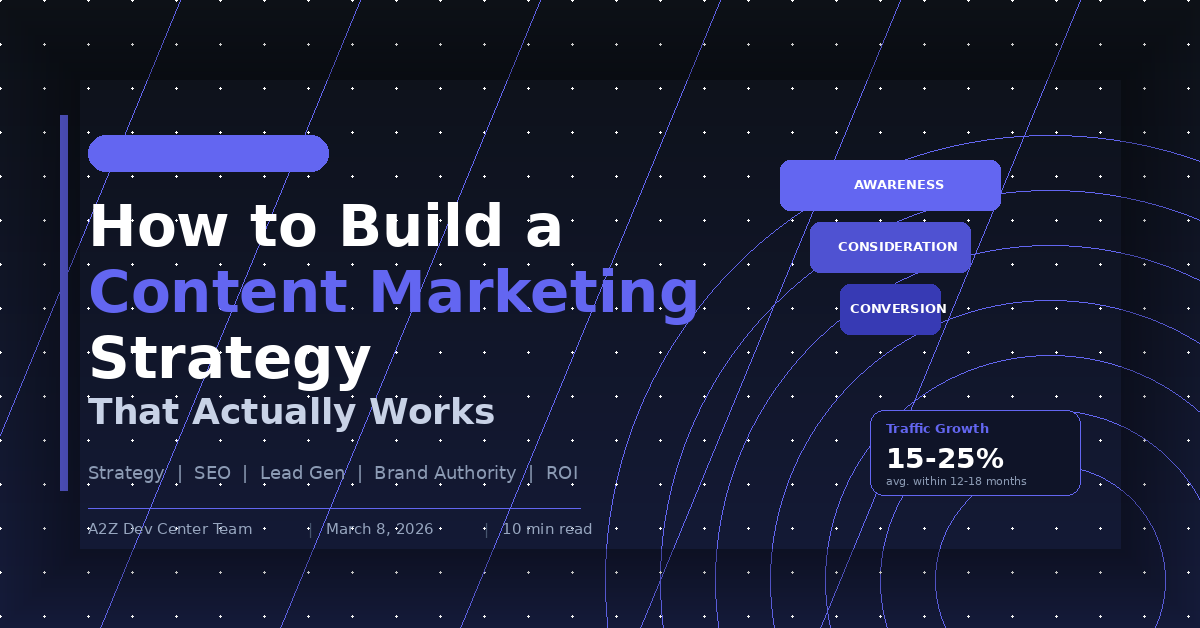
Content Marketing
Summarize this blog post with:
Most businesses that struggle with content marketing are not struggling because they lack content. They struggle because the content they have does not connect to anything. There is no thread running from audience research to topic selection to content format to distribution to measurement. Each piece exists in isolation, and without that thread, even well-written content just accumulates without moving the needle.
A content marketing strategy is that thread. It is the documented system that ensures every piece of content exists for a specific reason, reaches the right person at the right stage of their decision process, and contributes to a measurable business outcome. Without it, you are running a publishing operation. With it, you are running a marketing function.
This guide walks through how to build a content marketing strategy from the ground up, the decisions that matter at each stage, and how to make it durable enough to compound results over 12 to 18 months rather than stall after the first quarter.
Quick Answer: What Makes a Content Marketing Strategy Work?
How do you build a content marketing strategy that actually drives results?
A content marketing strategy that works starts with clear audience definition and keyword research, moves through topic cluster planning and content format selection, and connects every piece of content to a specific stage of the buyer journey. It integrates SEO from the beginning rather than as an afterthought, includes a distribution plan for each content type, and measures performance against business outcomes rather than vanity metrics. Businesses that operate with a documented strategy see 15 to 25% better organic lead quality and more predictable growth within 12 to 18 months compared to those publishing content without a strategic framework.
Key Takeaways
- A content marketing strategy is not a content calendar. It is a documented system connecting audience needs, keyword opportunity, content production, distribution, and measurement
- Audience research is the foundation. Strategy built on assumptions about who reads the content and what they need produces content that earns traffic but not trust or conversions
- Topic clusters outperform individual keyword targeting. A coordinated group of related content pieces builds topical authority faster than isolated articles targeting unrelated terms
- SEO integration from the start is non-negotiable in 2026. Content that is not built around search and AI visibility intent reaches a fraction of its potential audience
- Distribution planning deserves equal investment to content creation. Publishing without promoting is the single biggest efficiency leak in most content programs
- Strategy must be reviewed and adjusted quarterly. A content strategy written once and executed unchanged for 12 months will drift out of alignment with market conditions, audience behavior, and business priorities
Step 1: Define Your Audience With Precision
The most common mistake in content strategy is starting with topics instead of starting with people. Before any keyword research or editorial calendar planning, you need a detailed, honest picture of who you are creating content for.
This means building audience personas that go beyond demographic labels. A useful content persona captures what problems the person is actively trying to solve, what information they search for at each stage of the buying journey, what formats they prefer to consume (long reads, quick guides, video walkthroughs), what objections or concerns they carry into a purchase decision, and what language they actually use when they describe their problem. That last point matters more than most content teams acknowledge. The gap between how a business describes its own product and how a customer describes their problem is often where content misses its audience entirely.
Primary research is more valuable here than secondary research. Interviews with existing customers, sales call recordings, support ticket analysis, and community forum research all surface the actual language, concerns, and questions of real people. Secondary research fills in gaps but should not substitute for direct audience understanding. The content marketing services framework covers how audience research feeds into a complete content program structure.
Persona development also clarifies which audience you are not creating content for, which is equally important. Trying to write for everyone produces content that resonates with no one. Clear persona definition creates focus, and focus is what makes content useful rather than generic.
Step 2: Set Goals That Connect to Business Outcome
A content strategy without defined success metrics is a creative project. Metrics give it a business function. The challenge is choosing metrics that actually reflect business impact rather than activity.
Traffic is a metric but it is not a goal. Neither is word count, publishing frequency, or social shares. These are inputs and leading indicators. The outcomes a content strategy should be measured against are things like organic lead volume, cost per lead from organic content, pipeline influenced by content touchpoints, keyword rankings for commercially relevant terms, and for eCommerce, assisted conversions from content pages.
Set goals at two levels. Lagging indicators are the business outcomes you are ultimately working toward: a specific percentage increase in organic leads, a target number of first-page rankings for priority keywords, a measurable reduction in cost per acquisition as organic traffic grows. Leading indicators are the content activity and performance metrics that predict whether the lagging indicators will be reached: keyword ranking movement, organic traffic trend by content cluster, engagement rate benchmarks by content format.
Both sets of metrics matter. Leading indicators give you early signals that the strategy is working or needs adjustment. Lagging indicators confirm whether the work is producing the business outcomes that justified the investment. Aligning these with the broader digital marketing services goals your business is tracking ensures content is positioned as a revenue driver rather than a support function.
Step 3: Conduct Keyword Research Built Around Intent
Keyword research for a content strategy is different from keyword research for a single article. The goal is to map the full landscape of how your target audience searches across all stages of their decision journey, then identify where you have realistic ranking opportunity and commercial payoff.
Start with seed keywords, the core terms that describe what your business does and what problems it solves. From those seeds, expand into three categories of search intent.
Informational intent covers questions people ask while learning about a topic. These are typically top-of-funnel, high-volume terms where the searcher is not yet ready to buy but is building understanding. Content targeting informational intent builds awareness and topical authority.
Commercial intent covers terms people use when they are evaluating options. Comparison queries, “best of” searches, and “how to choose” queries fall into this category. Content targeting commercial intent reaches people actively in the consideration phase.
Transactional intent covers terms used by people who are ready to act. These are typically lower-volume but highest-converting. Landing pages and service-specific content target transactional intent directly.
A complete content strategy covers all three intent categories because the buyer journey moves through all three. A business that only creates informational content attracts readers but not buyers. One that only creates transactional content misses the majority of the audience at earlier stages.
Keyword research should also factor in AI search behavior. In 2026, a significant portion of informational queries are answered directly by AI tools like Google AI Overviews, Perplexity, and ChatGPT. Understanding how AI-driven SEO is reshaping search optimization is important context for structuring content to earn citations in AI answers, not just traditional blue-link rankings.
For businesses with regional audiences, keyword research must also capture local intent signals. A business in Michigan serving clients across Detroit, Grand Rapids, Ann Arbor, and Sterling Heights needs content targeting those specific geographic queries, not just generic national terms. Local SEO services in Michigan work in close coordination with content strategy to capture high-intent local searches that national content cannot reach.
Step 4: Build a Topic Cluster Architecture
Individual keyword targeting was the dominant content strategy for years. It still works, but topic clusters outperform isolated articles for building the kind of topical authority that earns both traditional rankings and AI citation in competitive categories.
A topic cluster is a group of related content pieces organized around a central pillar page. The pillar page covers a broad topic comprehensively at a high level. Cluster pages each cover a specific subtopic in depth, linking back to the pillar page and to each other. This architecture signals to search engines that your site has comprehensive, connected knowledge on a subject rather than scattered individual articles.
For example, a business offering content marketing services would build a pillar page around the broad topic of content marketing, then create cluster pages covering content strategy, B2B content marketing, SEO content writing, content marketing for startups, content distribution, and content performance measurement. Each cluster page links back to the pillar, creating an internal linking structure that distributes authority across the entire cluster.
Topic cluster architecture also simplifies editorial planning. Instead of deciding what to write about month by month, the cluster model gives a clear picture of which content pieces are needed to complete a cluster and which gaps represent ranking opportunities. The what is included in content marketing services guide covers how pillar and cluster content fits into a full service scope.
Step 5: Choose the Right Content Formats for Each Stage
Content format should follow audience behavior and search intent, not organizational preference or production convenience. Different stages of the buyer journey respond to different formats, and a strategy that only produces one format leaves most of the audience underserved.
Here is how format selection maps to journey stage in most B2B and service-based content programs.
Top of funnel (awareness): Long-form guides and tutorials, original research and data reports, comparison and “what is” articles, educational video content. These formats answer informational queries and introduce the brand to people who did not know it existed.
Middle of funnel (consideration): Case studies, detailed how-to content, comparison pages between solutions, expert Q&As, webinars and recorded demos. These formats serve people who are evaluating options and need evidence to support a decision.
Bottom of funnel (conversion): Service and solution pages, customer testimonials and results pages, ROI calculators, proposal-supporting content, free tools or assessments. These formats serve people who are ready to act and need confidence to do so.
A practical content calendar allocates creation effort across all three stages in proportion to where the biggest gaps exist in your current content library. Most businesses are over-indexed on top-of-funnel informational content and under-indexed on middle-funnel content that serves people actively evaluating solutions.
Format selection also affects distribution. Long-form guides distribute well through organic search and email. Short social content works for awareness amplification. Video content performs on YouTube and LinkedIn. Case studies are most effective in email nurture sequences and direct sales conversations. Format and distribution channel are decisions best made together, not sequentially. The performance marketing service context is worth reviewing here because paid amplification of top-performing organic content is one of the highest-ROI distribution tactics available.
Content Strategy Framework: Stage, Format, and Channel
| Funnel Stage | Primary Format | Primary Channel | Key Metric |
|---|---|---|---|
| Awareness | Long-form guides, research | Organic search, social | Organic traffic, rankings |
| Awareness | Short educational posts | LinkedIn, Instagram | Impressions, reach |
| Consideration | Case studies, comparisons | Email, organic search | Engagement, time on page |
| Consideration | Webinars, expert Q&As | Email, YouTube | Registrations, views |
| Conversion | Service pages, testimonials | Organic search, paid | Leads, conversions |
| Retention | Email sequences, updates | Open rate, retention |
Step 6: Build an Editorial Calendar That Reflects Strategy
An editorial calendar is the operational layer of a content strategy. It translates strategic priorities into a publishing schedule with clear ownership, deadlines, and quality checkpoints. Without it, strategy stays in documents and does not become content.
A well-structured editorial calendar includes the planned publish date, the content title and primary keyword target, the funnel stage and buyer persona the content serves, the assigned writer and editor, the due dates for draft, review, and publish, and the distribution plan for each piece.
Cadence matters but should be determined by quality capacity rather than a fixed volume target. Four thoroughly researched, well-optimized pieces per month consistently outperform twelve thin articles that were rushed to fill a calendar. Setting a publishing cadence your team can sustain at high quality is more important than matching a competitor’s volume, especially early in a content program when topical authority is still being established.
The editorial calendar should also include a quarterly review checkpoint. At every quarter, assess which content is ranking and driving conversions, which is generating traffic but not conversions (a CTA or targeting problem), which has not gained traction at all and may need to be consolidated or redirected, and which keyword gaps have emerged from competitive changes. This review cycle is what keeps the strategy responsive to market conditions rather than running on autopilot.
Step 7: Integrate SEO From Day One
The most common structural mistake in content strategy is treating SEO as a content optimization step rather than a content planning step. By the time a piece is written, the most important SEO decisions have already been made: which keyword it targets, what the content depth should be relative to what is ranking, what the heading structure should cover, and which internal links should be present.
On-page SEO for every piece of content includes a keyword-optimized title tag and meta description, a heading structure (H1, H2, H3) that covers the topic comprehensively and includes semantic variations of the target keyword, a word count and content depth benchmarked against current top-ranking pages, internal links to related content in the same topic cluster, schema markup appropriate to the content type, and image optimization with descriptive alt text.
For businesses with technical SEO issues on their website, all of this on-page work can be undermined by slow page speed, crawlability problems, or mobile usability issues. Understanding how Core Web Vitals directly affect SEO rankings is essential context for any business where organic search is a primary traffic channel. Content strategy and technical SEO are not separate workstreams. They affect the same outcomes and should be managed in coordination.
Businesses in specific regional markets add another SEO layer here. Content targeting Detroit, Ann Arbor, Grand Rapids, Lansing, or other Michigan markets needs location-specific optimization signals, not just generic national content with a location name inserted. The digital marketing agency in Michigan context explains how location-specific content and SEO work together to capture regional search intent. Businesses serving the Ann Arbor market specifically benefit from content built around Ann Arbor SEO signals, while those targeting Detroit need a Detroit-specific SEO approach embedded in the content strategy.
Step 8: Plan Distribution Before You Publish
Most content programs allocate 90% of their effort to creation and 10% to distribution. The ROI math on that split is backwards.
A piece of content that is created with a distribution plan in place reaches significantly more people than one where distribution is an afterthought. Distribution planning means deciding, before the content is written, how it will be shared through owned channels (email newsletter, social media profiles, internal linking from existing content), earned channels (outreach to relevant publications, community sharing, mentions by partners or industry voices), and paid channels (social amplification, retargeting of engaged visitors, content syndication).
Email is consistently the highest-converting distribution channel for content in B2B programs because it reaches an audience that already opted in and demonstrated interest. Structuring a content piece with an email-friendly summary and a specific list segment in mind before writing it produces better results than repurposing long-form content for email after the fact.
Social media distribution for content works best when adapted to each platform rather than cross-posted unchanged. A LinkedIn post sharing a content insight with a link performs differently from a Twitter/X thread summarizing the same article. A business that adapts content for each platform’s audience behavior will consistently outperform one that copies and pastes the same caption across all channels.
The 9 effective digital marketing tips to boost eCommerce business covers distribution tactics that apply directly to content-driven eCommerce programs. For businesses looking to build brand presence that amplifies content reach, the how to build a brand people actually remember online guide connects brand strategy to content distribution effectiveness.
Step 9: Measure, Report, and Adjust
A content strategy that does not have a reporting cadence is one that cannot be improved. Measurement is not the final step. It is the input into the next planning cycle.
Monthly reporting should cover keyword ranking movement for priority targets, organic traffic trend by content cluster, engagement metrics (average session duration, pages per session, scroll depth on key pieces), and conversion events tied to content (form fills, demo requests, downloads).
Quarterly reporting should connect those activity metrics to business outcomes: how many leads came from organic content this quarter, what is the cost per organic lead compared to paid channels, which topic clusters are contributing most to pipeline, and which content investments are underperforming their keyword opportunity.
The adjustment cycle is where strategy separates from tactics. When data reveals that a particular topic cluster is gaining traction faster than expected, allocate more production resources to it. When a content format is consistently underperforming, diagnose whether it is a creation quality problem, a distribution problem, or an audience targeting problem before scaling it further. When competitive rankings shift, understand which competitor is gaining ground and why before adjusting your own approach.
This iteration mindset is what turns a content strategy from a one-time planning exercise into a compounding business asset. Businesses that treat their content strategy as a living document, reviewed and adjusted regularly based on performance data, consistently outperform those that plan once and execute unchanged.
Frequently Asked Questions
Schedule a call
Talk to a subject-matter expert
Web development, SEO, or digital marketing — tell us about your project and we'll get back within one business day. No obligation.
- Free scope & strategy session
- A senior specialist, not a sales rep
- Your details stay confidential