Hubspot
Summarize this blog post with:
Most businesses that contact a HubSpot development company for the first time have the same starting point. They know HubSpot is the platform they want, or the platform they are already on, and they know the results they want from it, more leads, better CRM data, a website that converts, automated workflows that actually run correctly. What they are not sure about is exactly what a HubSpot development company does to get from where the portal currently sits to where it needs to be.
That gap between expectation and understanding is where most HubSpot investments underperform. Businesses buy HubSpot licenses expecting the platform to deliver results and then discover that the platform is a capability set, not a self-executing program. Realizing the capability requires configuration, development, integration, and strategy work that most internal teams do not have the bandwidth or specialist knowledge to do correctly.
This guide answers the question completely. What a HubSpot development company actually does, across every service category, which businesses need which services, what it costs, how long it takes, and how to choose the right company for your specific situation.
TL;DR
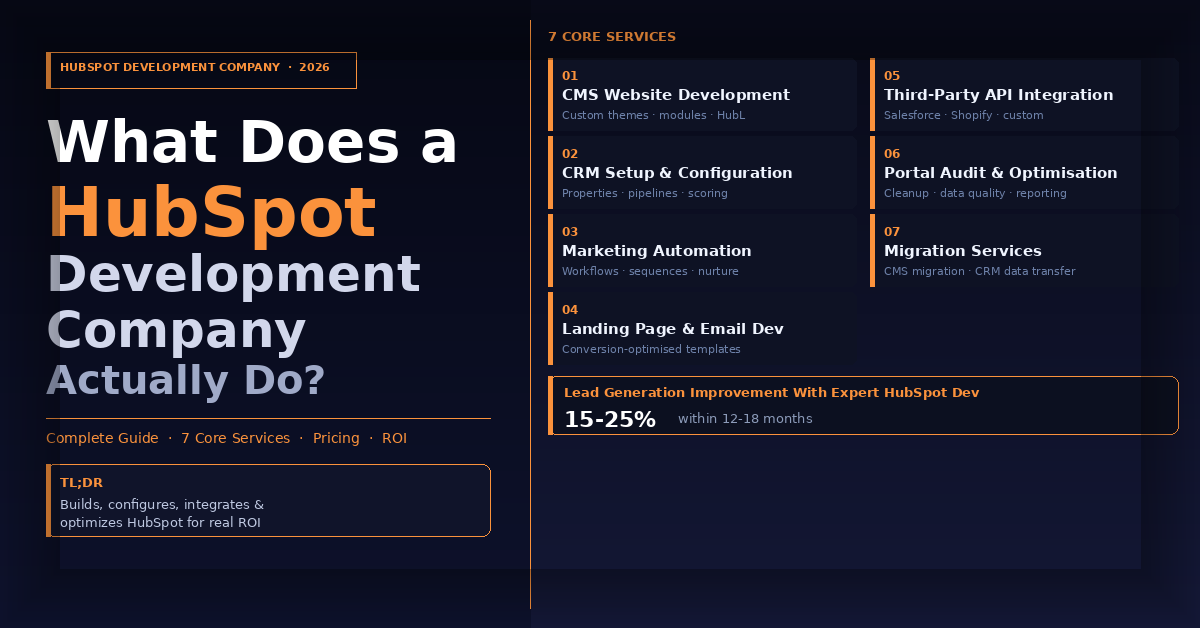
A HubSpot development company builds, configures, integrates, and optimizes HubSpot portals so that the platform delivers measurable business outcomes rather than sitting underutilized. Core services cover CMS website development, CRM setup and data migration, marketing automation and workflow development, custom module and theme creation, third-party API integrations, and ongoing portal management. The right HubSpot development company acts as a strategic and technical partner across the full HubSpot product suite, not just a web design agency that works in HubSpot. Businesses that invest in professional HubSpot development see 15 to 25% improvements in lead generation and pipeline efficiency within 12 to 18 months compared to those running self-configured portals.
What Is a HubSpot Development Company?
What is a HubSpot development company and what does it do?
A HubSpot development company is a specialist agency or team that builds, configures, and optimizes HubSpot portals across the platform’s full product suite. Unlike a general web agency that uses HubSpot as one of many tools, a HubSpot development company has deep technical expertise in HubSpot CMS, CRM, Marketing Hub, Sales Hub, Service Hub, and Operations Hub, and delivers outcomes across all of them. Services range from custom website development in HubSpot CMS to workflow automation, API integrations, data migrations, and ongoing portal management.
Key Takeaways
- A HubSpot development company is not the same as a HubSpot reseller or a general marketing agency that uses HubSpot. The distinction matters significantly when evaluating who to hire
- HubSpot CMS development and HubSpot CRM implementation are two separate disciplines that a full-service HubSpot development company covers, but many providers specialize in only one
- The most common reason HubSpot portals underperform is not the platform itself but the quality of the initial configuration and the absence of ongoing development work to extend it as business requirements change
- A HubSpot solutions partner designation from HubSpot indicates a certified level of platform expertise but does not guarantee delivery quality. Evaluation still requires portfolio review and reference checks
- Custom module development in HubSpot CMS is one of the most valuable services a HubSpot development company provides and one of the least understood by buyers
- The ROI from a HubSpot development company engagement is measurable and should be tracked against specific pipeline and revenue metrics rather than vanity metrics like sessions or form submissions
What Is a HubSpot Development Company?
A HubSpot development company is a specialist organization with deep technical and strategic expertise across the HubSpot platform, engaged to build, configure, integrate, and optimize HubSpot portals so that they produce measurable business results.
The definition matters because the market for HubSpot services contains several types of providers that describe themselves in similar ways but deliver fundamentally different things.
A HubSpot reseller sells HubSpot licenses and may provide basic onboarding but does not typically offer custom development work. A general marketing agency with HubSpot experience uses the platform for campaign management but may not have the technical depth to build custom integrations or CMS development. A freelance HubSpot developer provides technical execution on specific tasks but does not offer strategic direction or multi-discipline delivery. A full-service HubSpot development company combines technical development capability across CMS, CRM, and integrations with strategic expertise in how HubSpot’s product suite should be configured and connected to produce revenue outcomes.
Understanding which type of provider a company actually is, regardless of how they describe themselves, is the most important due diligence step in any HubSpot hiring decision. The hire HubSpot developer guide covers how to distinguish between these provider types using specific evaluation criteria.
Service 1: HubSpot CMS Website Development
HubSpot CMS development is the most visible service a HubSpot development company provides and the one most commonly associated with the category. It covers the design, development, and deployment of websites built natively within HubSpot’s content management system.
What makes HubSpot CMS development distinct from general web development is the integration between the website and the rest of the HubSpot portal. Pages built in HubSpot CMS connect directly to the CRM, meaning visitor behavior, form submissions, and content interactions are tracked in the same system that manages contacts, deals, and pipeline. Smart content displays personalized page content based on contact properties. HubSpot’s built-in SEO recommendations, A/B testing, and attribution reporting apply natively to CMS pages without requiring third-party tool integration.
A HubSpot development company building a website in HubSpot CMS works in the design manager using HubSpot’s HubL templating language to create custom page templates and modules. Custom modules give marketing teams drag-and-drop control over page layout within pre-built component structures, enabling non-developer content management without the performance and lock-in problems associated with page builders.
The deliverables from a HubSpot CMS development engagement include a custom theme with a shared design system, a library of custom modules covering the content types the site requires, page templates for each page type including homepage, service pages, landing pages, blog, and resource center, and integration with HubSpot’s contact tracking and form capture system. The custom HubSpot CMS development guide covers the technical architecture decisions that distinguish quality HubSpot CMS builds from template-based implementations.
Service 2: HubSpot CRM Setup and Configuration
HubSpot CRM is the foundation of every other HubSpot Hub. A HubSpot development company configuring a CRM from scratch or improving an existing configuration is doing the work that determines how accurately the rest of the platform reflects the business’s actual sales and marketing process.
CRM setup covers contact and company property configuration, defining the custom properties required to capture the data points relevant to the business that HubSpot’s default properties do not include. Deal pipeline configuration maps the company’s actual sales process stages into HubSpot’s deal pipeline structure, with stage criteria, probability weightings, and required fields defined at each stage. Lifecycle stage configuration defines when contacts move between lifecycle stages from subscriber through to customer and evangelist, and what triggers those transitions automatically.
Lead scoring setup assigns point values to contact properties and behavioral signals so that the CRM identifies sales-ready leads automatically rather than requiring manual review of every contact. User permissions and team structure configuration ensures that sales, marketing, and service teams each see the CRM data and tools relevant to their function without creating data quality risks from unrestricted access.
For businesses migrating from another CRM, data migration is a core component of HubSpot CRM setup. Migrating contact, company, deal, and activity data from Salesforce, Pipedrive, Zoho, or any other source requires field mapping, data cleaning, deduplication, and validation to ensure the HubSpot CRM starts with clean, accurate data rather than inheriting the data quality problems of the previous system. The HubSpot CRM how it helps in lead generation strategy post covers how proper CRM configuration directly affects lead generation outcomes.
Service 3: Marketing Automation and Workflow Development
HubSpot’s workflow automation is one of the most powerful capabilities in the platform and one of the most commonly underutilized by businesses without a HubSpot development company guiding implementation.
A HubSpot development company building marketing automation covers several distinct workflow types. Lead nurture workflows enroll contacts who convert on specific offers and deliver a sequence of emails and content interactions designed to progress them from awareness to sales readiness. Lead routing workflows assign new contacts to the correct sales owner based on territory, company size, industry, or lead source, ensuring that every lead reaches the right salesperson without manual assignment. Lifecycle stage workflows update contact lifecycle stages automatically based on behavioral and property criteria, keeping the CRM’s view of pipeline accurate in real time. Deal stage workflows trigger notifications, task creation, and follow-up actions when deals move between pipeline stages, ensuring nothing falls through the gaps between sales activities.
The quality difference between basic workflow setup and expert HubSpot workflow development shows up in error handling, branching logic, and the connection between workflow outcomes and CRM data. A poorly configured workflow runs in a straight line and fails silently when contacts do not match expected conditions. An expertly configured workflow branches based on contact properties, handles edge cases explicitly, logs outcomes to custom contact properties for reporting purposes, and connects to other workflows to create a coordinated automation ecosystem rather than a collection of isolated sequences.
The 7 custom HubSpot features that transformed our clients marketing post covers specific workflow architecture examples from production HubSpot implementations.
Service 4: HubSpot Landing Page and Email Development
Landing page and email development in HubSpot requires a HubSpot development company to work at the intersection of conversion rate optimization, HubSpot CMS development, and marketing strategy.
Landing page development covers custom template creation optimized for conversion performance, including navigation removal, above-the-fold form placement, smart content configuration for different visitor segments, and Core Web Vitals optimization that affects both organic ranking and paid campaign quality scores. A HubSpot development company building landing page templates does not just design them to look good. They architect them to convert the specific traffic types the client’s campaigns generate.
Email development in HubSpot covers custom email templates built to match brand standards, coded in HubSpot’s email template language to work correctly across all major email clients including Outlook, Apple Mail, and Gmail. Email template development for a HubSpot portal includes transactional email templates, marketing email templates for different campaign types, automated sequence email templates, and sales email templates used directly by the sales team through HubSpot’s sequences tool.
The HubSpot landing page development service page covers the specific development standards applied to conversion-optimized landing page builds and how to build HubSpot landing pages that actually convert explains the strategic decisions that govern template architecture.
Service 5: Third-Party API Integration
Third-party API integration is where a HubSpot development company’s technical depth most clearly differentiates it from general HubSpot users and basic implementation partners.
Most B2B businesses run several systems alongside HubSpot: an ERP, an accounting platform, a customer support tool, a product database, an e-commerce system, or proprietary internal applications. Getting these systems to share data with HubSpot cleanly requires custom API integration development that general-purpose integration tools like Zapier handle at a basic level but cannot address for complex or high-volume data synchronization requirements.
A HubSpot development company building a custom API integration covers authentication with the third-party system’s API, bidirectional data synchronization logic defining what data flows in which direction and under what conditions, error handling and retry logic for API failures, webhook configuration for real-time event-driven synchronization, and an admin interface within HubSpot for configuring the integration without code changes.
Common integration targets for HubSpot development company projects include Salesforce for businesses migrating CRM data or running HubSpot alongside Salesforce, Shopify and WooCommerce for e-commerce businesses connecting purchase data to contact records, accounting platforms including QuickBooks and Xero for connecting revenue data to CRM pipeline, and custom internal applications that need to both write data to HubSpot and receive data from it. The HubSpot development guide for scaling your tech stack covers how integration architecture decisions connect to the broader HubSpot portal strategy.
Service 6: HubSpot Portal Audit and Optimization
Many businesses that engage a HubSpot development company are not starting from scratch. They are inheriting a portal that was set up without adequate expertise, has grown through ad-hoc additions without strategic direction, and is now producing inconsistent data, unreliable automation, and limited reporting visibility.
A HubSpot portal audit identifies the specific configuration problems, unused features, data quality issues, and workflow conflicts that are limiting the portal’s performance. Audit deliverables include a contact property audit identifying duplicate, unused, or incorrectly configured properties, a workflow audit identifying broken triggers, missing error handling, and conflicting enrollment criteria, a CRM data quality assessment identifying duplicate contact and company records and data population rates for key properties, and a reporting audit identifying gaps between the business metrics leadership needs and the data the portal currently captures.
The optimization work that follows an audit covers property cleanup and consolidation, workflow rebuilding with correct logic and error handling, list cleanup and segmentation review, and reporting configuration to connect portal data to the business metrics that matter. The dedicated HubSpot developer vs agency comparison covers how audit and optimization responsibility should be allocated between dedicated developers and agency engagements.
Service 7: HubSpot Migration Services
HubSpot migration covers two distinct scenarios that a HubSpot development company handles differently.
The first scenario is migrating to HubSpot CMS from another website platform. WordPress, Webflow, Squarespace, and custom-built websites all require different migration approaches. Content migration covers extracting pages, blog posts, and media assets from the source platform and rebuilding them in HubSpot CMS. The migration is also an opportunity to improve site architecture, update content, and implement the technical SEO configuration that was missing or incorrect on the previous platform.
The second scenario is migrating CRM data from another platform to HubSpot. This is a more technically demanding process because it requires mapping data structures between platforms that use different field names, data types, and object relationships. A contact in Salesforce has a different data model than a contact in HubSpot, and mapping those differences correctly while preserving relationship data between contacts, companies, deals, and activities requires careful planning and validation. The HubSpot developer for hire guide covers the specific technical skills that migration projects require from the development team handling them.
HubSpot Development Company vs Freelancer vs In-House Developer
| Factor | HubSpot Development Company | Freelance Developer | In-House Developer |
|---|---|---|---|
| Strategic direction | Full service, cross-discipline | Technical execution only | Dependent on internal expertise |
| Availability | Dedicated team, consistent | Variable, competing commitments | Full time, single portal |
| Skill breadth | CMS, CRM, integrations, strategy | Typically one or two specialisms | Builds over time |
| Cost | Monthly retainer or project | Hourly or project | Salary plus benefits |
| Risk | Low, team redundancy | High, single point of failure | Medium |
| Best for | Growth stage, complex requirements | Specific technical tasks | Large portal, ongoing work |
| Scalability | Immediate | Limited | Limited by headcount |
What to Expect in the First 90 Days With a HubSpot Development Company
Days 1 to 30: Discovery and audit. A quality HubSpot development company begins every engagement with a structured discovery phase covering business objectives, current portal state, existing integrations, and priority outcomes. The portal audit runs in parallel, identifying the specific technical and configuration issues that need addressing before new development work begins. Discovery deliverables include a documented portal assessment, a prioritized roadmap, and an agreed scope for the first development phase.
Days 31 to 60: Foundation work. This phase addresses the highest-priority foundational issues identified in the audit, including CRM data quality, workflow conflicts, and tracking configuration gaps. For new portal builds, this phase covers CMS theme and module development, CRM property configuration, and initial workflow architecture. Foundation work is the work that everything else depends on. Skipping it to move faster to visible deliverables consistently produces poor outcomes.
Days 61 to 90: First deliverables and measurement. By day 90, a well-run HubSpot development engagement should have delivered measurable improvements in at least two of the client’s priority areas: lead capture, pipeline visibility, reporting accuracy, or workflow automation coverage. The reporting framework established in this phase connects HubSpot data to the business metrics that matter to leadership, creating the measurement foundation for evaluating ongoing ROI.
How Much Does a HubSpot Development Company Cost?
HubSpot development company pricing varies based on service scope, engagement model, and company size. The most common pricing structures are project-based pricing for defined deliverables like a website build or a migration, and retainer-based pricing for ongoing development and optimization work.
A custom HubSpot CMS website build typically ranges from $15,000 to $60,000 depending on site complexity, custom module count, and design requirements. A full HubSpot CRM implementation with data migration typically ranges from $5,000 to $25,000. Custom API integration development ranges from $3,000 to $20,000 per integration depending on complexity. Ongoing portal management and development retainers typically range from $2,000 to $8,000 per month.
These ranges reflect professional market rates for quality HubSpot development company work. Proposals significantly below these ranges warrant scrutiny about what is being excluded and whether the provider has the genuine expertise the work requires. The cost guide for hiring dedicated developers covers the broader context of development engagement pricing across different service models.
Frequently Asked Questions
Schedule a call
Talk to a subject-matter expert
Web development, SEO, or digital marketing — tell us about your project and we'll get back within one business day. No obligation.
- Free scope & strategy session
- A senior specialist, not a sales rep
- Your details stay confidential