Magento
Summarize this blog post with:
THE CORE DIFFERENCE IN ONE SENTENCE
Magento (Adobe Commerce) gives your engineering team total control over every line of your ecommerce stack, at the cost of significant infrastructure, security, and maintenance overhead. Shopify Plus gives your business team a fully managed enterprise platform that absorbs most of that overhead, at the cost of deep customization flexibility. Today, the Magento vs Shopify Plus decision is not about features. It is the most consequential platform choice an enterprise ecommerce brand will make this decade. It is about which type of operational overhead your organization is better equipped to manage. For brands weighing an Adobe Commerce vs Shopify Plus decision, or evaluating a Magento to Shopify Plus migration, the data below breaks down exactly where each platform wins.
THE SHORT VERSION
- Enterprise brands are choosing wrong in two directions. Some stay on Magento because of sunk costs and developer habits, paying 41% more in TCO than they need to. Others migrate to Shopify Plus without evaluating their B2B requirements, and then face a costly rebuild or a second migration within two years.
- The market data is dramatic but misleading on its own. Magento defectors run 17.8:1 in Shopify’s favor, per TechnologyChecker’s February 2026 analysis of 2.8 million stores. But a 17.8:1 migration ratio does not mean every migration is the right call. It means the market is overcorrecting.
- The Hyvä factor changes the entire TCO calculation for Magento. Most Magento comparisons benchmark the legacy Luma theme (4 second+ load times). A $15K-$30K Hyvä implementation produces sub-1.2 second load times that outperform Shopify Plus. This is the most important technical development in the Magento ecosystem in three years, and almost no comparison article accounts for it.
- A2Z Dev Center’s ecommerce development services cover both platforms. We build on both enterprise ecommerce platforms. We migrate brands from Magento to Shopify Plus when that is the right decision, and we optimize Magento deployments when it is not. This guide reflects the decision framework we apply to every enterprise ecommerce platform evaluation.
Why Are Enterprise Brands Choosing Wrong?
The wrong choice is not always moving to Shopify Plus. It is sometimes staying on Magento. And it is sometimes migrating away from Magento when you should not. Enterprise brands are making both mistakes in significant numbers, and the data tells you which category of error is more common, though not universal.
WRONG CHOICE 1: STAYING ON MAGENTO
Paying the inertia tax
Organizations staying on Adobe Commerce out of habit, sunk-cost thinking, or developer familiarity are paying 41% more in total cost of ownership than equivalent Shopify Plus operations, on average, according to Shopify’s commissioned TCO study. The inertia tax is not just financial. Fourteen percent of active Magento stores still run Magento 1, which reached end-of-life in June 2020. Six years later, these teams continue operating with unpatched security vulnerabilities because migration feels harder than staying.
WRONG CHOICE 2: MIGRATING TO SHOPIFY PLUS PREMATURELY
Migrating without evaluating B2B requirements
A brand with complex B2B workflows including company accounts, negotiated pricing, purchase order management, and ERP-driven catalog pricing may discover that migrating to Shopify Plus for lower operating costs creates new architecture challenges. Functionality that exists natively in Magento often requires third-party applications, custom middleware, or workflow redesign. As a result, the expected TCO advantage can narrow significantly, creating long-term operational tradeoffs that many migration evaluations fail to model accurately.
Is Magento Losing the Enterprise Market to Shopify Plus?
Yes, measurably. But the data has a nuance that every competitor comparison article misses.
11%
Magento stores lost YoY in Q3 2025.
3.8% lost QoQ during the same period.
17.8:1
Migration ratio from Magento to Shopify versus the reverse.
(TechnologyChecker, Feb 2026)
45.99%
Shopify’s ecommerce platform market share.
$378B GMV processed in 2025.
Magento lost 3.8% of stores quarter-over-quarter and 11% year-over-year in Q3 2025, according to howtohosting.guide’s platform statistics analysis. TechnologyChecker’s February 2026 analysis of 2.8 million stores found that Magento defectors run 17.8:1 in Shopify’s favor: for every one store moving from Shopify to Magento, 17.8 are moving the other direction. Shopify gained 520 Magento stores in a single 90-day window according to BuiltWith data.
What the migration data does not tell you is why each brand migrated and whether those migrations were correct decisions for their specific operations. Migration velocity reflects a broad market trend toward managed SaaS infrastructure. It does not indicate that every Magento brand should follow. Adobe Commerce maintains its strongest position in B2B commerce and enterprise segments where deep customization and native B2B features outweigh the operational cost differential. The enterprise ecommerce platform still processes approximately $155 billion in annual GMV and retains a 9.23% share of the US high-revenue enterprise market, per Uptek’s platform statistics research.
The cautionary data point: 14% of active Magento stores still run Magento 1, which hit end-of-life June 30, 2020. Six years after Adobe stopped providing security patches, these stores are running vulnerable infrastructure. This is not the Magento vs Shopify Plus decision going wrong. It is the choice to neither upgrade Magento nor migrate going catastrophically wrong. The brands genuinely at risk are not those evaluating platforms, they are those avoiding the evaluation entirely.
What Is the Total Cost of Magento vs Shopify Plus? The Number That Makes Brands Choose Wrong
Total cost of ownership is the most important and most frequently misquoted metric in the Magento vs Shopify Plus comparison. Here is what the named-source data actually shows about the Magento vs Shopify Plus cost gap.
ADOBE COMMERCE (MAGENTO)
Starting license
$22,000+/year
Cloud hosting (ACCS)
$40K-$125K+/year
3-year TCO
$400K-$1M+
5-year TCO (mid-enterprise)
$1M-$3M
vs Shopify (platform + stack)
+42% higher
Implementation timeline
4-8 months
SHOPIFY PLUS
Starting price
$2,300/month
Hosting included
Yes (managed SaaS)
3-year TCO
$200K-$500K
5-year TCO (mid-enterprise)
$500K-$1M
vs Adobe (overall)
33% lower avg
Implementation timeline
Weeks to months
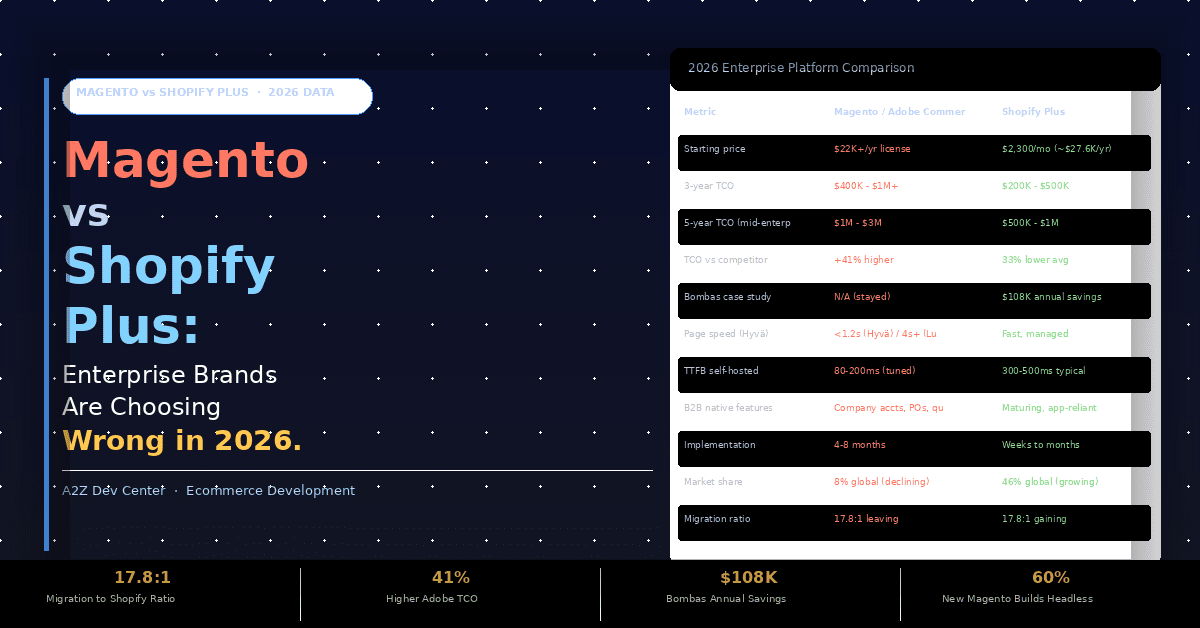
The headline numbers come from ECOSIRE’s March 2026 Adobe Commerce vs Shopify Plus enterprise platform analysis and are corroborated by 1Digital Agency’s May 2026 practitioner data on the Adobe Commerce vs Shopify Plus TCO split: Shopify Plus typically lands at 40-60% of equivalent Adobe Commerce TCO for merchants at $50M+ GMV. Bombas, an apparel retailer, documented $108,000 in annual platform cost savings after migrating from Adobe Commerce to Shopify, according to Shopify’s own commissioned TCO study.
The important caveat from 1Digital Agency, a dual-platform agency that does both Magento and Shopify Plus work: “For enterprise merchants at $50M+ GMV, Shopify Plus typically lands at 40-60% of equivalent Adobe Commerce TCO when you sum platform, hosting, security, patching, devops, and theme maintenance.” This figure applies to a specific operational profile. For complex B2B operations where Adobe Commerce’s native company accounts, shared catalogs, and purchase order workflows replace multiple third-party app subscriptions, the TCO gap narrows significantly and sometimes reverses at $10M+ GMV with deep B2B requirements.
The Hyvä Factor: Why Most Magento vs Shopify Plus Comparisons Use the Wrong Benchmark
This is the section missing from every competitor comparison article on the Magento vs Shopify Plus question, and it materially changes the analysis for any brand evaluating an existing Magento deployment.
THE HYVÄ THEME , WHAT IT CHANGES
The legacy Luma theme, which ships with Magento and is the benchmark most comparison articles use for Magento performance data, produces page load times of 4 seconds or more. This is the number that appears in most “Magento is slow” comparisons. The Hyvä theme, released in 2021 and now the dominant frontend solution for new Magento 2 builds, reduces average page load time to under 1.2 seconds and cuts Time to First Byte (TTFB) by up to 65%, according to wiserreview’s 2026 Magento statistics analysis.
A properly tuned self-hosted Magento store with Hyvä frontend achieves 80 to 200 milliseconds TTFB, which outperforms Adobe Commerce Cloud’s 300 to 500ms and competes directly with Shopify Plus on speed, per PageSpeedMatters’ February 2026 enterprise speed comparison. A Hyvä implementation costs $15,000 to $30,000. That investment produces better speed metrics than Shopify Plus at a one-time cost, changing the TCO math for brands evaluating the comparison based on performance alone.
60% of new Magento builds in 2026 use headless architecture, per Elogic Commerce’s 2026 data. The Magento deployment being compared to Shopify Plus today looks fundamentally different from the Magento deployment most comparison articles benchmark. If your Magento performance analysis is based on Luma, you are comparing a 2019 frontend against a modern SaaS platform and drawing incorrect conclusions. Our Magento development team implements Hyvä as the standard frontend for all new builds and for performance-critical existing stores.
The specific performance context matters for enterprise ad spend. PageSpeedMatters’ analysis is direct on this point: with enterprise ad budgets running $100K to $1M or more per month, the CPL impact of landing page speed is measured in hundreds of thousands of dollars annually. A 1-second load time delay reduces sales by up to 7%. For a brand doing $10M in monthly ecommerce revenue, 7% is $700,000 per year. The platform speed discussion is not a technical footnote. It is a commercial decision. Our broader SEO services cover how Core Web Vitals and page speed signals affect organic product visibility alongside direct conversion rate impact.
B2B Commerce: Where Magento Still Has a Genuine Advantage Over Shopify Plus
The single clearest signal that a brand should stay on Magento or choose Adobe Commerce over Shopify Plus is B2B commerce complexity. This is not a preference. It is an architectural reality today.
Adobe Commerce B2B (Native)
Built-In , No Apps Needed
- Company accounts with hierarchical buyer roles
- Shared catalogs and contract pricing per company
- Purchase order (PO) management and approval workflows
- Negotiable quotes (RFQ/CPQ) with sales rep interaction
- Requisition lists for repeat business buyers
- ERP-driven pricing with real-time catalog updates
- Credit limits and payment terms per account
Shopify Plus B2B (2022-Present)
Platform Feature + Apps
- Company accounts: native since 2022, maturing
- Customer-specific pricing: native but limited tiers
- Purchase orders: requires third-party app
- Complex quote management: requires third-party app
- ERP integration: via Shopify Flow + custom apps
- Requisition lists: third-party required
- Multi-brand operations: limited vs Adobe native
Elogic Commerce’s 2026 B2B cost analysis provides the clearest threshold: for complex B2B operations at $10M+ GMV, Adobe Commerce’s native feature depth justifies the cost differential versus Shopify Plus. Below $5M with simpler B2B needs, Shopify Plus delivers 50 to 75% lower TCO. This threshold is not absolute, but it is the most practically useful benchmark available from an independent source. Shopify Plus B2B launched in 2022 and has matured significantly, but it requires apps for advanced workflows that Adobe Commerce handles natively. Each app adds subscription cost, API dependency, and integration maintenance overhead that compounds against the nominal TCO advantage.
The 5-Criteria Decision Framework: Which Platform Is Right for Your Operation?
Every Magento vs Shopify Plus comparison article gives you a feature checklist. None give you a decision framework with specific thresholds. Here is the one we use for every enterprise platform evaluation. Run your operation through each criterion and tally the results to make the Magento vs Shopify Plus call with data, not intuition.
1
Criterion 1: B2B Complexity Score
If your operation requires any three or more of the following natively: company account hierarchies, negotiated quote management, ERP-driven catalog pricing, purchase order approval workflows, and credit limit management per account, your B2B complexity score points to Magento. If your B2B requirements are primarily customer-specific pricing and multiple user accounts under a company, Shopify Plus B2B can handle this. The correct question is not “do you have B2B?” but “does your B2B require native PO and quote management?” If yes, Magento. If no, evaluate the other four criteria. Our Shopify development team runs B2B requirement audits before recommending migration for any brand with existing B2B operations.
2
Criterion 2: Internal Development Capacity
Magento requires ongoing dedicated development resources. Security patches release monthly. Version upgrades require testing across your custom module stack. A self-hosted Magento deployment without a DevOps team or a reliable Magento agency is a liability, not an asset. Shopify Plus absorbs hosting, security, and infrastructure management entirely. If your organization has a dedicated ecommerce engineering team of three or more developers who know Magento, the platform cost differential may be justified by the capability retention. If your development capacity is a single developer or a generalist agency, Shopify Plus removes a category of risk that would compound against you in a Magento deployment.
3
Criterion 3: GMV Trajectory and Platform Leverage
Below $5M GMV with straightforward DTC or hybrid needs: Shopify Plus delivers the strongest TCO advantage, often 50-75% lower than Adobe Commerce. $5M to $50M GMV with mixed B2B and DTC: evaluate B2B complexity first (Criterion 1), then TCO. $50M+ GMV: Shopify Plus still typically runs at 40-60% of Adobe Commerce TCO, but the absolute dollar difference between $1M and $2M annually matters less at this revenue scale than the operational fit. Above $100M GMV, the Magento vs Shopify Plus choice becomes less about TCO and more about the customization depth requirement becomes the dominant decision variable.
4
Criterion 4: Time-to-Market Pressure
Adobe Commerce implementation takes 4 to 8 months for a standard enterprise deployment. Shopify Plus can launch in weeks to a few months depending on customization scope. If your organization is facing a platform end-of-life deadline, a major merchandising campaign, or a market window that requires an operational store sooner than 8 months away, this criterion alone may make Shopify Plus the only viable option regardless of what the other criteria suggest. The Contra Collective’s analysis frames this as “where your bottlenecks will live three years from now” , if your bottleneck is engineering velocity and launch speed, Shopify Plus removes it structurally. Our checkout UX optimization research shows how platform launch speed directly affects conversion rate, because delayed launches mean delayed learning from real traffic.
5
Criterion 5: Customization Depth Required
Shopify Plus has matured significantly. Shopify Functions allow custom logic at the checkout. Shopify Flow automates complex workflows. The Hydrogen framework enables headless builds. But Adobe Commerce still offers deeper customization at the database, catalog, pricing, and checkout architecture level than any Shopify Plus configuration can match. If your competitive advantage is built on proprietary ecommerce logic that would require significant compromise or workaround on Shopify Plus, that customization depth justifies Adobe Commerce’s higher TCO. The practical test: list your five most business-critical custom features. If more than two of them require Shopify API workarounds, custom apps, or significant compromise, your customization requirements may justify staying on Adobe Commerce.
The Migration Cost Nobody Talks About in the Magento vs Shopify Plus Debate
Brands making the Magento vs Shopify Plus decision typically compare licensing costs and operational overhead. They do not compare migration costs, and this is where the analysis goes wrong most frequently.
The Magento vs Shopify Plus migration cost is the number most absent from TCO comparisons. A Magento to Shopify Plus migration for an enterprise brand is not a licensing switch. It is a platform rebuild. A mid-market migration covering data migration, theme development, app configuration, workflow rebuild, SEO preservation, and integration reconnection typically costs $50,000 to $500,000 depending on catalog size, customization complexity, and integration depth, according to practitioner estimates from multiple ecommerce agencies. 1Digital Agency’s May 2026 analysis is explicit on this point: “Migration loses Magento’s customization flexibility.” If your business logic is encoded in custom Magento modules, that logic must be rebuilt as Shopify apps, Shopify Functions, or custom development, at project cost on top of migration cost.
The brands most likely to underestimate migration cost are those with long Magento histories, extensive customization, and multiple ERP and warehouse management integrations. A brand that has been on Magento since 2012 may have accumulated 40 to 80 custom modules built by different agencies over 14 years. Each module represents a migration decision: rebuild it, buy an equivalent Shopify app, or deprecate the functionality. That audit alone is a multi-week project before any code moves. Our ecommerce SEO guide covers the specific SEO preservation requirements during platform migration, because URL structure changes, redirect chains, and metadata migration are each independent risk surfaces that require dedicated attention during a Magento to Shopify Plus migration.
The Magento vs Shopify Plus Comparison Table
| Factor | Adobe Commerce (Magento) | Shopify Plus | Edge |
|---|---|---|---|
| Starting cost | $22K+/yr license + hosting | $2,300/month (hosting included) | Shopify Plus |
| 3-year TCO | $400K-$1M+ | $200K-$500K | Shopify Plus |
| 5-year TCO mid-enterprise | $1M-$3M | $500K-$1M | Shopify Plus |
| B2B native features | Company accounts, POs, quotes, shared catalogs, all native | Company accounts native; PO + quotes require apps | Magento |
| Customization depth | Full codebase access, custom modules, database-level control | Functions + Flow + Hydrogen; limited database access | Magento |
| Page speed (optimized) | Hyvä: <1.2s, 80-200ms TTFB | Fast, managed; ~300ms TTFB typical | Tie (Hyvä matched) |
| Page speed (legacy) | Luma: 4s+ load time | Fast out of box | Shopify Plus |
| Implementation time | 4-8 months | Weeks to months | Shopify Plus |
| Hosting/infra management | Self-managed or ACCS ($40K-$125K+/yr) | Fully managed, included | Shopify Plus |
| Security patching | Monthly patches required, team-managed | Platform-managed, automatic | Shopify Plus |
| Market share trajectory | 8% global, declining 11% YoY | 46% global, +30% revenue YoY | Shopify Plus |
| Migration to/from ratio | 17.8x leaving to Shopify | 17.8x receiving from Magento | Shopify Plus |
Frequently Asked Questions
The Magento vs Shopify Plus Decision Starts With the Right Evaluation Framework.
A2Z Dev Center builds and migrates on both platforms. We use the five-criteria framework outlined in this guide for every enterprise platform evaluation we perform. If you are comparing Magento vs Shopify Plus, our team can assess your B2B requirements, customization depth, operational complexity, and development capacity to determine which platform best aligns with your business before you commit to a migration that may not be necessary.
Book a Free Platform Evaluation
Schedule a call
Talk to a subject-matter expert
Web development, SEO, or digital marketing — tell us about your project and we'll get back within one business day. No obligation.
- Free scope & strategy session
- A senior specialist, not a sales rep
- Your details stay confidential