Magento
Summarize this blog post with:
Platform Comparison · eCommerce
Shopify
VS
Magento
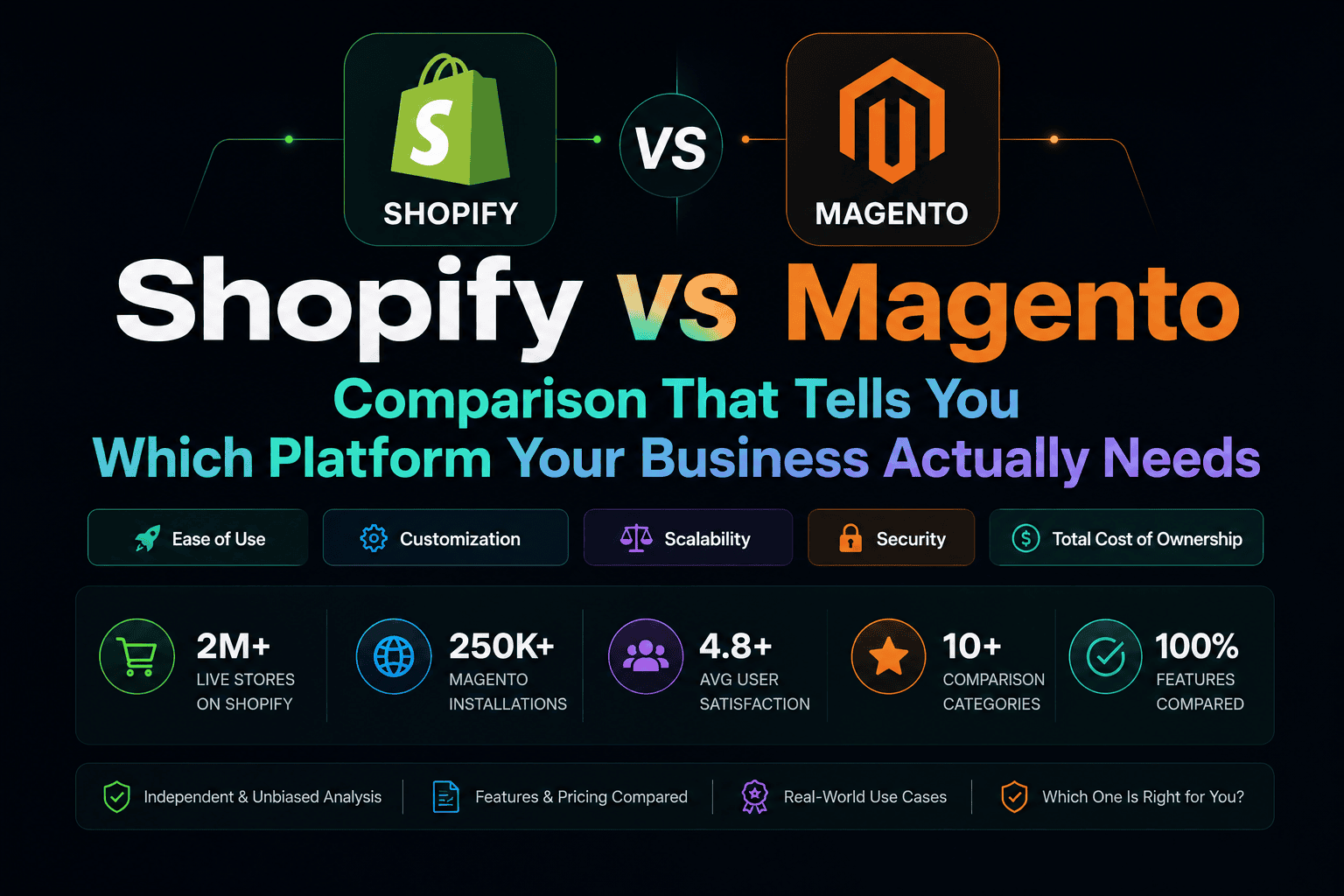
The Honest Comparison That Tells You Which Platform Your Business Actually Needs
The wrong question is “which platform is better?” The right question is “which platform fits my catalog, my team, my budget, and the next three years of my growth plan?” We build on both. Here is what we have learned.
Why Most Shopify vs Magento Comparisons Get It Wrong
Most comparisons are written by Shopify agencies (verdict: always Shopify) or Magento agencies (verdict: always Magento). Neither answer is honest. The platforms serve genuinely different business needs, and choosing the wrong one costs real money: either the $40,000–$100,000 Magento implementation that a Shopify Plus store at $2,300/month could have replaced, or the $200,000 Shopify Plus enterprise program that still cannot support the complex B2B quote workflow the business needs.
A2Z Dev Center builds on both platforms. We implement Magento 2 Open Source and Adobe Commerce for merchants who need catalog complexity and ERP integration depth. We build Shopify Plus stores with custom Liquid themes, Hydrogen headless, and B2B configuration for DTC and wholesale brands. We have no platform partnership incentive to push you one direction. The right answer depends on your specific situation, and this comparison is designed to get you to that answer.
The 2026 B2B shift: As of April 2026, Shopify B2B is native on every paid Shopify plan: company accounts, shared catalogs, custom pricing, payment terms (Net 15/30/60), purchase order support, and buyer self-service portals. The gap between Shopify and Magento for B2B closed dramatically. If you were planning to choose Magento specifically for B2B features, re-evaluate with the current Shopify B2B capability before deciding.
30-Second Platform Summary
🟢 Shopify / Shopify Plus: In 30 Seconds
A fully managed SaaS eCommerce platform. Shopify handles hosting, security, CDN, performance, and updates. You pay a monthly subscription and focus on selling. 6,000+ apps in the Shopify App Store. Hydrogen + Oxygen for headless builds. Native B2B as of April 2026. AI tools (Shopify Magic, Sidekick, Tinker, Agentic Storefronts for ChatGPT/Copilot). 2.66 million live stores. Shopify Plus starts at $2,300/month. For most DTC brands, startups, and SMBs, Shopify is the right starting point and a capable platform through $100M+ in annual revenue.
🟠 Magento 2 / Adobe Commerce: In 30 Seconds
An open-source PHP platform you install on your own hosting (or Adobe Commerce Cloud on AWS). No monthly platform fee for Magento Open Source, but hosting, development, security, and extensions are your responsibility. Adobe Commerce adds B2B module, Page Builder, Live Search (Adobe Sensei AI), Product Recommendations, and managed cloud hosting. 126,000 live stores (down 11% YoY per BuiltWith). Hyvä frontend replaces legacy Luma for Core Web Vitals compliance. Best for catalogs with 50+ attribute combinations, multi-store architecture, and deep ERP/PIM integration requirements where Shopify’s data model becomes a constraint.
Head-to-Head: 10 Key Decision Factors
| Factor | 🟢 Shopify Plus | 🟠 Magento / Adobe Commerce | Winner |
|---|---|---|---|
| Ease of Use | Hosted, managed, drag-and-drop. No server knowledge needed. Any team can manage. | Requires developer knowledge to configure, update, and maintain. Steeper learning curve. | Shopify |
| Pricing Predictability | Fixed monthly fee ($39–$2,300+). Costs visible upfront. Hosting included. | Platform free (OS) or $22K–$247K/yr (Adobe Commerce). Hosting + dev + extensions extra. | Shopify |
| Customization Depth | Themes + apps + Liquid + Hydrogen headless. Checkout Extensibility for Plus. Code access limited. | Full source code access. Unlimited custom PHP modules. Any database schema. Total control. | Magento |
| Catalog Complexity | Works well up to ~50K SKUs with standard configurations. Complex variants (50+ options) can hit limits. | Unlimited product attributes, configurable products with 50+ options, multi-source inventory, complex bundles. | Magento |
| B2B Commerce | Native B2B on all plans (April 2026): company accounts, shared catalogs, POs, payment terms, buyer portals. | Adobe Commerce B2B module: deeper quote workflows, requisition lists, approval hierarchies for large enterprises. | Shopify for most; Magento for complex enterprise B2B |
| Performance / Speed | Managed global CDN, automatic scaling, 99.98% uptime. You do not manage servers. | Depends on hosting. Hyvä frontend: 85–100 Lighthouse. Legacy Luma: 20–50 Lighthouse. Server management required. | Shopify (out-of-box); Magento with Hyvä closes gap |
| SEO Capability | Covers fundamentals well. Fixed URL structures (/products/, /collections/) limit advanced SEO control. | Full URL control, canonical management, layered navigation SEO, advanced sitemap, technical SEO depth. | Magento (for advanced SEO) |
| Multi-Store | Up to 9 expansion stores from one Shopify Plus admin. Separate storefronts, shared backend. | Unlimited store views from one Magento admin. Shared catalog, different domains, different languages all from one backend. | Magento (for complex multi-store) |
| AI Features | Shopify Magic (content), Sidekick (assistant), Tinker (dev), Agentic Storefronts (ChatGPT/Copilot), SimGym. | Adobe Sensei: Live Search, Product Recommendations, demand forecasting, 10+ AI agents. Adobe Experience Platform. | Both strong, different AI strategies |
| Security / Compliance | Shopify handles PCI compliance, SSL, security patches, DDoS protection. Nothing to manage. | PCI compliance is your responsibility. Security patches must be applied manually. Hosting security your problem. | Shopify (managed security) |
Real Total Cost of Ownership: Year 1
The most misleading comparison is price. “Magento is free” is one of the most persistent myths in eCommerce. Magento Open Source is free to download the same way a restaurant kitchen is free if someone hands you an empty building. Here is what each platform actually costs in year one for a mid-complexity production store.
🟢 Shopify Plus: Year 1 TCO
Platform subscription (12 months)$27,600
Custom theme development$8,000–$20,000
App subscriptions (avg)$3,000–$8,000
Shopify Payments / transaction fees$0 / 0.25% GMV
Ongoing support retainer$0–$24,000
Total Year 1 (mid-complexity)$38,600–$79,600
🟠 Magento Open Source: Year 1 TCO
Platform license$0
Managed hosting (Nexcess/Cloudways)$2,400–$6,000
Initial development (Hyvä + setup)$25,000–$100,000
Extensions (avg 5–10)$2,000–$8,000
Ongoing maintenance / patches$6,000–$36,000
Total Year 1 (mid-complexity)$35,400–$150,000
For Adobe Commerce Cloud, add the platform license: $40,000–$247,000/year. At enterprise scale ($5M+ GMV), the math can shift: Shopify Plus at 0.25% GMV plus app costs can exceed Adobe Commerce’s fixed licensing. But for the majority of US merchants processing under $1M/month, Shopify Plus’s predictable pricing and included infrastructure management produces lower total cost of ownership.
The SEO Reality in 2026
Both platforms support solid organic search performance, but with different depth and different constraints. Understanding the SEO difference is critical because for most eCommerce stores, organic search is the highest-ROI customer acquisition channel.
Shopify SEO in 2026
Shopify handles technical SEO fundamentals automatically: canonical URLs, SSL, mobile responsiveness, sitemaps, and structured data (Product schema) are generated out of the box. Performance is excellent. Shopify’s CDN delivers fast page loads globally without configuration. The constraint is URL structure: Shopify forces /products/ and /collections/ paths that cannot be changed. For most DTC stores, this is not a problem. For stores with complex category hierarchies where URL depth affects crawl priority, it can be.
🟢 Shopify SEO Strengths
Automatic structured data, global CDN performance, Shopify Agentic Storefronts (your products appear in ChatGPT and Microsoft Copilot searches), managed Core Web Vitals, and canonical URL handling. Shopify’s AI-first roadmap specifically addresses GEO (Generative Engine Optimization). Agentic Storefronts enable merchants to make their catalog discoverable in AI chat interfaces as a native Shopify feature.
Magento SEO in 2026
Magento gives more SEO control than any other eCommerce platform: full URL rewriting, custom canonical tags, layered navigation SEO configuration, and granular meta tag management per product, category, and store view. The caveat: this control requires a developer and an active SEO strategy. Magento’s SEO ceiling is higher, but the floor requires more work to reach.
🟠 Magento SEO 2026: The Hyvä Difference
Magento’s SEO performance in 2026 is defined by the Hyvä frontend. Legacy Luma theme: Lighthouse scores 20–50, Total Blocking Time 2–8 seconds, Core Web Vitals failure. Hyvä (Alpine.js + Tailwind CSS): Lighthouse 85–100, sub-2-second LCP. Any Magento store still on Luma in 2026 is ranking below its potential. Any new Magento build that does not use Hyvä is being built for a 2023 performance standard. A2Z Dev Center builds all Magento projects on Hyvä as the default.
AI Commerce: Shopify Agentic Storefronts vs Adobe Sensei
Both platforms have invested heavily in AI, but with fundamentally different strategies that reflect the platforms’ core philosophies.
Shopify’s AI Strategy: Agentic Commerce
Shopify’s 2026 AI direction is what they call “agentic commerce”: making Shopify stores discoverable and transactable in AI interfaces. Shopify Agentic Storefronts lets merchants make their catalog appear in ChatGPT, Microsoft Copilot, and other AI chat interfaces, managed directly from the Shopify admin. Shopify Magic writes product descriptions, edits images, and drafts email copy. Shopify Sidekick is an AI assistant that answers store questions and suggests next actions. For DTC merchants where AI search traffic is increasingly replacing traditional Google search for product discovery, Shopify’s Agentic Storefronts represents a genuine GEO advantage.
Adobe Commerce’s AI Strategy: Adobe Sensei
Adobe Sensei powers Magento’s AI capabilities: Live Search (AI-powered catalog search with natural language query understanding), Product Recommendations (ML-based personalized product suggestion blocks), and demand forecasting. In 2026, Adobe added 10+ AI agents across the platform. Adobe’s AI strategy is oriented toward personalization and merchandising intelligence, optimizing what merchants sell to who, rather than where the store appears. For enterprise merchants where conversion rate optimization and inventory optimization are the primary AI value drivers, Adobe Sensei’s merchandising AI is the stronger capability.
B2B eCommerce: Where the Platforms Stand in 2026
The B2B comparison between Shopify and Magento changed materially in 2025–2026 with Shopify’s expansion of native B2B features across all paid plans.
Shopify B2B (native on all paid plans, April 2026): Company accounts with parent-child hierarchy, shared catalogs with custom pricing per company, percentage or volume-based price lists, payment terms (Net 15/30/60), partial payments and deposits, purchase order support, quick-order lists, buyer roles and permissions, customer-managed self-service portal, draft order creation. For DTC brands adding a wholesale channel and for mid-market B2B operations, this capability is now sufficient without Magento.
Magento Adobe Commerce B2B module: Adds negotiated quote workflows (buyer submits quote, seller counters), requisition lists (named product lists saved by buyers for repeat ordering), advanced company hierarchy with multi-level approval chains, shared catalog with complex pricing rules and restricted visibility, and purchase order approval workflows with configurable approval limits. For manufacturers, distributors, and wholesale organizations with complex organizational buying processes (multiple approval layers, quote negotiation, contract pricing at account level), Adobe Commerce B2B remains deeper than Shopify B2B.
🟢 Choose Shopify B2B When
- Adding wholesale to an existing DTC brand
- B2B order volume under $5M annually
- Buyers self-serve via portal (no sales rep quoting)
- Standard pricing tiers (not per-account negotiated)
- Payment terms are Net 30 or simpler
- No complex multi-level approval workflows needed
🟠 Choose Adobe Commerce B2B When
- Manufacturers / distributors with complex B2B
- Quote negotiation is part of the buying process
- Multi-level approval chains (manager to director to VP)
- Per-account negotiated contract pricing
- Requisition lists for repeat industrial ordering
- B2B order volume above $10M annually
Industry Decision Guide: Which Platform for Your Business Type?
DTC / Consumer Brand
Shopify Plus
Fast launch, Shopify Magic AI, App Store ecosystem, Agentic Storefronts for AI search discovery. The platform DTC was built for.
B2B Manufacturer / Distributor
Adobe Commerce
Complex quote workflows, tiered pricing, approval hierarchies, ERP integration depth. Shopify B2B handles simpler B2B; Magento handles complex.
Startup / First Store
Shopify
Fastest launch. No server management. Built-in payments and security. Low technical overhead. Scale to Shopify Plus when revenue justifies.
Enterprise Retailer ($10M+)
Evaluate Both
Depends on catalog complexity. Shopify Plus handles $10M–$100M+ for simpler catalogs. Adobe Commerce for complex configurable products or multi-brand multi-region.
Multi-Store / Multi-Brand
Magento
12+ storefronts, 5 languages, 3 brands from one Magento admin. Shopify Plus supports up to 9 expansion stores. Check if that is enough.
Fashion / Apparel
Shopify Plus
Visual-first themes, Instagram + TikTok native integration, Shopify Markets for global selling, subscription commerce. Strong DTC fashion ecosystem.
Complex Product Catalog
Magento
Custom attributes without limit, configurable products with 50+ options, bundle products, downloadable products, complex pricing rules, native in Magento.
eCommerce + Content
Shopify
Shopify’s native blog + metafields handle most content needs. For content-heavy commerce, WooCommerce (WordPress) may be a better fit than either.
Platform Migration: Moving Between Shopify and Magento
Migration between platforms is a significant project, but it is common in both directions. Understanding the migration considerations helps evaluate the real long-term commitment each platform represents.
🟢 Magento → Shopify (Most Common Direction)
- ~520 stores migrate this direction every 90 days (BuiltWith 2025)
- Export: products, customers, orders, reviews via Magento API
- URL mapping: every Magento URL needs a Shopify 301 redirect
- Custom functionality audit: what Magento extensions need Shopify app replacements
- Checkout customization: rebuild in Shopify Checkout Extensibility
- B2B migration: reconfigure in Shopify B2B (April 2026 native)
- Timeline: 8–20 weeks depending on complexity
- Primary risk: SEO, URL structure changes without 301s cause ranking loss
🟠 Shopify → Magento (Less Common, Complexity-Driven)
- Uncommon: most businesses do not outgrow Shopify Plus
- Appropriate when: catalog complexity genuinely exceeds Shopify’s data model
- Export: products (CSV), customers, orders via Shopify API
- Custom module development: recreate Shopify app functionality in Magento
- Hyvä frontend: required for competitive Core Web Vitals
- ERP integration: design the integration architecture before migration
- Timeline: 16–40 weeks (significantly longer)
- Cost: typically $75,000–$250,000+ for mid-market scope
SEO preservation is the #1 migration risk. In Magento-to-Shopify migrations, URL structure changes are inevitable, Shopify forces /products/ and /collections/ paths. Every existing Magento URL must be mapped to a new Shopify URL with a 301 redirect before go-live. Missing redirects = 404 errors = lost Google rankings. A2Z Dev Center handles both migration directions with SEO preservation built into the migration plan, not left as post-launch remediation.
When to Choose Shopify. When to Choose Magento.
🟢 Choose Shopify When
- You want managed hosting, security, and updates handled for you
- You need the fastest path to a live, converting store
- Your catalog has standard product types (under 50K SKUs, standard variants)
- B2B is a channel you are adding, not your core complexity
- Marketing agility (launch pages, A/B test, promotions) without developers
- Your team does not include a Magento developer or server admin
- AI search visibility (ChatGPT, Copilot) via Agentic Storefronts matters
- Budget: under $100K total first-year investment
🟠 Choose Magento When
- Your catalog has 50+ configurable attributes or complex product structures
- You run 3+ storefronts / brands from one admin
- B2B includes quote negotiation, approval workflows, requisition lists
- ERP or PIM integration requires custom data mapping beyond Shopify’s model
- Technical SEO depth (full URL control, layered navigation) is a core strategy
- You have or can hire dedicated Magento developers
- Your process requires custom checkout logic that Shopify cannot support
- Adobe ecosystem (Analytics, Experience Platform) integration is planned
Frequently Asked Questions
The most important questions about choosing between Shopify and Magento in 2026.
Not Sure Which Platform Is Right for Your Business?
A2Z Dev Center builds on Shopify Plus and Magento 2 / Adobe Commerce, no platform partnership bias, no single-platform expertise limitation. We will evaluate your catalog complexity, B2B requirements, budget, and growth plan and recommend the right platform with honest reasoning. Then we build it, with SEO, GEO, and HubSpot CRM integrated from sprint 1.
Schedule a call
Talk to a subject-matter expert
Web development, SEO, or digital marketing — tell us about your project and we'll get back within one business day. No obligation.
- Free scope & strategy session
- A senior specialist, not a sales rep
- Your details stay confidential