Magento
Summarize this blog post with:
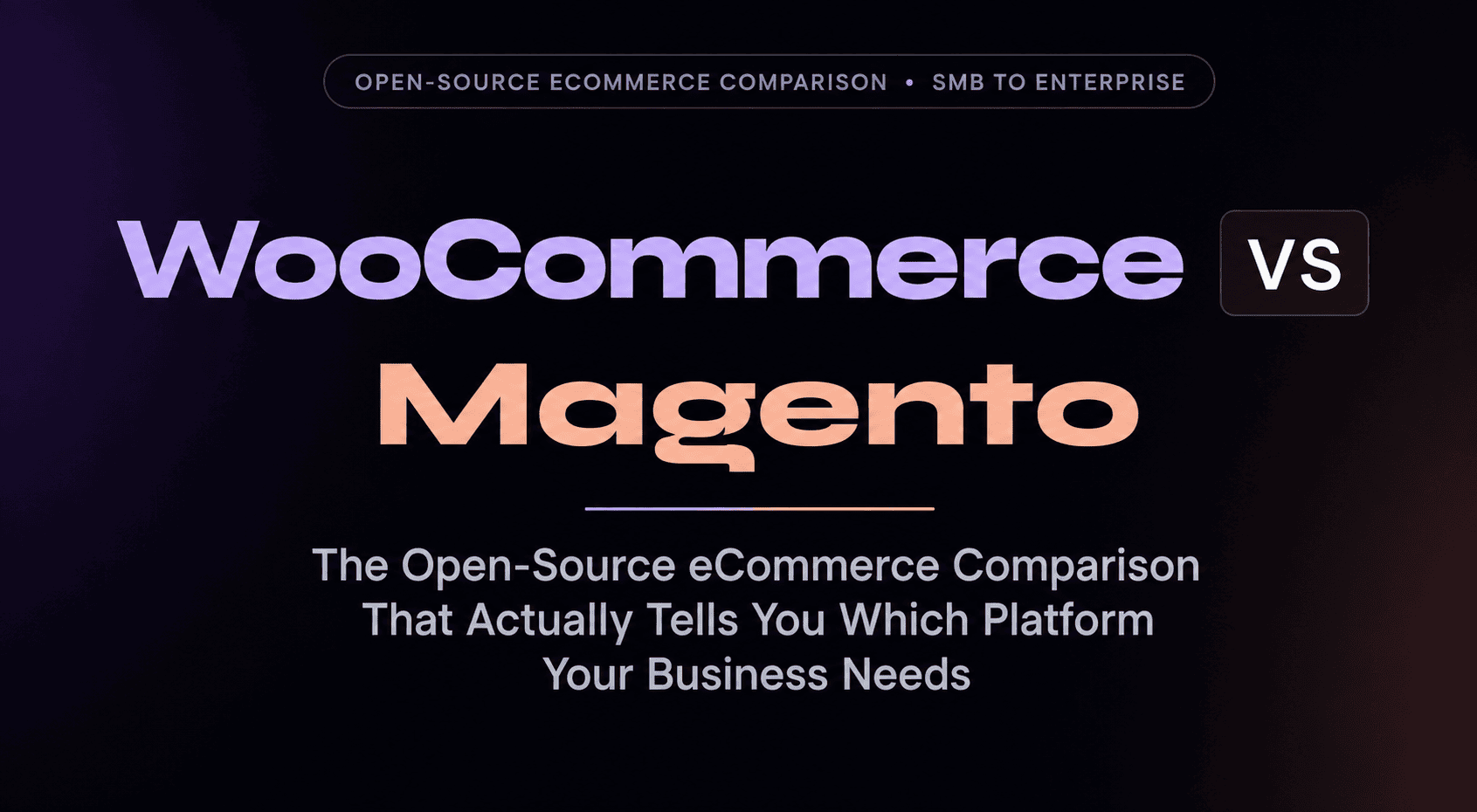
Open-Source eCommerce Comparison · SMB to Enterprise
WooCommerce
VS
Magento
The Open-Source eCommerce Comparison That Actually Tells You Which Platform Your Business Needs
Both are open-source. Both are free to download. Both power major eCommerce brands. But WooCommerce year-one costs $5K–$30K and Magento costs $20K–$100K+. The $15K–$70K gap is either a waste or a justified investment, depending entirely on your catalog complexity, team, and GMV.
Both Are Open-Source. One Is Right for Your Business. One Is an Expensive Mistake.
WooCommerce and Magento are both open-source, both free to download, and both capable of powering multi-million dollar eCommerce operations. The crucial difference is what “open-source” means in practice for each: WooCommerce is a WordPress plugin that adds eCommerce to the world’s most widely used CMS, accessible, fast to launch, and maintained by a developer ecosystem so large that solutions to most problems already exist as plugins. Magento is a dedicated eCommerce platform built in PHP, purpose-engineered for catalog complexity, multi-store architecture, and enterprise B2B, but requiring specialized developers, significant hosting infrastructure, and substantial ongoing maintenance investment.
The decision framework is not “which is better.” It is whether your catalog complexity, team resources, and revenue justify Magento’s investment. The $500K GMV question, does your business generate enough revenue that Magento’s enterprise capabilities provide ROI above WooCommerce’s lower cost, is the single most useful decision filter.
3.5M+
WooCommerce sites globally (BuiltWith)
8%
Magento global eCommerce platform share
3–4 wks
WooCommerce launch timeline (vs 8–16 wks Magento)
200K+
Orders/hour, Magento high-end capacity (Adobe)
$50–$150
WooCommerce developer hourly rate
$100–$250+
Magento specialist hourly rate
30-Second Platform Summary
💜 WooCommerce: In 30 Seconds
WooCommerce is a free open-source eCommerce plugin for WordPress, powering 3.5 million+ online stores globally. It inherits everything WordPress offers, the world’s best blogging tools, 60,000+ plugins covering every business need, Yoast/Rank Math for technical SEO, Gutenberg for rich content editing, and a developer ecosystem so large that WooCommerce developers are available at $50–$150/hr with short hiring timelines. Launch a production WooCommerce store in 3–4 weeks. Year-one operating cost: $5,000–$30,000. Zero platform transaction fees. Native HubSpot CRM integration via the official WordPress plugin. Content-driven eCommerce with WordPress blog is WooCommerce’s structural SEO advantage. Trade-offs: performance requires optimization at high scale (30,000+ SKUs), and complex configurable product structures are workable but not as elegant as Magento’s native catalog architecture.
🟠 Magento / Adobe Commerce: In 30 Seconds
Magento is a standalone open-source PHP eCommerce platform, Magento Open Source is free; Adobe Commerce adds B2B module, Page Builder, Live Search, Product Recommendations, and managed cloud hosting. Purpose-built for enterprise eCommerce: EAV (Entity-Attribute-Value) database architecture handles hundreds of configurable product attributes natively; multi-store management runs unlimited storefronts from one admin; the B2B module supports quote negotiation, company hierarchies, and requisition lists; high-end setups handle 200,000+ orders per hour. In 2026, Magento’s biggest architectural upgrade is Hyvä frontend, replacing legacy Luma (Lighthouse 20–50) with Alpine.js + Tailwind CSS (Lighthouse 85–100). Trade-offs: requires specialized developers at $100–$250+/hr, 8–16 week minimum launch timeline, $20K–$100K+ year-one operating cost, and small Magento talent pool means difficult hiring.
The 2026 Magento Game-Changer: Hyvä Frontend
🟢 Hyvä: The Magento Frontend Revolution in 2026
Hyvä is a modern Magento 2 frontend theme built with Alpine.js and Tailwind CSS, replacing the legacy Luma theme that shipped with Magento 2. Luma produces Lighthouse performance scores of 20–50 and Total Blocking Time of 2–8 seconds, Core Web Vitals failure that directly harms Google rankings and conversion rates. Hyvä achieves Lighthouse 85–100 and sub-2-second LCP on the same Magento backend, transforming Magento’s frontend performance from its weakest point to one of its strongest. In 2026, any Magento build not using Hyvä is being built to a 2020 performance standard. A2Z Dev Center builds all Magento projects on Hyvä as the default frontend. The Hyvä license costs approximately $1,000/year per store, justified for any project where Core Web Vitals affect SEO rankings or conversion rates. Before evaluating Magento, confirm your agency builds with Hyvä: any Magento build proposal without explicit Hyvä or equivalent frontend (PWA Studio, Breeze) should be reconsidered.
Real Total Cost of Ownership: Year 1
The “open-source is free” framing misleads most buyers evaluating both platforms. Here is what each platform actually costs in year one for a production mid-complexity store.
💜 WooCommerce: Year 1 Operating Cost
Managed WordPress hosting (WP Engine/Kinsta)$360–$600/yr
Domain name$15/yr
Premium theme (one-time)$60–$150
WooCommerce extensions (avg 5–8)$300–$1,500/yr
Security plugin (Wordfence Pro)$120/yr
Initial development (setup + customization)$2,000–$15,000
Ongoing maintenance (optional)$0–$6,000/yr
Total Year 1$5,000–$30,000
🟠 Magento Open Source: Year 1 Operating Cost
Managed Magento hosting (Nexcess/Cloudways)$2,400–$12,000/yr
Domain + SSL$30/yr
Hyvä frontend license$1,000/yr
Magento extensions (avg 5–10)$2,000–$8,000
Initial development (setup + Hyvä + customization)$15,000–$80,000
Ongoing maintenance (patches + updates)$6,000–$36,000/yr
Total Year 1$20,000–$100,000+
Adobe Commerce Cloud adds $22,000–$247,000/year in platform licensing on top of the development and hosting costs above. For large enterprise merchants evaluating Adobe Commerce, the platform licensing alone typically exceeds an entire WooCommerce year-one budget. The Magento investment is justified when: (1) catalog complexity requires EAV architecture; (2) multi-store operations from one admin are required; (3) GMV is above $1M–$5M where the infrastructure investment pays for itself; (4) enterprise B2B workflows (quote negotiation, requisition lists, company hierarchies) are core operations. Below those thresholds, WooCommerce delivers the same business outcomes at 20–30% of the cost.
Head-to-Head: 12 Key Decision Factors
| Factor | 💜 WooCommerce | 🟠 Magento / Adobe Commerce | Winner |
|---|---|---|---|
| Ease of Use | WordPress interface familiar to most users. Non-technical team members manage daily operations. | Requires developer expertise to configure, update, and maintain. Steep learning curve. | WooCommerce |
| Launch Timeline | 3–4 weeks for production store. Fast iteration. | 8–16 weeks minimum for comparable setup. Complex configuration. | WooCommerce |
| Year-One Cost | $5,000–$30,000. Developer rates $50–$150/hr. | $20,000–$100,000+. Developer rates $100–$250+/hr. | WooCommerce |
| Catalog Complexity | Handles up to ~10K SKUs well. Variable products workable for most configurations. | EAV architecture: hundreds of configurable attributes natively. Purpose-built for complex catalogs. | Magento |
| Multi-Store Management | Requires separate WP installs or multisite. More complex to manage at scale. | Unlimited storefronts from one Magento admin. Different domains, catalogs, currencies, languages. | Magento |
| B2B Commerce | B2B plugins (B2BKing, B2B for WooCommerce) workable for basic wholesale. Not enterprise-grade. | Adobe Commerce B2B: company hierarchies, quote negotiation, requisition lists, purchase approval workflows. | Magento (enterprise B2B) |
| Content Marketing / SEO | WordPress: world-class blogging, Yoast/Rank Math, full URL control. Best content-SEO platform. | PageBuilder improved in Adobe Commerce, but nothing approaches WordPress CMS capabilities. | WooCommerce (structural advantage) |
| Frontend Performance | Premium hosting + caching: excellent. Simple configuration required. | Hyvä: Lighthouse 85–100. Legacy Luma: 20–50. Must specify Hyvä in any build. | WooCommerce (simpler); Magento+Hyvä closes gap |
| Scalability | Strong to ~10K SKUs. Optimization required for 30K+. Performance degrades without tuning. | 200,000+ orders/hour capacity. Purpose-built for enterprise scale. No practical upper limit. | Magento |
| Developer Availability | 60,000+ WordPress developers globally. Short hiring timelines. Competitive rates. | Specialized Magento developers. Smaller pool. Longer hiring timelines. Higher rates. | WooCommerce |
| Headless / Composable | Headless WooCommerce + Next.js: WordPress REST API or WPGraphQL as backend. A2Z specialty. | Headless Magento + Hyvä PWA Studio or Next.js: full GraphQL API. Enterprise headless. | Both capable; Magento more enterprise-grade |
| HubSpot Integration | Native HubSpot WordPress plugin: 5-minute setup. Forms to CRM automatic. | Custom connector required. More complex CRM integration. | WooCommerce |
Catalog Architecture: The Core Technical Difference
The most important technical difference between WooCommerce and Magento is invisible to most comparison articles: their product catalog database architectures.
💜 WooCommerce Product Architecture
WooCommerce uses WordPress’s standard post + meta table structure for products. Simple products, variable products (with variations), grouped products, and external/affiliate products cover most standard eCommerce needs. WooCommerce variable products support attributes (size, color) with variations, a 5-attribute product with 3 values each creates up to 243 variations. This handles most fashion, apparel, and standard configurable product requirements. Where it struggles: products with 10+ attribute types (a fine jewelry piece with metal type, metal purity, stone type, stone grade, stone weight, cut, finish, setting style, and chain length) create unwieldy variation tables. Bulk import/export of complex configurable products is slow. Admin performance degrades above ~30,000 SKUs without significant optimization.
🟠 Magento EAV Architecture: Built for Complexity
Magento uses an EAV (Entity-Attribute-Value) database architecture specifically designed for complex, attribute-rich product catalogs. Instead of storing all product data in a single table, EAV stores each attribute value in its own row, allowing unlimited custom attributes without schema changes. A jewelry product can have 50+ attributes (metal type, purity, stone, cut, weight, certificate, setting, finish, chain type, chain length, clasp, occasion, style, gender) all configured natively as searchable, filterable attributes. Configurable products combine these attributes into customer-selectable product options. Layered navigation (faceted search) filters by any attribute combination natively. For catalogs where the product is defined by its specifications more than its SKU, Magento’s EAV architecture handles what WooCommerce can only approximate.
The catalog complexity test: If a customer choosing your product needs to select 5+ attributes (size, color, material, finish, weight, grade, configuration) before adding to cart, and your catalog has hundreds or thousands of such configurable products, Magento’s EAV architecture is the right tool. If your products have 1–3 configuration options (size, color, material) and your catalog has under 10,000 SKUs, WooCommerce variable products handle the requirement without Magento’s overhead.
SEO and Content Marketing: Where WooCommerce Has Its Clearest Advantage
For businesses where content marketing, blog posts, guides, comparison pages, product education, drives organic traffic and product discovery, WooCommerce’s WordPress foundation is a structural SEO advantage that Magento cannot match.
💜 WooCommerce SEO + Content Advantage
- WordPress Gutenberg: rich editorial content for blog posts, product guides, and comparison pages that rank for long-tail keywords
- Yoast SEO / Rank Math: granular meta titles, descriptions, canonical tags, schema markup per product and post type
- Full URL structure control, design category and product URLs for topic clusters and SEO hierarchy
- Content to product internal linking is native to WordPress architecture
- HubSpot forms on blog posts capture leads who discover products through content
- WooCommerce product schema (JSON-LD) generated automatically for rich snippet eligibility
🟠 Magento SEO: Technical Depth for Large Catalogs
- Full URL rewriting and layered navigation SEO, handles 100,000+ SKU catalog SEO architecture
- Custom canonical tags per product, category, and store view, avoids duplicate content in large filtered catalogs
- XML sitemap with granular include/exclude control per content type
- Adobe Sensei Live Search (Adobe Commerce): AI-powered catalog search with natural language query understanding
- Hyvä frontend: Lighthouse 85–100 resolves Core Web Vitals failures that previously hurt Magento SEO
- Weakness: Magento’s CMS/blog capabilities are basic compared to WordPress, content-driven SEO requires significant custom development
Headless Options: Both Platforms in 2026
Headless eCommerce, separating the frontend from the backend to run a React/Next.js frontend consuming the platform’s API, is available on both platforms in 2026, with different maturity levels.
💜 Headless WooCommerce + Next.js (A2Z’s Architecture)
Headless WooCommerce uses WordPress as the content management and eCommerce backend, exposed via WordPress REST API or WPGraphQL, with a Next.js 15 frontend consuming the API. A2Z Dev Center builds this stack: WordPress admin for content + WooCommerce for product and order management + WPGraphQL for API layer + Next.js 15 with ISR for CDN-fast storefronts + HubSpot CRM for lead capture. The result: editorial content in WordPress Gutenberg, product catalog in WooCommerce admin, 95+ Lighthouse score Next.js frontend. This architecture combines WordPress’s content management strengths with Next.js’s performance and Vercel deployment.
🟠 Headless Magento + Next.js / PWA Studio
Headless Magento uses Magento’s GraphQL API as the backend with a React/Next.js or Vue Storefront frontend. Magento’s GraphQL API covers full catalog, cart, checkout, customer account, and order management. The enterprise headless Magento architecture handles complex configurable products and B2B workflows that headless WooCommerce cannot replicate natively. Trade-off: significantly higher development and maintenance cost. Headless Magento projects typically start at $75,000–$200,000+ compared to headless WooCommerce + Next.js at $20,000–$60,000.
Migration: Moving Between Platforms
💜 Magento → WooCommerce (Most Common Direction)
- Export Magento products, customers, orders via Magento API or data migration tools (Cart2Cart, Litextension)
- Map Magento catalog attributes to WooCommerce product types, complex configurable products may require simplification
- URL structure change: Magento URLs to WooCommerce /product/ paths require 301 redirect mapping
- Rebuild Magento extension functionality in WooCommerce plugins
- Reconfigure B2B pricing, customer groups in WooCommerce B2B plugin
- Timeline: 6–16 weeks depending on catalog size and complexity
- Primary reason: lower operating cost and maintenance burden
- Primary risk: losing multi-store and complex B2B workflows that WooCommerce cannot fully replicate
🟠 WooCommerce → Magento (Complexity-Driven)
- Export WooCommerce products via CSV or REST API
- Map WooCommerce variable products to Magento configurable products in EAV architecture
- Magento attribute set design, define attribute families before migration
- Customer + order data migration via Magento data migration tool
- URL mapping: WooCommerce /product/ paths to Magento URL rewrites with 301s
- Build or configure Magento extensions to replace WooCommerce plugins
- Timeline: 12–24 weeks for mid-complexity stores
- Primary reason: catalog complexity, multi-store needs, enterprise B2B requirements
- Primary risk: cost escalation and timeline underestimation, common with agencies new to Magento
Use Case Decision Guide
SMB / Startup
WooCommerce
Fast launch, low cost, WordPress familiarity. 3–4 weeks live. $5K–$30K year one. Magento is overkill at this scale.
Content-Driven eCommerce
WooCommerce
Blog-to-product conversion is the growth model. WordPress CMS + Yoast SEO + WooCommerce is the best content-commerce platform available.
Fashion / Apparel (Under 10K SKUs)
WooCommerce
Standard size + color variations. Under 10K SKUs. WooCommerce variable products + Flatsome or Divi theme. Faster and cheaper than Magento.
Complex Configurable Products (50+ Attributes)
Magento
Jewelry, electronics, industrial equipment with hundreds of attribute combinations. EAV architecture is the right tool, WooCommerce is a workaround.
Multi-Brand / Multi-Region
Magento
Multiple storefronts with different currencies, languages, and catalogs from one admin. WooCommerce multisite is workable but not as elegant.
Enterprise B2B / Wholesale
Magento
Adobe Commerce B2B: company hierarchies, quote negotiation, requisition lists, approval workflows. WooCommerce B2B plugins cover basic needs only.
High-Volume eCommerce ($5M+ GMV)
Magento
200,000+ orders/hour capacity, enterprise hosting, Adobe Commerce managed cloud. WooCommerce can scale but requires significant optimization investment.
Mid-Market ($500K–$5M GMV)
Evaluate Both
Depends entirely on catalog complexity and B2B requirements. Simple catalog leans WooCommerce. Complex catalog or multi-store leans Magento with Hyvä.
Headless / Composable
Both (Different Scale)
Headless WooCommerce + Next.js ($20K–$60K). Headless Magento + Next.js ($75K–$200K+). Choose based on catalog complexity and budget.
HubSpot CRM Integration
WooCommerce
Native HubSpot WordPress plugin, 5-minute setup, forms auto-populate CRM. Magento requires custom connector. WooCommerce wins on integration simplicity.
When to Choose WooCommerce. When to Choose Magento.
💜 Choose WooCommerce When
- Your catalog has standard products under 10,000 SKUs
- Content marketing and SEO are primary growth channels
- Fast launch (3–4 weeks) is a business requirement
- Budget under $30,000 year one
- WordPress developers available in your market at $50–$150/hr
- HubSpot CRM integration with blog and product pages is required
- Subscriptions, memberships, or digital downloads are core products
- You do not need multi-store management or enterprise B2B workflows
- Headless architecture at accessible cost ($20K–$60K)
🟠 Choose Magento When
- Products have 50+ configurable attributes (jewelry, electronics, industrial)
- Multiple storefronts (brands, regions) need one admin
- Enterprise B2B is core: quote negotiation, company hierarchies, requisition lists
- GMV exceeds $1M–$5M and justifies the platform investment
- You have or can hire dedicated Magento developers at $100–$250+/hr
- Adobe ecosystem integration (Analytics, Experience Platform) is planned
- High-volume catalog (100,000+ SKUs) with complex layered navigation
- Always build with Hyvä frontend, never legacy Luma
Frequently Asked Questions
The questions eCommerce merchants and developers ask most when choosing between Magento and WooCommerce in 2026.
Building an Open-Source eCommerce Store? We Build Both, With SEO and HubSpot Integrated From Day One.
A2Z Dev Center builds WooCommerce stores (WordPress + WooCommerce + HubSpot CRM + Yoast SEO + Next.js headless option) and Magento stores (Magento 2 + Hyvä frontend + B2B configuration + headless option). Platform-agnostic: we recommend based on your catalog complexity, GMV, and team resources, not which platform we prefer to build. At $40–$80/hr, integrated web development + eCommerce + SEO + CRM from one team at rates well below specialist agency pricing.
Schedule a call
Talk to a subject-matter expert
Web development, SEO, or digital marketing — tell us about your project and we'll get back within one business day. No obligation.
- Free scope & strategy session
- A senior specialist, not a sales rep
- Your details stay confidential