Salesforce
Summarize this blog post with:
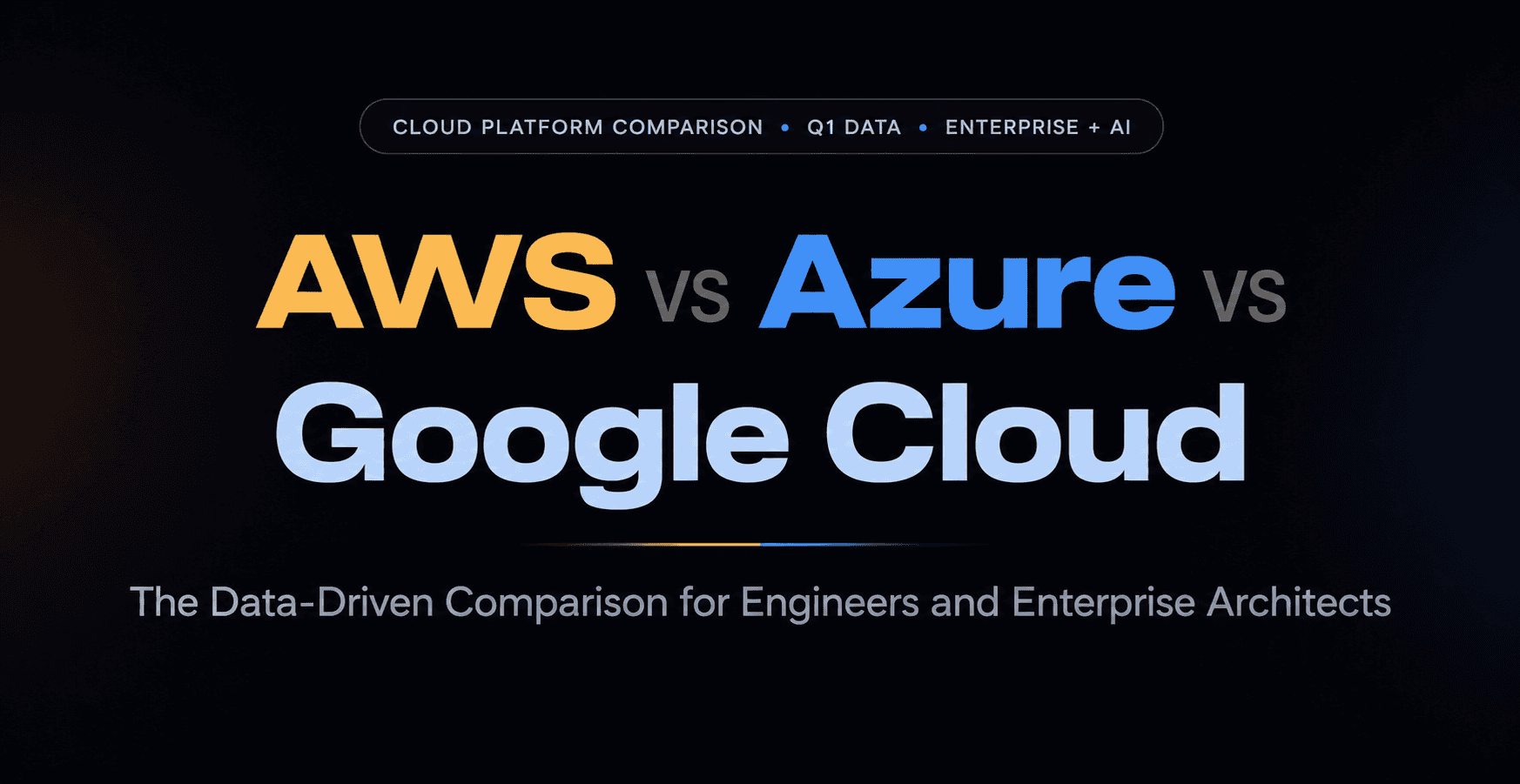
Cloud Platform Comparison · Enterprise + AI
AWS
vs
Azure
vs
Google Cloud
The Data-Driven Comparison for Engineers and Enterprise Architects
AWS holds 30% of the $129B/quarter cloud market. Azure holds 25% and is growing 40% YoY. Google Cloud holds 13% and is growing 63% YoY, the fastest hyperscaler. The differences that matter today are AI strategy, pricing structure, and ecosystem lock-in, not raw capability.
The 30-Second Cloud Decision
Three questions determine your cloud provider choice faster than any feature comparison:
Question 1: Do you run Microsoft? If your organization uses Microsoft 365, Windows Server, SQL Server, Active Directory, or .NET, Azure is the natural choice. The native integrations eliminate middleware complexity that any other cloud would require. The exclusive OpenAI partnership is the AI bonus.
Question 2: Is AI/ML or data analytics your primary workload? Google Cloud’s TPU v6 hardware, BigQuery for analytics, and Vertex AI for model deployment are the strongest AI infrastructure at the best price point (GCP cut compute pricing 8% in Q1 2026). If you are training models at scale or running analytics on petabytes of data, GCP’s purpose-built infrastructure wins.
Question 3: Do you need everything else? AWS’s 200+ services catalog covers more use cases than any other cloud. The deepest talent pool, the most mature ecosystem, the most third-party integrations. For teams that want flexibility, AWS is the default.
30%
AWS market share Q1 2026
25%
Azure market share Q1 2026
13%
GCP market share Q1 2026
+19%
AWS YoY growth
+40%
Azure YoY growth
+63%
GCP YoY growth (fastest)
Market Share vs. Momentum: Why the Numbers Tell Two Different Stories
AWS is the biggest and the slowest-growing. GCP is the smallest and the fastest-growing. Azure is gaining on AWS in absolute revenue faster than at any point in its history. Understanding this dynamic is more useful than any service feature comparison for long-term cloud strategy decisions.
The Q1 2026 market reached $129 billion, up 35% year-over-year, the fastest growth since Q4 2021. AWS posted $37.6 billion in Q1 revenue with $14.2 billion in operating income. Amazon CEO Andy Jassy projected AWS could reach a $600 billion annual run rate by 2036. Google Cloud Q1 2026 revenue grew 63% YoY with consistent profitability, the first major hyperscaler to demonstrate that AI investment translates to profitable cloud revenue growth at scale. Azure’s revenue grew 40% YoY on the strength of Microsoft enterprise relationships and the OpenAI partnership pulling entire organizations onto Azure, not just infrastructure but their AI strategy.
The multi-cloud reality: 89% of enterprises now use two or more cloud providers (up from 87% in 2025, and 76% in 2024). The strategic answer is not “pick one”, it is “pick a primary and use each provider for its genuine strength.” Common patterns: AWS as primary compute + GCP for BigQuery analytics, or Azure as primary for Microsoft workloads + GCP for AI training. Terraform and Pulumi manage infrastructure across all three. The main challenge: data transfer (egress) costs between clouds.
Platform Summaries: What Each Cloud Actually Does Best
☁️ AWS: The Broadest, Most Mature Platform
- 200+ managed services, the most comprehensive catalog of any cloud platform, covering compute, storage, databases, networking, ML, IoT, satellite ground stations, quantum computing sandboxes
- Bedrock multi-model AI: Anthropic Claude, Meta Llama, Amazon Titan, Stability AI, Cohere, marketplace approach preventing lock-in. More Bedrock tokens consumed in Q1 2026 than all prior years combined. AI spend up 170% QoQ
- AWS Lambda: the most mature serverless function platform. API Gateway, EventBridge, SQS, SNS for event-driven architecture
- Largest talent pool: most AWS-certified professionals globally; most tutorials, Stack Overflow answers, community resources
- S3: defined object storage as a category, the most copied service in cloud history. 11 nines durability
- 30 geographic regions, 96 Availability Zones, most extensive global infrastructure
- European Sovereign Cloud launched Germany, January 2026
💙 Microsoft Azure: The Enterprise and AI Integration Platform
- Exclusive OpenAI partnership: GPT-4o, GPT-5, DALL-E via Azure OpenAI Service, enterprise-grade security, compliance, and networking at lower latency than OpenAI API directly
- Microsoft 365 native integration: Active Directory to Entra ID, Office 365, Teams, SharePoint, SQL Server, Windows Server, eliminates middleware for Microsoft-stack organizations
- Azure Arc: manage on-premises, multi-cloud, and edge resources from Azure’s single control plane, best hybrid cloud management of any provider
- Most compliance certifications, 100+ regulatory compliance offerings including HIPAA, FedRAMP, GDPR, PCI DSS, ISO 27001, plus Azure Government and Sovereign Clouds for EU/China
- Azure DevOps: enterprise CI/CD, repos, pipelines, and testing native to Azure ecosystem
- Azure Cosmos DB: globally distributed NoSQL database with multi-region writes native
🔵 Google Cloud: The AI, Analytics, and Kubernetes Platform
- TPU v6: Google’s proprietary tensor processing units, most cost-effective hardware for training large language models at scale; alternative to NVIDIA GPUs for AI training workloads
- Vertex AI: end-to-end ML platform using Gemini models, TensorFlow, JAX, Google’s proprietary AI research infrastructure available to customers
- BigQuery: the industry standard for petabyte-scale analytical data warehousing, serverless, auto-scaling, SQL interface, integrates with Looker for BI
- GKE (Google Kubernetes Engine): Google invented Kubernetes, GKE is the most mature, most closely maintained Kubernetes managed service available
- Private subsea fiber network: traffic routes away from public internet, more consistent global latency than AWS or Azure
- Q1 2026: 8% compute price cut across all regions, the most aggressive pricing move of any hyperscaler this year. Auto sustained-use discounts: 20–30% off list without any commitment
AI Platform Battle: Bedrock vs Azure OpenAI vs Vertex AI
AI platform choice today is considered a decade-long architectural commitment. Switching costs are enormous, not just code, but data pipelines, fine-tuned models, and team expertise built around each ecosystem. This is the section that matters most for new AI-integrated application decisions.
☁️ AWS Bedrock: The Multi-Model Marketplace
Bedrock provides access to multiple foundation models from one API: Anthropic Claude (including Claude 3.5 Sonnet and Opus), Meta Llama, Amazon Titan, Stability AI, Cohere, Mistral, and more. The multi-model approach prevents lock-in to any single AI provider and lets teams choose models per use case, Claude for reasoning, Titan for embeddings, Stability for images, Llama for open weights. In Q1 2026, more tokens flowed through Bedrock than in all prior years combined, with AI-related customer spend up 170% quarter-over-quarter. AWS also provides SageMaker for end-to-end ML: data labeling, training, deployment, and monitoring from one platform. For teams at A2Z Dev Center building applications on Claude (Anthropic’s model), Bedrock is the production deployment path.
💙 Azure OpenAI Service: The GPT-5 Exclusive
Azure’s exclusive OpenAI partnership provides enterprise-grade access to GPT-4o, GPT-5, and DALL-E, with Azure’s security, compliance, and networking rather than consuming OpenAI’s consumer API. For organizations standardizing on OpenAI’s models, Azure OpenAI Service provides lower latency and tighter enterprise integration than direct OpenAI API access. Azure AI Studio provides a unified development environment for model fine-tuning, evaluation, and deployment. For the many enterprises choosing their AI strategy based on “we will use GPT,” Azure is the natural home, not because the models are better, but because the enterprise integration (Active Directory auth, Azure VNet private endpoints, compliance logging) eliminates work that would otherwise be custom development.
🔵 Google Vertex AI: TPU Native, BigQuery Connected
Vertex AI is Google’s AI/ML platform, built on the same infrastructure Google uses internally for training Gemini. TPU v6 hardware provides the most cost-effective alternative to NVIDIA GPUs for training large-scale models, for AI startups spending $1M+/month on training compute, TPU pricing can reduce costs by 30–50% vs equivalent GPU instances. Vertex AI connects natively to BigQuery for ML on structured data (BigQuery ML runs SQL-syntax model training). GCP is the natural home for AI teams building applications on Google’s Gemini models, running training workloads cost-efficiently, or integrating ML directly with BigQuery analytics pipelines. GCP offers the highest startup credits ($200K–$350K for AI-focused startups), a meaningful factor for early-stage AI companies.
Head-to-Head: 12 Key Decision Factors
| Factor | ☁️ AWS | 💙 Azure | 🔵 Google Cloud |
|---|---|---|---|
| Market Share (Q1 2026) | 30% ($37.6B Q1 rev) | 25% (+40% YoY) | 13% (+63% YoY fastest) |
| Service Catalog | 200+ services. Widest selection. Everything exists. | ~200 services. Microsoft-native depth. | ~150+ services. Focused on core + AI. |
| AI / ML Platform | Bedrock: multi-model (Claude, Llama, Titan). SageMaker. | Azure OpenAI: exclusive GPT-5. Enterprise compliance. | Vertex AI: TPU v6. Gemini. BigQuery ML. |
| Microsoft Integration | Requires connectors. | Native: AD to Entra, M365, Teams, SQL Server, .NET. | Requires connectors. |
| Kubernetes | EKS (solid). | AKS (strong). | GKE: Google invented Kubernetes. Most mature. |
| Data Analytics | Redshift, Glue, Athena. | Synapse Analytics, Data Lake. | BigQuery: serverless, auto-scale, SQL. Industry standard. |
| Compute Pricing | Competitive. Reserved Instances / Savings Plans complex. | Enterprise bundles if Microsoft customer. Higher list. | 5–10% cheaper. Auto sustained-use discounts. 8% cut Q1 2026. |
| Startup Credits | Up to $100K (AWS Activate). | Up to $150K (Azure for Startups). | $200K–$350K. Highest for AI startups. |
| Hybrid Cloud | AWS Outposts. | Azure Arc: manage on-prem + multi-cloud from Azure. | Anthos / Google Distributed Cloud. |
| Compliance Certifications | Comprehensive (100+). | Most certifications. Azure Government. Sovereign Clouds. | Strong but fewer than Azure. |
| Global Infrastructure | 30 regions, 96 AZs. Most global. | 60+ regions. Most regions globally. | 49 regions, 148 zones. Private fiber network. |
| Talent Pool / Hiring | Largest certified AWS pool. Most community resources. | Large Azure talent pool. Microsoft ecosystem. | Smaller but growing. GCP AI certs in highest AI demand. |
Pricing: What You Actually Pay
On-demand list pricing is similar across all three providers. The real cost difference comes from sustained-use discounts, reserved pricing complexity, egress charges, and enterprise licensing bundles. Here are representative prices for common services as of Q1 2026.
☁️ AWS Pricing
t3.medium EC2 (on-demand)$0.0416/hr
1-year Reserved Instance~30% off list
Spot Instances70–90% off on-demand
S3 Standard storage$0.023/GB-month
RDS MySQL (db.t3.medium)$0.068/hr
Lambda (per 1M requests)$0.20
Data egress (internet)$0.09/GB (1st 10TB)
💙 Azure Pricing
B2s VM (on-demand)$0.0416/hr
1-year Reserved VM~30–40% off list
Spot VMs60–90% off on-demand
Blob Storage (Hot tier)$0.018/GB-month
Azure SQL (General Purpose)$0.378/vCore-hr
Azure Functions (per 1M)$0.20
Data egress (internet)$0.087/GB (5–10TB)
🔵 GCP Pricing
e2-medium (on-demand)$0.034/hr (cheaper)
Auto sustained-use discount20–30% off (automatic)
Spot VMs (Preemptible)60–91% off on-demand
Cloud Storage (Standard)$0.020/GB-month
Cloud SQL MySQL (db-n1-s2)$0.054/hr (cheaper)
Cloud Functions (per 1M)$0.40 (higher)
Data egress (internet)$0.08/GB (0–1TB)
GCP’s sustained-use discount is the most developer-friendly pricing model. AWS and Azure require you to commit to 1–3 year Reserved Instances or Savings Plans to get 30–40% off list price. GCP automatically applies 20–30% discount to any instance running more than 25% of the month, no commitment, no upfront payment, no planning required. For startups and teams without a FinOps practice, GCP’s automatic discounts are a meaningful practical advantage over AWS’s complex RI/Savings Plan architecture.
Startup Credits: Which Provider Pays You to Start
☁️ AWS Activate
$100K
Up to $100,000 credits. AWS Activate portfolio includes credits, training, and support. 12–24 month validity.
💙 Azure for Startups
$150K
Up to $150,000 credits via Microsoft for Startups (Founders Hub). Includes GitHub Enterprise and M365 access.
🔵 Google for Startups
$200–350K
Highest credits, up to $350,000 for AI-focused startups. Automatic sustained-use discounts add further value.
FinOps: The Hidden Cloud Cost Problem No One Talks About
📊 Cloud Waste Equals 28% of Total Spend
Cloud waste, underutilized or idle resources, accounts for 28% of total enterprise cloud spend across all three providers (Eastgate/Gartner 2026). The average enterprise overspends on cloud by nearly a third before any optimization. Organizations that adopt multi-cloud FinOps (Financial Operations) practices save 15–25% annually regardless of which provider they use. Sources of waste: idle EC2/VM instances running at 5% CPU, unattached EBS volumes and elastic IPs, S3 data that has not been accessed in 6+ months sitting in Standard tier instead of Glacier, development environments running 24/7 instead of only during business hours, and over-provisioned RDS instances sized for peak load but idle at 10% most hours. Before choosing between AWS, Azure, and GCP based on pricing, implement FinOps on your current cloud. The savings from optimization typically dwarf any provider switching cost savings.
Sovereign Cloud and Compliance: The Regulatory Reality
Data sovereignty, governments demanding that sensitive data stay within national borders, is reshaping cloud selection for regulated industries. Sovereign cloud infrastructure spending is forecast to hit $80.4 billion in 2026, a 35% jump from 2025. All three providers are racing to meet these requirements.
☁️ AWS Sovereign Cloud
AWS launched its European Sovereign Cloud in Germany in January 2026, operated by AWS Europe (Germany) GmbH, an independent AWS subsidiary, with all data and operations within the EU under EU control. AWS GovCloud for US government workloads remains the most mature government cloud offering. AWS has the most global regions (30) with data residency guarantees in each.
💙 Azure Sovereign Clouds
Azure operates the most extensive sovereign cloud portfolio: Azure Government (US DoD and civilian agencies), Azure China (operated by 21Vianet), and Azure Germany (compliance-focused). Azure leads on compliance certifications with 100+ regulatory offerings and “Sovereign Clouds” engineered specifically for EU and China data residency requirements. For US federal government, regulated financial services, and EU organizations with data localization requirements, Azure’s compliance depth is unmatched.
🔵 GCP Sovereignty
Google Cloud operates 49 regions and 148 zones with strategic focus on high-growth markets in Asia and Latin America. GCP’s private subsea fiber network routes data away from the public internet, a sovereignty-adjacent advantage for data in transit. GCP’s Assured Workloads provides configurable compliance controls for regulated industries. GCP’s sovereign cloud offering is less mature than Azure’s dedicated sovereign products but expanding rapidly.
Cloud Certifications: Career and Hiring Data
☁️ AWS Certifications
- Solutions Architect Assoc.Most common
- Developer AssociateHigh demand
- DevOps ProfessionalSenior roles
- ML SpecialtyGrowing fast
- Job demandHighest by volume
- Average salary$130K–$160K
💙 Azure Certifications
- Azure Administrator (AZ-104)Most common
- Azure Developer (AZ-204)Strong demand
- Solutions Architect Expert$140K avg
- AI Engineer (AI-102)High growth
- Job demandStrong enterprise
- Average salary$125K–$155K
🔵 GCP Certifications
- Cloud Engineer (ACE)Entry point
- Cloud Architect (PCA)Senior roles
- ML EngineerHighest AI demand
- Data EngineerBigQuery focus
- Job demandHighest for AI/data roles
- Average salary$135K–$165K
Which Cloud for Your Workload Type?
Microsoft / Enterprise Stack
Azure
M365, AD, SQL Server, Windows Server, native integrations eliminate middleware. OpenAI GPT-5 exclusive partnership for AI.
AI Model Training at Scale
Google Cloud
TPU v6 hardware, most cost-effective alternative to NVIDIA GPUs. Vertex AI + Gemini infrastructure. $200K–$350K startup credits for AI teams.
Data Analytics / Warehousing
Google Cloud
BigQuery is the industry standard for petabyte-scale analytics. Serverless, auto-scaling, SQL interface. Looker BI native integration.
Startup (First Cloud)
Google Cloud
Highest startup credits ($200K–$350K). Auto sustained-use discounts (no commitment needed). Simple pricing model.
Kubernetes / Containers
Google Cloud
Google invented Kubernetes. GKE is the most mature, most closely maintained managed Kubernetes service.
General Purpose / Broadest Stack
AWS
200+ services, largest talent pool, most third-party integrations, most tutorials and community resources. The safest default.
AI Inference (OpenAI / GPT)
Azure
Exclusive OpenAI partnership. GPT-5 via Azure OpenAI Service with enterprise compliance, lower latency than direct OpenAI API.
Government / Regulated Industry
Azure
Most compliance certifications (100+). Azure Government, Azure Germany Sovereign Cloud. FedRAMP High, HIPAA, GDPR, PCI all covered.
Multi-Model AI (Claude + Llama + Others)
AWS
Bedrock: Anthropic Claude, Meta Llama, Amazon Titan, Stability AI, Cohere from one API. Best for teams wanting model flexibility.
Hybrid Cloud (On-Prem + Cloud)
Azure
Azure Arc manages on-premises, multi-cloud, and edge resources from one control plane. Best hybrid management of any provider.
Web App Deployment (A2Z Stack)
AWS + GCP
A2Z Dev Center deploys Next.js on Vercel (edge) or AWS (EC2/Lambda/CloudFront), databases on RDS, assets on S3. GCP for Firebase + Cloud Run.
Cost-Optimized Compute
Google Cloud
5–10% cheaper compute than AWS/Azure. 8% additional price cut Q1 2026. Auto sustained-use discounts require no commitment.
Frequently Asked Questions
The questions engineers and enterprise architects ask most when choosing between AWS, Azure, and Google Cloud.
Deploying Your Web Application on AWS or Google Cloud?
A2Z Dev Center deploys Next.js and React web applications on AWS (EC2, RDS, S3, CloudFront, Lambda) and Google Cloud (Cloud Run, Firebase, GCS, Cloud SQL), with GitHub Actions CI/CD, Docker containerization, SSL/TLS, DNS, and monitoring configured from launch. At $40–$80/hr, cloud deployment is built into web development in the same sprint as your application, not left as a post-launch project. Your application goes live with production-grade infrastructure from day one.
Start Your Cloud + Web App Project →
Schedule a call
Talk to a subject-matter expert
Web development, SEO, or digital marketing — tell us about your project and we'll get back within one business day. No obligation.
- Free scope & strategy session
- A senior specialist, not a sales rep
- Your details stay confidential