
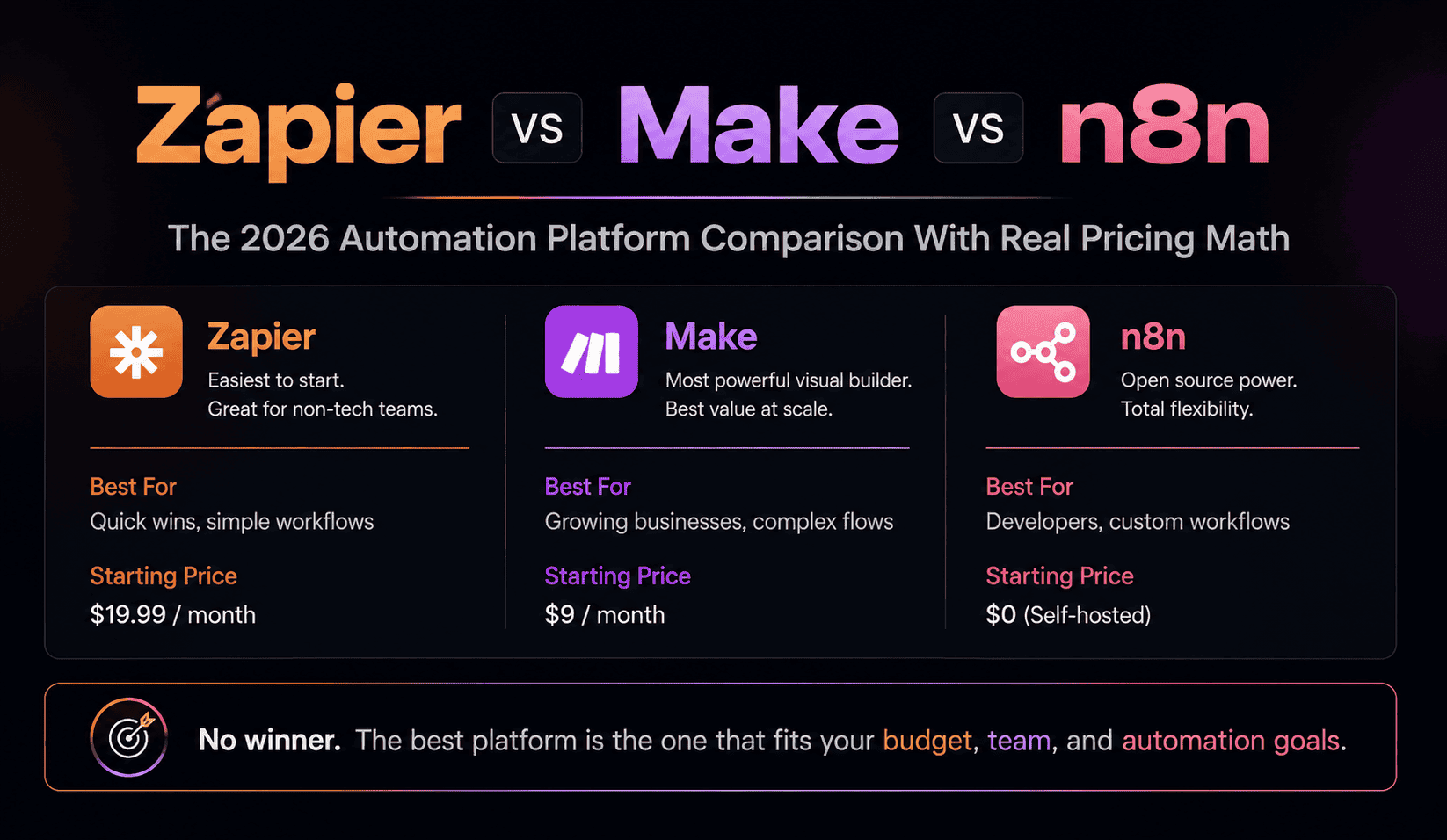
Zapier
vs
Make
vs
n8n
The Automation Platform Comparison With Real Pricing Math
At 10,000 workflow runs per month with 8 steps each: Zapier costs $250–$400+. Make costs $150–$200. n8n costs $50. That 5–8x price gap exists because these platforms bill completely differently, and most comparisons do not explain how. Here is what actually determines your choice.
The Billing Difference Most Articles Miss, and Why It Matters Most
Before comparing features or integrations, understand how each platform charges you. This is the single most important factor at scale, and it is misunderstood by most comparison articles that show only base plan prices.
How Each Platform Counts Usage: The Critical Difference
This billing difference is why n8n is 5–8x cheaper for complex workflows. A workflow with a trigger + filter + 6 actions = 8 tasks on Zapier, 8 operations on Make, but 1 execution on n8n. At 10,000 runs/month: Zapier and Make count 80,000 billable units; n8n counts 10,000. As your workflows get more complex, Zapier and Make costs grow linearly with step count. n8n’s cost does not change at all. Complexity is free on n8n.
Real Pricing at Three Volume Levels
These calculations use a realistic mid-complexity workflow: 8 steps per run (trigger + filter + 5 actions + error handler). This is typical for a CRM lead routing workflow, a customer onboarding sequence, or an eCommerce order processing automation.
| Scenario (8-step workflow) | ⚡ Zapier | 🎨 Make | 🔴 n8n Cloud |
|---|---|---|---|
| 500 runs/month (4,000 tasks/ops/5,000 exec) | ~$20–$50/mo (Pro) | ~$10–$16/mo (Core) | ~$20/mo (Starter) |
| 2,000 runs/month (16,000 tasks / 16,000 ops / 2,000 exec) | ~$70–$100/mo | ~$29–$59/mo | ~$20–$50/mo |
| 10,000 runs/month (80,000 tasks / 80,000 ops / 10,000 exec) | $250–$400+/mo | $150–$200/mo | ~$50/mo |
| 50,000 runs/month (400K tasks / 400K ops / 50K exec) | $800–$1,500+/mo | $400–$600/mo | ~$170/mo |
| Self-hosted n8n (any volume) | N/A | N/A | $20–$80/mo (VPS cost only) |
At 10,000 runs/month with a typical 8-step workflow: n8n is approximately 5–8x cheaper than Zapier. For high-volume automation, that difference pays for a developer’s time to set up n8n many times over. For teams processing 50,000+ runs/month, self-hosted n8n at $20–$80/month in server costs vs Zapier at $800–$1,500+/month is the single strongest business case for switching. Zapier’s premium is justified when developer time avoided (non-technical teams building in 15 minutes vs. hours of technical setup) outweighs the subscription cost.
Platform Summaries: What Each Actually Does Best
⚡ Zapier: The Integration King
- 8,000+ integrations, the largest catalog of any automation platform. If an app exists, Zapier probably connects to it. For obscure B2B tools, there is approximately a 95% chance Zapier already has a native connector.
- Simplest UX in the category, trigger-action-filter model learnable in under 2 hours with no technical knowledge. Form-based interface rather than visual canvas or code editor. Setup experience is the cleanest available.
- 2026 AI updates: Zapier Agents (autonomous AI task execution across 8,000+ apps), AI Copilot (builds Zaps from natural language descriptions), MCP (Model Context Protocol) support for connecting Claude and ChatGPT to 8,000+ apps.
- Premium pricing: $20/month Starter through $100+/month Professional. Charges per task, every workflow step counts. Gets expensive fast for complex, high-volume workflows.
- Linear format limitation: Zapier’s trigger-then-actions model handles simple and moderately complex workflows elegantly but hits structural limits for branching logic and parallel processing that Make and n8n handle natively.
🎨 Make: The Visual Power Tool
- Visual canvas builder, the most intuitive way to understand complex workflows. You can trace exactly how data flows across your automation at a glance. Branching paths, parallel processing, and looping logic are visual, not described in code.
- 2,000+ integrations with notably deeper configuration per connection than Zapier, Google Sheets, Salesforce, and HubSpot integrations expose more functionality per connected module.
- 2026 AI updates: Maia AI assistant (builds scenarios from natural language), Make AI Agents (autonomous task execution, October 2025), Make Grid (enterprise-wide automation governance).
- Best price-to-complexity ratio: Handles workflows that require Zapier’s premium plans at approximately 60% lower cost. Generous free tier (1,000 operations/month with 2 active scenarios). Part of the Celonis ecosystem, Vodafone (£2.2M saved), Delivery Hero (200+ hours/month), Lufthansa, Siemens.
- European HQ advantage: Make is Czech-based (Celonis-owned), EU data residency is naturally easier for GDPR compliance than Zapier’s US-hosted infrastructure.
🔴 n8n: The Developer’s Automation Platform
- Open-source + self-hostable: run n8n on your own servers with zero execution fees. Pay only for server infrastructure ($20–$80/month on a VPS handles most business volumes).
- n8n 2.0 (January 2026): native LangChain integration, 70+ AI nodes (OpenAI, Anthropic Claude, Ollama, Google Gemini, Cohere), persistent agent memory across executions, sandboxed JavaScript/Python code execution, self-hosted LLM support, vector database integrations for RAG workflows.
- AI agent lead: assessed as 12–18 months ahead of Zapier and Make for complex AI orchestration as of June 2026. The only platform where agents can have memory, execute multi-step reasoning, and orchestrate other AI agents natively.
- Per-execution pricing: entire workflow = 1 execution. A 50-step workflow costs the same as a 2-step workflow. n8n Cloud from ~$20/month (Starter). $55M Series B funding (2024), now a serious enterprise contender.
- Technical requirement: Node.js knowledge helpful for custom function nodes. JSON expression editor exposed. Not appropriate for non-technical teams without developer support.
AI Capabilities: The 2026 Differentiator
All three platforms added significant AI capabilities in 2025–2026. But their approaches, and the resulting capabilities, differ fundamentally. This is where n8n has created the clearest competitive differentiation.
🔴 n8n AI: The Most Advanced Architecture
n8n 2.0’s native LangChain integration treats AI agents as first-class workflow citizens rather than API calls. 70+ AI-specific nodes cover: LLM integration (OpenAI GPT-4o, Anthropic Claude, Gemini, Mistral, Llama via Ollama), agent memory (persistent conversation history across workflow executions), vector database nodes (Pinecone, Weaviate, Qdrant for semantic search), tool nodes (agents can call other n8n nodes as tools), and human-in-the-loop patterns (pause for human approval within automated workflows). You can wire in your own local models via Ollama, connect your own vector databases, and build RAG systems entirely within n8n, with no data leaving your infrastructure if self-hosted. For teams building AI automation, LLM-powered workflows with conditional reasoning and persistent memory, n8n is 12–18 months ahead of competitors as of June 2026.
⚡ Zapier AI: Breadth and Accessibility
Zapier Agents enable autonomous AI task execution across 8,000+ apps, a non-technical user can deploy an agent that monitors email, extracts data, updates CRM records, and sends Slack notifications without writing a line of code. The AI Copilot builds complete Zap configurations from natural language descriptions. MCP (Model Context Protocol) support lets Claude and ChatGPT directly access and trigger Zapier’s 8,000+ app catalog through conversational interfaces. Zapier’s AI advantage is breadth, the combination of the largest app catalog with AI execution means agents can take action in more tools than any competitor. The limitation: Zapier treats AI as another API call rather than building a native agent architecture with memory and reasoning.
🎨 Make AI: Maia and Active Development
Maia AI assistant builds Make scenarios from natural language descriptions, describe what you want automated, Maia generates the canvas workflow for review and modification. Make AI Agents (October 2025) enable autonomous task execution with multi-step decision making. Make’s AI capabilities are in active development and improving rapidly but trail n8n’s LangChain-native architecture for complex agent workflows. Make’s advantage: AI scenario building is more visually intuitive than n8n’s node-based AI setup, non-technical users can deploy AI-augmented workflows more easily than n8n while accessing more complex logic than Zapier allows.
Head-to-Head: 12 Key Decision Factors
| Factor | ⚡ Zapier | 🎨 Make | 🔴 n8n |
|---|---|---|---|
| Ease of Use | Best. No technical knowledge. <2 hrs to first automation. | Visual canvas. Moderate learning. Manageable for non-dev. | Most technical. JSON, expressions, developer-native. |
| Integrations | 8,000+ native. Widest catalog. 95% app coverage. | 2,000+ with deeper per-app config depth. | 1,000+ native + unlimited via HTTP Request node. |
| Pricing at Scale | Most expensive. Per-task. 80K tasks at 10K runs/mo. | Mid-range. Per-operation. 60% less than Zapier. | Cheapest. Per-execution. 10K executions regardless of steps. |
| Complex Logic | Linear format. Branching limited. Simpler workflows. | Visual canvas handles branching, loops, parallel processing. | Node-based. Unlimited complexity. Conditional branching, loops. |
| AI Agents (2026) | Zapier Agents + MCP. Breadth + accessibility. | Maia AI + Make Agents. Visual AI workflow building. | LangChain native. 70+ AI nodes. Memory. RAG. 12–18mo ahead. |
| Self-Hosting | Cloud only. No self-hosting option. | Cloud only. No self-hosting option. | Fully self-hostable. Open-source. $0 execution fees. |
| Data Sovereignty | US-hosted. GDPR requires compliance configuration. | EU-hosted (Czech Republic/Celonis). Easier GDPR. | Self-hosted = your data stays on your servers. Full sovereignty. |
| Free Tier | 100 tasks/month (very limited). 5 Zaps. | 1,000 operations/month + 2 active scenarios. More useful. | n8n Community (self-hosted) = unlimited free. |
| Error Handling | Basic. Email notifications when Zap fails. | Visual error routes. Fallback scenarios built into canvas. | Developer-grade. Custom error handling per node. |
| Workflow Complexity | Up to ~20 steps comfortably. Complex = awkward. | Handles 50+ steps visually. Best complex visual UX. | Unlimited. Code execution. Sub-workflows. No practical limit. |
| Custom Code | Code by Zapier (JS/Python). Limited. | HTTP module + basic expressions. | Full JS/Python execution nodes. npm packages available. |
| Enterprise Features | SSO, audit logs, admin controls, SLA. | Make Grid for enterprise governance (2026). | Self-hosted enterprise control. Cloud: SSO and audit logs. |
A2Z Dev Center: HubSpot + WooCommerce Automation Stack
A2Z Dev Center builds automation stacks for clients integrating HubSpot CRM, WooCommerce, WordPress, and marketing tools. Our platform recommendation depends on team technical capacity and workflow complexity.
⚡ When We Recommend Zapier for Clients
For clients where the marketing team manages automation without developer support, Zapier is the right choice. HubSpot + WooCommerce + Mailchimp + Slack + Google Sheets via Zapier, all connected without touching code. A HubSpot form submission triggers a Zap that creates a WooCommerce customer, adds them to a Mailchimp list, notifies the sales team in Slack, and logs to Google Sheets. Setup time: under 2 hours. Maintenance: marketing coordinator can update triggers and actions independently. At 500–2,000 runs/month (typical for most SMB clients), Zapier’s pricing is manageable at $20–$70/month.
🔴 When We Recommend n8n for Clients
For clients with developer resources and complex automation needs, multi-step order processing, AI-powered lead scoring, GDPR-compliant data workflows, or volume above 5,000 runs/month, n8n self-hosted is the right recommendation. WooCommerce order webhook → n8n processes → updates HubSpot deal stage → checks inventory via REST API → triggers fulfillment → sends customer email via SendGrid → logs to Airtable → if high-value order, creates HubSpot task for account manager. A 12-step workflow on Zapier costs 12 tasks × volume. On n8n, it costs 1 execution × volume. At 5,000 runs/month: Zapier $150–$250/month vs n8n self-hosted ~$40/month (VPS cost).
Use Case Decision Guide
When to Choose Each Platform
⚡ Choose Zapier When
- Non-technical team builds and maintains automations
- You need the widest integration catalog (8,000+ apps)
- Speed of setup is the primary priority
- Volume is under 5,000 runs/month
- AI Agents with breadth (8,000 apps) matters more than AI depth
- MCP for Claude/ChatGPT + 8,000 apps is your AI integration strategy
- Budget for premium UX is available
🎨 Choose Make When
- Complex visual workflows with branching and parallel paths
- Zapier pricing is too high but technical staff are unavailable
- GDPR and EU data residency matters (EU-HQ)
- Visual error handling and fallback scenarios are important
- Free tier for testing is important (1,000 ops/month)
- Volume between 2,000–20,000 runs/month
- Enterprise governance needed (Make Grid)
🔴 Choose n8n When
- Developer or technical team available
- Volume exceeds 10,000 runs/month
- Self-hosting required for data sovereignty or GDPR
- AI agent workflows with LangChain, persistent memory, RAG
- Custom code execution (JS/Python) needed in workflows
- Budget is constrained and volume is high
- Building complex multi-agent AI systems
Frequently Asked Questions
The questions teams ask most when choosing between Zapier, Make, and n8n in 2026.
Building a HubSpot + WooCommerce Automation Stack?
A2Z Dev Center builds automation workflows connecting HubSpot CRM, WooCommerce, WordPress, email platforms, and third-party APIs, using Zapier for non-technical client teams and n8n (self-hosted) for high-volume or developer-managed automation programs. We recommend the right platform based on your team’s technical capacity and workflow volume, then implement it with SEO and CRM integrated from sprint 1 at $40–$80/hr.
Build Your Automation Stack →Talk to a subject-matter expert
Web development, SEO, or digital marketing — tell us about your project and we'll get back within one business day. No obligation.
- Free scope & strategy session
- A senior specialist, not a sales rep
- Your details stay confidential