
Hubspot
Summarize this blog post with:
2026 Rankings · Healthcare Software Development · USA
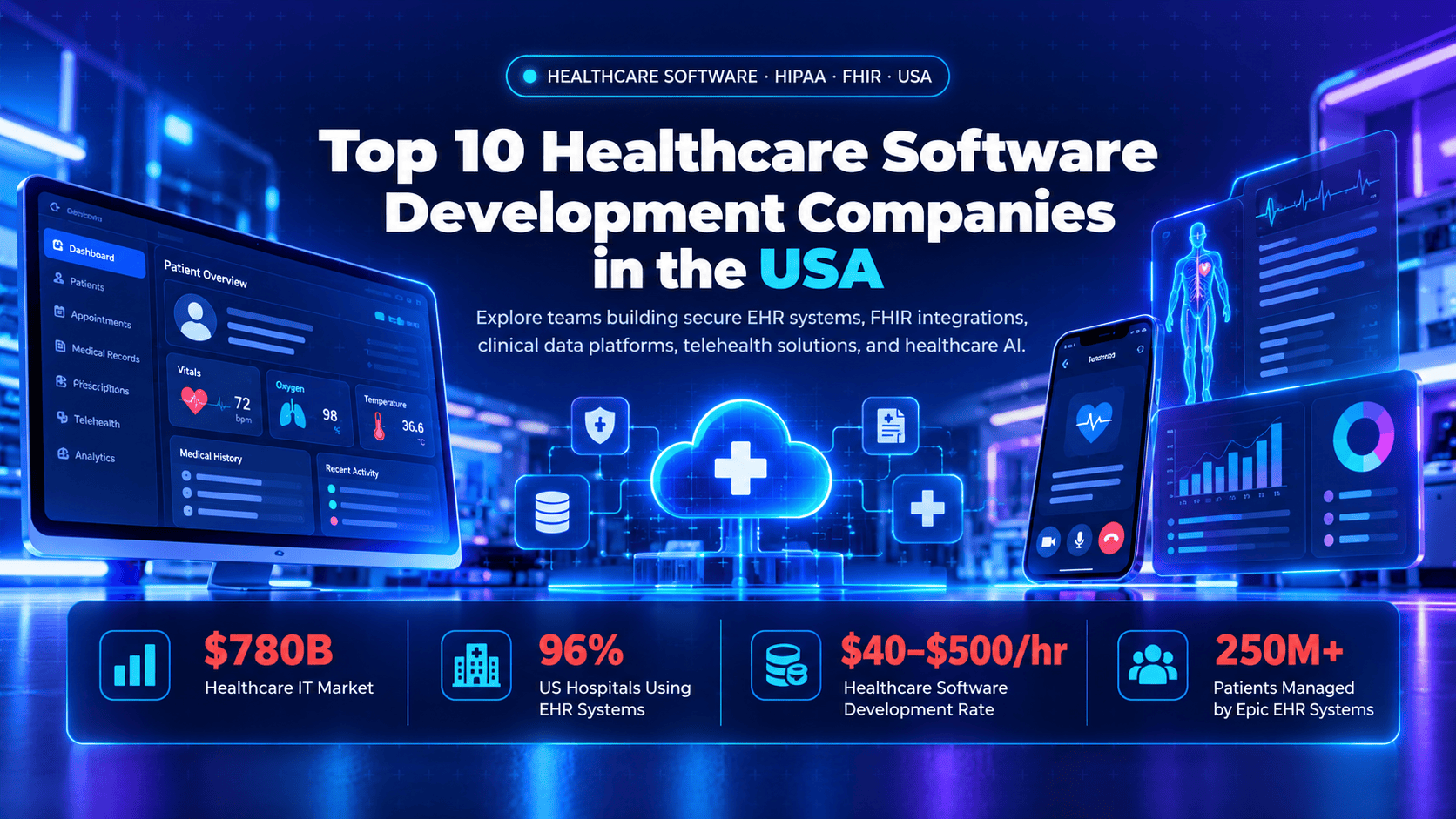
Top 10 Healthcare Software Development Companies in the USA (2026)
Compare the best healthcare software development companies in the USA for 2026. Expert reviews of HIPAA-compliant EHR development, FHIR integration, clinical data warehousing, telehealth platforms, and healthcare AI/ML firms.
Why Specialized Healthcare Software Development Matters in 2026
Healthcare software development operates under a fundamentally different set of constraints than general enterprise software. Every application that handles Protected Health Information (PHI) must be architected for HIPAA compliance from the ground up, not bolted on after the fact. The 21st Century Cures Act mandates open HL7 FHIR R4 API access to patient data, while CMS interoperability rules require health plans and providers to enable patient data portability. Getting these requirements wrong exposes healthcare organizations to OCR enforcement actions and fines that routinely reach millions of dollars.
The technical complexity of healthcare software is compounded by the clinical environment it must integrate with. Building a patient portal is not just a web development project, it requires SMART on FHIR authorization, integration with a specific EHR’s API, patient identity matching logic, and clinical terminology mapping across SNOMED CT, LOINC, and RxNorm coding systems. A clinical data warehouse is not just a data engineering project, it requires understanding ADT event streams, clinical document structures, and OMOP Common Data Model transformation for population health analytics.
This guide evaluates the top 10 healthcare software development companies in the USA based on HIPAA compliance expertise, HL7 FHIR integration depth, EHR platform experience, clinical data architecture capability, and verified outcomes from healthcare client engagements. Whether you need a FHIR integration layer, a custom clinical application, or a full healthcare data platform, these firms have the domain expertise to deliver.
How We Ranked These 10 Healthcare Software Development Companies
Rankings based on our evaluation of HIPAA compliance expertise, HL7 FHIR integration depth, EHR platform experience, Clutch/KLAS ratings, and verified healthcare client outcomes. Ranked by: Clutch score · Review count · USA market expertise.
How We Ranked These 10 Healthcare Software Development Companies
✓HIPAA-Compliant Development
✓HL7 FHIR Integration
✓EHR/EMR Development
✓Clinical Data Warehousing
✓Healthcare AI/ML
✓Patient Portal Development
✓Telehealth Platforms
✓Healthcare Interoperability
The Top 10 Healthcare Software Development Companies in the USA (2026)
#1
Epic Systems
4.7Clutch Rating
Contact for pricingHourly Rate
EHR Market LeaderClutch Reviews
About Epic Systems
Epic Systems is the dominant EHR platform in the USA, powering over 250 million patient records across major health systems including Kaiser Permanente, Mayo Clinic, Johns Hopkins, and Cleveland Clinic. With a market share exceeding 35% among US hospitals, Epic’s MyChart patient portal, Cogito analytics suite, and App Orchard ecosystem define the standard for large health system technology infrastructure.
Core Services
💡 Best for: Large Health System EHR
📍 Verona, WI
#2
Cognizant
4.5Clutch Rating
$150-$250/hrHourly Rate
Global IT ServicesClutch Reviews
About Cognizant
Cognizant is one of the largest healthcare IT services companies in the USA, with a dedicated healthcare practice serving payers, providers, pharmaceutical companies, and medical device manufacturers. Their TriZetto healthcare platform (acquired by Cognizant) powers a significant portion of US health insurance claims processing, giving the firm deep payer-side expertise that few competitors match.
Core Services
💡 Best for: Large Payer + Provider IT
📍 Teaneck, NJ
#3
Deloitte
4.6Clutch Rating
$250-$500/hrHourly Rate
Big Four ConsultingClutch Reviews
About Deloitte
Deloitte operates one of the largest healthcare consulting practices in the world, combining technology implementation with strategic advisory in value-based care, health equity, regulatory compliance, and clinical operations transformation. Their Life Sciences and Healthcare sector practice is regularly ranked among the top healthcare consulting firms globally.
Core Services
💡 Best for: Healthcare Strategy & AI
📍 New York, NY
#4
Accenture
4.5Clutch Rating
$200-$450/hrHourly Rate
Global SIClutch Reviews
About Accenture
Accenture brings global scale to healthcare software development and digital health transformation, with practices spanning hospital systems, health insurance companies, pharmaceutical firms, and government health agencies. Their acquisition of several healthcare IT boutiques has deepened capabilities in clinical workflow design, telehealth platform development, and AI-powered clinical decision support.
Core Services
💡 Best for: Digital Health Transformation
📍 New York, NY
#5
Inovalon
4.6Clutch Rating
$SaaS + ServicesHourly Rate
Healthcare Data PlatformClutch Reviews
About Inovalon
Inovalon is a Maryland-based healthcare technology company specializing in cloud-based healthcare data analytics platforms that help payers, providers, and pharmaceutical companies improve clinical outcomes and operational efficiency. Their platform processes billions of medical events annually, powering quality measure reporting, care gap analysis, and population health management at national scale.
Core Services
💡 Best for: Payer Analytics & Quality
📍 Bowie, MD
#6
Cerner (Oracle Health)
4.4Clutch Rating
Contact for pricingHourly Rate
Major EHR VendorClutch Reviews
About Cerner (Oracle Health)
Cerner, now operating as Oracle Health following Oracle’s acquisition, is one of the two dominant EHR platforms in the USA alongside Epic. Cerner’s PowerChart clinical documentation system is installed across thousands of hospitals, ambulatory clinics, and government health facilities including the VA’s Oracle Cerner EHR deployment, the largest federal EHR implementation in history.
Core Services
💡 Best for: Government & Large Provider
📍 Kansas City, MO
#7
TCS (Tata Consultancy Services)
4.4Clutch Rating
$100-$175/hrHourly Rate
Global IT ServicesClutch Reviews
About TCS (Tata Consultancy Services)
TCS (Tata Consultancy Services) provides large-scale healthcare IT services to US health systems, payers, and life sciences companies, with particular strength in multi-year EHR implementation programs, claims processing modernization, and healthcare data migration projects. Their global delivery model allows healthcare organizations to staff large implementation programs at lower cost than US-only consulting firms.
Core Services
💡 Best for: Large-Scale EHR Programs
📍 New York, NY
#8
Netsmart Technologies
4.6Clutch Rating
$SaaS + ImplementationHourly Rate
Behavioral Health SpecialistClutch Reviews
About Netsmart Technologies
Netsmart Technologies is the leading behavioral health and post-acute care EHR company in the USA, serving over 750,000 clinicians at more than 40,000 organizations including community mental health centers, substance use disorder treatment facilities, intellectual and developmental disabilities (IDD) providers, and long-term post-acute care organizations.
Core Services
💡 Best for: Behavioral & Post-Acute EHR
📍 Overland Park, KS
#9
Meditech
4.4Clutch Rating
Contact for pricingHourly Rate
Community Hospital EHRClutch Reviews
About Meditech
Meditech is a Canton, MA-based EHR company that has served community hospitals and rural health systems for over 50 years. Their Meditech Expanse cloud-based EHR platform is particularly popular among community hospitals, critical access hospitals, and multi-site rural health networks that find Epic and Cerner pricing and implementation complexity prohibitive.
Core Services
💡 Best for: Community & Rural Hospitals
📍 Canton, MA
#10
Jelvix
Healthcare software engineering
10+ years in healthcareCompany-Reported
ISO 27001, 27701, 9001, 13485Certifications Listed
Not listedClutch Rating
Not publishedHourly Rate
About Jelvix
Jelvix is a software engineering firm that reports hands-on HIPAA experience and says it has worked in healthcare for over a decade. It lists ISO 27001, ISO 27701, ISO 9001, and ISO 13485 certifications, which cover information security, privacy management, quality management, and medical-device quality systems.
We could not confirm its headquarters, headcount, or named healthcare clients from public sources, so treat the certification and experience claims as self-reported. Ask for HL7 and FHIR integration references, a compliance walkthrough, and rates before shortlisting.
Core Services
💡 Best for: Healthcare product teams that want an independent engineering partner with HIPAA experience and quality certifications.
📍 U.S. clients · headquarters not verified here
Quick Comparison: Top 10 Companies
All rankings based on Clutch verified reviews, September 2026. Entry 10 is based on the firm’s own published information and its Clutch listing where available.
| # | Company | Rating | Status | Rate | Best For | Why Choose |
|---|---|---|---|---|---|---|
| 1 | Epic Systems | ★★★★☆ 4.7 | EHR Platform | Contact | Large Health System EHR | Market-leading EHR, MyChart, Cogito, Cosmos analytics |
| 2 | Cognizant | ★★★★☆ 4.5 | Healthcare IT Scale | $150-$250/hr | Large Payer + Provider IT | TriZetto payer platform, RCM, EHR implementation |
| 3 | Deloitte | ★★★★☆ 4.6 | Strategy + Tech | $250-$500/hr | Healthcare Strategy & AI | Value-based care, analytics strategy, clinical AI |
| 4 | Accenture | ★★★★☆ 4.5 | Global SI | $200-$450/hr | Digital Health Transformation | Telehealth, EHR consolidation, Life Sciences |
| 5 | Inovalon | ★★★★☆ 4.6 | Data Platform | SaaS | Payer Analytics & Quality | HEDIS, population health, claims analytics platform |
| 6 | Oracle Health (Cerner) | ★★★★☆ 4.4 | Major EHR Vendor | Contact | Government & Large Provider | VA deployment, revenue cycle, Oracle cloud integration |
| 7 | TCS | ★★★★☆ 4.4 | Global IT Services | $100-$175/hr | Large-Scale EHR Programs | Cost-effective multi-year EHR and claims modernization |
| 8 | Netsmart | ★★★★☆ 4.6 | Behavioral Health | SaaS | Behavioral & Post-Acute EHR | myAvatar, mental health, substance use, IDD providers |
| 9 | Meditech | ★★★★☆ 4.4 | Community EHR | Contact | Community & Rural Hospitals | Expanse cloud EHR, cost-effective for smaller systems |
| 10 | Jelvix | Not listed | ISO-certified (self-reported) | Not published | Healthcare product teams | HIPAA experience with four ISO certifications listed |
Frequently Asked Questions
Common questions about top 10 healthcare software development companies in the USA.
Who are the best healthcare software development companies in the USA?
Based on this ranking, the best healthcare software development companies in the USA are Epic Systems, Cognizant, and Deloitte. The comparison table above lists each firm’s rating, rate, and best-fit use case, so you can match one to your project and budget.
What does a healthcare software development company do?
A healthcare software development company designs, builds, and integrates clinical and administrative applications that meet healthcare-specific regulatory, interoperability, and security requirements. Core services include custom EHR/EMR development, HL7 FHIR API integration, HIPAA-compliant application architecture, patient portal and telehealth platform development, clinical data warehouse construction, and healthcare AI/ML model integration into clinical workflows.
Healthcare software development is technically distinct from general software development because it requires PHI (Protected Health Information) security architecture, compliance with 21st Century Cures Act interoperability rules, familiarity with HL7 FHIR R4 standards, and understanding of clinical workflows across inpatient, ambulatory, behavioral health, and post-acute care settings. Experienced healthcare software firms also understand ONC certification requirements, CMS quality reporting mandates, and the practical realities of integrating with dominant EHR platforms like Epic, Cerner, and Meditech.
How much does HIPAA-compliant software development cost?
HIPAA-compliant healthcare software development costs vary widely by application complexity and engagement scope. A focused integration project, such as a FHIR API connector between two healthcare systems, typically runs $15,000-$50,000. A complete patient portal with secure messaging, appointment scheduling, and health record access ranges from $60,000-$200,000 depending on EHR integration complexity. A custom clinical module or specialized application (telehealth platform, RPM dashboard, care coordination tool) typically starts at $100,000-$500,000+.
HIPAA compliance engineering adds meaningful cost, including PHI encryption architecture, audit logging infrastructure, penetration testing, BAA documentation, and risk assessment, but is non-negotiable for any application handling protected health information. Hourly rates for experienced healthcare software developers range from $40-$80/hr at boutique specialists to $200-$500/hr at large consulting firms.
What is HL7 FHIR and why does it matter?
HL7 FHIR (Fast Healthcare Interoperability Resources) is the modern standard for healthcare data exchange, replacing older HL7 v2.x and CCD/CDA document exchange formats. FHIR defines a RESTful API framework with standardized resource types, Patient, Observation, Condition, MedicationRequest, DiagnosticReport, and hundreds more, that allow healthcare systems to exchange clinical data in a consistent, queryable format over standard HTTPS connections.
FHIR matters in 2026 because it is now legally required: the 21st Century Cures Act mandates that EHR vendors and health systems expose patient data through FHIR R4 APIs without information blocking. This opens new possibilities for digital health app development using SMART on FHIR authorization, patient data portability applications, and clinical decision support tools that pull real-time EHR data. Any healthcare software development company building modern clinical integrations must have deep FHIR implementation experience.
What healthcare software certifications should developers have?
When evaluating healthcare software development companies, look for evidence of specific technical and compliance expertise rather than generic certifications. Key markers include: HIPAA Security Rule implementation experience with documented risk assessment methodology; HL7 FHIR R4 API integration experience with named EHR systems (Epic, Cerner, Meditech); SMART on FHIR application development for EHR-embedded apps; and HITRUST CSF or SOC 2 Type II compliance in their own development and operations environment.
At the firm level, look for ONC Health IT Certification body experience if the engagement involves certifiable EHR features, and Microsoft Azure Healthcare APIs, AWS HealthLake, or Google Cloud Healthcare API implementation credentials for cloud-based health data platform work. Client references from healthcare organizations that passed ONC certification audits or HITRUST assessments using software built by the firm are the strongest signal of real compliance capability.
What is the difference between an EHR and an EMR?
An EMR (Electronic Medical Record) is a digital version of a patient’s chart within a single practice or clinic, containing the medical and treatment history of a patient at one provider organization. EMRs are designed primarily for use by clinicians within that practice and typically do not travel outside the organization that created them.
An EHR (Electronic Health Record) is a broader, more interoperable concept, designed to share information across multiple providers, health systems, and care settings. EHRs are built to exchange data through Health Information Exchanges (HIEs), CommonWell, Carequality, and now FHIR R4 APIs, enabling a primary care physician to see the emergency department records from a different health system. In practice, the terms are often used interchangeably in the market, but the distinction matters when evaluating interoperability requirements: a true EHR system must support data exchange beyond the walls of a single organization, which drives the technical architecture decisions a healthcare software development company must make.
Bottom Line: Which USA Company Is Right for You?
The best healthcare software development companies in the USA combine deep HIPAA compliance engineering with clinical domain knowledge and modern HL7 FHIR interoperability expertise. The right vendor depends heavily on your organization’s specific needs: large health systems may need an Epic-certified implementation partner like Cognizant or Accenture; behavioral health organizations need Netsmart’s specialized clinical workflows; community hospitals evaluating EHR platforms should consider Meditech Expanse as a cost-effective alternative to enterprise platforms.
When comparing healthcare software partners, separate EHR vendors from builders. Vendors sell the platform, while development partners build integrations, apps, and workflows around it. Ask for HIPAA and HL7 FHIR references, how protected health information is handled in development, and who signs the business associate agreement.
Related reading: Top Custom Software Development Companies in the USA · Top Cloud Computing Services Companies in the USA · Top Cybersecurity Companies for SMBs in the USA · Top 10 Data Engineering Companies in the USA
Schedule a call
Talk to a subject-matter expert
Web development, SEO, or digital marketing — tell us about your project and we'll get back within one business day. No obligation.
- Free scope & strategy session
- A senior specialist, not a sales rep
- Your details stay confidential