
Top 10
Summarize this blog post with:
2026 Rankings · Fintech Software Development · USA
Top 10 Fintech Software Development Companies in the USA (2026)
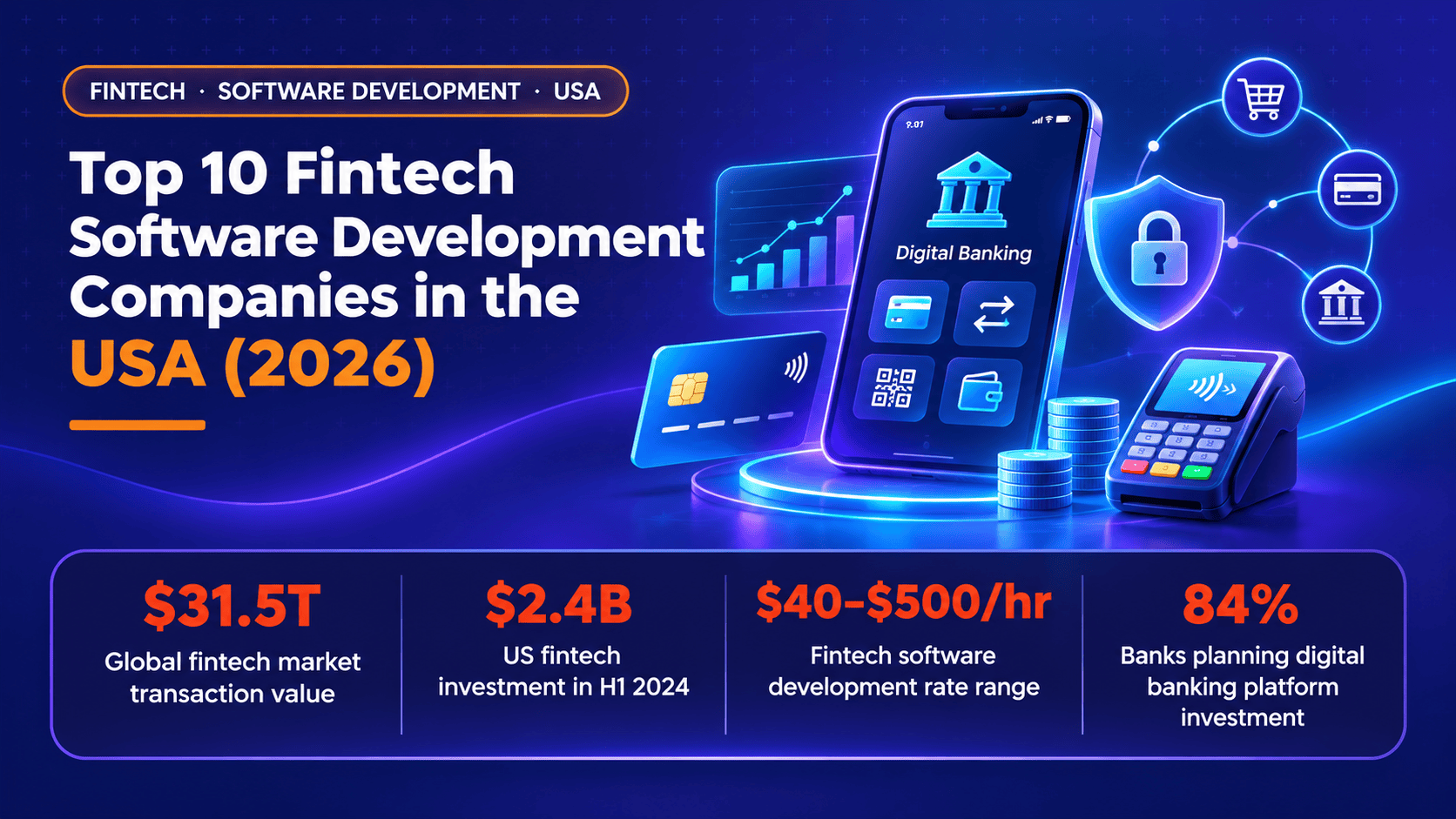
Compare the best fintech software development companies in the USA for 2026. Expert reviews of firms building payment platforms, digital banking apps, lending technology, RegTech, AML/KYC systems, and open banking APIs.
Why Specialized Fintech Development Expertise Matters in 2026
Fintech software development sits at the intersection of cutting-edge technology and one of the most heavily regulated industries in the world. An application that handles payment card data must be built to PCI DSS v4.0 standards. A digital banking product serving US consumers must navigate CFPB open banking rules, FFIEC cybersecurity guidelines, and state money transmitter licensing. A lending platform must automate TRID disclosures, HMDA reporting, and ECOA adverse action notices. Getting these right requires financial domain expertise that cannot be quickly acquired, it must be earned through real engagements with real regulatory consequences.
The technical architecture of financial applications also demands a different standard of reliability. A payment processing engine that goes down for two hours costs merchants thousands in lost sales and erodes brand trust permanently. A fraud detection model with a 0.5% false positive rate on a platform processing 10 million transactions monthly generates 50,000 wrongly declined transactions per month. A core banking system with data consistency bugs creates regulatory exposure that can result in enforcement actions. The best fintech software development companies understand these stakes and architect for the reliability, auditability, and security standards the financial sector requires.
This guide evaluates the top 10 fintech software development companies in the USA based on financial domain expertise, PCI DSS and regulatory compliance capability, payment and banking API integration depth, AI and fraud detection engineering, and verified client outcomes. Whether you need a targeted payment integration, a full digital banking platform, or end-to-end lending technology, these firms have the expertise to deliver to financial industry standards.
How We Ranked These 10 Fintech Software Development Companies
Rankings based on our evaluation of financial domain expertise, PCI DSS and regulatory compliance capability, payment and banking API integration depth, Clutch/G2 ratings, and verified client outcomes. Ranked by: Clutch score · Review count · USA market expertise.
How We Ranked These 10 Fintech Software Development Companies
✓Payment Platform Development
✓Digital Banking Apps
✓Lending Technology
✓RegTech & AML
✓Open Banking APIs
✓PCI DSS Compliance
✓Fraud Detection AI
✓InsurTech Platforms
The Top 10 Fintech Software Development Companies in the USA (2026)
#1
FIS Global
4.5Clutch Rating
Contact for pricingHourly Rate
Fintech Platform GiantClutch Reviews
About FIS Global
FIS Global is one of the largest financial technology companies in the world, providing core banking platforms, payment processing infrastructure, and capital markets technology to thousands of financial institutions across the globe. Their Modern Banking Platform and Worldpay payment network power a substantial percentage of global financial transactions.
Core Services
💡 Best for: Core Banking & Payments
📍 Jacksonville, FL
#2
Fiserv
4.5Clutch Rating
Contact for pricingHourly Rate
Financial TechnologyClutch Reviews
About Fiserv
Fiserv serves over 10,000 financial institutions globally and is particularly known for its Clover point-of-sale platform, digital banking solutions, and core account processing systems that power community banks and credit unions across the USA. Their acquisition of First Data created one of the largest integrated payments and banking technology platforms in the market.
Core Services
💡 Best for: Community Bank & Credit Union
📍 Milwaukee, WI
#3
Accenture
4.6Clutch Rating
$200-$450/hrHourly Rate
Global SIClutch Reviews
About Accenture
Accenture’s Financial Services practice is one of the largest globally, serving retail banks, investment banks, insurance companies, payments firms, and capital markets organizations across transformation programs ranging from core banking modernization to embedded finance platform development. Their depth of financial domain expertise, combined with cloud and AI engineering capability, makes them a primary partner for major banks undertaking multiyear technology transformations.
Core Services
💡 Best for: Large Bank Transformation
📍 New York, NY
#4
Deloitte
4.6Clutch Rating
$250-$500/hrHourly Rate
Big Four ConsultingClutch Reviews
About Deloitte
Deloitte brings a powerful combination of regulatory expertise and technology delivery capability to financial services institutions, particularly those navigating complex regulatory environments including Basel III/IV, Dodd-Frank, GDPR for financial data, and FinCEN AML requirements. Their Financial Services practice combines advisory, risk, and technology consulting in ways that pure technology firms cannot match.
Core Services
💡 Best for: Regulatory + Tech Combined
📍 New York, NY
#5
Cognizant
4.5Clutch Rating
$120-$200/hrHourly Rate
Global IT ServicesClutch Reviews
About Cognizant
Cognizant serves major US banks, insurance companies, and capital markets firms with large-scale fintech implementation and modernization services. Their financial services practice is particularly strong in insurance technology, policy administration, claims processing, underwriting automation, and digital distribution platform development, alongside deep core banking implementation capabilities on platforms like Temenos, Thought Machine, and Mambu.
Core Services
💡 Best for: Insurance + Core Banking
📍 Teaneck, NJ
#6
Capgemini
4.5Clutch Rating
$150-$275/hrHourly Rate
Global IT + ConsultingClutch Reviews
About Capgemini
Capgemini publishes the widely-cited World Fintech Report annually, reflecting their deep immersion in global fintech trends and technology adoption patterns. Their financial services technology practice covers open banking API platform development, payments modernization including ISO 20022 migration, core banking transformation on cloud-native platforms, and embedded finance product development for non-bank financial service providers.
Core Services
💡 Best for: Open Finance & PSD2
📍 New York, NY
#7
EPAM Systems
4.7Clutch Rating
$125-$225/hrHourly Rate
Engineering-First ConsultingClutch Reviews
About EPAM Systems
EPAM Systems is a Pennsylvania-based engineering consultancy with a strong reputation for fintech product engineering, particularly building complex capital markets systems, trading platforms, payment processing engines, and digital banking products that require deep software architecture expertise rather than platform configuration skills. Their engineering-first culture attracts senior technical talent that pure consulting firms often struggle to retain.
Core Services
💡 Best for: Capital Markets & Platform Builds
📍 Newtown, PA
#8
Infosys BPM
4.4Clutch Rating
$80-$150/hrHourly Rate
Global IT ServicesClutch Reviews
About Infosys BPM
Infosys provides large-scale financial services technology implementation and operations support to major US banks, insurance companies, and capital markets firms. Their Finacle core banking platform powers financial institutions across emerging markets and is gaining traction in the USA as mid-tier banks seek modern alternatives to legacy core systems.
Core Services
💡 Best for: Large-Scale Fintech Ops
📍 Bangalore / USA
#9
NCR Voyix
4.4Clutch Rating
Contact for pricingHourly Rate
Banking & Commerce TechClutch Reviews
About NCR Voyix
NCR Voyix (formerly NCR Corporation, now split into NCR Atleos and NCR Voyix) provides digital banking platforms, ATM and self-service banking technology, and merchant banking solutions to banks, credit unions, and retailers across the USA. Their D3 Banking Technology platform (acquired) delivers modern mobile and online banking experiences that community banks and credit unions use to compete with large national bank digital offerings.
Core Services
💡 Best for: Digital Banking Platform
📍 Atlanta, GA
#10
Softjourn
Founded 2001
2001Founded
300+ (company-reported)Team Size
Silicon Valley, CAHeadquarters
Not publishedHourly Rate
About Softjourn
Softjourn is a software development and IT consulting firm founded in 2001 by Emmy Gengler and Jeff Kreuser, headquartered in Silicon Valley with R&D offices in Ukraine, Poland, and Brazil. It describes expert product teams in fintech and media and entertainment, with fintech work for payment processors, banks, transaction acquirers, expense management systems, and prepaid card issuers.
It reported passing 300 employees by early 2023, though directories list varying ranges. Blockchain is one of its services, but public project detail is limited, so ask for fintech references and compliance experience. Rates are not published.
Core Services
💡 Best for: Fintech product teams that want an engineering partner with payments, banking, and card-program experience.
📍 Silicon Valley, CA · engineering in Ukraine, Poland, and Brazil
Quick Comparison: Top 10 Companies
All rankings based on Clutch verified reviews, September 2026. Entry 10 is based on the firm’s own published information and its Clutch listing where available.
| # | Company | Rating | Status | Rate | Best For | Why Choose |
|---|---|---|---|---|---|---|
| 1 | FIS Global | ★★★★☆ 4.5 | Core Banking Platform | Contact | Core Banking & Payments | Platform giant: Worldpay, Banking-as-a-Service |
| 2 | Fiserv | ★★★★☆ 4.5 | Banking & Payments | Contact | Community Bank & Credit Union | Clover POS, digital banking, card services |
| 3 | Accenture | ★★★★☆ 4.6 | Global SI | $200-$450/hr | Large Bank Transformation | Core banking, ISO 20022, AI fraud systems |
| 4 | Deloitte | ★★★★☆ 4.6 | Big Four Consulting | $250-$500/hr | Regulatory + Tech Combined | Regulatory compliance tech, risk, AML automation |
| 5 | Cognizant | ★★★★☆ 4.5 | Global IT Services | $120-$200/hr | Insurance + Core Banking | TriZetto payer, Temenos/Thought Machine implementations |
| 6 | Capgemini | ★★★★☆ 4.5 | Global IT + Consulting | $150-$275/hr | Open Finance & PSD2 | Open banking, ISO 20022, European regulatory |
| 7 | EPAM Systems | ★★★★☆ 4.7 | Engineering Consulting | $125-$225/hr | Capital Markets & Platform Builds | Trading systems, microservices, engineering-first |
| 8 | Infosys | ★★★★☆ 4.4 | Global IT Services | $80-$150/hr | Large-Scale Fintech Ops | Finacle core banking, high-volume implementations |
| 9 | NCR Voyix | ★★★★☆ 4.4 | Banking & Commerce | Contact | Digital Banking Platform | D3 Banking, ATM software, community bank focus |
| 10 | Softjourn | Not listed | Fintech Engineering | Not published | Fintech product teams | Payments and banking software for processors, banks, and issuers |
Frequently Asked Questions
Common questions about top 10 fintech software development companies in the USA.
Who are the best fintech software development companies in the USA?
Based on this ranking, the best fintech software development companies in the USA are FIS Global, Fiserv, and Accenture. The comparison table above lists each firm’s rating, rate, and best-fit use case, so you can match one to your project and budget.
What does a fintech software development company do?
A fintech software development company builds custom financial technology applications, integrates payment and banking APIs, and engineers regulatory compliance systems for financial institutions, payment companies, insurers, lending platforms, and fintech startups. Core services include payment gateway integration (Stripe, Adyen, Braintree, FedNow), loan origination and management platform development, digital banking application engineering, AML/KYC identity verification workflow automation, fraud detection AI model development, and open banking API platform construction.
Unlike general software development, fintech development requires deep expertise in financial regulatory frameworks (PCI DSS, SOC 2, FFIEC, OCC guidance), financial data security architecture, and the specific APIs, data standards, and integration patterns of the financial services industry, including ISO 20022 payment messaging, NACHA ACH rules, SWIFT connectivity, and credit bureau API integration. Experienced fintech software firms understand both the technology and the regulatory environment it operates in.
How much does fintech software development cost?
Fintech software development costs depend significantly on application complexity and regulatory requirements. A payment integration layer connecting an existing application to Stripe or Plaid typically runs $10,000-$40,000. A complete digital lending platform with loan origination, underwriting automation, credit bureau integration, and TRID-compliant document generation ranges from $150,000-$600,000+. A full digital banking application with account management, payments, and mobile capabilities starts at $200,000-$1M+ depending on feature scope and integration complexity.
PCI DSS compliance engineering, penetration testing, SOC 2 audit preparation, and AML/KYC workflow implementation add meaningful cost to any fintech engagement but are essential for applications handling financial transactions. Hourly rates range from $40-$80/hr for boutique fintech specialists to $200-$500/hr for Big Four consulting firms. For early-stage fintech startups, boutique firms with relevant financial domain experience typically provide better cost-to-value than large SI firms.
What is PCI DSS and why does it matter for fintech applications?
PCI DSS (Payment Card Industry Data Security Standard) is a mandatory security framework that applies to any organization that stores, processes, or transmits payment card data, including credit card numbers, CVVs, and cardholder names. Compliance is enforced by the payment card brands (Visa, Mastercard, AmEx, Discover) through merchant and service provider agreements. Non-compliance can result in fines of $5,000-$100,000 per month and ultimate loss of card processing privileges.
For fintech applications, PCI DSS v4.0 (effective March 2025) requires specific technical controls including network segmentation, tokenization of PANs in storage, TLS 1.2+ for all cardholder data transmission, access logging for all systems in scope, and annual penetration testing. Experienced fintech software development companies architect applications to minimize PCI scope from the start, using hosted payment fields, Stripe Elements, or Adyen Drop-in to keep raw card data off application servers entirely, dramatically reducing compliance burden and audit cost.
What is open banking and how does it affect fintech development?
Open banking is a regulatory and market framework that requires financial institutions to provide third-party access to customer financial data through standardized APIs, when authorized by the customer. In the USA, the CFPB’s Section 1033 rule (finalized in 2024) establishes open banking rights for consumers, requiring banks to support data portability through standardized APIs. In Europe, PSD2 has mandated open banking since 2018.
For fintech software development, open banking creates both opportunity and technical complexity. Fintech apps can now access bank account data, transaction history, and payment initiation capabilities through aggregators like Plaid, MX, Finicity (Mastercard), and Akoya, enabling personal finance management, account verification for onboarding, and bank-to-bank payment initiation without card network involvement. Implementing these integrations correctly requires handling OAuth 2.0 authorization flows, customer consent management, data freshness and caching logic, and API resilience patterns for when bank connections return errors or require re-authentication.
What security certifications should fintech developers have?
When evaluating fintech software development companies, look for demonstrated expertise in the security and compliance frameworks relevant to financial applications. Key markers include: PCI DSS QSA or ISA experience, consultants who have participated in actual PCI audits understand what auditors look for; SOC 2 Type II compliance in the firm’s own operations, indicating they follow security controls they apply to client projects; and FFIEC Information Security Handbook familiarity for firms working with bank-regulated entities.
At the individual practitioner level, look for CISSP, CISM, or CISA certifications on the security architecture team, and familiarity with OWASP Top 10 web application security practices and NIST 800-53 financial control mappings. For AML/KYC work specifically, practitioners with ACAMS (Association of Certified Anti-Money Laundering Specialists) certification bring financial crime domain knowledge that purely technical developers typically lack. Verified client references from financial institutions that passed OCC or state banking examiner reviews of software built by the firm are the strongest signal of real-world regulatory compliance delivery.
Bottom Line: Which USA Company Is Right for You?
The best fintech software development companies in the USA combine deep financial domain knowledge with engineering rigor across PCI DSS compliance, AML/KYC automation, payment processing architecture, and digital banking platform development. The right vendor depends on your organization’s specific needs: large banks undertaking core banking transformation may need Accenture or Deloitte’s combination of regulatory expertise and technology delivery; community banks need FIS, Fiserv, or NCR Voyix platform expertise; capital markets-focused firms should evaluate EPAM’s engineering depth.
When comparing fintech partners, separate platform providers from builders. Processors and core banking vendors supply the rails, while development partners build products on top of them. Ask for compliance references (PCI DSS, SOC 2), how integrations are tested, and who owns the codebase.
Related reading: Top Custom Software Development Companies in the USA · Top Cybersecurity Companies for SMBs in the USA · Top Cloud Computing Services Companies in the USA · Top 10 Enterprise App Modernization and Legacy Migration Companies in the USA
Schedule a call
Talk to a subject-matter expert
Web development, SEO, or digital marketing — tell us about your project and we'll get back within one business day. No obligation.
- Free scope & strategy session
- A senior specialist, not a sales rep
- Your details stay confidential