AI
Summarize this blog post with:
2026 Rankings · Database Development · USA
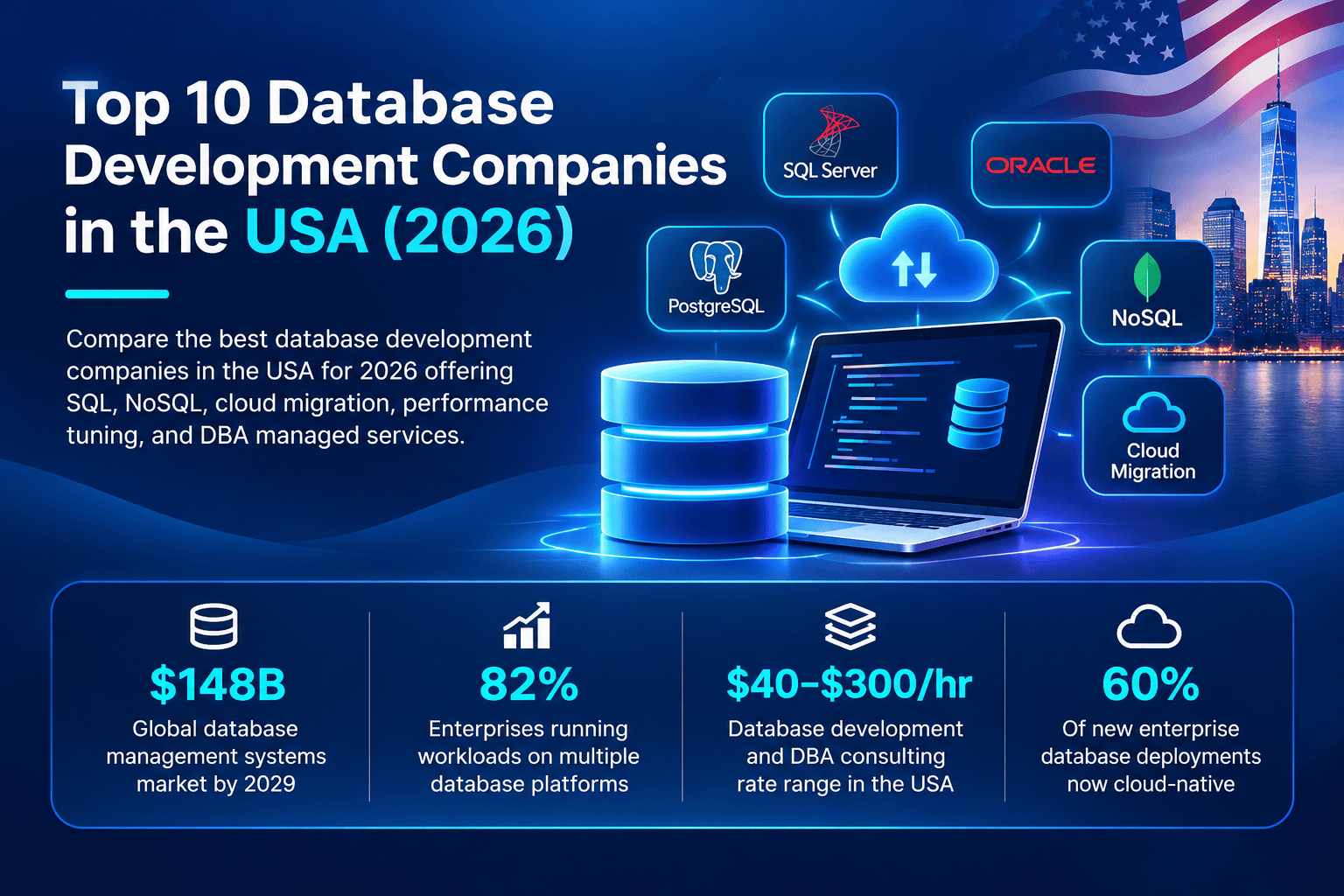
Top 10 Database Development Companies in the USA (2026)
Compare the best database development companies in the USA for 2026. Expert reviews of firms offering SQL Server, Oracle, PostgreSQL, NoSQL, cloud database migration, performance tuning, and DBA managed services.
Why Database Development Expertise Is Mission-Critical in 2026
Every application that stores, retrieves, or analyzes data depends on its database layer performing correctly. A poorly designed database schema causes performance problems that compound over time, what runs adequately at 100,000 rows becomes unusable at 10 million rows without architectural intervention. A missing index on a frequently-filtered column can turn a 20-millisecond query into a 45-second full table scan. A poorly configured high availability setup can turn a 10-minute maintenance window into a 4-hour outage. These are not edge cases, they are predictable consequences of database architecture decisions made early in a system’s life that create technical debt measured in years.
The database landscape in 2026 is more complex than ever. Organizations must choose between relational, document, key-value, graph, time-series, and vector databases, and increasingly run several simultaneously in polyglot persistence architectures. Cloud-native database services (Azure SQL, Amazon Aurora, Google Cloud Spanner, Snowflake) offer operational advantages but require new expertise in provisioning, scaling, cost management, and cloud-specific performance tuning. Meanwhile, organizations still run decades of Oracle, SQL Server, and DB2 infrastructure that needs careful maintenance, modernization planning, and eventual migration to reduce licensing costs and operational burden.
This guide evaluates the top 10 database development companies in the USA based on multi-platform technical depth, performance tuning expertise, cloud database migration capability, NoSQL architecture knowledge, and verified outcomes from real database engagements. Whether you need a targeted performance tuning engagement, a new database design, ongoing DBA managed services, or a cloud migration plan, these firms have the expertise to deliver.
How We Ranked These 10 Database Development Companies
Rankings based on our evaluation of multi-platform database expertise, performance tuning capability, cloud migration experience, Clutch/G2 ratings, and verified database development outcomes. Ranked by: Clutch score · Review count · USA market expertise.
How We Ranked These 10 Database Development Companies
✓SQL Server Development
✓Oracle DBA Services
✓PostgreSQL & MySQL
✓NoSQL Architecture
✓Cloud Database Migration
✓Performance Tuning
✓Database Security
✓DBA Managed Services
The Top 10 Database Development Companies in the USA (2026)
#1
Microsoft (SQL Server & Azure SQL)
4.8Clutch Rating
Contact/LicensingHourly Rate
Database Platform CreatorClutch Reviews
About Microsoft (SQL Server & Azure SQL)
Microsoft is the creator of SQL Server, the most widely deployed enterprise relational database in the USA, and the Azure SQL family of managed cloud database services. SQL Server’s 40-year track record in enterprise applications, combined with the Azure SQL Managed Instance’s near-perfect SQL Server compatibility in a fully managed cloud service, makes Microsoft the dominant database platform for US enterprises running Windows and .NET application stacks.
Core Services
💡 Best for: SQL Server & Azure SQL
📍 Redmond, WA
#2
Oracle
4.6Clutch Rating
Contact/LicensingHourly Rate
Enterprise Database GiantClutch Reviews
About Oracle
Oracle Database remains the gold standard for mission-critical enterprise applications requiring the highest levels of ACID compliance, data integrity, and high availability, powering the financial systems, ERP platforms (SAP, Oracle EBS), and telecommunications infrastructure of the world’s largest enterprises. Oracle’s Autonomous Database on OCI brings self-tuning, self-patching, and self-securing capabilities to cloud Oracle deployments.
Core Services
💡 Best for: Mission-Critical RDBMS
📍 Austin, TX
#3
ScienceSoft
4.7Clutch Rating
$50-$120/hrHourly Rate
IT Consulting FirmClutch Reviews
About ScienceSoft
ScienceSoft is a McKinney, TX-based IT consulting firm with a dedicated database development practice covering SQL Server, PostgreSQL, MySQL, Oracle, MongoDB, and cloud-native database services across Azure, AWS, and GCP. Their database team handles the full spectrum from greenfield schema design to legacy database modernization and cloud migration projects.
Core Services
💡 Best for: Multi-Platform Database Dev
📍 McKinney, TX
#4
Datavail
4.6Clutch Rating
$75-$150/hrHourly Rate
Database Managed ServicesClutch Reviews
About Datavail
Datavail is one of the largest database managed services and DBA consulting firms in the USA, specializing in ongoing Oracle DBA, SQL Server DBA, PostgreSQL DBA, and MySQL DBA services delivered as a managed service model. Their 24×7 database monitoring and support model suits organizations that need expert DBA coverage without the cost and recruiting challenge of hiring senior in-house DBAs.
Core Services
💡 Best for: 24×7 DBA Managed Services
📍 Englewood, CO
#5
Xtivia
4.5Clutch Rating
$80-$150/hrHourly Rate
Database & BI ConsultingClutch Reviews
About Xtivia
Xtivia is a Colorado-based database consulting firm with particular depth in Oracle Database, Oracle E-Business Suite (EBS), and JD Edwards database administration, making them a strong choice for organizations running Oracle ERP systems that need both application database expertise and core Oracle DBA skills in a single engagement.
Core Services
💡 Best for: Oracle ERP Database Admin
📍 Colorado Springs, CO
#6
Percona
4.7Clutch Rating
$100-$200/hrHourly Rate
Open Source DB SpecialistClutch Reviews
About Percona
Percona is the world’s leading open source database consulting and services company, with unparalleled depth in MySQL, MariaDB, PostgreSQL, and MongoDB. Their Percona Server for MySQL and Percona Distribution for PostgreSQL are enhanced open source database distributions used by enterprises worldwide for production workloads that require better performance and observability than the standard community builds provide.
Core Services
💡 Best for: MySQL & PostgreSQL Specialist
📍 Raleigh, NC
#7
Infosys
4.4Clutch Rating
$80-$150/hrHourly Rate
Global IT ServicesClutch Reviews
About Infosys
Infosys provides large-scale database administration and modernization services to Fortune 500 enterprises, with particular strength in managing complex multi-database environments running Oracle, SQL Server, SAP HANA, and DB2 across on-premises and hybrid cloud deployments. Their global DBA delivery model enables 24×7 database support coverage at cost structures that US-only staffing models cannot match.
Core Services
💡 Best for: Large-Scale DBA Ops
📍 Bangalore / USA
#8
Couchbase
4.6Clutch Rating
$SaaS + ServicesHourly Rate
NoSQL PlatformClutch Reviews
About Couchbase
Couchbase provides an enterprise NoSQL document database platform combining JSON document storage, key-value caching, full-text search, and real-time analytics in a single distributed system, reducing the number of separate database technologies organizations need to operate for interactive applications. Their Couchbase Capella fully-managed cloud service removes operational complexity from distributed NoSQL deployments.
Core Services
💡 Best for: JSON Document & Cache DB
📍 Santa Clara, CA
#9
Snowflake
4.7Clutch Rating
$SaaS consumptionHourly Rate
Cloud Data PlatformClutch Reviews
About Snowflake
Snowflake has redefined what a cloud database can be, separating compute from storage to enable elastic scaling, near-instant query performance on petabyte-scale data, and revolutionary data sharing capabilities that allow organizations to share live data across organizational boundaries without copying or moving it. Their platform has become the dominant choice for analytical workloads, data lakehouse architectures, and data sharing applications among US enterprises.
Core Services
💡 Best for: Cloud Data Warehouse
📍 San Mateo, CA
#10
Pythian
Founded 1997
1997Founded
400 (Wikipedia; sources vary)Team Size
Ottawa, CanadaHeadquarters
Not publishedHourly Rate
About Pythian
Pythian is a data and cloud services firm founded in 1997 by Paul Vallée, headquartered in Ottawa, Ontario, with offices in New York City, London, and Hyderabad. It supports Oracle, SQL Server, MySQL, Hadoop, Cassandra, and other databases along with the infrastructure beneath them, and its catalog includes database managed services, cloud consulting, data analytics managed services, and AI automation.
It has partnerships with AWS, Google, and Microsoft, and Mill Point Capital acquired it in 2019. Its main base is outside the U.S., so confirm U.S. delivery coverage and time-zone support. Rates are not published.
Core Services
💡 Best for: Companies that run several database platforms and want a specialist team for operations and migration.
📍 Ottawa, Canada · offices in New York, London, and Hyderabad
Quick Comparison: Top 10 Companies
All rankings based on Clutch verified reviews, September 2026. Entry 10 is based on the firm’s own published information and its Clutch listing where available.
| # | Company | Rating | Status | Rate | Best For | Why Choose |
|---|---|---|---|---|---|---|
| 1 | Microsoft SQL Server | ★★★★☆ 4.8 | Platform Creator | Licensing | SQL Server & Azure SQL | Market-leading relational DB, Azure SQL cloud family |
| 2 | Oracle | ★★★★☆ 4.6 | Enterprise DB Giant | Licensing | Mission-Critical RDBMS | Oracle 23ai, Autonomous DB, Exadata, RAC |
| 3 | ScienceSoft | ★★★★☆ 4.7 | DB Development Firm | $50-$120/hr | Multi-Platform Database Dev | SQL Server, PostgreSQL, MongoDB, cloud migration |
| 4 | Datavail | ★★★★☆ 4.6 | Managed DBA Services | $75-$150/hr | 24×7 DBA Managed Services | Oracle, SQL Server, PostgreSQL managed DBA |
| 5 | Xtivia | ★★★★☆ 4.5 | Oracle & ERP DB | $80-$150/hr | Oracle ERP Database Admin | Oracle EBS, JD Edwards, RAC, GoldenGate |
| 6 | Percona | ★★★★☆ 4.7 | Open Source DB | $100-$200/hr | MySQL & PostgreSQL Specialist | Deepest MySQL/PostgreSQL open source expertise |
| 7 | Infosys | ★★★★☆ 4.4 | Global IT Services | $80-$150/hr | Large-Scale DBA Ops | Multi-database, SAP HANA, Oracle at enterprise scale |
| 8 | Couchbase | ★★★★☆ 4.6 | NoSQL Platform | SaaS | JSON Document & Cache DB | Low-latency NoSQL, Capella cloud, N1QL analytics |
| 9 | Snowflake | ★★★★☆ 4.7 | Cloud Analytics DB | SaaS consumption | Cloud Data Warehouse | Elastic analytics, data sharing, Cortex AI, Snowpark |
| 10 | Pythian | Not listed | Database Managed Services | Not published | Multi-database estates | Oracle, SQL Server, MySQL, and open-source database operations |
Frequently Asked Questions
Common questions about top 10 database development companies in the USA.
Who are the best database development companies in the USA?
Based on this ranking, the best database development companies in the USA are Microsoft (SQL Server & Azure SQL), Oracle, and ScienceSoft. The comparison table above lists each firm’s rating, rate, and best-fit use case, so you can match one to your project and budget.
What does a database development company do?
A database development company designs, builds, optimizes, and maintains the database systems that store and serve an organization’s data. Core services include database schema design and normalization, stored procedure and function development, query performance tuning, index strategy design, high availability and disaster recovery configuration, database migration (on-premises to cloud, or between platforms), NoSQL architecture design, and ongoing DBA managed services.
Database development is distinct from application development because it requires deep knowledge of database engine internals, execution plan analysis, storage engine behavior, concurrency control mechanisms, buffer pool management, alongside data modeling skills and the ability to write efficient SQL, PL/SQL, T-SQL, or query languages for NoSQL platforms. Experienced database development firms understand not just how to write queries, but why a particular query runs slowly and what architectural change will fix it permanently rather than temporarily.
How much does database development cost in the USA?
Database development costs in the USA vary by engagement type and complexity. A database performance tuning engagement, analyzing slow queries, redesigning indexes, restructuring problem queries, typically runs $5,000-$25,000 for a focused 2-4 week engagement and often delivers immediate, measurable impact. A custom database schema design and development project for a new application typically ranges from $10,000-$60,000 depending on complexity and the number of entities, relationships, and business rules that must be encoded in the database layer.
Database migration projects, moving an on-premises Oracle or SQL Server database to Azure SQL, Amazon RDS, or Google Cloud SQL, range from $15,000-$100,000+ depending on database size, stored procedure complexity, and application dependency scope. Ongoing DBA managed services typically run $2,000-$8,000 per month for a single-database managed service covering monitoring, patching, backup management, and on-call incident response. Hourly rates range from $40-$80/hr for boutique specialists to $150-$300/hr for large consulting firms.
What is the difference between SQL and NoSQL databases?
SQL (relational) databases store data in tables with predefined schemas and use SQL (Structured Query Language) for data manipulation. They enforce ACID (Atomicity, Consistency, Isolation, Durability) properties, support complex multi-table JOINs, and are optimized for transactional workloads where data integrity is paramount. Leading examples include SQL Server, Oracle, PostgreSQL, and MySQL. Relational databases are the right choice for financial transactions, inventory systems, HR platforms, and any application where data relationships are complex and integrity constraints are non-negotiable.
NoSQL databases sacrifice strict schema enforcement and JOIN capability in exchange for horizontal scalability, flexible schema evolution, and often dramatically higher write throughput. Different NoSQL types serve different workloads: document databases (MongoDB, Couchbase) store JSON-like documents suited to product catalogs and user profiles; key-value stores (Redis, DynamoDB) provide sub-millisecond lookup by key; column-family databases (Cassandra, HBase) handle high-volume time-series and sensor data; graph databases (Neo4j) model relationship-heavy data like social networks and knowledge graphs. Modern applications increasingly use polyglot persistence, multiple database types in the same architecture, each optimized for its specific workload.
How do I choose the right database for my application?
Choosing the right database starts with understanding your application’s access patterns, how data will be written, read, and queried, rather than defaulting to the most familiar technology. For applications with complex relational data, multi-entity transactions, and reporting requirements, a relational database (PostgreSQL, SQL Server, MySQL) is almost always the correct choice. For high-throughput applications with simple key-based lookups, document databases or key-value stores often outperform relational databases by an order of magnitude at scale.
Consider these dimensions: data structure (structured/tabular vs. document/JSON vs. graph); query complexity (ad-hoc analytical queries favor PostgreSQL or Snowflake; simple key lookups favor Redis or DynamoDB); write volume (Cassandra handles millions of writes per second that SQL databases cannot); consistency requirements (financial transactions need ACID; social media likes tolerate eventual consistency); and team expertise (the best database for your workload that no one on your team can operate well is a bad choice). An experienced database development company can assess these dimensions and recommend the right database architecture, or polyglot combination, for your specific requirements.
What is database performance tuning and when do I need it?
Database performance tuning is the practice of analyzing and improving how a database processes queries, manages memory, and handles concurrent access, resulting in faster query response times, higher transaction throughput, and reduced hardware resource consumption. Signs that a database needs tuning include: queries that take more than 1 second for operational lookups; reports that take minutes to complete; CPU or memory utilization consistently above 80%; blocking and deadlock events in SQL Server or lock wait events in PostgreSQL; and application timeouts during peak traffic periods.
The tuning process typically starts with identifying the top resource-consuming queries using SQL Server Query Store, pg_stat_statements in PostgreSQL, or Oracle AWR reports. Each slow query is analyzed through execution plan review, identifying table scans that should be index seeks, hash joins that should be nested loops, or missing statistics causing poor cardinality estimates. Fixes include index additions or redesigns, query rewrites, statistics updates, partitioning changes, and in some cases schema refactoring where the data model itself is the root cause of performance issues. Professional tuning engagements regularly achieve 10x, 50x query performance improvements on databases that have grown organically without architectural review.
Bottom Line: Which USA Company Is Right for You?
The best database development companies in the USA combine deep technical knowledge of database engine internals with practical experience in performance tuning, cloud database migration, NoSQL architecture, and database security. The right vendor depends on your specific platform and need: Oracle shops with ERP complexity should evaluate Xtivia; organizations needing 24×7 DBA coverage should consider Datavail; MySQL/PostgreSQL-heavy technology companies should look at Percona; and analytics-first organizations building on Snowflake need partners with Data Vault 2.0 and Snowpark expertise.
When comparing database partners, ask which engines each firm runs in production, how performance tuning and backups are tested, and what support hours cover your time zone. Vendors sell the engine, while consultancies design, migrate, and operate it.
Related reading: Top 10 Data Warehousing Companies in the USA · Top 10 Data Engineering Companies in the USA · Top Cloud Computing Services Companies in the USA · Top Custom Software Development Companies in the USA
Schedule a call
Talk to a subject-matter expert
Web development, SEO, or digital marketing — tell us about your project and we'll get back within one business day. No obligation.
- Free scope & strategy session
- A senior specialist, not a sales rep
- Your details stay confidential