SEO
Summarize this blog post with:
Car dealership SEO is the process of optimizing a dealership’s website, Google Business Profile, inventory pages, and service content to appear in local search results, the Google Map Pack, and AI-generated search answers when buyers search for vehicles or services near their location. It is distinct from national brand SEO because every conversion metric, from a phone call to a direction request, is local and intent-driven.
Your car dealership shows up when they search your name. It disappears when they search “Toyota near me.” Those are different problems with completely different causes, and most car dealership SEO guides treat them as the same problem with the same solution. They are not.
When someone types your dealership’s name, Google finds you easily because you have branded signals: your domain, your Google Business Profile, your reviews all pointing to the same entity. When someone types “Toyota near me,” Google is choosing between every Toyota dealership within driving distance based on authority, relevance, and local signals you may not have built. Car buyers use an average of 4.6 websites during the purchase journey, according to Cox Automotive’s 2025 Car Buyer Journey Study. If your dealership is not appearing in that search session, you are absent from the decision entirely.
- 823,000 monthly searches for “car dealerships near me.” “Near me” automotive searches have grown 200% in recent years. The buyers typing these queries are ready to visit, not browsing. 76% of people who search locally visit a business within 24 hours, per Demand Local’s 2026 research.
- 95% of car buyers research online before purchasing (Cox Automotive 2024), spending an average of 14 hours and 19 minutes total across their research journey. If your car dealership SEO is broken, you are invisible during the most influential phase of the purchase decision.
- This guide diagnoses the 5 specific structural reasons your dealership is invisible in “Toyota near me” searches, then gives you the exact fixes for each one, including the June 2025 vehicle listing schema deprecation most dealers have not acted on yet.
- A2Z Dev Center’s local SEO services include car dealership SEO audits, Google Business Profile optimization, VDP content architecture, and local citation building for dealerships that want to appear when buyers search, not just when they already know your name.
Why Does Toyota.com, Cars.com, and AutoTrader Always Outrank Your Dealership?
Before diagnosing your invisibility, you need to understand the competitive landscape you are actually in. When a buyer searches “Toyota near me” or “used Toyota Camry near me,” they are not just competing against other Toyota dealers in your market. They are competing against Toyota’s own national website, Cars.com, AutoTrader, Edmunds, CarGurus, and a tier of automotive aggregator sites that have been accumulating domain authority, backlinks, inventory volume, and reviews for 20 years.
Toyota.com / Autotrader / Cars.com
Why they outrank you
Domain authority built over decades. Millions of backlinks from media, manufacturer relationships, and cross-linking. National inventory breadth (every model, every trim). Hundreds of thousands of reviews across all their listed dealers. Structured data implemented at scale by dedicated engineering teams. Content updated daily across millions of pages.
Your Dealership , What You Can Win
Where you can actually compete
The Google Map Pack (top 3 local results) for “[brand] dealer near me” queries. Service-specific local searches (“Toyota oil change [city]”, “brake service [city]”). Hyper-local inventory queries (“[model] [year] for sale in [city]”). Your own branded searches. Review-driven local prominence in your specific geography.
The practical implication: do not try to outrank Toyota.com for “Toyota Camry.” That is a fight you will not win on domain authority alone. Focus your car dealership SEO on the Map Pack for dealer-intent queries, the service department for high-intent local searches, and specific model-plus-city combinations where your local inventory pages can outrank national aggregators on relevance. Our analysis of why businesses don’t appear in near me searches applies directly to the dealership context: local prominence signals trump domain authority in the Map Pack, which is the surface you can actually win.
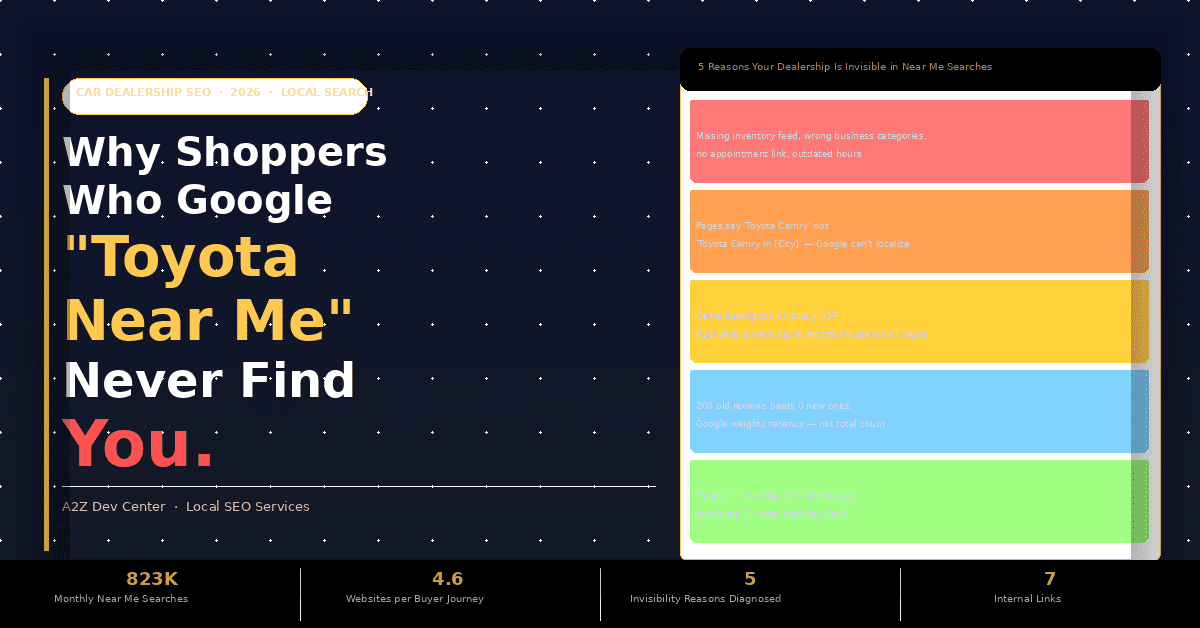
The 5 Reasons Your Car Dealership Is Invisible in “Toyota Near Me” Searches
These are the five structural causes behind local search invisibility for dealerships. Most dealers have at least three of these active simultaneously. Identify which apply to your dealership before changing anything.
1
Your Google Business Profile is incomplete, miscategorized, or missing key features
The Google Business Profile (GBP) is the single most powerful local SEO asset a car dealership has, and most dealerships have not fully configured it. Dealerships with complete and accurate Google profiles are 2.7 times more likely to be considered reputable by consumers, per DealersGear’s 2026 research. The most common GBP failures for dealerships: using only “Car Dealer” as the primary category when you should also list “Toyota Dealer,” “Used Car Dealer,” and “Auto Repair Shop” (if you have service). Not connecting your inventory feed to GBP (which enables vehicle cards in Maps and inventory in the knowledge panel). Missing or incorrect appointment booking links. Outdated hours that do not reflect your service department’s separate schedule. No Q&A section answers, which competitors are sometimes populating with misleading information. And no systematic photo uploads showing your showroom, team, service bays, and delivery moments, all of which feed Google’s relevance scoring for local results.
2
Your inventory and model pages have no location signals , they say “Toyota Camry” not “Toyota Camry in [Your City]”
Google cannot localize a page that does not tell it where you are. Most dealership websites, especially those running OEM-provided templates or large DMS platforms, generate inventory pages with titles like “2024 Toyota Camry XLE” and no city, state, or regional signal anywhere in the title tag, H1, or body copy. A buyer in Austin searching “2024 Toyota Camry near me” generates a local intent signal. Google tries to serve a locally relevant result. Your page, which mentions Austin nowhere on it, loses to a competitor whose title reads “2024 Toyota Camry XLE in Austin, TX” even if the competitor has lower domain authority. Every model page and every service category page on your site needs a city or metro-area modifier in the title tag and H1. This is the fastest implementation win in car dealership SEO and requires no new content, only page-level metadata changes across your key templates.
3
Your Vehicle Detail Pages use OEM boilerplate descriptions that create a duplicate content problem at scale
This is the most structurally damaging car dealership SEO problem most dealers do not know they have. OEM-provided vehicle descriptions are syndicated to every dealer who carries that vehicle. When 400 Toyota dealerships across the country all have a VDP for a 2025 Camry XLE with the same 200-word manufacturer description, Google sees 400 near-identical pages and has no basis to differentiate any single dealer’s page as authoritative. It typically either ranks none of them for inventory searches or rotates through them unpredictably. Every Vehicle Detail Page on your site should have a unique description that includes at least: the vehicle’s year, make, model, trim, and color; your dealership name and city; one locally specific detail (local delivery option, your service team’s brand specialization, or financing specifics); and a direct call-to-action with a phone number or test-drive link. Scaled across hundreds of VDPs, this is a content architecture project, not a manual writing task.
4
Your review velocity has stalled , old reviews are actively hurting you against competitors with fresh ones
Google’s local ranking algorithm weights the recency of reviews alongside total count and average rating. A dealership with 400 reviews and no new ones in 90 days is losing Map Pack position to a competitor with 120 reviews and 8 new ones this month. This is not a theory. It is the mechanism behind why dealerships that dominated local results in 2022 are now appearing in position 4, 5, or off the Map Pack entirely without any negative events on their profile. Review velocity, the rate at which new reviews arrive, is an active ranking factor in local automotive SEO that the vast majority of dealership SEO strategies treat as a one-time setup task rather than an ongoing operational process. The fix is not asking everyone for a review at delivery. It is building a systematic, weekly review request workflow tied to your service department CRM touchpoints, where the purchase-to-delivery-to-service cycle generates a predictable review request cadence rather than a surge-and-drought pattern.
5
You are ranking 4th or lower in the Map Pack , which means you are functionally invisible
The Google Map Pack shows three results for most local automotive queries. Position 4 and below appear only when a user explicitly clicks “More places,” which the vast majority do not. Studies across local search consistently show that the top three Map Pack listings capture the overwhelming share of clicks and calls on local dealer searches. If your car dealership SEO has you ranking fourth in your market for “Toyota dealer near me,” you are not underperforming. You are invisible. The Map Pack ranking factors that matter most for car dealerships are: GBP completeness and activity (posts, Q&A responses, photo uploads), review volume and velocity, NAP (Name, Address, Phone) consistency across all citations, proximity to the searcher’s location, and local link authority from community, media, and automotive directory sources. Our SEO team runs Map Pack gap analyses as the first step in every dealership engagement, because the ranking difference between position 3 and position 4 is the difference between being found and not existing.
How Do You Fix Your Google Business Profile to Win the Map Pack?
1
Set your primary category to your brand-specific dealer type
If you are a Toyota dealership, your primary GBP category should be “Toyota Dealer,” not the generic “Car Dealer.” Add secondary categories: “Used Car Dealer” if you carry pre-owned inventory, and “Auto Repair Shop” if you operate a service department (which you should, for the service SEO section below). Google uses categories to determine which searches your profile is eligible to appear in. Mismatched or generic categories are one of the fastest fixes in local SEO for car dealerships, taking under 10 minutes to correct and producing Map Pack movement within 2 to 4 weeks as Google recrawls your profile.
2
Connect your inventory feed and enable vehicle cards
Google Business Profiles for dealerships support direct inventory connections that surface vehicle cards directly in the Maps knowledge panel when buyers search your dealership. This requires connecting your inventory management system (via a supported integration or a structured feed) to your GBP. When active, buyers searching “Toyota dealers near me” and clicking your Map Pack result see available inventory immediately without visiting your website. This reduces friction between search intent and inventory discovery, which is exactly the conversion moment you need to own. Most dealerships do not have this configured, which means their Map Pack listing is a dead-end compared to competitors who have set it up.
3
Build a review velocity system, not a one-time review campaign
The review velocity problem (Reason 4 above) requires a process fix, not a volume fix. Build these three touchpoints into your weekly operational workflow: a same-day text message to every customer who takes delivery (not a week later when the moment has passed); a 7-day follow-up from your service advisor to every service customer with a specific review request linked directly to your GBP review form; and a 30-day service reminder that includes a review request for customers who have not yet reviewed. The target is 8 to 15 new reviews per month for a mid-volume dealership. This rate maintains Map Pack prominence against competitors who run one-time review campaigns and then stop. Never script reviews or offer incentives. Both violate Google’s policies and risk profile suspension.
4
Add location-specific model pages with consistent NAP
Create or update your top 10 model pages to include your city name in the title tag, H1, and first paragraph. Format: “2025 Toyota Camry in [City], [State] | [Dealership Name].” Include your full address on each page. Embed a Google Maps module. Add a click-to-call button tied to your GBP phone number. Ensure this phone number is identical to the one on your GBP, your website footer, your Autotrader listing, your Cars.com listing, and every other automotive directory you appear in. NAP inconsistency across citations actively suppresses Map Pack performance by creating conflicting entity signals that confuse Google’s local disambiguation system.
What Is VDP SEO and Why Does Every Car on Your Lot Need Its Own Optimized Page?
VDP stands for Vehicle Detail Page, the individual page for each specific vehicle on your lot. VDPs are the most important SEO surface on a dealership website and the most neglected. A buyer searching “2022 Toyota RAV4 Limited AWD red for sale near me” has already done their research. They know the exact vehicle they want. They are ready to call. If your VDP for that vehicle is not indexable, not locally relevant, and not uniquely described, that buyer goes to a competitor whose VDP appears in their search results.
Typical VDP , Invisible in Search
Title: 2022 Toyota RAV4 Limited
Description: The 2022 Toyota RAV4 Limited features standard safety systems, 8-inch touchscreen, heated front seats and a 203-hp 2.5L engine. Contact us for pricing.
Location signal: None
Unique content: None (OEM boilerplate)
Schema: None
Optimized VDP , Findable in Search
Title: 2022 Toyota RAV4 Limited AWD in Austin, TX | Central Toyota
Description: This one-owner 2022 RAV4 Limited AWD is available at Central Toyota in Austin. 18,400 miles, Midnight Black, fully loaded with Panoramic View Monitor. Schedule a test drive today or call 512-XXX-XXXX.
Location signal: City + state in title + body
Schema: Vehicle + LocalBusiness
Google announced in June 2025 that vehicle listing structured data would no longer be supported in search results. The special visual vehicle displays that inventory feeds once produced in search are gone. If your technical SEO strategy still includes vehicle listing schema as a ranking driver, stop. Redirect that investment toward crawlable VDPs with clean Vehicle schema (still valid for entity understanding), LocalBusiness schema on every key page, and Review schema on testimonial pages. The fundamental VDP work, unique titles, locally relevant descriptions, and fast mobile pages, remains the correct approach. The deprecated feature was the visual rich result, not the underlying structured data practice.
For most dealerships, VDP optimization at scale requires a templated approach across your DMS platform. The ecommerce development architecture that makes individual product pages crawlable and uniquely described is directly analogous to what dealerships need for VDPs. The principles are identical: unique title tags generated from vehicle attributes, location modifiers in page metadata, schema markup for vehicle entity identification, and a clear conversion path (call, text, schedule test drive) above the fold on every page.
Why Is Service Department SEO the High-Intent Revenue Your Dealership Is Missing?
Most automotive SEO budgets for dealerships focus on sales inventory: model pages, VDPs, new vehicle landing pages. Service department SEO is dramatically underinvested relative to its revenue opportunity, and the intent difference explains why this is a mistake.
A buyer searching “used Toyota RAV4 near me” is still evaluating. They may visit your site, browse inventory, and then spend three more weeks researching before they buy anywhere. A buyer searching “Toyota oil change near [your city]” is booking an appointment today. The service searcher has higher immediate conversion intent, a recurring lifetime value (they come back every 5,000 miles), and 57% of them return to the selling dealer for service after their vehicle purchase, per Autotrader and Cox Automotive’s 2026 retention data. Service SEO is not just a revenue line, it is a retention engine.
| Service Page | Target Query Format | Intent | Priority |
|---|---|---|---|
| Oil Change | [Brand] oil change near [city] / [Brand] oil change [city] | Book appointment NOW | Highest |
| Brake Service | brake service [city] / [brand] brake repair near me | Book appointment NOW | Highest |
| Tire Service | tire rotation [city] / tire replacement [brand] [city] | Book appointment TODAY | High |
| Battery Replacement | [brand] battery replacement near me | Urgent, same-day need | High |
| Transmission Service | [brand] transmission service [city] | Research then book | Medium |
| AC Repair | car AC repair near me / [brand] AC service [city] | Seasonal urgent | Medium |
| Multi-point Inspection | free car inspection [city] / [brand] inspection near me | Lead generation | Medium |
Each service page should include: the specific service name plus your brand and city in the title tag; a brief explanation of what the service includes and how long it takes; current pricing or a “call for pricing” CTA; online booking functionality or a prominent phone number; and schema markup identifying your business as an Auto Repair Shop. These pages also build your GBP relevance for service-related queries, because Google cross-references your website content with your GBP categories to determine which searches your profile is eligible for. A dealership with strong service pages and an “Auto Repair Shop” GBP category captures service queries that dealerships with only “Car Dealer” set will never see.
How Is AI Search Changing Car Dealership Visibility in 2026?
12% of car buyers now use AI tools for initial vehicle research, per Demand Local’s 2025 new buyer metric. That number is small but accelerating. 31.3% of the entire US population will use generative AI search in 2026, according to eMarketer’s 2026 projection. The buyers asking ChatGPT or Perplexity “what is the best Toyota dealership near me in Austin?” are real, they are growing, and most dealerships have zero presence in those answers.
What determines whether your dealership appears in an AI search answer for a dealer recommendation query is substantially different from what determines Google Map Pack ranking. AI engines pull from review platforms (Google, Yelp, DealerRater, Cars.com ratings), community discussion (Reddit threads about local dealers), news and press mentions, and your own website content structured as direct answers to common questions. A dealership that has 400 Google reviews, active DealerRater responses, and a website FAQ section that directly answers “what makes your Toyota service department different from an independent shop?” has the kind of citation-eligible content AI systems can extract and reference. Our content marketing team builds this AEO-structured content specifically for dealerships that want to appear in AI-generated local recommendations alongside traditional search results.
The buyer journey context: Cox Automotive’s 2025 study found that only 7% of buyers completed their entire purchase process online, and 63% said their ideal experience combines online research with in-person elements. 86% still see the vehicle in person before buying. Car dealership SEO is not about replacing the showroom. It is about ensuring you are one of the 4.6 websites that buyer visits during their research, because those who are not in that research session do not get considered at the showroom stage at all.
Frequently Asked Questions
Your Dealership Is Losing “Toyota Near Me” Buyers Every Day
You Are Not in the Map Pack.
A2Z Dev Center runs car dealership SEO audits that diagnose exactly which of the 5 invisibility reasons applies to your dealership, then build the GBP optimization, VDP content architecture, review velocity system, and service page structure that moves you into the top 3 local results.
Book a Free Dealership SEO Audit
Schedule a call
Talk to a subject-matter expert
Web development, SEO, or digital marketing — tell us about your project and we'll get back within one business day. No obligation.
- Free scope & strategy session
- A senior specialist, not a sales rep
- Your details stay confidential