
Cross-Platform vs. Native: Which Wins for Custom Mobile Apps in 2026?
 By Akash Patel
·
📅 Published: March 8, 2026
·
⏱ 15 min read
By Akash Patel
·
📅 Published: March 8, 2026
·
⏱ 15 min read
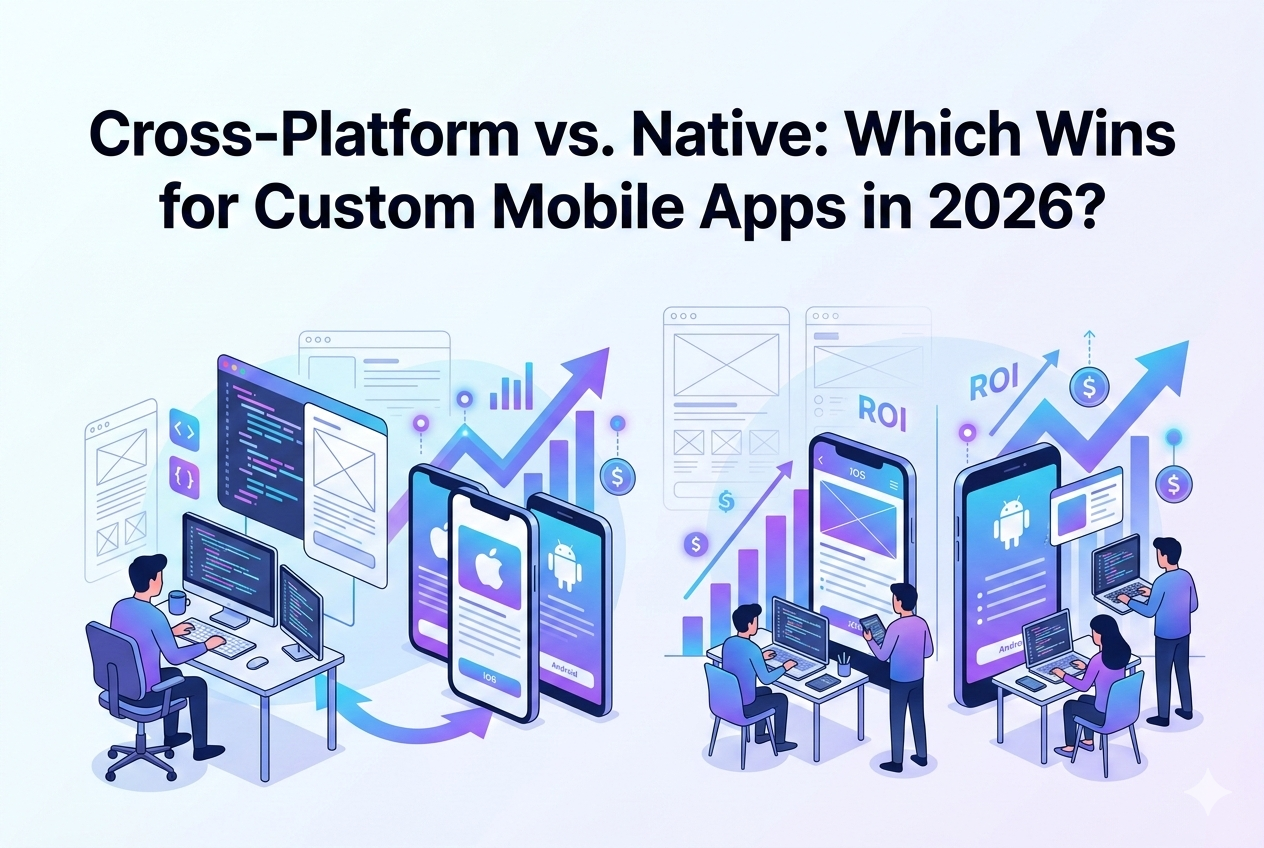
Picture this: your product team has a green light, a budget, and a mobile app concept that could genuinely move the business forward. Then someone asks the question that stalls more product decisions than any other — do we build native or cross-platform?
It feels like a technology question. It isn’t. It’s a business decision with long-term consequences for performance, user retention, development velocity, and scalability. Getting it wrong doesn’t just affect the build — it affects everything downstream.
The cross platform vs native app development debate has been running for years, but 2026 has shifted the terms considerably. Frameworks have matured. The performance gap has narrowed. AI-native features have complicated the calculus. And the businesses that made confident, well-reasoned choices are pulling ahead of those that defaulted to habit or followed the wrong advice.
If you’re building a custom mobile app — whether it’s a consumer product, a B2B tool, or an enterprise platform — this guide gives you the clear-eyed comparison you need. The real tradeoffs, the right use cases, and a decision framework built for how companies actually operate today.
Quick Answer: Cross-Platform vs. Native App Development
Which is better — cross-platform or native app development?
There is no universal winner. Native app development delivers maximum performance, full platform integration, and the highest-fidelity user experience — at greater investment and longer timelines. Cross-platform mobile app development reaches iOS and Android from a single codebase, reducing build time and maintenance overhead while delivering near-native performance for most standard application categories.
Businesses that align their development approach with their actual product requirements — rather than defaulting to trend or budget pressure — consistently report 15 to 25% improvements in development efficiency and stronger user retention within 12 to 18 months of launch. The right choice depends on your product complexity, performance requirements, and growth trajectory.
Key Takeaways
- Native app development offers superior performance and platform integration but requires higher investment and separate iOS and Android codebases
- Cross-platform frameworks — particularly Flutter and React Native — have matured significantly and now deliver near-native experiences for most standard application types
- The performance gap between native and cross-platform is narrowing in 2026, but remains meaningful for AI-native features, real-time processing, and deep hardware integration
- Startups and SMBs with multi-platform requirements often achieve stronger early ROI through cross-platform development; enterprise products with complex technical requirements frequently justify native investment
- The decision framework centers on four factors: core technical requirements, user experience expectations, three-year maintenance capacity, and time-to-market constraints
- Choosing the wrong approach for your context — in either direction — routinely costs more to remediate than the initial build investment differential
What Native App Development Actually Delivers
Native mobile app development means building platform-specific applications — Swift or Objective-C for iOS, Kotlin or Java for Android — using each platform’s own development environment, APIs, and design language.
The fundamental advantage is direct access. Native applications communicate with device hardware and operating system features without abstraction layers. Camera systems, biometric authentication, GPS, Bluetooth protocols, background processing, push notification infrastructure — all operate at the performance level the platform was engineered to support.
For applications where performance is the core product, this matters profoundly. A real-time trading platform processing streaming market data. A health monitoring app running continuous sensor analysis. An augmented reality experience rendering complex spatial overlays at sustained frame rates. In these contexts, native development isn’t a preference — it’s a technical prerequisite. If you’re unsure how these technical requirements affect your specific project, reviewing a comprehensive mobile app development guide for 2026 can help clarify the scope before any architecture decision is made.
Native also produces interfaces that feel inherently correct on each platform. iOS users navigate with swipe gestures, haptic feedback patterns, and Human Interface Guidelines conventions. Android users expect Material Design behavior, back-button logic, and notification handling that follows the platform’s own rhythm. Native development implements these naturally. Cross-platform frameworks approximate them — sometimes convincingly, sometimes noticeably.
The tradeoff is structural. Two platforms mean two codebases, two development streams, two QA cycles, and two release management processes. For organizations with the resources and product requirements to justify that investment, the output quality is objectively superior. For those without both, it can represent a significant misallocation of engineering capacity.
The Cross-Platform Case: More Capable Than Its Reputation Suggests
Cross-platform mobile app development has traveled a long distance from its early reputation as a compromise solution. The frameworks leading the category in 2026 — Flutter, React Native, and .NET MAUI — are production-proven at significant scale and powering applications used by millions of people daily.
Flutter, maintained by Google, compiles directly to native ARM code using its own rendering engine (Skia/Impeller), bypassing the JavaScript bridge that constrained earlier frameworks. The result is smooth animations, fast startup times, and UI performance that is genuinely difficult to distinguish from native in most application scenarios.
React Native’s new architecture — the JSI (JavaScript Interface) and Fabric renderer — significantly reduced the overhead that previously made complex interactions feel sluggish. If your team already has JavaScript experience and is evaluating cross-platform options, this deeper look at why React mobile app development stands out over other technologies is worth reviewing before making a final framework choice.
The business case is straightforward under the right conditions. One codebase serves both iOS and Android, which means one development team, one QA process, one release cycle, and substantially faster time to market. For startups validating a product concept, for SMBs with genuine multi-platform requirements but constrained engineering capacity, or for enterprises building internal tools where peak performance isn’t the primary criterion — the efficiency argument is compelling.
Cross-platform development also simplifies iteration velocity. A product change — a UI update, a feature addition, a behavioral fix based on user feedback — happens once and deploys to both platforms simultaneously. At the speed most modern product teams operate, that efficiency accumulates into a meaningful competitive advantage over time. That said, teams building eCommerce-facing apps should also consider which essential features an eCommerce mobile app must have before choosing a framework that can support them properly.
Native vs. Cross-Platform: A Direct Comparison
| Factor | Native Development | Cross-Platform Development |
|---|---|---|
| Performance ceiling | Maximum — direct OS access | Near-native for most use cases |
| Initial investment | Higher — dual codebases | Lower — single codebase |
| Time to market | Longer | Significantly faster |
| Platform API access | Complete depth | Framework-dependent coverage |
| UI/UX fidelity | Platform-perfect | Very good; occasionally approximate |
| Team structure | iOS + Android specialists required | Unified cross-platform team |
| Maintenance overhead | Two parallel streams | Single unified stream |
| AI/ML feature support | Full native SDK access | Improving; some gaps remain |
| Ideal use case | Complex, performance-critical products | MVP, internal tools, multi-platform reach |
| 2026 maturity | Consistently high | Significantly advanced |
| Long-term scalability | High with appropriate resourcing | High for most product categories |
Performance in 2026: Where the Real Gap Lives
The performance conversation around native vs cross platform development has become more nuanced than binary comparisons suggest — and that nuance matters for decision-making.
For standard application categories — eCommerce platforms, content apps, productivity tools, booking systems, social features, B2B dashboards — cross-platform frameworks in 2026 deliver experiences that are genuinely indistinguishable from native in everyday use. The benchmarking gap that exists in controlled tests does not consistently translate into perceptible differences for real users performing real tasks.
The gap remains significant in specific, well-defined scenarios. Computationally intensive operations running sustained calculations. Real-time data processing at high frequency. Complex 3D rendering and advanced animation sequences. Deep hardware integrations requiring low-level API access. On-device AI inference using platform-native machine learning frameworks — Core ML on iOS, ML Kit on Android.
It’s also worth understanding that performance is not just a runtime consideration — it’s a UX and SEO factor. Poor load times and unstable behavior affect app store ratings, user retention, and organic discoverability. Understanding how Core Web Vitals impact your SEO rankings is equally relevant for web-adjacent mobile experiences built on technologies like PWA or React Native Web.
The practical guidance for decision-makers: define your actual performance requirements before framing the native vs cross platform app development choice. If your application’s core value proposition depends on capabilities where frameworks have documented performance limitations, native is the appropriate foundation. If it doesn’t, the performance argument for native carries substantially less weight than it did three years ago.
Strategic Decision Framework: Four Questions That Clarify the Choice
Most cross platform vs native mobile apps decisions get complicated by the wrong variables. These four questions cut through the noise:
1. What does your application actually do at its technical core?
Map the specific capabilities your product depends on. Real-time sensor processing, AR rendering, advanced biometric integration, and on-device AI inference are native territory. Information delivery, standard CRUD workflows, content consumption, and typical mobile interaction patterns are well within cross-platform capability.For deeper context on how platform choice affects architecture, the comparison guide on choosing your platform for mobile app development — native or cross-platform covers the technical dimensions in detail.
2. Who are your users and what experience standard do they hold you to?
Consumer applications in competitive categories face high comparative experience expectations. Enterprise internal tools face lower scrutiny. B2B field applications serve users who prioritize function over form. Know which standard your product is being evaluated against before letting the performance debate override business common sense.
3. What is your realistic three-year maintenance capacity?
Two native codebases require two development streams indefinitely — not just for the initial build, but for every feature update, security patch, OS version adaptation, and bug fix for the product’s entire lifetime. If your team structure and engineering budget can sustain that reality, native is viable. If the honest answer is no, the cross-platform maintenance efficiency advantage may matter more than any initial quality differential.
4. How material is your time-to-market window?
Cross-platform’s single codebase advantage routinely represents a 30 to 40% reduction in initial build timeline for equivalent feature sets. For startups with runway constraints, for businesses in fast-moving competitive categories, or for products where learning from real users quickly is the primary strategic objective — that speed differential is commercially significant.
When Native Development Is the Right Investment
Specific product contexts consistently justify native development, regardless of efficiency arguments in the other direction:
- Performance-critical consumer applications where experience quality directly influences retention and revenue — fintech, health tech, gaming, AR/VR experiences
- Applications requiring complete hardware integration — continuous biometric monitoring, low-latency Bluetooth device communication, advanced camera pipeline control
- Products with platform-exclusive feature requirements — Apple Watch and widget integration, iOS Live Activities, Android-specific background services and home screen widgets
- High-security enterprise applications — secure enclave access, advanced biometric authentication pipelines, mobile device management integration
- Flagship long-lifecycle products where the compounding cost of framework limitations over multiple release cycles exceeds the initial investment differential
If you’re building an iOS-first product and want a clearer picture of what native development actually involves end-to-end, this overview of what to expect from a professional iOS app development company is a useful reference. For Android-specific considerations including cost and timeline realities, the guide on Android app development services — cost, timeline, and features covers the major decision points.
When Cross-Platform Development Is the Smarter Strategy
Cross-platform mobile app development wins decisively in a different set of contexts — and that set is larger in 2026 than it has ever been:
- MVP and product validation — reaching both platforms quickly to test market assumptions before committing to full native investment
- Internal enterprise tools — employee-facing applications where functional completeness matters more than UI perfection
- Content-driven applications — news platforms, knowledge bases, documentation tools, media apps where standard mobile interaction patterns dominate
- Multi-platform products with unified design systems — applications where consistent cross-platform experience is a deliberate product decision rather than a limitation
- Budget-conscious projects with genuine dual-platform requirements — startups and SMBs that need iOS and Android coverage without doubling their engineering investment
- Rapid-iteration products — applications where continuous deployment across both platforms is an operational expectation, not an occasional event
Before committing to a framework, it’s worth examining the top mobile app development trends to watch in 2026 — particularly around how cross-platform frameworks are evolving to support AI features and foldable devices. Teams exploring whether custom mobile app development is worth the cost will also find a useful cost-vs-value framework there.
React Native and Flutter have both demonstrated production viability at significant scale. Choosing cross-platform in the right context in 2026 is not a compromise — it is a sound strategic decision.
2026 Trends Actively Reshaping This Decision
Three developments in 2026 are materially affecting how organizations approach the native vs cross platform development evaluation:
On-Device AI Integration
AI-native features — on-device inference, real-time language processing, computer vision, and personalization engines running locally — are increasingly central to mobile product differentiation. These capabilities integrate more deeply and performantly with native frameworks today. Core ML on iOS and ML Kit on Android provide optimized access to device neural processing units that cross-platform frameworks are still working to expose comprehensively. For a broader picture of where AI is taking application development, this analysis of how AI and machine learning are reshaping web app development draws useful parallels to the mobile context.
Progressive Web Apps as a Third Option
It’s worth acknowledging that for certain product categories — particularly mobile eCommerce — PWAs represent a viable third path that sidesteps the native vs. cross-platform debate entirely. Understanding why progressive web apps are gaining traction in mobile eCommerce is increasingly relevant for brands whose primary use case is shopping rather than complex app functionality.
Developer Ecosystem Convergence
The talent pool for Flutter and React Native has grown substantially. Experienced cross-platform developers are meaningfully easier to hire in 2026 than they were three years ago. This reduces one of the practical arguments for native — that specialized cross-platform expertise was harder to find and retain — and makes cross-platform team-building more commercially realistic for organizations outside major tech hubs.
ROI and Long-Term Investment Considerations
Mobile app development investment — regardless of approach — should be evaluated across a three-year horizon, not a project delivery timeline.
Native development carries higher initial investment, reflecting dual development streams and the specialized expertise each platform requires. That investment returns through superior performance outcomes, lower defect rates in complex technical scenarios, and user experience quality that reinforces brand positioning at the platform level. For consumer applications where retention and lifetime value determine revenue, the quality differential has real commercial weight.
Cross-platform development generates ROI through operational efficiency. Faster initial launch, unified maintenance cycles, and smaller team requirements reduce total cost of ownership over the product lifecycle. Organizations that choose cross-platform for the right reasons — not just cost pressure, but genuine strategic fit — consistently report 15 to 25% development efficiency improvements within the first 12 to 18 months.
The most expensive outcome in either direction is choosing the wrong approach for your context and discovering the limitation mid-product rather than pre-build. Common missteps in early decisions are well-documented — the guide on mistakes new app creators make and how to avoid them is worth reviewing before architecture decisions are finalized, regardless of which direction you’re leaning.
Re-platforming a production mobile application — migrating from cross-platform to native or vice versa — is a rebuild, not a migration. It costs more than making the right call initially and is a disruption that most product teams consistently underestimate until they’re in the middle of it. Teams looking for foundational guidance on avoiding these pitfalls will also find the 10 tips for building a successful mobile app for your business a practical starting reference.
If you’re at the stage of comparing partners and approaches for your build, the A2Z Dev Center mobile app development services page outlines how these architectural decisions are handled across different project types and scales.
Frequently Asked Question


Ready to Get Started?
Your Details will be Kept confidential. Required fields are marked *


