SEO
Summarize this blog post with:
Chicago Business Owners: Why You’re Invisible on Google and What Local SEO Actually Fixes
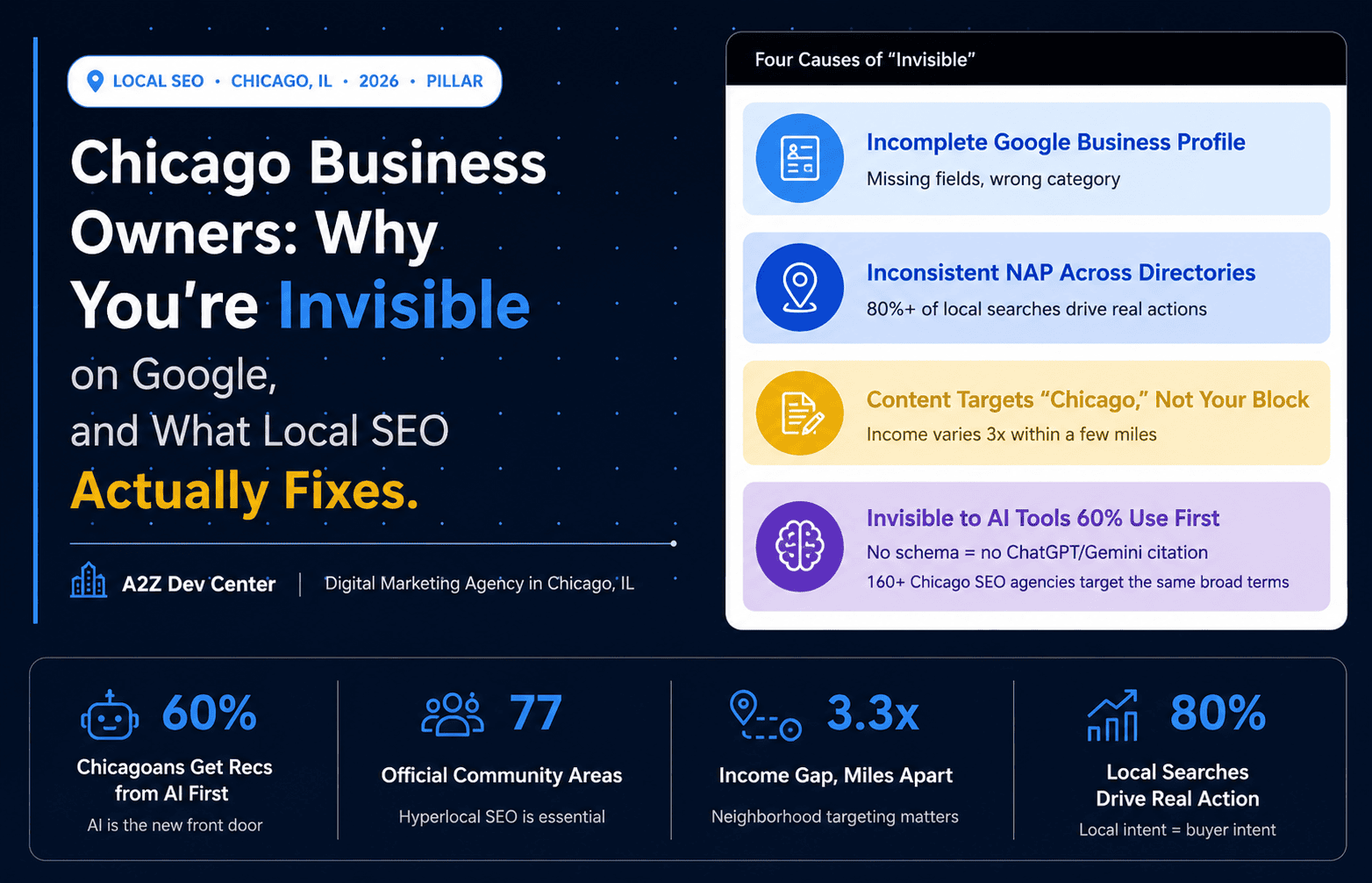
The Diagnosis: If your Chicago business isn’t showing up when people search for what you do, the cause is rarely “bad SEO” in the abstract. It’s a specific, identifiable gap, an incomplete Google Business Profile, missing schema markup, content built for the wrong neighborhood, or invisibility to the AI tools an increasing share of Chicagoans now ask first, and each of these has a specific fix.
This guide diagnoses Chicago local search invisibility as four distinct, identifiable causes, then shows exactly what fixes each one. Most local SEO content for Chicago covers pieces of this (a GBP checklist here, an AI search warning there), but nobody connects “why you’re invisible” to “what local SEO actually fixes” as a direct cause-to-fix map. That’s what follows.
The Short Version
✓There are four specific reasons a Chicago business is invisible on Google, an incomplete Google Business Profile, inconsistent business information across directories, content built for “Chicago” instead of your actual neighborhood, and invisibility to AI search tools. Each has a distinct fix.
✓Over 60% of Chicago consumers now receive local business recommendations from AI assistants like ChatGPT, Gemini, and Perplexity before opening a traditional search engine, per iSimplifyMe’s analysis.
✓Chicago is made up of 77 official community areas and 200+ neighborhoods, with median household income varying by more than 3x between areas just a few miles apart, search behavior genuinely changes block by block, not just citywide.
Over 80% of local searches lead to real-world actions, calls or visits, per Lift Digital’s analysis, and with 160+ SEO agencies competing in Chicago for broad terms, neighborhood-and-cause-specific content is where real differentiation remains. A2Z Dev Center’s local SEO services and SEO services address all four causes below directly.
“Invisible” Has Four Specific Causes, Each With a Specific Fix
“My business doesn’t show up on Google” is not a diagnosis, it’s a symptom. The four sections below each describe one specific, identifiable cause of that symptom, and the specific fix for it. Most Chicago businesses have one or two of these four problems, not all four, and identifying which ones apply to you is the actual first step, not generic “do more SEO” advice.
Cause 1: Your Google Business Profile Is Incomplete
Fix: Complete every field, choose the exact right category. Your Google Business Profile (GBP) is the single most powerful free local SEO tool available, it’s what appears in the map pack, Google Maps, and the Knowledge Panel. A fully optimized GBP means completing every field: business name exactly as it appears everywhere else, address, phone number, website URL, business hours, holiday hours, and business categories. Google rewards completeness; an incomplete profile ranks lower than a complete one.
The category mistake specifically: if you’re a digital marketing agency, your primary category should be “Digital Marketing Agency”, not a vague adjacent category like “Marketing Consultant” or “Advertising Agency” if “Digital Marketing Agency” is genuinely the more accurate fit. This single field affects which searches you’re eligible to appear in at all.
The fix: Audit every field in your GBP against this checklist. If your phone isn’t ringing from Google searches, this is almost always where the problem starts, and it’s the one cause on this list you can fully fix yourself, for free, in under an hour.
Cause 2: Your NAP Is Inconsistent Across Directories
Fix: Audit name, address, phone across every listing. Local citations are listings of your business’s name, address, and phone number (NAP) across online directories, Yelp, Bing Places, industry-specific directories, and dozens of others. Google uses these listings to verify your business’s existence and consistency. If your information is mismatched or outdated across these directories, even with a perfect GBP, it sends a confusing signal that can hurt rankings.
Over 80% of local searches lead to real-world actions like calls or visits. If someone finds an old address or a disconnected phone number on a directory listing, that’s a lost customer who was 80% likely to act, lost to inconsistent information rather than to a competitor.
The fix: Search for your business name across the major directories (Yelp, Bing Places, Apple Maps, industry-specific platforms relevant to your category) and verify your name, address, and phone number match your GBP exactly. Update any mismatches. This is free, and it’s the second most common cause of invisibility after an incomplete GBP.
Cause 3: Your Content Targets “Chicago,” Not Your Neighborhood
Fix: Build a hyper-local keyword cluster for your actual area. Search behavior in Chicago changes every few miles. That’s not a figure of speech, it’s a measurable reality of a city made up of 77 official community areas and more than 200 distinct neighborhoods, each with its own character, demographics, and search habits.
Near North Side: $122,603
Median household income. Includes River North, Gold Coast, and the Magnificent Mile. Population 105,481.
North Lawndale: $37,247
Median household income. A few miles away. Population 31,244.
Both are official Chicago community areas. The median household income gap between them is more than 3 times, and the distance between them is a matter of miles, not states. A business that targets “Chicago” generically is trying to speak to both of these areas, and everything in between, with the same content. A business that builds content specifically for its actual neighborhood, its income level, its demographics, its local landmarks and corridors, speaks to the audience that’s actually searching nearby.
The practical tool here is a keyword cluster, a structure with four tiers: a primary service keyword, secondary related-service keywords, hyper-local neighborhood-specific keywords, and question-based keywords. Here’s how the same cluster structure produces genuinely different content depending on which Chicago neighborhood a business is actually in.
| Cluster Tier | River North-Area Business | North Lawndale-Area Business |
|---|---|---|
| Primary | Digital marketing agency Chicago | Digital marketing agency Chicago |
| Secondary | Custom WordPress development, premium brand websites, luxury retail marketing | Small business website design, affordable local SEO, community business marketing |
| Hyper-Local | Marketing agency near River North, web design Gold Coast, SEO company Magnificent Mile | Marketing agency North Lawndale, web design West Side Chicago, SEO for small businesses near Douglas Park |
| Question-Based | How much does a premium website cost in Chicago? | How can a small business in Chicago afford a website? |
The primary keyword is identical, both businesses reasonably target “digital marketing agency Chicago.” But everything below that tier should reflect the actual neighborhood, its income level, its dominant business types, and the specific way people search when they’re nearby. A business using the River North column’s keywords for a North Lawndale-area client (or vice versa) is targeting an audience that doesn’t match its actual location or service.
Cause 4: You’re Invisible to the AI Tools 60% of Chicagoans Use First
Fix: Implement schema markup and structured business data. Over 60% of Chicago consumers now receive local business recommendations from AI assistants like ChatGPT, Gemini, and Perplexity before ever opening a traditional search engine, per iSimplifyMe’s analysis. These tools are already answering queries like “best personal injury lawyer in Chicago” and “top HVAC companies near Lincoln Park” with synthesized, cited responses.
AI search engines don’t rank pages the way traditional search does. They synthesize answers from sources they consider authoritative, structured, and entity-rich. A business that has spent thousands of dollars per month on traditional SEO tactics but has zero structured data markup (schema) is invisible to these AI engines, regardless of how much it has spent elsewhere.
Here’s the connection most Chicago SEO content misses: Causes 1, 2, and 4 are not three separate problems requiring three separate strategies. They’re the same underlying problem viewed from two angles. A complete, accurate, schema-marked-up business profile is exactly what BOTH Google’s traditional local algorithm AND the AI systems 60% of Chicagoans now consult first actually need. Fixing Cause 1 (complete GBP) and adding structured data markup (schema) to your website addresses Cause 4 at the same time, they’re not competing budget priorities, they’re the same fix serving two channels.
Why Generic “Chicago SEO” Doesn’t Work With 160+ Agencies Competing for the Same Terms
The Competitive Reality: There are over 160 SEO agency providers in Chicago alone, per DesignRush’s directory. Nearly all of them target the same broad terms: “digital marketing agency Chicago,” “Chicago SEO company,” “local SEO Chicago.” For these broad terms, the competition is genuinely saturated, well-funded agencies have spent years and significant budgets establishing authority for exactly these phrases. But the four causes above point toward where genuine differentiation remains: cause-specific content (which of the four problems does a business actually have, and what’s the specific fix), and neighborhood-specific content (River North vs North Lawndale vs any of Chicago’s other 75 community areas). Almost no Chicago SEO content combines both, a cause-specific diagnostic AND neighborhood-specific application, which is exactly the combination this guide provides.
What Local SEO Actually Fixes: A Before/After by Cause
| Cause | Before | After |
|---|---|---|
| Incomplete GBP | 45 GBP listings unclaimed for one client | All listings claimed, complete, correct category |
| Inconsistent NAP | Mismatched info across directories | Consistent NAP, stronger trust signals |
| Generic content | Zero local footprint, no competitive rankings | Top 3 Map Pack via schema + geo-targeting |
| No AI visibility | Zero structured data, invisible to AI engines | Schema markup makes business citable by AI search |
These before/after examples reflect real patterns reported across Chicago SEO case studies: one agency’s work for a client involved claiming 45 previously unclaimed GBP listings, while another took a client from zero local footprint and no competitive rankings to the Top 3 Map Pack through schema implementation, geo-targeting, and verified off-page local signals. Both outcomes map directly to the causes above, they’re not separate “SEO magic,” they’re the direct result of fixing identifiable gaps.
How to Choose a Digital Marketing Agency in Chicago
With 160+ agencies to choose from, the practical filter is whether an agency can speak to the four causes above specifically for your business: can they audit your GBP and identify exactly what’s incomplete? Can they show you your current NAP consistency across directories? Can they build a neighborhood-specific keyword cluster for your actual location, not a generic “Chicago” cluster? And do they implement schema markup as standard practice, not as an upsell add-on, given that this is now foundational to AI search visibility for 60% of the market?
An agency that can answer all four concretely, ideally with a free audit showing where your business currently stands on each cause, is positioned to fix the actual problem rather than sell generic services. A2Z Dev Center’s SEO services and local SEO services are built around this four-cause diagnostic, and for businesses operating across multiple Michigan and Midwest markets, our Michigan digital marketing services apply the same neighborhood-specific approach.
Frequently Asked Questions
Everything Chicago business owners need to know about local search visibility.
Schedule a call
Talk to a subject-matter expert
Web development, SEO, or digital marketing — tell us about your project and we'll get back within one business day. No obligation.
- Free scope & strategy session
- A senior specialist, not a sales rep
- Your details stay confidential