SEO
Summarize this blog post with:
What This Guide Covers
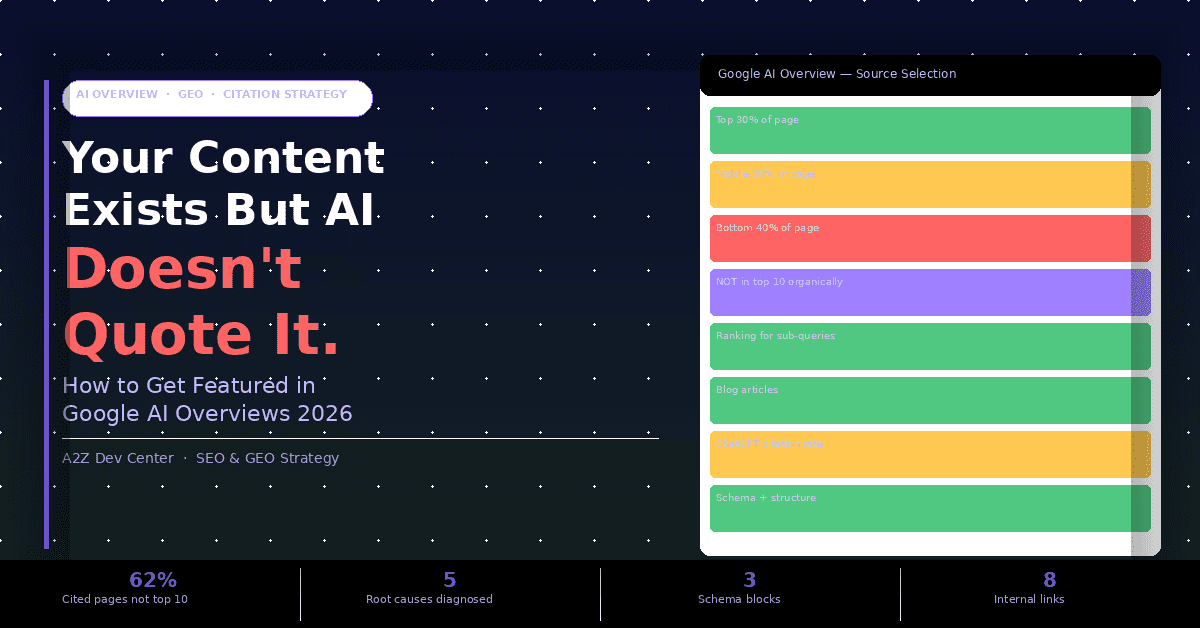
- The finding that breaks conventional wisdom: 62% of pages cited in Google AI Overviews do not rank in the organic top 10, according to Ahrefs' analysis of 863,000 keywords. You do not need to outrank your competitors to get cited. You need to out-structure them.
- The 5-reason diagnosis: Most content fails to get cited for one of five specific reasons. This guide tells you how to diagnose which one is killing your visibility.
- The Island Test and the fan-out strategy: Two specific, actionable techniques that no competitor guide develops into practical steps. Both are based on original research with named sources.
- A2Z Dev Center's SEO services cover AI Overview optimisation as a structured engagement. We audit your current citation visibility, identify the specific structural gaps, and rebuild the content layers that earn citations. Read the full context on how AI Overviews affect your organic traffic before deciding whether to optimise or ignore this channel.
Organic CTR on queries where a Google AI Overview appears dropped 61% between June 2024 and September 2025, falling from 1.76% to 0.61%, according to Sudha Solutions' 2025 SERP analysis. That number is not a prediction. It is the current state for any query where your content ranks but is not cited in the AI summary. Your page loads. Your ranking holds. Your traffic disappears.
The response most SEO teams reach for is the wrong one. They try to rank higher. That might help. But the data shows ranking alone is not the driver of AI Overview citations. The structure of your content is.
The Finding That Changes Everything: Most Cited Pages Do Not Rank in the Top 10
How Citation vs. Ranking Correlation Has Changed
| Cited pages ranking in top 10 (mid-2025) | 76% | Now: 38% |
| Citations from pages OUTSIDE top 10 (early 2026) | 24% | Now: 62% |
| Source | Ahrefs, 863,000 keywords + 4M AI Overview URLs | |
This shift happened in under 12 months. Stridec's February 2026 analysis of the same Ahrefs dataset confirms the finding. In mid-2025, a top-10 ranking was almost a prerequisite for AI Overview citation. Today, 62% of cited pages do not have that prerequisite. Google's AI is pulling from sources based on content extractability and entity trust, not position alone.
The practical meaning: if you have been waiting to optimise for AI Overviews until your pages rank higher, you have been waiting for the wrong signal. Structure your content correctly, and citations can come at position 15. Ignore structure, and position 1 will not save you. This is the mindset shift the rest of this guide builds on.
Why Is Your Content Not Being Cited? The 5-Reason Diagnosis
Sudha Solutions' 2026 analysis identifies five signals AI engines use to evaluate sources. Applied as a diagnostic, they become the five specific reasons your content is invisible in AI Overviews. Identify which one applies before changing anything.
1
Structure Problem: Your best answer is buried
CXL's study of 100 pages found that 55% of all AI Overview citations come from the top 30% of a page's content. The bottom 40% contributes just 21%. If your key answer, definition, or data point sits inside paragraph 8 of a 1,500-word guide, the AI extractor may never reach it. Symptom: you cover the topic well, but AI cites a shorter, shallower competitor whose answer appears in the first 300 words. Fix: front-load your best content. Start each section with a direct answer sentence. Move your key findings above the fold, not below the explanation.
3
Verifiability Problem: Your content makes claims AI cannot verify
AI engines avoid content they cannot verify against other sources. "Our approach delivers results" is a claim with no corroboration point. "Clients who implemented this reduced ad spend by 34% in 6 months" is a specific, potentially verifiable claim. Sudha Solutions' research found that pages with structured formats and schema markup are 30-40% more likely to be cited, largely because schema and named sources give AI systems verification anchors. Symptom: your content is well-written but makes general claims without data, named sources, or specific numbers. Fix: add at least one named-source statistic per 200 words. Name the study or the date. Replace "many marketers say" with "Ahrefs' 2026 keyword analysis found."
4
Consensus Problem: Only your website makes this claim
AI engines build confidence through consensus. If ten sources say the same thing, the AI treats it as reliable. If only your website says something, the AI treats it as a potential outlier and may not cite it. Symptom: you publish original research or a novel framework that no other site has covered. Traffic is low, citations are zero. Fix: seed your findings across the web. Get your data cited in industry blogs. Share findings in LinkedIn posts, Reddit threads, or industry forums. Brands whose content exists only on their own site have 4x lower citation probability than brands with equivalent content also referenced on Quora, Reddit, and external publications, according to Sudha Solutions' 2025 citation analysis. Building organic growth in 2026 requires this third-party seeding layer.
The Island Test: How to Write Passages AI Actually Extracts
CXL's 100-page citation study identified what they call the "island test": a passage passes if it makes complete sense when read in isolation, without the paragraphs before or after it. Respona's citation research found that the optimal length for these self-contained passages is 134 to 167 words. Passages inside this range, written to stand alone, are extracted at significantly higher rates than prose that assumes surrounding context.
Here is the same paragraph, written two ways. The first fails the island test. The second passes it.
Fails The Island Test
This approach has been shown to work particularly well in B2B contexts. As we discussed in the previous section, the key is making sure your content is structured properly. When you do this correctly, you will see improvements in your citation rate over time. The process requires attention to the factors mentioned above, especially the ones related to structure and entity signals. Results will vary, but the direction is consistent with what the research shows.
AI cannot extract this. Too many pronouns, no data, assumes prior context.
Passes The Island Test
B2B service pages that front-load a 40-60 word direct answer under each H2 heading earn AI Overview citations at measurably higher rates than pages that bury answers in narrative prose. ALM Corp's February 2026 citation analysis found that 72.4% of cited ChatGPT blog posts included an identifiable answer capsule (40-60 words) placed directly after a question-based heading. When that capsule included original data or proprietary insight, citation likelihood increased further, with 34.3% of cited posts combining both elements.
AI can extract and cite this standalone. Specific data, named source, no pronouns requiring context.
The rule for every section you write: the heading plus the first two sentences must form a complete, citable unit. ALM Corp's 2026 citation research states it plainly: "An H2 like 'Why listicles earn more AI citations' should be followed immediately by a sentence that answers the heading directly, not by a transitional sentence that delays the point." Our content marketing team rebuilds existing articles to pass the island test as part of every AI visibility engagement.
The 30% rule in practice: 55% of AI Overview citations come from the top 30% of a page (CXL). On a 2,000-word article, that is the first 600 words. Every key finding, answer, and stat should appear before word 600. The rest of the article deepens and supports those points, but the citable content must be front-loaded.
The Fan-Out Query Strategy: How Sub-Queries Boost Citation Odds 161%
Google's AI Overview does not answer your query as a single question. It decomposes your query into multiple sub-queries (called fan-out queries), retrieves results for each, then synthesises a combined answer. CXL's March 2026 research found that ranking for these fan-out sub-queries boosts your AI Overview citation probability by 161%.
Most content teams do not know their fan-out sub-queries exist. Here is how to find and rank for them.
1
Find your primary query's fan-out sub-queries
Type your primary keyword into Google and scroll to the "People Also Ask" section. Each PAA question is a fan-out sub-query that Google's AI decomposes your original search into. For "how to get cited in AI Overviews," the fan-outs include "what format does Google AI Overview prefer," "does ranking help AI citations," and "how do I write extractable content." These are the sub-queries your page must also answer to earn the parent citation.
2
Check Google Search Console for sub-query impressions you already have
Open Search Console, go to Performance, filter by your primary URL, then scan the Queries report for question-format queries you appear for but rank below position 10. Each of these is a fan-out opportunity. A query where you have 400 impressions at position 14 can become a fan-out citation driver with a dedicated H2 section that directly answers it. Export the full query list, filter for question format ("what," "how," "why," "when"), and sort by impression volume. The top 10 questions are your fan-out target list.
3
Add a dedicated H2 for each fan-out sub-query
For each fan-out sub-query, add an H2 to your existing article that mirrors the question exactly. Write a 40-60 word direct answer as the first sentence under that H2. This satisfies the island test and creates a citation anchor for the sub-query. Ranking for the sub-query at position 8 for a 2,000-impression query, combined with the 161% citation boost from fan-out ranking, frequently produces AI Overview citations before you move your primary keyword at all. It is the fastest path to citation for pages that already have content but no AI visibility.
4
Add FAQPage schema to the new Q&A sections
Each fan-out H2 with its direct answer qualifies as a FAQPage schema item. Implementing FAQPage schema on these sections does two things: it increases your eligibility for Google's "People Also Ask" box (which is itself a fan-out display format), and it signals to the AI extractor that this section is a discrete, standalone answer unit. Use Google's Rich Results Test to validate the implementation. FAQ sections are cited even when the main article body is not, according to ALM Corp's 2026 citation analysis.
What Content Formats Get Cited Most in Google AI Overviews?
Search Engine Land's analysis of 8,000 AI Overview citations found that blog articles account for 46% of all citations, while news articles contribute 20%. The remaining third comes from product pages, guides, and reference content. Blog articles win because their heading structure and direct-answer format align with how the AI extractor retrieves passages.
Within the blog format, specific structures earn citations at disproportionate rates. Numbered how-to guides with clear steps. Definition articles that answer "what is" questions in the first two sentences. Comparison articles with structured tables. FAQ sections with standalone Q&A pairs. These formats share a common property: each section functions as a self-contained unit. The AI extractor can pull any section and it reads as a complete, citable answer without surrounding context. For ecommerce businesses, product category pages and buying guides in this format consistently outperform product pages alone in AI Overview citation frequency.
Platform-Specific: Google AIO vs ChatGPT vs Perplexity vs Bing Copilot
Each major AI platform selects sources differently. If you optimise for Google AI Overviews first and want to extend that visibility to other platforms, here is how the priorities shift.
| Platform | Primary Signal | Content Priority | Key Structural Requirement | Start Here |
|---|---|---|---|---|
| Google AI Overviews | Top-30% page positioning + fan-out sub-query ranking | Answer-first structure, entity authority | Island-test passages, FAQPage schema, question H2s | Priority 1 |
| ChatGPT | Encyclopedic authority + Wikipedia-style neutrality | Reference-grade content, specific data, named sources | 40-60 word answer capsule directly after H2; only 15% of retrieved pages are cited | Priority 2 |
| Perplexity | Recency + community signals (Reddit, Quora) | Fresh content with 2025/2026 data, forum presence | Visible publication/update date, fresh statistics, external community discussion | Priority 2 |
| Bing Copilot | AEO alignment + FAQ structure | Question-format headings, FAQ schema | FAQPage schema, HowTo schema for procedural content | Priority 3 |
Start with Google AI Overviews. The structural requirements overlap heavily with ChatGPT and Bing Copilot. The island test, answer capsules, question H2s, and FAQPage schema all help across platforms. Perplexity requires an additional layer of community seeding, which is a separate engagement. Domains active on Quora and Reddit have 4x higher Perplexity citation probability than domains existing only on their own website, per Sudha Solutions' 2025 research.
The Schema and Entity Layer: What AI Reads Before It Reads Your Words
Schema markup does not directly cause AI Overview citations. It helps the AI extractor correctly identify and parse standalone answer blocks, which increases citation likelihood. The schemas that matter for AI Overview visibility are specific and different from the basic SEO schema most sites have implemented.
Organisation schema with sameAs properties is the foundation. This tells AI systems your brand is a defined entity with consistent identity across platforms. The sameAs array should link to your LinkedIn company page, your Crunchbase or Wikipedia page if you have one, your social profiles, and any major directory listings where your business appears. Without sameAs links, AI systems cannot confirm your brand is the same entity mentioned across different sources.
FAQPage schema on every service page and guide is the next priority. FAQ sections are cited even when the main article body is not, according to ALM Corp's citation analysis. Build each FAQ answer as an island-test-passing passage: 50-120 words, self-contained, direct answer first, no pronouns requiring prior context.
Article or BlogPosting schema with datePublished, dateModified, author (linked to a Person schema), and publisher (linked to your Organisation schema) creates the trust metadata AI systems use to evaluate content freshness and authority. A blog post without an author schema is anonymous content. Anonymous content has lower citation probability than attributed expert content.
Our technical SEO team implements and validates the full schema stack as part of every AI visibility engagement. The schema audit alone frequently reveals structural errors that explain why well-ranked content is not being cited.
How to Measure Your AI Overview Citation Performance
Tracking Method 1
Google Search Console
Go to Performance, click "Search type" dropdown, select "Web." Then filter by query. Look for impressions from queries where your CTR is lower than expected, which often indicates an AIO is capturing the click instead. Add the "AI Overview" filter when available in your account to see AIO-specific impressions separately.
Tracking Method 2
Manual Testing
Run your 10 highest-priority queries in an incognito Google tab monthly. Screenshot whether an AI Overview appears and whether your site is cited. Record in a Google Sheet. This free test takes 20 minutes and gives you a baseline before any structural changes. Retest the same queries every 30 days to track progress.
Tracking Method 3
Competitor Benchmarking
For queries where you do not appear in the AI Overview, identify which pages are being cited. Pull those pages, run them through the island test criteria, and identify what structural differences exist. A competitor cited in AIO with a shorter, lower-authority page almost always has better answer-first structure and more specific data than your equivalent page.
Set a 90-day measurement window before evaluating whether your structural changes are working. Google's AI Overview extraction updates as Google recrawls and re-evaluates sources. A structural improvement implemented today may take 4 to 8 weeks to produce a measurable change in AIO impression share, based on typical recrawl cycles for sites with moderate crawl budgets.
Frequently Asked Questions
Your Content Is There. It Just Is Not Citation-Ready. Let's Fix That.
AI Overview visibility is not a content volume problem. It is a content architecture problem. A2Z Dev Center's SEO team audits your current AIO citation performance, diagnoses which of the 5 structural reasons applies, and rebuilds the content layers that earn citations. We work on existing pages, not just new ones.
Book a Free AIO Citation Audit
Schedule a call
Talk to a subject-matter expert
Web development, SEO, or digital marketing — tell us about your project and we'll get back within one business day. No obligation.
- Free scope & strategy session
- A senior specialist, not a sales rep
- Your details stay confidential