
AI
Summarize this blog post with:
Quick Answer: What Is Generative Engine Optimisation?
Generative engine optimisation (GEO), also spelled generative engine optimization, is the practice of structuring your website content so AI platforms like ChatGPT, Perplexity, and Google AI Overviews cite your business when answering user questions. Unlike traditional SEO, which targets a position on a results page, GEO targets a citation inside a synthesised AI answer.
The Short Version
- About 68% of US Google searches ended without a click in early 2026 (SparkToro). Many users now get their answer from an AI summary and move on. Your website ranked. Nobody visited. That is the problem GEO solves.
- GEO is not a replacement for SEO. It is the next layer on top. SEO gets you findable. GEO gets you cited. You need both, and the technical foundations of one directly support the other.
- Most GEO guides are written for marketing teams. This one is written for business owners who want to know: what is this, does it matter for my business, and what do I actually do about it this week.
- A2Z Dev Center’s digital marketing services cover GEO strategy, content restructuring, and schema implementation for businesses that want to appear in AI-generated answers, not just search rankings.
Somebody typed “best accountants for small businesses in [your city]” into ChatGPT last week. ChatGPT answered with three firm names. Yours was not one of them. Not because you are not good enough. Because your website content is not structured in a way that AI engines can extract and trust. That is a GEO problem, and it has nothing to do with your Google ranking.
Generative engine optimisation is the discipline that changes this. The term was formally coined in an academic paper published at KDD 2024 by researchers at Princeton, Georgia Tech, and IIT Delhi. Since then, the field has grown faster than any marketing concept since mobile-first SEO. The reason is simple: AI-referred sessions jumped 527% year over year in the first five months of 2025, according to Previsible’s 2025 AI Traffic Report. That kind of growth rate does not wait for you to catch up.
Why Does Generative Engine Optimisation Matter for Your Business Right Now?
The short answer: your buyers have changed how they research before they buy, and most businesses have not noticed yet.
ChatGPT processes 2.5 billion prompts per day as of mid-2025. Google’s AI Overviews now appear in searches across 200 countries in 40 languages. These are not future trends. They are the current reality of how your potential customers are finding information about businesses like yours.
The citation gap: When an AI answers a query, it typically cites only a handful of sources, compared to Google’s 10 blue links. Fewer slots means higher competition. Businesses that earn AI citations reach buyers who never click to any website but still absorb brand information and make purchase decisions based on it, according to Profound’s 2025 AI citation analysis. Our guide on how Google AI Overviews affect your traffic covers the specific mechanisms behind this shift.
Here is the business case without the jargon. A potential client asks Perplexity: “Which digital marketing agencies specialise in SEO for ecommerce?” Perplexity generates an answer citing four agencies. Those four agencies did not pay for those citations. They earned them by having content that Perplexity’s AI could extract, verify, and trust. If your agency is not among them, you lost that buyer without ever knowing they existed.
SEO, AEO, and GEO: What Is the Difference?
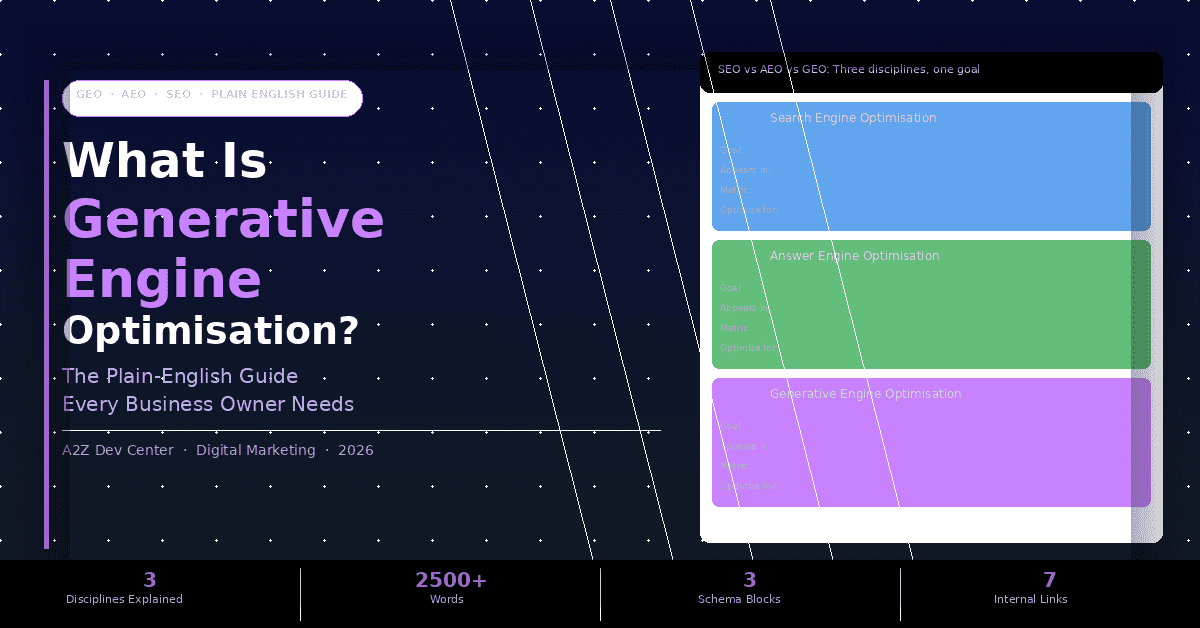
Most articles on generative engine optimisation compare GEO to SEO and skip AEO (Answer Engine Optimisation), which sits between the two. Here is the three-way breakdown every business owner needs.
| Discipline | Full Name | Goal | Appears In | Success Metric | Core Signal |
|---|---|---|---|---|---|
| SEO | Search Engine Optimisation | Rank in search results | Google, Bing results pages | Position + organic clicks | Keywords + backlinks |
| AEO | Answer Engine Optimisation | Become the direct answer | Featured snippets, People Also Ask | Direct answer appearances | Question-format content |
| GEO | Generative Engine Optimisation | Get cited in AI answers | ChatGPT, Perplexity, Google AI Overviews | AI citations + brand mentions | Entity authority + structure |
The simplest version: SEO gets you found. AEO gets you answered. GEO gets you cited. All three operate on the same technical foundation (a well-structured, fast, trustworthy website), but each targets a different surface and requires different content decisions on top of that foundation. Most businesses have some SEO. Few have AEO. Almost none have GEO, which is exactly the opportunity. Our SEO services build the technical foundation that all three disciplines require.
GEO Terms in Plain English
GEO comes with its own vocabulary. These are the terms you will meet most often, with what each one means for a business.
- Citation: a link or named mention of your site inside an AI-generated answer. It is the main thing GEO aims to earn.
- Entity: a clearly defined thing, such as your business, its services, its location and its people. AI systems rely on consistent entity facts to know who you are.
- Retrieval-augmented generation (RAG): the process where an AI looks up current web content and uses it to build an answer.
- Passage: a self-contained block of text that answers one question fully. See our explanation of the 134 to 167 word passage rule for how long a quotable passage tends to be.
- Share of voice: how often your brand appears across a fixed set of AI answers compared with competitors.
- LLMO: another name some people use for the same work. Our guide to AEO vs GEO vs SEO sorts out how these labels overlap.
How Do AI Engines Actually Decide What to Cite?
The mechanism is called RAG, which stands for Retrieval-Augmented Generation. When you ask ChatGPT a question, the model does not just draw from its training data. It retrieves relevant web content in real time, evaluates that content for trustworthiness and relevance, and synthesises an answer using the retrieved sources as citations. Think of it like a research assistant who pulls documents from a filing cabinet, reads them, and writes you a summary with footnotes. Your website is one of the documents in that filing cabinet. GEO is the practice of making your document the one the assistant reaches for first.
Each major AI platform weights its sources differently. First Page Sage conducted 11,128 commercial queries across four AI platforms in their April 2026 research, producing the most detailed algorithm breakdown available.
ChatGPT
Prioritises encyclopedic, authoritative content. Wikipedia accounts for 47.9% of ChatGPT’s top citations. Content that reads like a trusted reference, with clear definitions, specific data, and neutral expert framing, is favoured heavily. For ecommerce businesses, our ecommerce SEO guide covers how to structure product and category content for AI citation eligibility.
Perplexity
Rewards recency and community discussion. Content published recently, with citations to current research, and topics that appear in forums like Reddit, performs better here. Update key pages with the current year, fresh statistics, and “what changed in 2026” sections to improve Perplexity citation frequency.
Google AI Overviews
Strongly favours content already ranking in the top 10 organic results for the query. This means your Google SEO foundation directly feeds your Google AI Overviews presence. Pages that pass Core Web Vitals, carry FAQPage schema, and rank on page 1 have the highest probability of appearing in AI Overview citations.
Claude (Anthropic)
The outlier in First Page Sage’s research: Claude has the lowest internet reliance of the major AI engines. It draws heavily from pre-training data, which means building brand authority through authoritative third-party coverage, industry directories, and published research is more effective than optimising a single web page for Claude citations.
What Does GEO-Optimised Content Look Like? (Before and After)
This is the section that none of the five competing articles on this topic include. Every one of them explains GEO principles in the abstract. Here is the same paragraph, before and after GEO optimisation, so you can see exactly what changes and why AI engines will now cite the second version.
Before GEO Optimisation
Our accounting firm provides a wide range of services for businesses of all sizes. We have experienced professionals who can help with your tax needs, bookkeeping, and financial planning. Contact us today to learn more about how we can support your business goals.
After GEO Optimisation
Thornton & Associates is a Leeds-based accounting firm specialising in tax compliance and financial planning for SMEs with 5 to 50 employees. The firm has handled over 800 year-end accounts since 2018, with an average client saving of £4,200 annually through R&D tax credit claims. Free 30-minute consultations are available for new clients.
What changed? Four things. The firm is named specifically (entity clarity). The specialisation is exact, not vague. A verifiable number is present (800 accounts, £4,200 average saving). The service offer is concrete (30-minute consultation). AI engines cite the second version because they can extract a specific, verifiable fact that answers a user’s query. The first version gives them nothing to quote. Most business website content looks like the first example. Restructuring it to look like the second is the core work of GEO optimisation. Building an organic growth strategy in 2026 requires this type of entity-specific content as its foundation.
10 GEO Actions Every Business Owner Can Take This Week
These are listed in order of impact. Do the first three this week. They require no developer and no budget.
1
Write a 40-word definition of what your business does and put it at the top of your homepage
AI engines look for clear, extractable definitions. Write one sentence that names your business, your specific service, your specific audience, and one measurable outcome. Put it in the first paragraph of your homepage and your About page. That single sentence is what AI platforms pull as your entity definition.
2
Rewrite section headers as direct user questions
Change “Our Services” to “What Does [Your Business] Do?” Change “About Us” to “Who Is [Business Name] and What Do We Specialise In?” A header formatted as a question that mirrors what someone would type into ChatGPT is the single highest-ROI GEO change you can make to existing content, according to Enrich Labs’ 2026 GEO analysis.
3
Add one specific statistic with a cited source to every page
AI models prefer citable data over general claims. “We help businesses grow” gives an AI engine nothing to quote. “Our clients reduced customer acquisition cost by an average of 34% in the first 6 months” is quotable. Use real data from your own client results, industry reports you can link to, or published research. Target at least one cited fact per 200 words across your key service pages.
4
Build a FAQ section on every service page
FAQ sections are the most AI-extractable content format on your website. Each question should mirror an exact query a customer would type into an AI platform. Each answer should be self-contained and under 80 words. Add FAQPage schema markup to the HTML (a developer can do this in under an hour) so search engines and AI crawlers read it as structured data, not plain text. Our content marketing team builds GEO-structured FAQ libraries as a standalone service.
5
Make your business name, location, and service consistent everywhere online
AI engines build entity graphs, mapping your business name to your location, industry, and services across every online source. If your Google Business profile says “Thornton Accounting,” your website says “Thornton & Associates,” and your Yelp profile says “Thornton Tax Services,” the AI engine sees three different entities and trusts none of them. Consistent naming across your website, Google Business, LinkedIn, industry directories, and review platforms is the foundation of entity authority.
6
Get listed on at least three authoritative industry directories
First Page Sage’s algorithm research found that appearing in established directories (G2, Clutch, Yelp, TripAdvisor depending on your industry) directly influences commercial recommendations from ChatGPT, Gemini, and Perplexity. Wikipedia accounts for 47.9% of ChatGPT’s top citations, but industry directories are the next tier. List your business with a complete, accurate profile on every relevant directory for your sector.
7
Publish one original data point this month
Original research, client surveys, and internal data are citation magnets. You do not need a formal study. Survey 20 of your clients and publish the results on your website. “78% of our clients cited response time as the primary reason they chose us over a competitor” is a data point AI engines will cite when answering questions about your service category. Publish it as a dedicated page or blog post with a clear title and schema markup.
8
Add author bios with credentials to all content
Google’s E-E-A-T (Experience, Expertise, Authoritativeness, Trustworthiness) guidelines directly influence AI Overview citations. Pages written by named authors with visible credentials, professional profiles (LinkedIn), and clear expertise signals are cited more frequently than anonymous content. Add a byline with author name, role, years of experience, and a link to their LinkedIn profile on every blog post and key service page.
9
Test your current AI visibility right now
Open ChatGPT or Perplexity and type the five most common questions your target customers ask about your service category. Check whether your business appears in any of the answers. Then type “[service type] in [your city]” and check whether you are cited. This free test takes 15 minutes and tells you your baseline GEO performance before you change anything. Record the results so you can measure improvement in 90 days. Our performance marketing guide covers how to integrate AI visibility testing into a broader measurement framework.
10
Implement Organisation schema on your homepage
Organisation schema is structured data that tells AI engines and search engines your business name, address, website, phone number, social profiles, and founding information in machine-readable format. It is the closest thing to an official entity declaration for your business on the web. Structured data can make pages eligible for rich results, and the same markup that benefits SEO also strengthens GEO entity recognition. A developer can implement it in under two hours.
How Do You Measure GEO Performance?
Traditional SEO metrics (rankings, organic clicks, bounce rate) measure only part of your visibility in 2026. GEO requires an additional measurement layer.
Manual
Test 5 queries in ChatGPT + Perplexity monthly. Note if you appear.
GSC
Google Search Console shows AI Overview impressions separately from organic results.
Referral
Track direct referral traffic from ChatGPT, Perplexity, and Claude in GA4.
Set up a monthly GEO audit: test your 10 highest-intent service queries in ChatGPT and Perplexity, record whether you are cited, and track any changes. For Google AI Overviews, your Search Console Performance report now shows AI Overview impressions alongside regular organic impressions. Filter by AI Overview to see which queries surface you in AI answers versus standard results. A 90-day measurement window is the minimum for meaningful GEO trend data.
How Long Does GEO Take, and What Should You Expect?
There is no reliable timeline. Changes to your own pages, such as clearer definitions, FAQ sections and schema, can be picked up whenever search engines recrawl them, which takes days or weeks. Mentions on other sites, which carry a lot of weight for AI systems, build over months. Set a baseline now by asking the same 20 or 30 questions in ChatGPT, Perplexity and Gemini, record who is cited, and repeat monthly. Our guide to tracking AI search visibility shows how to run that routine.
Expect uneven results at first. A page can be cited on one platform and ignored on another, and answers change from day to day. Look for the trend over a few months, not a single screenshot.
Common GEO Mistakes
- Treating GEO as a replacement for SEO instead of a layer on top of it.
- Publishing long paragraphs with no clear, quotable answer.
- Using different business names, addresses or descriptions across the web.
- Ignoring third-party mentions. Our post on earning brand citations on Wikipedia, Reddit and YouTube explains why they matter.
- Adding an llms.txt file and expecting results. See whether you need an llms.txt file before spending time on it.
- Quoting statistics without a named source you have checked.
Frequently Asked Questions
Your Business Needs to Be Cited, Not Just Ranked. Let’s Build That Foundation.
Most businesses have not started GEO optimisation yet. That gap is the opportunity. A2Z Dev Center’s digital marketing team builds the entity structure, FAQ content, schema markup, and authority signals that earn AI citations for service businesses and ecommerce stores.
Book a Free GEO AuditRelated reading: how GEO differs from SEO and AEO.
Schedule a call
Talk to a subject-matter expert
Web development, SEO, or digital marketing — tell us about your project and we'll get back within one business day. No obligation.
- Free scope & strategy session
- A senior specialist, not a sales rep
- Your details stay confidential