
Wordpress
Summarize this blog post with:
The short version
- Headless separates your storefront from your store’s back-office systems, connecting them via APIs so each can change independently.
- The headline numbers are real: companies report a 42% average conversion rate increase after headless implementation, and each 1-second improvement in page load time increases conversions by 2%, per Swell’s 2026 headless commerce data.
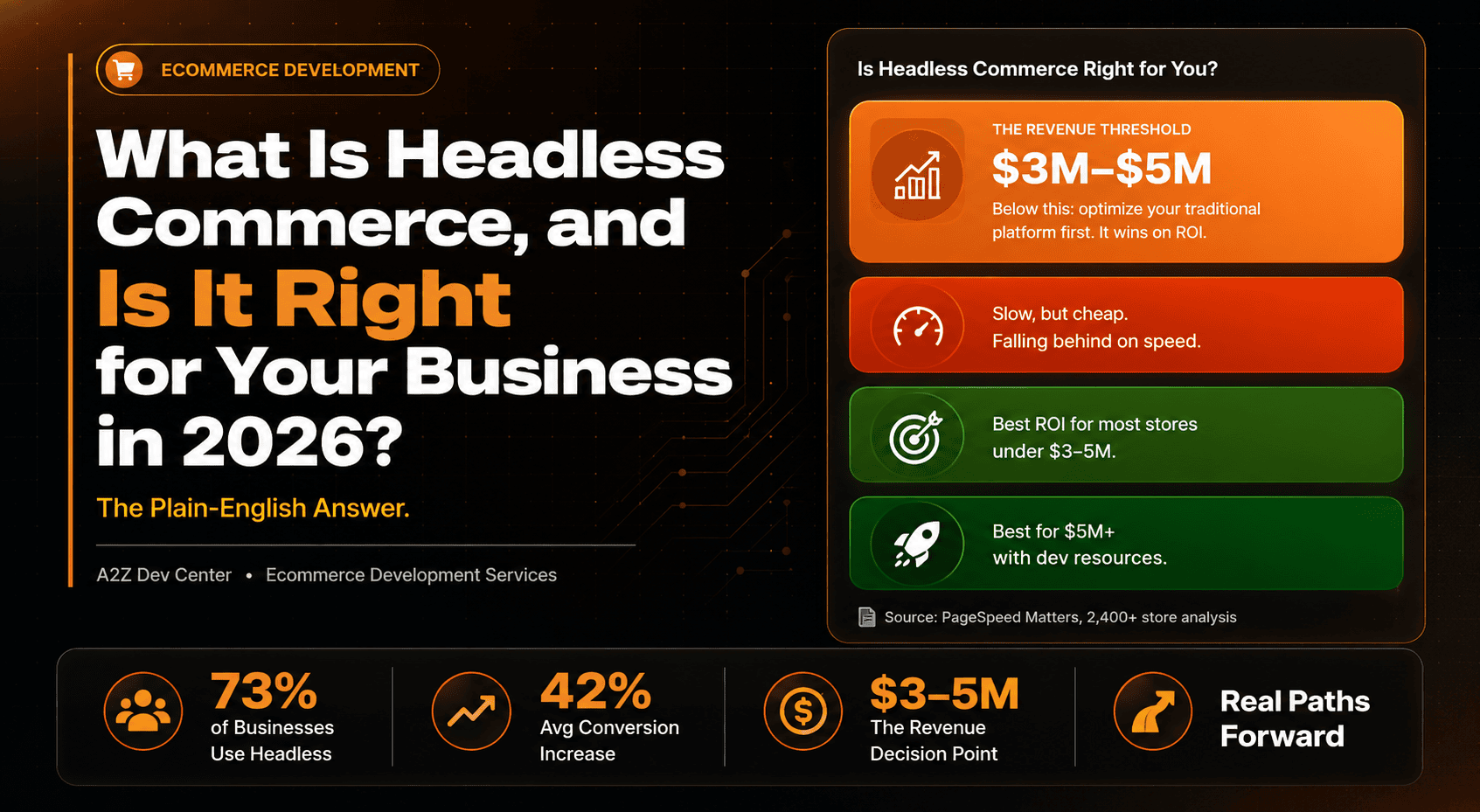
- But the most important number is one most guides bury: an analysis of more than 2,400 stores found that for businesses under $3 million to $5 million in annual revenue, optimizing your existing traditional platform delivers better ROI than a full headless rebuild, per PageSpeed Matters’ March 2026 comparison.
- A2Z Dev Center’s ecommerce development services cover all three paths in this guide: traditional platform setup, performance optimization of your existing store, and full headless builds, so the recommendation you get is based on your numbers, not on which service we would prefer to sell.
What Is Headless Commerce, Explained Simply?
Picture your online store as having two halves. The frontend is everything a customer sees and interacts with: the homepage, product pages, the shopping cart, the checkout screens. The backend is everything that happens behind the scenes: tracking inventory, processing payments, managing orders, storing customer data.
In a traditional ecommerce setup, like a standard Shopify or WooCommerce store, these two halves are bundled together. The same system that manages your products and orders also controls how your pages look and render. This is simple and fast to set up, which is exactly why platforms like Shopify became so popular: you get a working store quickly without needing a development team.
Frontend (“The Head”)
What customers see
Pages, design, cart, checkout UI, built in React, Next.js, or any framework you choose
API CONNECTION
Backend (Commerce Engine)
What runs the business
Products, inventory, orders, payments, customer data, in Shopify, BigCommerce, or custom
Headless commerce removes the head, the frontend, from the body, the backend, and lets you build a completely custom frontend that talks to your existing commerce backend through APIs. You keep the order processing, inventory, and payment systems you already trust, but you gain complete control over how your store looks, loads, and behaves, unconstrained by your platform’s built-in themes and templates.
Headless Commerce vs Traditional Ecommerce (Side by Side)
Factor
Traditional
Headless
Setup speed
Days to weeks
Weeks to months
Frontend flexibility
Limited to platform themes
Fully custom, any framework
Page load speed
Baseline
20-50% faster, LCP improves 0.6-1.2s
Ongoing maintenance
Lower, platform-managed
Higher, two systems to maintain
Non-technical management
Yes, familiar admin interface
Limited, frontend changes need developers
Risk profile
Single system, single point of failure
API failures can break the storefront
The Real Benefits, Backed by 2026 Data
The benefits of headless commerce are not marketing exaggeration; the data is genuinely strong. Companies report a 42% average conversion rate increase after headless implementation, per Swell’s 2026 headless commerce trends report. Each 1-second improvement in page load time increases conversions by 2%, and headless architectures deliver page loads 20 to 50% faster than traditional counterparts, with median Largest Contentful Paint improvements of 0.6 to 1.2 seconds, per PageSpeed Matters’ analysis of 2,400+ stores using March 2026 CrUX data.
Adoption reflects this: 73% of businesses now use headless architecture, up from 64% just two years earlier, and 98% of businesses not currently using headless plan to evaluate the approach within the next 12 months. Small business adoption specifically has grown at a 22.4% compound annual growth rate, showing this is not purely an enterprise phenomenon.
A real-world example: Combat Corner switched to a React frontend on WP Engine’s Atlas platform with a BigCommerce backend and saw a 431% improvement in performance with load speeds 604% faster, per Coaxsoft’s March 2026 case study analysis. Debenhams implemented a React PWA frontend and saw a 20% conversion rate increase and 40% increase in mobile revenue by addressing mobile customer drop-off.
The Drawbacks Nobody Likes to Talk About
Every benefit above comes with a corresponding cost, and the guides that only list benefits are not giving you the full picture.
Increased ongoing maintenance
You now have two systems instead of one: the frontend and the backend, each needing updates, monitoring, and occasional fixes. Per Eastside Co’s December 2025 analysis, this is one of the most common drawbacks businesses underestimate before migrating.
Longer ramp-up time for your team
Your team is used to a familiar admin dashboard where they manage products, content, and orders in one place. With headless, content and frontend changes typically require a developer, even for small updates that a non-technical team member could previously make themselves.
More reliance on developers, ongoing
This is not a one-time migration cost. Every frontend change, every new feature, and every design update now goes through a development process rather than a theme editor or page builder.
If the APIs fail, the whole system can break
Your frontend and backend now communicate over a network connection. If that API connection has an outage, is slow, or returns errors, your storefront can go down or behave unpredictably, even if your backend commerce engine is running fine.
The $3-5M Question: When Headless Actually Pays Off
The Number Most Guides Bury
$3M-$5M / year
An analysis of more than 2,400 stores across Shopify, BigCommerce, WooCommerce, and Magento, comparing each platform against its headless counterpart, found that for most brands under $3 million to $5 million in annual revenue, optimizing their existing traditional platform delivers better ROI than a headless rebuild, per PageSpeed Matters’ March 2026 comparison. The speed advantage of headless only translates into more revenue when implementation quality is high and your traffic volume is large enough to make that speed difference financially meaningful.
Here’s why this threshold exists, in plain terms. Headless commerce delivers its biggest win through speed: faster pages convert better. But a faster page is only worth more money if enough people are hitting that page for the speed difference to add up to real revenue. For a high-traffic store, shaving even half a second off every page load translates into a large number of additional conversions every day. For a lower-traffic store, that same half-second improvement affects far fewer total visits, so the extra revenue may not cover the additional cost and complexity of running two systems.
Do the math for your store (example)
Your monthly revenue$100,000/month
Estimated revenue recovered per 2 seconds shaved off load time$15,000-$25,000/month
Annual impact at this revenue level$180,000-$300,000/year
For a store doing roughly $100,000 per month ($1.2M annually), shaving 2 seconds off load time can mean $15,000 to $25,000 per month in recovered revenue, per Moydus’ 2026 cost comparison, which can pay for a headless build within a year at that revenue level. But notice the gap: $1.2M annually is still below the $3-5M threshold where PageSpeed Matters’ broader analysis found headless rebuilds typically win. This is exactly why the honest answer is “it depends on your specific numbers,” not a blanket yes or no, and why the calculation above is worth doing for your actual store before committing to either path.
Do Your Customers (and AI Shopping Agents) Need This?
There is a newer factor in this decision that did not exist a few years ago: AI shopping agents. In 2026, a growing number of purchases start with someone asking an AI assistant to find, compare, or even buy a product on their behalf. These AI agents work by reading structured data from store websites quickly and efficiently.
In plain terms: when an AI shopping agent visits your store to check if you have a product in stock and at what price, it wants a fast, clean answer, not a full webpage with images, scripts, and ads that takes seconds to load. Headless architectures are built to serve exactly this kind of fast, structured data at the edge (meaning from servers physically closer to whoever, or whatever, is making the request). Traditional platforms serving a full HTML page to an AI agent waste that agent’s time and computing budget, per WeArePresta’s January 2026 analysis, and the agent may simply move on to a competitor’s store that responds faster.
This does not mean every business needs headless commerce specifically to be AI-agent-ready. It means that speed and structured data are becoming relevant to a new category of “visitor,” and this consideration adds weight to the decision for stores that are already close to the $3-5M threshold, since AI agent traffic is an additional reason the speed advantage of headless may pay off sooner than the historical human-traffic-only calculation would suggest.
“Optimized Traditional”: The Third Option Most Guides Skip
Most headless commerce content frames this as a binary choice: stay traditional, or go headless. There is a third path, and for most businesses under the $3-5M threshold, it is the right one: optimize your existing traditional platform first.
Path 1: Traditional, As-Is
Do nothing
You keep falling behind on speed as competitors pull ahead. Lowest cost, lowest performance, declining relative position.
Path 2: Optimized Traditional
Best ROI for most SMBs
Image optimization, code cleanup, caching, theme performance audits, and Core Web Vitals fixes on your existing Shopify, WooCommerce, or Magento store. Captures much of the speed benefit at a fraction of the cost.
Path 3: Full Headless
Best for $5M+ with dev resources
Maximum flexibility and performance ceiling, but requires the traffic volume and ongoing development resources to justify the maintenance overhead.
Optimizing your traditional platform can capture a meaningful portion of the speed benefits headless promises, often a significant fraction of that 20 to 50% page load improvement, through image compression, removing unused theme code and apps, implementing proper caching, and fixing Core Web Vitals issues, all without the ongoing API maintenance burden or developer dependency that comes with headless. Our Shopify development services and Magento development services include exactly this kind of performance optimization work as a standalone engagement, separate from any headless conversation.
Is Headless Commerce Right for Your Business? (5-Question Checklist)
1
Is your annual revenue above $3-5 million?
If no, optimized traditional likely delivers better ROI right now. If yes, continue to question 2.
2
Do you have access to ongoing development resources?
Not just for the build, but for every frontend change afterward. If you do not have an in-house developer or a reliable agency relationship for ongoing work, the maintenance burden of headless will compound.
3
Have you already optimized your current platform?
If your current Shopify, WooCommerce, or Magento store still has unoptimized images, bloated apps, and no caching strategy, you have not captured the easy wins yet. Do this first regardless of your eventual decision.
4
Do you need experiences your current platform’s themes genuinely cannot deliver?
Truly custom checkout flows, multiple frontends from one backend (web, app, kiosk), or content-heavy commerce experiences are the cases where headless flexibility is not just nice to have, but necessary.
5
Does your traffic volume make a speed improvement financially significant?
Use the calculation method above: estimate your revenue recovered per second of load time improvement, and compare that annual figure honestly against the cost and ongoing overhead of a headless build.
If you answered “no” to question 1, the honest recommendation in 2026 is optimized traditional, not headless, regardless of how much headless commerce content you have been seeing. Our web app development services can also help if your “headless-like” needs are actually about building a specific custom application (a customer portal, a configurator) that connects to your existing store via API, without requiring a full storefront rebuild.
Frequently Asked Questions
Making the Right Ecommerce Architecture Decision for Your Business
Headless commerce is a genuinely powerful architecture when the conditions are right: sufficient revenue to justify the complexity, access to ongoing development resources, and traffic volume large enough that speed improvements translate into meaningful additional conversions. For businesses that meet those conditions, the data is compelling.
For businesses that do not yet meet those conditions, the right move is to optimize your existing platform first, capture the speed improvements that are available within your current setup, and revisit the headless question when your revenue and traffic make the economics work. Our ecommerce development services cover all three paths and include an honest assessment of which one fits your specific numbers, not a pitch for whichever service carries the highest margin. Contact us at our contact page to discuss your store’s situation.
Schedule a call
Talk to a subject-matter expert
Web development, SEO, or digital marketing — tell us about your project and we'll get back within one business day. No obligation.
- Free scope & strategy session
- A senior specialist, not a sales rep
- Your details stay confidential