SEO
Summarize this blog post with:
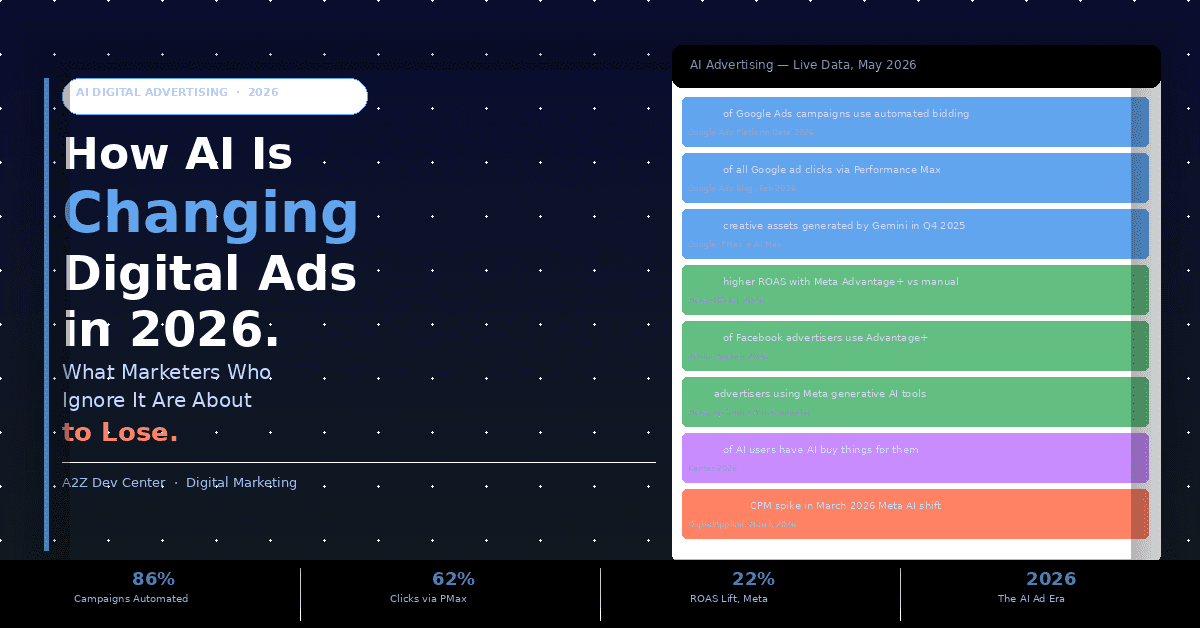
The state of AI digital advertising 2026 is unambiguous: 86% of all Google Ads campaigns now run on automated bidding. Performance Max drives 62% of every Google ad click. Meta Advantage+ delivers 22% higher ROAS than manually managed campaigns, and 82% of Facebook advertisers are already running it. Google’s Gemini model generated 70 million creative assets inside Performance Max and AI Max campaigns in Q4 2025 alone. AI digital advertising is not coming. It is already the majority of what runs.
- If you are still managing bids manually, you are bidding against machines on every impression. Google’s auction-time AI calculates a unique bid using device, location, time, browser, and behavioral history. No human matches that speed or signal volume. Being in the 14% still running manual is not a strategy. It is a cost.
- Meta’s March 2026 algorithm update hit manual campaigns the hardest. CPMs rose 15% to 40% in the first two weeks of March 2026 for advertisers who had not automated. Those running Advantage+ saw the algorithm shift absorb around the outcome they’d configured. The platform rewarded preparation and penalized inertia.
- The buyer is increasingly a bot. Kantar’s 2026 research found 24% of AI users already have an AI assistant making purchasing decisions on their behalf. Your audience targeting assumptions built around human buyer behavior are becoming structurally outdated.
- A2Z Dev Center’s digital marketing services include AI digital advertising strategy, Performance Max architecture, and Meta Advantage+ setup for businesses running campaigns today. Before assuming your current setup is competitive, read what the actual performance gaps look like below.
86% automated means you are one of 14% still doing it manually. And you are not bidding against the 14%. You are bidding against the 86% that have already handed optimization to systems that recalculate their bids thousands of times a day, per auction, with signals no human can process. Every impression you win in that environment, you win on price alone, not on intelligence. That is the state of AI digital advertising today, and it gets sharper from here.
The question in AI digital advertising today is not whether to use AI advertising tools. The platforms have already answered that question for you. The real question is whether you are feeding those AI systems the right signals, the right creative, and the right structure to get results above the algorithmic average, or whether you are letting the AI run on defaults and then wondering why your ROAS is declining quarter over quarter. A2Z’s performance marketing guide covers what actual results look like when campaigns are built for AI optimization rather than against it.
86%
Google Ads campaigns on automated bidding (Google Ads Platform Data 2026)
22%
Higher ROAS with Meta Advantage+ vs manual (Meta Official 2026)
24%
Of AI users have AI make purchases for them (Kantar 2026)
How Is AI Changing Digital Advertising on Google?
Performance Max, AI Max, Smart Bidding, and the End of Keyword Control
Performance Max is now the engine behind 62% of all Google ad clicks, per the Google Ads Blog’s February 2026 update. That figure did not exist as a campaign type four years ago. 72% of Google advertisers now run at least one PMax campaign, a jump of 34 percentage points since 2024, according to Google’s internal data. The holdouts are not protecting something. They are simply running behind.
The newer development is Google AI Max for Search. By January 2026, every managed account in North America had the option to run keyword-free Search campaigns. The interface asks for a landing page, a budget, and a target ROAS or CPA. Gemini handles match types, negatives, ad copy variants, and sitelink selection. In Q4 2025 alone, Google reported that advertisers used Gemini to generate nearly 70 million creative assets inside AI Max and Performance Max campaigns. For context: that is more creative production in one quarter than most agencies produce across their entire client roster in a decade.
Smart Bidding has completed its takeover as the default. 86% of all Google Ads campaigns use some form of automated bidding, including Target CPA, Target ROAS, or Maximize Conversions, per SearchLab’s Google Ads Statistics 2026. Google’s auction-time bidding now calculates a unique bid for every single impression using real-time signals: device, browser, time of day, location, and behavioral history combined. No manual bid can compete with that calculation at scale. Advertisers using Smart Bidding see 20% to 40% better performance than manual bidding, per Google’s internal benchmarks.
The newest placement is Ads in AI Mode, which Google began testing in the US in late 2025. This puts advertiser ads directly within AI-generated search responses, reaching conversational and multi-step queries that traditional keyword campaigns miss entirely. Google AI Overviews now affect 15% to 20% of commercial search queries, per Search Engine Land’s 2026 analysis. Marketers not structured for these placements are invisible on a growing portion of commercial intent.
The Broad Match + Smart Bidding combination: Advertisers pairing Broad Match with Smart Bidding see an average 35% increase in conversions, per Google’s internal data. The AI’s query matching is sophisticated enough to find relevant searches that exact match excludes. This combination was considered risky in 2022. It is standard practice in 2026. For Shopify stores specifically, Broad Match + Smart Bidding feeding into Performance Max routinely outperforms manual keyword sculpting by this margin when the product feed and conversion tracking are clean.
What Did Meta Change in 2026 and What Happened to Manual Campaigns?
The Creative Shift: Why Bidding Skill Is No Longer Your Edge
When AI Handles Targeting, Creative Becomes the Last Remaining Competitive Variable
AI-driven targeting has commoditized audience segmentation. Every advertiser running Advantage+ or Smart Bidding is using the same underlying optimization engine. The differentiation is now almost entirely in what the AI is given to work with: creative assets, product feeds, first-party data signals, and landing page quality. Creative quality now drives approximately 70% of campaign performance outcomes across platforms, per industry composite data from DigitalApplied Q1 2026 benchmarks.
The AI creative data adds a specific and useful dividing line. AI-generated ads achieve approximately 12% higher click-through rates on Meta compared to human-created ads targeting identical audiences with equivalent budgets, per DigitalApplied’s Q1 2026 AI creative benchmark analysis. However, for products above a $100 average order value, human-created creative still produces better downstream ROAS than AI-generated assets. The AI creates more clicks. The human creates more buyers, at high AOV.
The practical implication for most advertisers: AI handles creative production volume and rapid variant testing. Humans handle the strategic angle, the narrative specificity, and the brand differentiation that closes a $300 purchase. Using AI to generate 20 variants of an ad nobody has thought carefully about is not a creative strategy. It is a testing framework built on a weak brief. The winning approach is human-directed creative strategy executed at AI production scale.
On TikTok, the dynamic is different. UGC-style content outperforms polished, professionally produced creative by 2.5x on the platform. AI video generation tools are producing functional UGC-style content, but authentic creator-led content maintains a performance advantage for brands where cultural credibility matters. The practical signal: content marketing investment that produces creator-led assets now has direct measurable impact on paid advertising performance.
What Marketers Who Ignore AI Advertising Are Actually Losing
Every competitor article on this topic says “you’ll fall behind.” Here are the specific mechanisms by which that happens, with numbers.
1
They lose every per-auction bid calculation to AI-optimized accounts
Google’s auction-time AI calculates a unique bid for every single impression using signals no human manager can process at auction speed: device type, browser, time of day, location, and full behavioral history combined in real time. Manual bidders set flat bids or apply basic dayparting. Against AI Max or Smart Bidding opponents, every impression they win, they win by overpaying on price rather than precision. Smart Bidding delivers 20% to 40% better performance than manual bidding per Google’s internal benchmarks. The gap compounds over time because the AI learning curve keeps improving while manual accounts stay static.
2
They pay the CPM penalty when platforms update their AI
Meta’s March 2026 algorithm shift sent CPMs up 15% to 40% for manual campaigns that were not aligned with the new outcome-based optimization model. Advantage+ advertisers, already configured around conversion signals the new system was weighting, absorbed the update more cleanly. Platform AI updates will keep happening. Each update is a stress test of whether your campaign architecture is aligned with where the platform’s AI is optimizing. Manual campaigns will consistently fail this test more expensively than automated ones.
3
They miss the queries and audiences that only AI surfaces
AI Max’s keyword-free Search and Advantage+’s open audience expansion reach queries and audience segments that rule-based targeting excludes by definition. Ads in AI Overviews reach 15% to 20% of commercial queries that traditional keyword campaigns are not even eligible for. Marketers running rigid exact-match campaigns or manual audience definitions are buying a subset of the available intent. The AI-native campaigns are buying all of it, at better prices, because they convert the traffic the algorithm has pre-qualified.
4
Their creative output cannot match AI production volume at current cycles
Meta’s post-March 2026 AI delivery system penalizes creative fatigue automatically. The algorithm detects when a creative’s performance signal is declining and reduces its distribution. This now happens at 14 to 21 days in AI-optimized campaigns, down from 45 days in manual targeting environments. Advertisers still refreshing creative monthly are running fatigued assets for two to three weeks of every month. The platform is already down-ranking them while they are waiting for creative review approval. In Q4 2025 alone, Google’s Gemini generated 70 million ad assets. That is the production pace the AI systems are designed around. Human-only creative production cannot match this testing cadence.
5
They are targeting human buyers while AI agents are making the decisions
Kantar‘s 2026 research found 24% of AI users already have an AI assistant making purchasing decisions on their behalf, and that number is moving in one direction. Your audience targeting, your creative messaging, and your conversion path were built for a human reading an ad and deciding to click. A segment of your audience is now a bot evaluating your product against a decision framework an AI has set. Demographic targeting, interest signals, and behavioral lookalikes built on human behavior are becoming structurally outdated for a portion of your market. This does not have a clean fix yet. But ignoring it is the same mistake as ignoring mobile-first in 2013.
How to Adapt Your AI Digital Advertising Strategy Today
These are not theoretical. Each step is implementable now, for any advertiser running Google or Meta campaigns, regardless of budget size.
1
Enable Enhanced Conversions on Google and CAPI on Meta before anything else
Enhanced Conversions passes hashed first-party customer data from your site back to Google’s bidding AI, improving signal quality and conversion accuracy by an average of 5% to 15% per Google’s documentation. Meta’s Conversion API does the same for Facebook and Instagram, filling the signal gaps created by browser restrictions and iOS privacy changes. Both cost nothing beyond developer time to implement. Every week you run AI bidding without these active is a week the algorithm is learning from noisier data than it could have. This is the single highest-impact configuration task for any advertiser today, and most accounts do not have it correctly set up.
2
Upload your customer list to both platforms before running AI campaigns
Meta’s Advantage+ and Google’s Performance Max both perform significantly better when launched with a customer list seed. Upload your email list (minimum 1,000 contacts on Meta, 1,000+ on Google) as a Custom Audience or Customer Match list. This gives the AI a concrete definition of who your buyers are rather than building its model from zero. Google’s Smart Bidding then uses this as a behavioral baseline, significantly shortening the learning period. Without a seed list, you are asking the algorithm to find buyers from scratch with no prior context. That is the equivalent of hiring a salesperson and giving them no product knowledge or customer history on their first day.
3
Run Performance Max alongside Search, not instead of it
Adalysis’ study of 3,300 campaigns found that when both Performance Max and Search campaigns were eligible for the same search terms, Search campaigns typically had higher conversion rates for those specific terms. PMax captures incremental reach across YouTube, Display, Discover, Gmail, and Maps that Search does not touch. Search captures the highest-intent keyword-matched queries with more control and transparency. The correct architecture is PMax for cross-channel reach combined with tight Search campaigns for your core commercial keywords running simultaneously. Monitor the search terms report in both, add exclusions where they overlap, and let them complement rather than cannibalize. For SEO-focused businesses, understanding how PMax affects organic click share is equally important as the paid performance it delivers.
4
Tighten your creative refresh cycle to 14 to 21 days on Meta
Post-March 2026, Meta’s AI delivery system actively penalizes creative fatigue by reducing distribution to assets showing declining performance signals. This happens at 14 to 21 days in AI-optimized campaigns, compared to 45 days or longer in legacy manual targeting. Build a content calendar that schedules new creative variants every two weeks minimum. This does not require polished production on every cycle. Authentic, simple creative outperforms overproduced assets on most Meta placements, and simple creative can be produced quickly. The goal is to give the algorithm something fresh to test before it starts penalizing the current creative through reduced reach.
5
Ensure your landing page loads under 2.5 seconds on mobile before scaling AI campaigns
AI bidding systems optimize for conversion. They route budget toward the pages and audiences that convert at the highest rate. A landing page that takes 5 seconds to load on mobile does not just lose conversions. It actively teaches the algorithm that this traffic converts poorly, causing it to reallocate budget away from the signals that drove that traffic. The AI learning loop runs from ad to landing page to conversion signal. A slow page breaks the loop. Advertisers scaling Performance Max or Advantage+ spend without fixing mobile page speed are paying the AI to discover and then deprioritize their best audiences. Our content and technical team addresses this as part of every campaign architecture review.
Platform Comparison: AI Digital Advertising Today
| Platform | AI System | Key Stat | Best Use | The Risk if You Ignore It |
|---|---|---|---|---|
|
Google Search |
AI Max + Smart Bidding | 86% automated; +35% conversions with Broad Match + SB | High-intent buyer capture | Paying over-market for every manual impression |
| Google PMax | Performance Max | 62% of all Google clicks; 72% advertiser adoption | Cross-channel reach + conversion | Missing all non-search placements your competitors own |
|
Meta Advantage+ |
Andromeda + GEM | 22% higher ROAS; 82% adoption; 4M+ on generative AI | eCommerce + lead gen at scale | CPM spikes on every algorithm update like March 2026 |
|
Google AI Mode |
Gemini-powered | Ads in AI Overviews: 15-20% of commercial queries | Conversational + complex queries | Invisible on a growing share of buyer research sessions |
| TikTok | Smart+ AI | UGC outperforms polished 2.5x; lowest CPM at $3.50 | Awareness + upper funnel | Paying 2.5x more per engagement with polished creative |
Frequently Asked Questions
Your AI Digital Advertising Campaigns Are Running on Autopilot.
The Question Is Whether the AI Is Winning.
Most underperforming Google and Meta campaigns are not failing because of the AI. They are failing because of what the AI is not being given: clean conversion signals, customer list seeds, fresh creative, and the right campaign architecture. A2Z Dev Center audits and rebuilds AI advertising setups for businesses whose current results do not match the platform benchmarks.
Book a Free AI Advertising Audit
Schedule a call
Talk to a subject-matter expert
Web development, SEO, or digital marketing — tell us about your project and we'll get back within one business day. No obligation.
- Free scope & strategy session
- A senior specialist, not a sales rep
- Your details stay confidential