
Content Marketing
Summarize this blog post with:
Quick Answer: What Is Content Marketing ROI?
Content marketing ROI is the measurable return generated by content investments relative to the cost of producing and distributing that content, expressed as a percentage. A complete content marketing ROI calculation connects content consumption data from GA4 to pipeline and revenue data from your CRM, closing the loop between blog traffic and closed deals. Only 21% of marketers can accurately calculate content marketing ROI, according to DigitalApplied’s 2026 measurement framework research.
What This Guide Covers
- Content marketing ROI is not a traffic problem. It is an attribution infrastructure problem. Most teams have the data. They do not have the connection between their GA4 content data and their CRM revenue records. This guide builds that connection step by step.
- Your CMO does not ask “what was our bounce rate?” in a quarterly review. They ask five specific questions. This guide builds the content marketing metrics framework around those five questions, not a list of 16 metrics that sound impressive but answer nothing a CFO cares about.
- 81% of content teams are not tracking AI search visibility as a content marketing performance metric in 2026, according to DigitalApplied’s March 2026 research. This guide adds it to your content ROI measurement framework before your competitors do.
- A2Z Dev Center’s content marketing services include ROI measurement framework design, GA4-to-CRM attribution setup, and content scoring system implementation. This guide reflects the measurement architecture we build for every content program.
Your content team published 48 articles last quarter. Organic traffic grew 18%. Dwell time increased. Social shares are up. You walk into the quarterly review, open your reporting deck, and your CMO looks at slide 3 and asks: “Which of these drove revenue?” You do not have a clean answer. Not because your content is not working. Because you are measuring content marketing ROI with the wrong framework.
How to measure content marketing ROI is one of the most searched questions in content strategy, and yet only 21% of marketers can accurately tie content to revenue. The measurement gap is not a content quality problem. It is an attribution infrastructure problem. The sections below fix that, starting with what your CMO actually needs to see.
What Is Content Marketing ROI and Why Is It So Hard to Measure?
Content marketing ROI measures the revenue generated by your content program relative to the cost of producing and distributing that content. The formula looks simple. The measurement is not. The core difficulty is attribution: a buyer who reads six blog posts, downloads one guide, watches one webinar, and then converts via a Google Ad is a content-influenced conversion that last-touch attribution will credit entirely to the ad. Your content marketing ROI appears as zero. The buyer’s journey was 80% content.
DigitalApplied’s February 2026 content ROI measurement framework research identifies the root cause precisely: “The measurement gap is not a content quality problem. It is an attribution infrastructure problem.” The 79% of marketers who cannot accurately measure their content marketing ROI are not running bad content programs. They are running unmeasured ones. Your digital marketing strategy requires this attribution infrastructure as a baseline before content ROI can be reported honestly to any leadership audience.
The scale of the measurement gap: Only 39% of B2B content programs have a documented content strategy, according to the Content Marketing Institute’s B2B survey. Teams without documented strategy almost universally lack documented measurement frameworks. Content marketing metrics cannot be optimized if they are not being tracked against consistent definitions quarter over quarter.
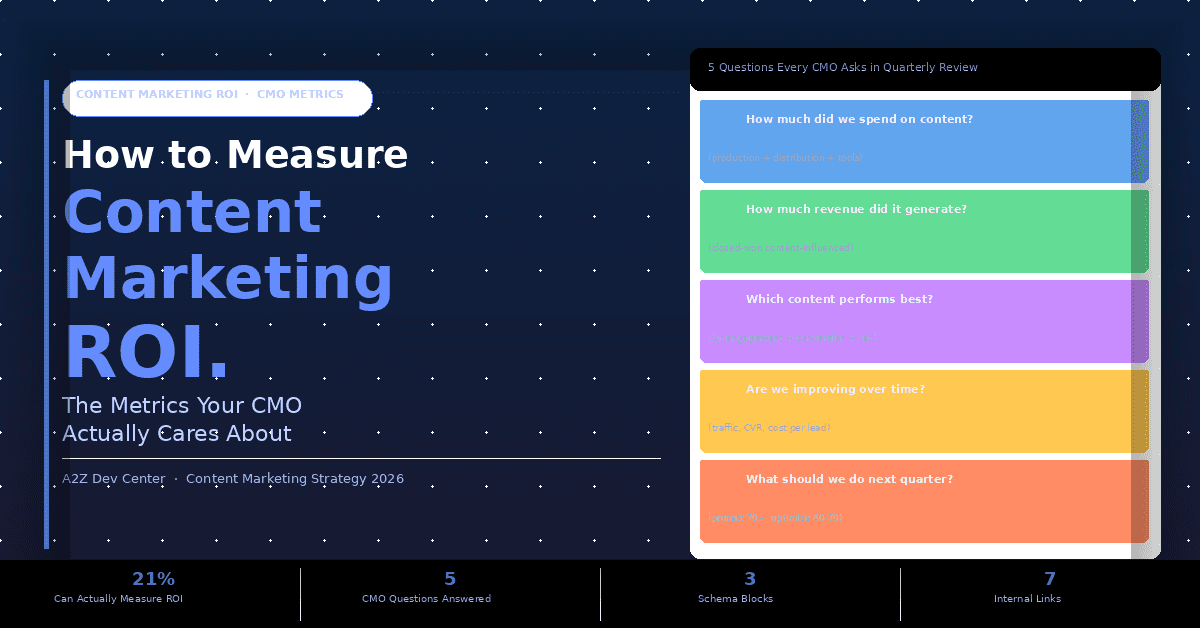
The 5 Questions Every CMO Asks in a Quarterly Content Marketing Review
Instead of starting with a list of content marketing metrics, start with the five questions your CMO will ask. Every metric in your content ROI measurement framework should answer one of these questions directly. If a metric does not answer any of the five, it does not belong in your deck.
Q1
How much did we spend on content this quarter?
This question requires a complete content cost accounting: production (writing, design, video), distribution (paid promotion, email send costs), tools (SEO tools, content management, analytics), and internal team time at blended rate. Most content teams track only production costs and dramatically understate total content investment, which in turn inflates their reported content marketing ROI.
Metric: Total Content Cost = Production + Distribution + Tools + (Hours × Blended Rate)
Q2
How much revenue did the content program generate?
This is where most content marketing metrics frameworks fail. “How much revenue” requires connecting GA4 content path data to CRM closed-won records. Pipeline influenced counts all closed-won deals where a prospect touched a content asset at any point in their journey. Direct attribution counts deals where content was the first or converting touchpoint. Both are valid. Both need to be reported separately, because conflating them inflates your content marketing ROI calculation.
Metric: Pipeline Influenced (secondary) + Direct Revenue Attribution (primary)
Q3
Which content performs best?
This question requires a content scoring system that produces a single comparable number for every piece in your library. Without a content score, “which performs best” generates arguments between the person who looks at traffic, the person who looks at conversions, and the person who looks at time on page. A content score integrates all three into one number that enables honest prioritization. Content scoring is the ROI proxy that works before conversion happens and is the most practical content marketing KPI for optimization decisions between reporting periods.
Metric: Content Score 0-100 (engagement depth + conversion assists + revenue attribution weight)
Q4
Are we improving quarter over quarter?
QoQ trend reporting requires consistent metric definitions. A change in how you define “content-influenced pipeline” between Q2 and Q3 makes the comparison meaningless. Fix your content marketing KPI definitions before Q1 reporting and hold them through four consecutive quarters. Trend data from four consistent quarters tells your CMO more about content marketing ROI trajectory than any single-quarter snapshot ever will.
Metric: QoQ change in organic MQLs, cost per content-attributed lead, total pipeline influenced
Vanity Metrics vs CMO-Ready Content Marketing Metrics , Which to Drop From Your Deck
Every content team tracks some vanity metrics. The CMO-ready content marketing metrics that answer the five questions above are different in kind, not just degree, from the metrics that look impressive in a reporting dashboard but fail to inform a budget decision. Knowing which to drop before building your content marketing ROI report saves the meeting and preserves your credibility with finance leadership.
| Metric | Type | What It Actually Shows | CMO Verdict |
|---|---|---|---|
| Page views | Vanity | Volume of traffic, regardless of quality or intent | Drop, replace with engaged sessions |
| Social shares | Vanity | Content virality, no revenue correlation | Drop, irrelevant to pipeline |
| Follower count growth | Vanity | Audience growth, no conversion measurement | Drop, report only if brand goal |
| Bounce rate alone | Vanity | Tells you someone left, not why or what they did before | Drop, replace with scroll depth + time |
| Organic sessions | CMO-ready | Volume of search-intent visitors finding your content | Include, filter by keyword intent tier |
| Content-attributed MQLs | CMO-ready | Leads where content was a touchpoint, directly impacts CAC | Lead metric, always include |
| Pipeline influenced | CMO-ready | Revenue where content touched the buyer journey | Primary revenue metric |
| Content score | CMO-ready | 0-100 combined score for every piece, enables prioritization | Include, answers Q3 and Q5 |
| Cost per content-attributed lead | CMO-ready | Content marketing efficiency vs paid channel CPL | Include, direct budget justification |
| AI citation rate | CMO-ready | Presence in ChatGPT/Perplexity answers (2026 metric) | Include, emerging distribution channel |
Content marketing generates 3x more leads per dollar than outbound marketing at 62% lower cost, according to HubSpot’s 2025 content performance research. But this advantage is invisible without proper content marketing metrics tracking. The CMOs who understand content marketing ROI do not react to page views declining. They react to cost per content-attributed lead increasing. That shift in measurement focus is the difference between a content program that gets budget cut and one that gets budget increased. Our research on why most startups build organic growth wrong traces the root cause directly to this measurement gap.
The Content Marketing ROI Formula: Two Versions With Worked Examples
How to measure content marketing ROI requires two formulas depending on your reporting context. The simple formula works for single-campaign reporting. The LTV-adjusted formula is the content marketing ROI calculation your CMO wants to see when justifying multi-quarter content investment.
Formula 1: Simple Content Marketing ROI
Formula 2: LTV-Adjusted Content Marketing ROI (Semrush Methodology)
ROI = ((Revenue Attributed to Content − Total Content Cost) / Total Content Cost) × 100
Example: $8,000 content spend | $24,000 in content-attributed revenue
ROI = (($24,000 − $8,000) / $8,000) × 100 = 200%
Formula 2: LTV-Adjusted Content Marketing ROI (Semrush Methodology)
ROI = ((Customer LTV × Number of Content-Attributed Customers) − Content Cost) / Content Cost × 100
Example: $2,400 LTV | 10 content-attributed customers | $8,000 content cost
ROI = ((\$2,400 × 10) − \$8,000) / \$8,000 × 100 = 200%, same numerically, but accounts for full customer value, not just first deal
The content ROI timeline your CMO needs to defend to the CFO: Content marketing reaches positive ROI at 12 to 18 months from program launch, and achieves 6x or higher ROI at 24 months, according to OwlClaw’s 2026 content marketing benchmark analysis of HubSpot research. This means a content program evaluated at 90 days will always appear to fail. Comparing content marketing ROI to paid media ROI at 30-day horizons is the single most common mistake that leads to content budget cuts. Your performance marketing channel delivers faster ROI and lower volume. Content delivers slower ROI and compound growth. Both need different measurement time horizons to be evaluated fairly.
Which Attribution Model Should You Use for Content Marketing ROI?
Attribution model choice is one of the most consequential and least discussed content marketing KPI decisions a team makes. The same content program reported under first-touch attribution versus last-touch attribution can show a 10x difference in apparent content marketing ROI. Your CMO needs to know which model you are using and why.
First-Touch Attribution
Awareness ProgramsGives 100% of revenue credit to the first content asset a buyer encountered. Best for measuring top-of-funnel content marketing performance metrics. Overstates the value of awareness content and undercounts the contribution of conversion-stage content. Use when your CMO needs to justify awareness content investment to finance.
Last-Touch Attribution
Conversion ProgramsGives 100% credit to the final touchpoint before conversion. Default in most GA4 setups. Systematically undercounts content marketing ROI because content almost never appears as the last touchpoint before a CRM form submission. Heavily biases credit toward paid search and direct. Avoid as the primary content ROI measurement model.
For most content marketing programs, multi-touch linear attribution gives the most complete and defensible content marketing ROI picture. It requires that your GA4 is configured with custom events for content engagement (scroll depth, video views, guide downloads) and that those events are connected to your CRM contact records. Our SEO services include GA4 custom event configuration and attribution model setup as a standard component of content ROI measurement framework engagements.
Content Scoring: The Content Marketing ROI Proxy That Works Before Conversion
Content scoring is the content marketing performance metric that gives every piece in your library a single comparable number before any conversion event is recorded. It solves the CMO’s Q3 question (“which content performs best?”) without requiring revenue attribution data, which typically lags content publication by 3 to 6 months in B2B cycles.
70-100
Protect and AmplifyHigh engagement + conversion assists. Increase distribution budget. Add internal links from lower-scoring pages. Refresh data annually to maintain freshness signal.
40-70
OptimizeGood engagement but weak conversion. Test CTA placement, add content upgrades, strengthen internal linking to commercial pages. Reassess score after 90 days of changes.
0-40
Consolidate or RetireLow engagement and conversion for two consecutive quarters. Merge into a stronger piece, 301-redirect the old URL to preserve link equity, or retire and redirect to a category page.
The content score formula weights three dimensions: engagement depth (scroll percentage above 60%, average session duration above 2 minutes, return visit rate), conversion assists (CTA clicks, form interactions, internal link follow-through to commercial pages), and revenue attribution (whether this piece appears in the GA4 path of closed-won CRM contacts). According to DigitalApplied’s 2026 content ROI framework, content scoring above 70 identifies top performers to protect and amplify, while scoring below 40 for two consecutive quarters identifies consolidation candidates. Updating content identified by scoring produces significant results: OwlClaw’s 2026 research found that refreshing underperforming blog posts increases organic traffic by 60 to 100% within 90 days at zero new content cost.
The 2026 Content Marketing KPI Nobody Is Tracking: AI Search Visibility
AI search visibility is the content marketing performance metric that measures whether your content is cited in AI-generated answers from platforms like ChatGPT, Perplexity, and Google AI Overviews. 81% of content teams are not tracking this metric, according to DigitalApplied’s March 2026 research. That figure represents a measurement blind spot that is growing larger as AI search becomes a primary discovery channel for buyers.
The challenge is that LLM citations and AI Overview appearances do not create referral visits in GA4. A buyer who discovers your brand because ChatGPT cited your article while answering a question does not appear in your analytics as a referral from ChatGPT. They appear as direct traffic or are invisible entirely. This means your content marketing ROI is structurally understated for any team producing content that earns AI citations without measuring it. Our GEO (Generative Engine Optimisation) guide covers the full measurement framework for tracking AI visibility as a content distribution channel.
Add AI search visibility to your content marketing ROI dashboard through three channels: manual monthly testing of your 10 highest-priority queries in ChatGPT and Perplexity (record whether your content is cited), Google Search Console filtering for AI Overview impressions and clicks (available in the Performance report), and Semrush’s AI Visibility Toolkit for automated monitoring of brand mention frequency in AI-generated answers.
How to Build a Content Marketing ROI Dashboard Your CMO Will Actually Use
The five CMO questions from earlier in this guide map directly to five panels in a content marketing ROI dashboard. One page. Five panels. Updated monthly. Reviewed quarterly.
1
Panel 1: Investment (answers Q1)
Total content spend this quarter versus last quarter, broken down by production, distribution, and tools. Add a cost per content-attributed lead trend line. This single trend line tells your CMO whether content is becoming more or less efficient as your program scales.
2
Panel 2: Revenue Attribution (answers Q2)
Pipeline influenced (all closed-won deals where a prospect touched content) and direct content attribution (deals where content was the first or primary conversion touchpoint). Report both separately with the attribution model clearly labelled. Multi-touch linear is the recommended model for most programs.
3
Panel 3: Content Score Distribution (answers Q3)
A ranked list of your top 20 content pieces by score, color-coded by tier (70+, 40-70, below 40). Percentage of your total library in each tier. Quarter-over-quarter shift in distribution: are more pieces moving into the 70+ tier? This panel drives the editorial calendar decision for next quarter.
4
Panel 4: QoQ Benchmark Trends (answers Q4)
Organic MQL volume, cost per content-attributed lead, and total pipeline influenced across the last four quarters as trend lines, not point-in-time snapshots. Four-quarter trends reveal whether your content marketing ROI is improving, plateauing, or declining. Single-quarter data is almost always meaningless due to seasonal variation and campaign timing.
5
Panel 5: AI Visibility (answers Q4 and Q5)
Monthly AI citation rate trend (% of tested queries where your brand is cited), Google AI Overview impression count from Search Console, and top-cited content pieces. This panel shows your CMO that you are measuring the 2026 content distribution channel that 81% of competitors are ignoring. It positions your content program as forward-looking, not just traffic-focused.
Frequently Asked Questions
Build the Content Marketing ROI Measurement Framework Your CMO Actually Needs.
Most content teams are one GA4 configuration and one attribution model decision away from being able to answer all five CMO questions accurately. A2Z Dev Center builds content marketing ROI measurement frameworks including GA4-to-CRM attribution setup, content scoring system implementation, and monthly reporting dashboards designed around executive decision-making.
Book a Free Content ROI Audit
Schedule a call
Talk to a subject-matter expert
Web development, SEO, or digital marketing — tell us about your project and we'll get back within one business day. No obligation.
- Free scope & strategy session
- A senior specialist, not a sales rep
- Your details stay confidential