
HubSpot Landing Page Templates: Free vs Custom Options in 2026
 By Akash Patel
·
📅 Published: March 23, 2026
·
⏱ 13 min read
By Akash Patel
·
📅 Published: March 23, 2026
·
⏱ 13 min read
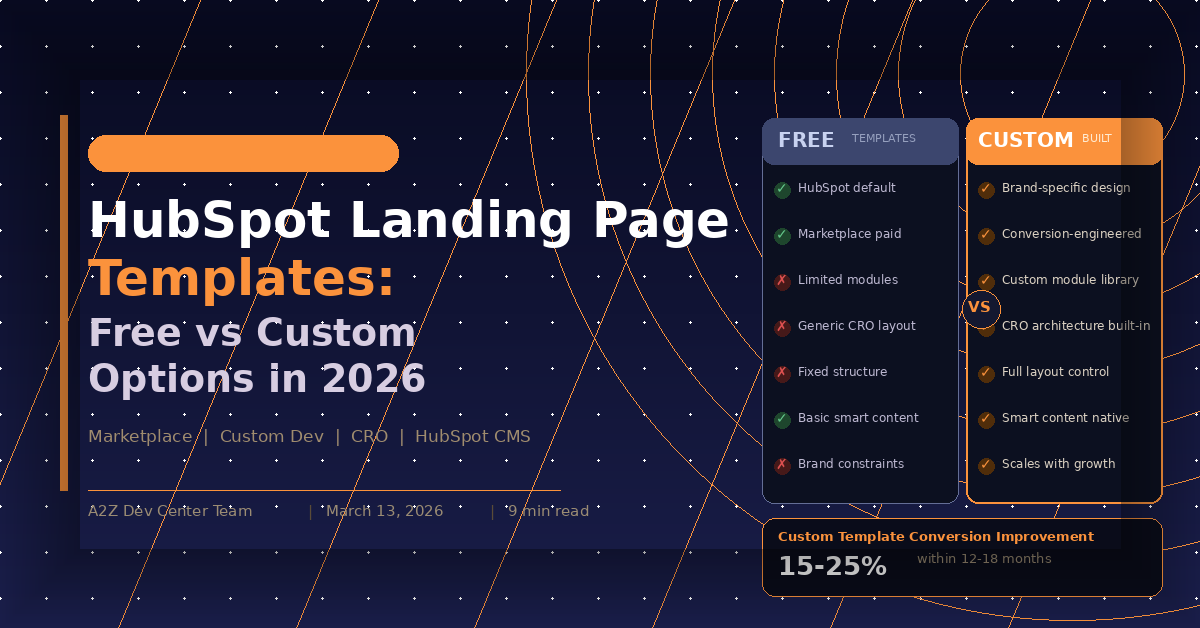
When you are building landing pages in HubSpot, the template decision comes earlier than most teams expect and carries more weight than most teams give it. Get the template foundation right and every page you build on top of it inherits the right structure, the right performance characteristics, and the right conversion architecture. Get it wrong and you are working around limitations with every new page you create.
The choice between free and custom HubSpot landing page templates is not simply a cost decision. It is a question of how much design control you need, how consistent your brand requirements are, how fast your page volume is growing, and how much conversion performance matters relative to the effort of building and maintaining a custom template system.
This guide breaks down both options honestly, covers what the HubSpot template marketplace actually offers, explains where free templates fall short and custom templates earn their cost, and gives you a clear framework for deciding which direction is right for your business right now.
Quick Answer: Should You Use Free or Custom HubSpot Landing Page Templates?
What is the practical difference between free and custom HubSpot landing page templates and how should a business choose?
Free HubSpot landing page templates are the right starting point for businesses with low page volume, limited brand requirements, and early-stage lead generation programs. Custom HubSpot templates are the right investment for businesses with established brand standards, high page volume, specific conversion architecture requirements, or performance marketing programs where landing page conversion rate improvements have direct revenue impact. Businesses using properly built custom templates consistently see 15 to 25% higher conversion rates than those working within free template constraints over a 12 to 18 month period.
Key Takeaways
- Free HubSpot landing page templates from the marketplace are a legitimate starting point but most are built for visual appeal rather than conversion performance
- Custom HubSpot templates pay for themselves quickly when landing pages are connected to paid campaigns where conversion rate differences have direct cost-per-lead impact
- The HubSpot template marketplace has over 1,000 templates but quality varies significantly and conversion-focused options require careful evaluation before purchase
- Custom template development gives you control over module architecture, performance optimization, and smart content integration that free templates cannot provide
- Brand consistency across a large page portfolio is nearly impossible to maintain with free templates and becomes significantly easier with a custom template system built on a shared design foundation
- The decision between free and custom is not permanent. Most growing businesses start with free or marketplace templates and migrate to custom when page volume and performance requirements justify the investment
What Free HubSpot Landing Page Templates Actually Include
HubSpot provides a set of free landing page templates accessible directly within the page editor. These templates cover the basic structural requirements of a landing page: a hero section, a form placement area, a features or benefits section, and social proof positioning.
The free templates are built by HubSpot’s design team and are technically sound in terms of responsive layout and basic performance. They will not break on mobile, they will load at reasonable speeds, and they will give you a functional starting point without any development work.
The limitations show up when you try to adapt them to specific brand requirements or conversion optimization needs. Free templates use fixed module arrangements that cannot be restructured without developer access to the template code. Color schemes, typography, and spacing are governed by the template’s built-in style settings, which offer limited customization through HubSpot’s visual design manager without touching the underlying code. And the conversion architecture of most free templates, specifically the relationship between headline placement, form position, and social proof arrangement, reflects generic best practices rather than a conversion-optimized structure built for your specific traffic type.
The how to build HubSpot landing pages that actually convert guide covers the specific conversion architecture decisions that free templates often constrain, including above-the-fold form placement and navigation removal, both of which require template-level changes in many free HubSpot templates.
What the HubSpot Template Marketplace Offers
The HubSpot template marketplace is a third-party ecosystem of paid templates built by HubSpot partner agencies and independent developers. At any given time the marketplace contains over 1,000 landing page templates ranging from free to several hundred dollars for premium options.
Marketplace templates offer more design variety than the default free options and many are built with conversion-focused layouts that the standard free templates lack. The best marketplace templates include proper navigation removal options, above-the-fold form layouts, testimonial placement near CTAs, and mobile-optimized structures that go beyond simple responsiveness.
The challenge with marketplace templates is quality variance. Templates range from excellent to poorly coded, and visual appeal in the marketplace preview does not reliably predict conversion performance or technical quality. Before purchasing any marketplace template, it is worth checking whether it has been updated recently, whether the developer has other templates with strong reviews, and whether the template’s module structure matches your page requirements without requiring significant rebuilding.
The HubSpot landing page design tips guide covers what to evaluate in any template from a conversion architecture perspective, which applies directly to marketplace template evaluation before purchase.
Where Free Templates Fall Short
Free and marketplace HubSpot landing page templates share several limitations that become significant as your landing page program matures.
The first limitation is brand consistency at scale. When you are building five or ten landing pages per month across multiple campaigns, maintaining consistent typography, spacing, button styling, and color application becomes genuinely difficult with free templates. Each page requires manual style decisions, and without a shared design system enforced at the template level, visual inconsistency accumulates across your page portfolio in ways that erode brand trust over time.
The second limitation is module flexibility. Free templates come with a fixed set of modules in a fixed arrangement. Adding a custom module type, such as a comparison table, an interactive ROI calculator, or a video testimonial carousel, requires either significant workarounds using the existing module set or direct template code editing that most marketing teams are not equipped to do.
The third limitation is performance optimization. Free templates are not built with Core Web Vitals optimization as a primary design constraint. Custom template builds can be engineered from the ground up to minimize render-blocking scripts, implement lazy loading, and optimize font delivery in ways that free templates simply were not designed to support. For paid campaigns where quality score is affected by landing page load speed, this difference has direct cost implications. The what are core web vitals and why they impact your SEO rankings post covers how page performance scores connect to both organic ranking and paid campaign efficiency.
What Custom HubSpot Landing Page Templates Deliver
Custom HubSpot landing page templates are built by HubSpot developers in the design manager using HubSpot’s templating language, HubL, and custom module architecture. A properly built custom template system gives your marketing team a page builder experience that looks like a flexible drag-and-drop editor but is actually governed by a design system with consistent constraints.
The practical benefits show up in four areas. Brand consistency is enforced at the template level, meaning typography, color, spacing, and component styling are controlled centrally and apply automatically across every page built on the template. Conversion architecture is built in, with navigation removal, above-the-fold form options, social proof positioning, and CTA contrast handled in the template design rather than requiring manual decisions on every page. Performance is optimized from the start, with images, scripts, and fonts handled in ways that free templates do not support. And module flexibility is designed to match your actual page requirements, including any custom interactive elements your campaigns need.
The custom HubSpot CMS development guide covers how custom template architecture connects to broader portal development strategy, including the design manager setup and module library structure that makes custom templates scalable across large page volumes. The dedicated HubSpot developer vs agency comparison is worth reading before you decide who builds your custom template system.
When to Use Free Templates vs Custom Templates
The decision framework is simpler than the debate around it suggests.
Use free or marketplace HubSpot landing page templates when you are building fewer than five landing pages per month, your brand requirements are flexible enough to adapt to available template structures, your campaigns are not yet at the scale where conversion rate differences have significant revenue impact, and you do not have developer resources or budget for custom template development right now.
Invest in custom HubSpot landing page templates when you are building more than five pages per month and manual brand consistency is becoming a problem, you are running paid campaigns where a two to three percentage point conversion rate improvement would produce meaningful cost-per-lead improvement, your brand standards require design precision that marketplace templates cannot deliver, or your campaigns need custom module types that do not exist in available templates.
The migration path from free to custom is not as disruptive as it sounds. A custom template build does not require rebuilding existing pages. Pages built on old templates can be migrated individually as they are updated, or the custom template can be deployed for new pages while existing pages remain on their current templates until they come up for review. The HubSpot development guide for scaling your tech stack covers how template migration fits into a broader portal improvement roadmap without disrupting active campaigns.
Free vs Custom HubSpot Landing Page Templates: Comparison
| Factor | Free Templates | Marketplace Templates | Custom Templates |
|---|---|---|---|
| Cost | Free | $50 to $300 one-time | Development investment |
| Brand consistency | Limited | Moderate | Full control |
| Conversion architecture | Generic | Varies by template | Built to specification |
| Module flexibility | Fixed | Limited | Fully flexible |
| Core Web Vitals optimization | Not prioritized | Varies | Engineered in |
| Smart content support | Basic | Varies | Full integration |
| Maintenance | HubSpot managed | Developer dependent | Agency or in-house |
| Best for | Early stage | Growing teams | Scale programs |
Frequently Asked Questions
Ready to Get Started?
Your Details will be Kept confidential. Required fields are marked *


