
How to Choose an SEO Service Provider in 2026: The No-BS Buyer’s Guide
There is no shortage of SEO service providers. There is, however, a significant shortage of honest conversations about what most of them actually deliver, how to tell the good ones apart from the rest, and what questions separate a genuinely capable team from one that knows how to sound capable without being it.
The SEO industry has a trust problem that is largely self-inflicted. Years of black-hat tactics, vanity metric reporting, and overpromised results have left a large number of businesses either burned by a bad experience or deeply skeptical of any provider’s claims before the relationship starts. That skepticism is justified. The average business buying SEO services for the first time has almost no reliable framework for evaluating what they are being sold until the results, or lack of them, arrive months later.
This guide exists to close that gap. It covers what a legitimate SEO service provider actually does, what separates high-performance providers from mediocre ones, the specific red flags that predict poor outcomes, the questions that reveal provider quality before any money changes hands, and a practical checklist for making the final decision with confidence.
How Do You Choose an SEO Service Provider?
What is the most reliable process for choosing an SEO service provider that delivers real results?
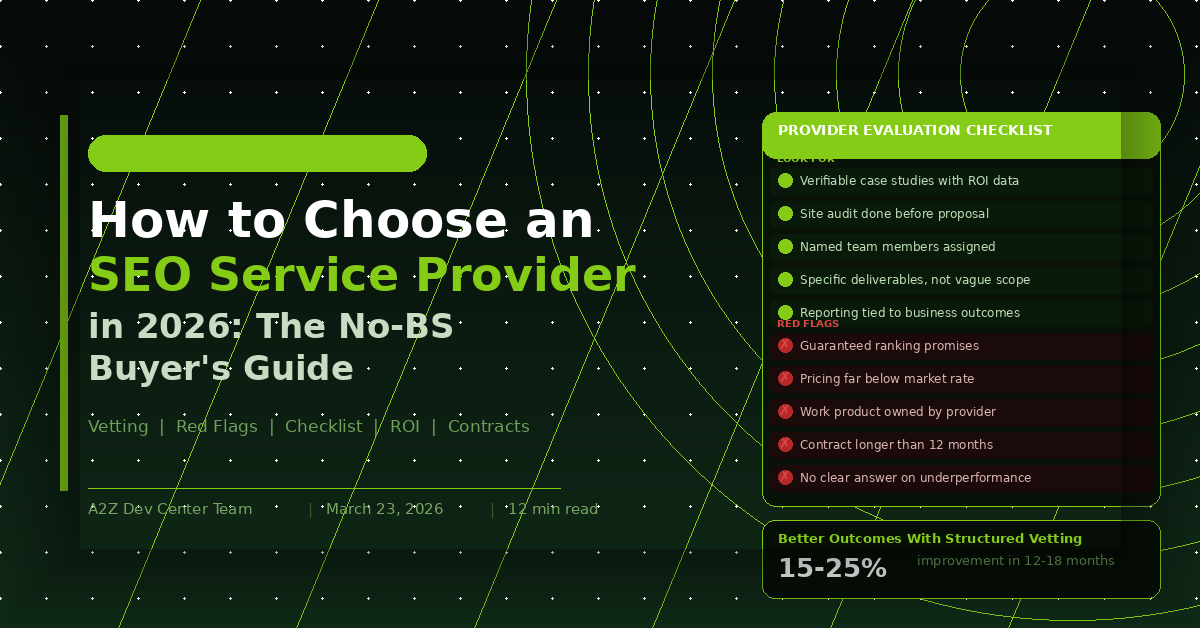
Choosing the right SEO service provider requires evaluating four things in sequence: their technical competence demonstrated through specific portfolio outcomes rather than generic case studies, their strategic approach to your specific competitive situation rather than a templated service package, their reporting transparency in connecting SEO activity to revenue metrics rather than ranking or traffic vanity metrics, and their contract terms including ownership of work product and exit conditions. Businesses that apply a structured evaluation process before selecting an SEO service provider see 15 to 25% better organic search performance outcomes within 12 to 18 months compared to those who choose based on price or proposal quality alone.
Key Takeaways
- The most important question to ask any SEO service provider is not what they will do but how they will measure whether it is working, and what happens if it is not
- Portfolio case studies that show ranking improvements without connecting them to traffic, leads, or revenue are almost always concealing underperformance at the business outcome level
- A legitimate SEO service provider will conduct a site audit before proposing a scope of work. Any provider proposing a fixed deliverable set without first understanding your site’s specific technical state is selling a template, not a strategy
- Contract terms matter as much as service quality. Intellectual property ownership of content and links built, notice period, and exit conditions determine how much leverage you have if the relationship underperforms
- Local SEO and national SEO require fundamentally different strategies and provider specializations. Hiring a provider without relevant experience in your specific SEO context produces poor results regardless of their overall reputation
- The cheapest SEO service is almost always the most expensive one in the long run. Providers operating below sustainable market rates are cutting corners somewhere, and the corners cut in SEO are almost always the ones that produce the worst long-term outcomes
What a Legitimate SEO Service Provider Actually Does
Before evaluating any provider, it is worth being clear about what a legitimate SEO service provider’s work actually covers. The vagueness of most SEO proposals is not accidental. It is a function of the fact that SEO work spans technical, content, and authority-building disciplines that are genuinely difficult to describe simply. But vagueness in a proposal is a risk for the buyer, not an inherent feature of the service.
A comprehensive SEO service covers three interconnected areas. Technical SEO addresses the infrastructure layer: how search engine crawlers access and index the site, whether the site’s architecture supports ranking for target keywords, how Core Web Vitals scores affect ranking eligibility, whether structured data is correctly implemented, and whether there are technical issues such as duplicate content, broken internal links, or crawl budget problems that limit the site’s ranking potential regardless of content quality.
On-page SEO covers the content and keyword strategy layer: whether target pages are optimized for the right keywords at the right search intent level, whether content depth and quality meet E-E-A-T standards for the topic area, whether internal linking architecture distributes authority correctly across the site, and whether page titles, meta descriptions, headings, and schema markup are configured to maximize click-through rates from search results.
Off-page SEO covers the authority-building layer: earning backlinks from relevant, authoritative sources that signal topical authority to search engines, building brand mentions and citations in industry publications, and managing the site’s overall link profile quality.
A provider who specializes deeply in one of these areas but lacks capability in the others will produce limited results because SEO performance is a function of all three working together. The SEO service provider page covers how a full-service SEO program is structured across all three disciplines. For businesses in Michigan and surrounding markets, the Michigan SEO company overview shows how local market expertise connects to technical SEO execution.
The Red Flags That Predict Poor SEO Outcomes
Learning to identify SEO provider red flags before signing a contract is the most cost-effective due diligence investment available. These are the most consistent predictors of poor outcomes based on what businesses consistently report after bad SEO experiences.
Guaranteed rankings are the single most reliable red flag in the SEO industry. No legitimate SEO service provider can guarantee specific ranking positions because search rankings are determined by Google’s algorithm, not by any provider’s actions. A provider who guarantees page one rankings is either lying about what they can control or planning to use tactics that produce short-term ranking improvements followed by algorithmic penalties that do more damage than the original problem.
Pricing significantly below market rates almost always indicates one of three things: templated low-effort deliverables with no genuine strategic work, link building through private blog networks or other black-hat methods that produce short-term gains and long-term penalties, or an offshore execution model with limited quality oversight that produces work that fails basic E-E-A-T standards. Sustainable professional SEO requires significant ongoing human effort. Providers charging rates that cannot cover that effort are not delivering it.
Vague deliverable descriptions in proposals are a structural protection for the provider, not a feature for the client. A proposal that promises “monthly SEO optimization” without specifying what optimization activities will be performed, on which pages, targeting which keywords, and measured against which metrics is not a service agreement. It is a subscription to ambiguity that benefits the provider when underperformance needs to be explained.
Reporting that only shows rankings and traffic without connecting those metrics to leads, revenue, or other business outcomes is a sign that the provider either does not know how to connect SEO to business impact or does not want to because the connection would reveal underperformance. The digital marketing agency in Detroit page covers how integrated reporting should connect SEO activity to revenue outcomes across the full marketing stack.
Ownership of content and links built on your behalf that reverts to the provider if the relationship ends is a contractual term that should disqualify any provider immediately. Content created for your site and backlinks earned to your domain are assets that belong to your business regardless of who created them.
The Questions That Reveal Provider Quality
The quality of an SEO service provider is most reliably revealed by the answers they give to specific questions before any proposal is generated. These questions are designed to go below the surface of a polished sales presentation.
“Can you show me a site you have done SEO for in our industry or a directly comparable one, and walk me through the specific actions you took and the business outcomes that resulted?” A provider who can answer this question specifically, with verifiable data, is demonstrating genuine capability. A provider who responds with generalizations, non-comparable examples, or confidentiality claims for all portfolio work is not.
“What will you do in the first 30, 60, and 90 days specifically?” The answer to this question reveals whether the provider has a structured methodology or whether they are improvising. A legitimate SEO service provider can describe a clear onboarding and initial audit process, a prioritized technical remediation phase, a keyword and content gap analysis phase, and a content and link building execution phase with specific outputs at each stage.
“How do you measure success and what metrics will appear in monthly reports?” Providers who answer this question with ranking position and organic traffic as the primary metrics are telling you that they will optimize for metrics they can influence rather than metrics that reflect business impact. Providers who include leads from organic search, revenue influenced by organic traffic, and cost per acquisition comparisons to paid channels in their reporting framework are treating SEO as a business investment rather than a technical service.
“What happens if we do not see results after six months?” The answer reveals both the provider’s confidence in their methodology and the contractual protections available to you if it underperforms. A provider with genuine confidence in their approach will have a clear answer. A provider who deflects this question or responds with explanations for why results always take longer than expected has answered it indirectly.
“Who specifically will work on our account and what are their relevant experience and qualifications?” The same team assignment question that applies to any professional services hire applies to SEO. The person presenting the proposal and the person executing the work are often different, and the quality gap between them is the most common source of disappointment in agency relationships. The hire HubSpot developer guide covers how team assignment questions should be handled in any professional services evaluation.
How to Evaluate an SEO Proposal
An SEO proposal is the primary document through which a provider communicates their understanding of your situation and their approach to improving it. Evaluating proposals critically requires knowing what each section should contain and what its absence or vagueness signals.
The site audit section should demonstrate that the provider has actually reviewed your site before the proposal was written. It should identify specific technical issues, content gaps, and competitive positioning observations that are particular to your site. A proposal that could apply to any site in your industry without modification was not written from a genuine audit of your specific situation.
The keyword strategy section should explain the reasoning behind target keyword selection, specifically why those keywords represent the right balance of search volume, ranking difficulty, and commercial intent for your business stage and competitive position. Generic keyword lists without competitive analysis context are a sign that the provider is selling a template.
The deliverables section should be specific enough to create accountability. Monthly content production should specify word count, topic selection process, and publication schedule. Link building should specify the approach, the quality criteria for target domains, and the minimum domain authority or traffic thresholds for link targets. Technical SEO should specify which issues will be addressed in which order and what the remediation process looks like.
The reporting section should specify exactly which metrics will be reported, at what frequency, in what format, and how those metrics connect to business outcomes. A reporting commitment in the proposal is the basis for accountability throughout the relationship. The local SEO services Michigan page covers how local SEO reporting should connect geographic keyword performance to lead generation outcomes specifically for regional businesses.
Local SEO vs National SEO: Choosing the Right Provider Type
The distinction between local and national SEO is not just a difference in keyword targeting. It reflects fundamentally different competitive dynamics, different ranking factors, and different provider specializations.
Local SEO targets geographic intent searches, the queries that include location modifiers or that Google interprets as local intent based on the searcher’s location. Ranking in local search results, particularly in the Google Local Pack, depends on Google Business Profile optimization, local citation consistency, proximity signals, review volume and recency, and location-specific content, in addition to the standard technical and content SEO factors.
A provider specializing in local SEO will have specific expertise in Google Business Profile management, local citation building and cleanup, review generation strategy, and location page architecture. A national SEO specialist may lack this expertise entirely. For businesses serving a defined geographic market, hiring a local SEO specialist consistently outperforms hiring a general SEO provider regardless of the general provider’s overall reputation.
For businesses in Michigan specifically, the Ann Arbor SEO company, Grand Rapids SEO company, Sterling Heights SEO company, Detroit SEO company, and Lansing SEO company pages cover how local market expertise applies to SEO execution in each of those specific markets.
Contract Terms Every SEO Buyer Should Negotiate
SEO contracts are almost universally written to protect the provider. Understanding which terms to negotiate before signing protects the buyer.
Minimum contract length should be evaluated against the realistic timeline for SEO results. Six to twelve month minimums are standard and reasonable because SEO requires sustained effort before meaningful results compound. Contracts shorter than six months signal a provider who does not believe in their own methodology enough to ask for the time required to demonstrate it. Contracts longer than twelve months for an initial engagement give the provider too much protection against underperformance.
Ownership of work product including all content created for your site, all backlinks earned to your domain, and all technical improvements made to your site infrastructure must transfer to you unconditionally. Any provider who retains ownership of work product created on your behalf, or who threatens to remove links built if the relationship ends, is using intellectual property as a lock-in mechanism.
Reporting frequency and format should be specified in the contract rather than described verbally during the sales process. Monthly reporting is standard. What the report covers, which metrics it includes, and which team member presents it should all be contractually specified.
Notice period for cancellation should be 30 to 60 days for a monthly retainer. Notice periods longer than 60 days give the provider extended revenue protection that reduces their urgency to perform. The digital marketing services in Michigan overview covers how retainer structures should balance provider commitment requirements against client protection terms.
Frequently Asked Questions
About Author




Ready to Get Started?
Your Details will be Kept confidential. Required fields are marked *


