
What Does a Shopify Development Company Actually Do? Complete Guide for 2026
 By Akash Patel
·
📅 Published: March 29, 2026
·
⏱ 15 min read
By Akash Patel
·
📅 Published: March 29, 2026
·
⏱ 15 min read
TL;DR
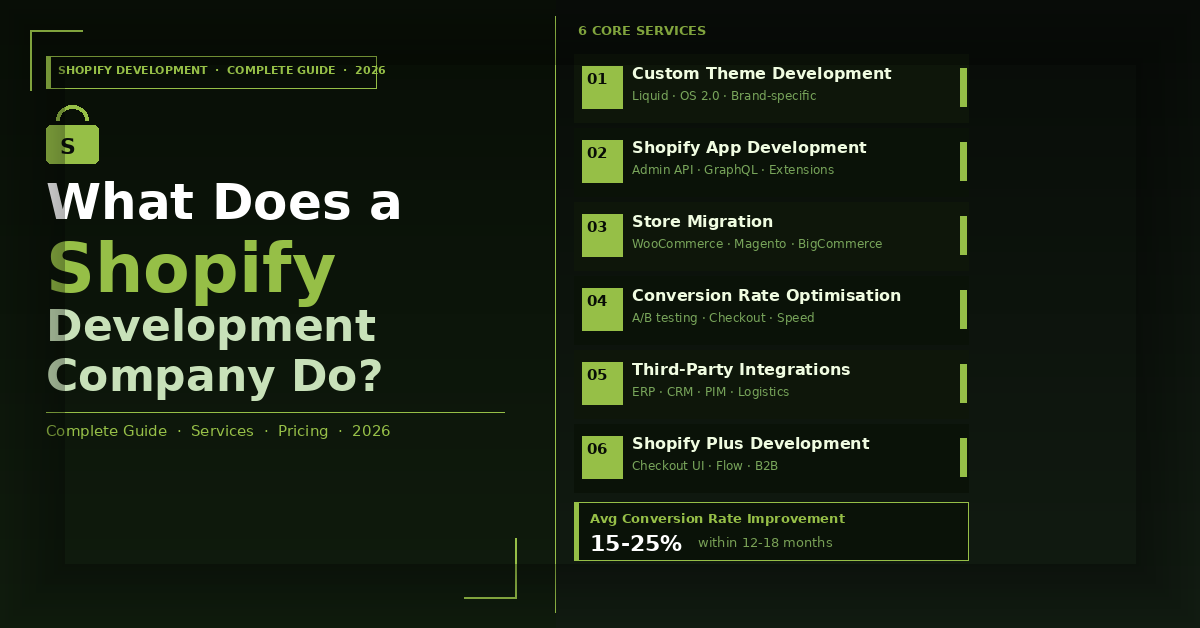
A Shopify development company builds, customizes, integrates, and optimizes Shopify stores so the platform drives measurable eCommerce revenue rather than sitting underutilized. Core services cover custom theme development, Shopify app development, store migrations, conversion rate optimization, third-party integrations, and ongoing store management. Businesses that invest in professional Shopify development see 15 to 25% improvements in store conversion rates and revenue per visitor within 12 to 18 months compared to those running out-of-the-box themes without optimization.
What does a Shopify development company do?
A Shopify development company builds and optimizes Shopify stores through custom theme development, app development, migration from other platforms, conversion rate optimization, third-party API integrations, and ongoing performance management. Unlike a general web agency, a Shopify development company has deep expertise in Shopify Liquid templating, the Shopify API, Online Store 2.0 architecture, and the platform-specific decisions that determine eCommerce performance and revenue outcomes.
Most businesses that contact a Shopify development company for the first time have already tried the simpler path. They picked a premium theme, configured it using the documentation, installed a few apps from the Shopify App Store, and launched. The store works. It accepts orders, processes payments, and ships products. But it does not perform. Conversion rates sit below industry benchmarks. Page speed scores are poor. The checkout experience has friction that the business cannot diagnose or fix without deeper platform expertise.
That gap between a functional Shopify store and a high-performing one is where a professional Shopify development company creates its value. The platform provides an exceptional commerce infrastructure. Realizing the full potential of that infrastructure requires custom development work, strategic configuration decisions, and ongoing optimization discipline that most internal teams and generic web agencies do not have the Shopify-specific expertise to deliver.
This guide covers every service a Shopify development company provides, which businesses need which services, what results to expect, how much it costs, and exactly how to evaluate whether a provider has the genuine capability to deliver what they propose.
Key Takeaways
- A Shopify development company is not the same as a Shopify theme installer or a general eCommerce agency. The distinction matters significantly when evaluating who to hire for serious store growth.
- Custom theme development using Shopify Liquid and Online Store 2.0 consistently outperforms premium marketplace themes on performance, brand differentiation, and conversion rate.
- Shopify app development fills the functionality gaps that no existing app in the Shopify App Store covers cleanly for your specific business requirements.
- Store migration from WooCommerce, Magento, or BigCommerce is one of the most technically demanding services a Shopify development company provides, and shortcuts here produce the most costly mistakes.
- Conversion rate optimization in Shopify is a distinct discipline from design and requires expertise in A/B testing, page speed optimization, checkout flow analysis, and buyer psychology.
- The ROI from a Shopify development company engagement should be tracked against conversion rate, average order value, and revenue per visitor, not vanity traffic metrics.
What Is a Shopify Development Company?
A Shopify development company is a specialist organization with deep technical and strategic expertise across the Shopify platform, engaged to build, configure, integrate, and optimize stores so that they produce measurable business results.
The definition matters because the market for Shopify services contains several types of providers that describe themselves similarly but deliver fundamentally different things. A Shopify theme installer sets up a purchased theme and configures basic store settings but does not perform custom development work. A general eCommerce agency uses Shopify as one of many platforms and may lack the depth needed for custom Liquid development or complex API integrations. A freelance Shopify developer provides technical execution on specific tasks but does not offer strategic direction or multi-discipline delivery. A full-service Shopify development company combines technical development capability across themes, apps, and integrations with strategic expertise in how the platform should be configured to produce revenue outcomes.
Understanding which type of provider a company actually is, regardless of how they describe themselves, is the most important due diligence step in any Shopify hiring decision. Our Shopify development service page covers how to evaluate Shopify development providers against specific technical and strategic criteria.
Service 1: Custom Shopify Theme Development
Custom theme development is the highest-impact service a Shopify development company provides and the one that most directly affects store conversion rates, brand perception, and long-term maintainability. It covers the complete design and development of a Shopify storefront built natively in the platform using Shopify Liquid templating and Online Store 2.0 section architecture.
Shopify Online Store 2.0 uses a JSON template architecture that gives merchants drag-and-drop section control on every page type, not just the homepage as in legacy themes. A custom theme built to OS 2.0 standards gives the merchant full visual editing control over layouts without requiring developer involvement for content changes, while preserving the performance and brand integrity of a custom-built design system.
The performance difference between a custom-built Shopify theme and a premium marketplace theme is measurable in Core Web Vitals scores. Premium themes carry code for dozens of features and design variants that most stores will never use. That unused code adds to page weight, increases JavaScript parse time, and degrades Largest Contentful Paint scores that directly affect both organic search ranking and conversion rates. A custom theme contains only the code the specific store requires, producing consistently better performance on equivalent infrastructure.
For businesses also evaluating Magento for larger catalog requirements, the Magento development services overview explains where each platform is the stronger choice for your specific requirements.
Service 2: Shopify App Development
Shopify’s App Store contains over 8,000 apps covering most standard eCommerce functionality requirements. Custom Shopify app development addresses the scenarios where no existing app meets the requirement cleanly, where the best available app carries unacceptable performance overhead, or where functionality needs deep integration with proprietary business systems that no general-purpose app was designed to connect to.
A Shopify development company building a custom app works with Shopify’s REST and GraphQL Admin APIs, the Storefront API for customer-facing functionality, Shopify webhooks for event-driven automation, and Shopify’s app extension framework for embedding functionality directly into the merchant’s admin, the storefront checkout, and customer account pages.
Common custom Shopify app development scenarios include custom product configurators for businesses selling configurable products with complex option combinations that the standard Shopify variant system cannot handle, custom B2B pricing apps applying different price levels and payment terms to different customer accounts, custom subscription management systems for businesses whose subscription model does not fit standardized app approaches, and custom ERP or warehouse management integrations where the specific business system has no quality Shopify integration in the App Store.
Our eCommerce development service page covers how custom app development fits within a broader eCommerce platform strategy, and the web app development overview explains the technical architecture considerations for complex Shopify app builds.
Service 3: Shopify Store Migration
Migrating an existing eCommerce store to Shopify is one of the most technically demanding services a Shopify development company provides and one where shortcuts produce the most costly mistakes. A migration done poorly loses product SEO equity built over years, corrupts customer data, breaks order history, and produces a store that underperforms the old one despite running on a better platform.
A professional Shopify migration covers product catalog migration including variants, images, and metafields with data integrity validation at each stage. Customer data migration transfers contact records and purchase history with relationships between customers and orders preserved. Order history migration retains historical order data for customer service, loyalty programs, and reporting. URL redirect mapping creates 301 redirects from every old URL to its Shopify equivalent to preserve the organic search equity accumulated by the old domain’s ranking history.
The URL redirect mapping component is consistently the most underinvested migration step and the one that produces the most costly long-term damage when skipped. Every indexed URL on the old site without a correct redirect pointing to its Shopify equivalent will return a 404 error, lose its accumulated link equity, and drop from search results. For established stores with significant organic search traffic, this represents a measurable revenue loss that can take months to recover from. The Core Web Vitals and SEO rankings post covers how URL structure and redirect strategy connect to organic search performance outcomes after a migration.
Service 4: Conversion Rate Optimization
Shopify conversion rate optimization is a distinct discipline from theme design and one that a Shopify development company applies systematically rather than intuitively. The average eCommerce store converts between 1.5% and 3% of visitors into buyers. Stores in the top 10% of performers convert at 5% or above. The gap between median and top-performing conversion rates represents a significant revenue opportunity from existing traffic that does not require additional marketing spend to capture.
CRO for Shopify covers product page optimization addressing image quality, product description structure, social proof placement, and urgency signals that affect add-to-cart rates. Collection page optimization covers filtering, sorting, and product card design that determines whether visitors find products matching their intent. Checkout flow optimization reduces cart abandonment through progress indicators, trust signal placement, shipping cost transparency, and payment option variety. Page speed optimization directly improves conversion rates because stores with better Core Web Vitals scores consistently convert at higher rates than slower equivalents on identical traffic.
A/B testing in Shopify requires a structured methodology to produce valid results. Testing single variables on pages with sufficient traffic, running tests long enough to reach statistical significance, and measuring revenue per visitor rather than just conversion rate are the disciplines that separate optimization programs producing compounding improvements from those producing misleading conclusions. The conversion focused landing page guide covers the CRO principles that apply equally across Shopify product pages and landing pages.
Service 5: Third-Party Integrations
Most established eCommerce businesses run several systems alongside Shopify. An ERP managing inventory and financials. A CRM tracking customer relationships and lifetime value. A product information management system governing catalog data. A logistics platform managing fulfillment and shipping. Getting these systems to share data with Shopify cleanly, in real time, with proper error handling, requires integration development that general-purpose tools like Zapier handle at a basic level but cannot address for complex or high-volume data synchronization requirements.
A Shopify development company building a custom integration covers API authentication and connection management, bidirectional data synchronization logic, webhook configuration for real-time event-driven updates, error handling and retry logic for API failures, and an admin interface for configuring integration settings without code changes. Integrations built to these standards run reliably in production without requiring developer intervention for routine operation.
Common integration targets include NetSuite and SAP for enterprise inventory and financial management, Salesforce and HubSpot for CRM and marketing automation, custom warehouse management systems for businesses with fulfillment complexity that standard apps do not support, and loyalty and rewards platforms requiring bidirectional customer data synchronization. Our HubSpot development company services cover how Shopify and HubSpot integrations are typically architected for B2C brands running both platforms together.
Service 6: Shopify Plus Development
Shopify Plus is the enterprise tier of Shopify, designed for high-volume merchants requiring advanced customization, dedicated infrastructure, and B2B commerce capabilities. A Shopify development company with Shopify Plus expertise unlocks capabilities not available on standard plans.
Shopify Plus checkout customization is the most significant technical differentiator. Standard Shopify restricts checkout customization to CSS styling. Shopify Plus allows checkout extensibility through Checkout UI extensions, enabling custom field additions, dynamic shipping and discount logic, and checkout experience personalization that are impossible on standard plans. Shopify Flow, available exclusively on Shopify Plus, enables complex multi-condition automation workflows for order processing, fraud risk management, inventory alerts, and customer segmentation that go significantly beyond standard Shopify automation capabilities.
Shopify Plus is worth the investment for stores generating above $1 million in annual revenue or requiring advanced checkout customization, B2B wholesale functionality, or multi-store organization management. A Shopify development company can help assess whether your requirements justify the higher plan cost before you commit.
Shopify Development Company vs Freelancer vs In-House Developer
| Factor | Shopify Dev Company | Freelancer | In-House Developer |
|---|---|---|---|
| Strategic direction | Full service, cross-discipline | Technical execution only | Depends on internal expertise |
| Skill breadth | Theme, apps, CRO, integrations | Typically one to two specialisms | Builds over time |
| Availability | Dedicated team, consistent | Variable, competing projects | Full time, single store |
| Risk | Low, team redundancy | High, single point of failure | Medium |
| Cost model | Project or retainer | Hourly or project | Salary plus benefits |
| Best for | Growth stage, complex stores | Specific defined tasks | Large store, ongoing work |
What to Expect in the First 90 Days
A quality Shopify development company begins every engagement with a structured discovery phase covering business objectives, current store performance baseline, existing integrations, catalog complexity, and priority outcomes. The first 30 days cover this discovery work alongside a store audit identifying specific performance issues, theme architecture problems, app conflicts, and conversion friction points. Discovery deliverables include a documented assessment, a prioritized development roadmap, and an agreed scope for the first phase.
Days 31 to 60 deliver the core technical foundation: custom theme architecture and component build, critical app configuration and integration setup, page speed optimization addressing the highest-impact Core Web Vitals improvements, and analytics configuration ensuring conversion tracking is accurate before optimization work begins. Foundation work done correctly prevents the expensive rework that follows when it is skipped to accelerate visible deliverables.
By day 90 a well-run Shopify development engagement should have launched the new store or completed the primary development phase, established a conversion rate baseline from post-launch data, identified the first A/B testing priorities based on analytics and heat mapping data, and delivered the reporting framework connecting store performance to the revenue metrics that matter to the business.
How Much Does a Shopify Development Company Cost?
Shopify development company pricing varies based on service scope, store complexity, and engagement model. The most common structures are project-based pricing for defined deliverables like a theme build or a migration, and retainer-based pricing for ongoing development and optimization work.
A custom Shopify theme build typically ranges from $5,000 to $30,000 depending on design complexity and custom section count. A full store build with catalog migration typically ranges from $8,000 to $50,000. Custom Shopify app development ranges from $5,000 to $40,000 per app depending on functionality scope. Third-party integrations range from $3,000 to $20,000 per integration depending on data model complexity. Ongoing store management and optimization retainers range from $1,500 to $6,000 per month. CRO programs with active A/B testing and analytics typically range from $2,000 to $8,000 per month.
Proposals significantly below these ranges warrant scrutiny about what is being excluded and whether the provider has genuine Shopify expertise. Our cost guide for hiring dedicated developers covers the broader context of development engagement pricing across different service models.
How to Choose the Right Shopify Development Company
Evaluating a Shopify development company requires looking past the portfolio presentation to the specific technical and strategic capabilities that determine project outcomes. Run three to five of their live Shopify portfolio stores through Google PageSpeed Insights and record Core Web Vitals scores. A provider with consistently good scores across portfolio sites is demonstrating development quality that cannot be faked with visual screenshots.
Ask for case studies connecting development work to conversion rate and revenue outcomes, not just design improvements. Ask who specifically will work on your project and confirm their Shopify Liquid and OS 2.0 experience. Assess the discovery process: a quality Shopify development company conducts a structured audit before proposing scope rather than offering fixed deliverables without understanding your current store state. Review contract terms covering intellectual property ownership of custom code and theme files, post-launch support terms, and notice period for cancellation.
For a broader evaluation framework covering professional services providers generally, the no-BS buyer’s guide to choosing a service provider covers the universal due diligence principles that apply equally to Shopify development company evaluation. The guide to choosing a website development company covers the contract and team evaluation criteria in detail.
Frequently Asked Questions



Ready to Get Started?
Your Details will be Kept confidential. Required fields are marked *


