Shopify
Summarize this blog post with:
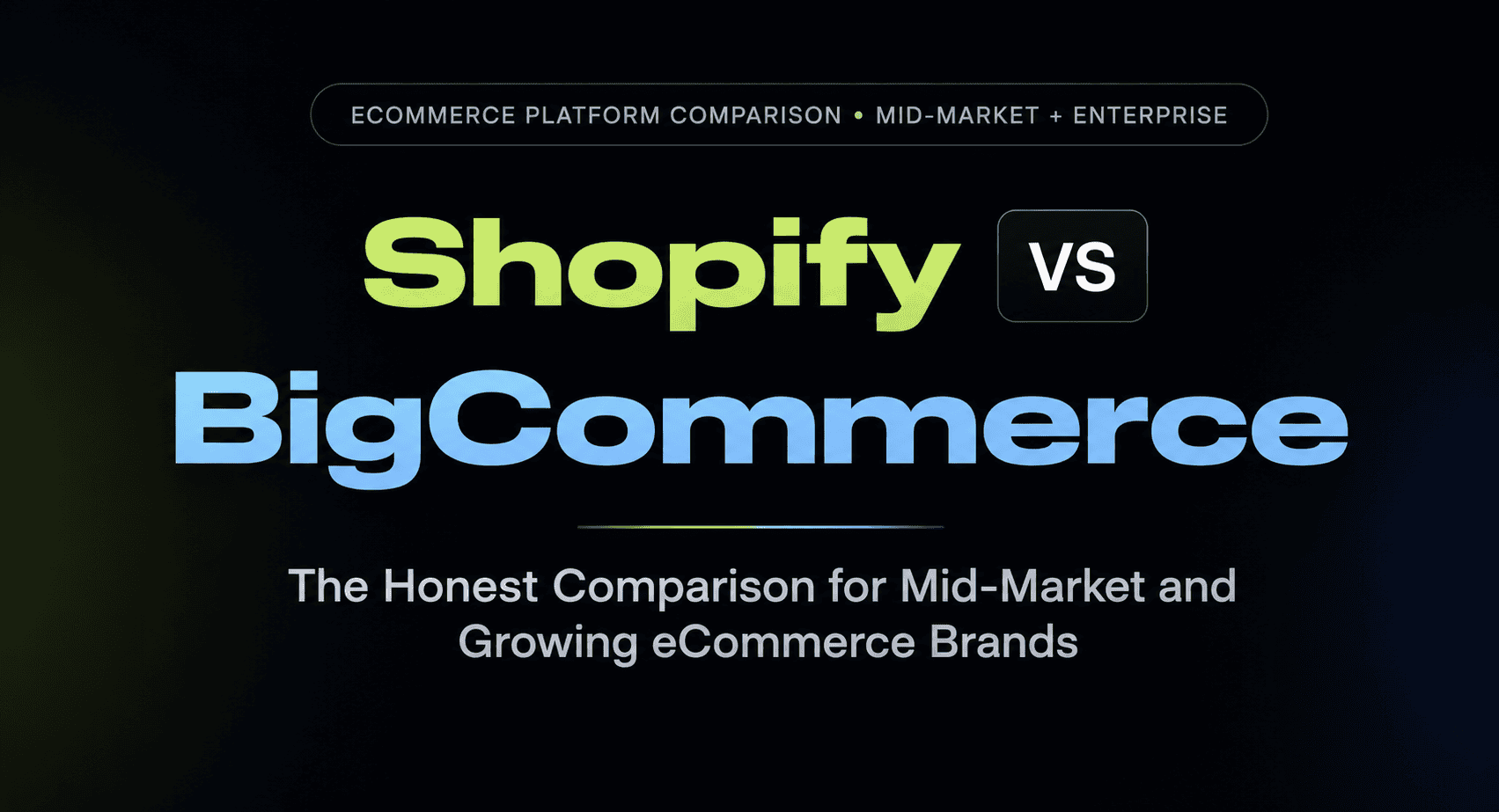
eCommerce Platform Comparison · Mid-Market + Enterprise
Shopify
VS
BigCommerce
The Honest Comparison for Mid-Market and Growing eCommerce Brands
Shopify powers 4.6 million stores with the world’s best checkout. BigCommerce powers 130,000+ merchants with zero transaction fees, native B2B, and the Catalyst headless framework. Both are excellent. Only one fits your next 24 months of growth.
The Two Questions That Decide the Comparison
Most Shopify vs BigCommerce comparisons bury the decision in feature lists. The real decision comes down to two questions that determine which platform is right for your specific situation:
Question 1: Are you using Shopify Payments? If yes, Shopify’s transaction fees disappear and its total cost advantage improves significantly. If no (international merchants, high-risk categories, preferred gateway), BigCommerce’s zero transaction fee model can save $3,000–$15,000/year at scale.
Question 2: Do you need B2B features before $2,300/month? BigCommerce includes customer groups, price lists, quote management, and bulk pricing at $105/month. Shopify gates all meaningful B2B features to Plus at $2,300/month. For a wholesale or distribution business, this single question can produce a $26,000/year cost difference.
4.6M
Shopify active stores (175 countries)
130K+
BigCommerce merchants, 75% ARR from Enterprise
91%
Shop Pay mobile conversion uplift vs standard checkout
$0
BigCommerce transaction fees on ALL payment gateways
2,048
Shopify native variants, was 100
82%
MKM revenue growth on headless BigCommerce Catalyst
30-Second Platform Summary
🟢 Shopify: In 30 Seconds
Shopify is the world’s largest eCommerce platform, 4.6 million stores, $200B+ annual GMV, $11B annual revenue. A fully managed SaaS platform where Shopify handles hosting, security, CDN, PCI compliance, and infrastructure. Shopify’s defining competitive advantages in 2026: Shop Pay (100M+ users, up to 91% higher mobile conversion than standard checkout); the 8,000+ app ecosystem; native POS for omnichannel retail; Shopify Magic + Sidekick AI; Agentic Storefronts (your products in ChatGPT and Copilot); and the Winter ‘26 Renaissance Edition increasing native product variants to 2,048 per SKU (was 100). Hydrogen (React headless framework) + Oxygen (Vercel-class hosting) for headless builds. Trade-off: 0.5–2% transaction fees on non-Shopify Payments gateways; B2B features gated to Plus ($2,300/month); app-dependent model means rising costs as you scale.
🔵 BigCommerce: In 30 Seconds
BigCommerce is the “Open SaaS” eCommerce platform, fully hosted like Shopify, but with open APIs, no platform transaction fees, and native features that Shopify charges apps for. 130,000+ merchants globally; Enterprise customers represent 75% of ARR (BigCommerce has strategically shifted toward mid-market and enterprise). The 2026 BigCommerce story is Catalyst: a React + Next.js headless starter integrated with Makeswift (no-code visual editor), giving brands a 95+ Lighthouse score headless storefront that marketers manage without developers. Zero transaction fees on 20+ embedded payment providers. Native B2B Edition (customer groups, price lists, quote management) at $105/month. Trade-off: revenue caps force plan upgrades at $50K/$180K/$400K GMV; smaller app ecosystem (1,300 vs 8,000); no native POS system; smaller merchant community than Shopify.
The 2026 Changes That Shift the Comparison
Shopify Winter ‘26 Renaissance Edition, 2,048 Variants: Shopify shattered its notorious 100-variant limit in the Winter ‘26 update, increasing native product variants to 2,048 per SKU. This eliminates one of the most frequently cited reasons for choosing BigCommerce over Shopify for complex configurable product catalogs. Brands previously forced to use apps like Infinite Options to exceed 100 variants can now manage complex product configurations natively in Shopify.
BigCommerce Catalyst + Makeswift, Headless for Non-Developers (Late 2025): BigCommerce’s Catalyst framework (React + Next.js headless starter) is now fully integrated with Makeswift, a no-code visual editor. This means brands can run a performance-optimized React headless storefront (95+ Lighthouse scores) where marketers manage content, layouts, and promotions without developer dependency. For brands evaluating headless eCommerce, Catalyst + Makeswift is the most accessible production-ready headless stack in 2026. MKM Building Supplies documented 82% revenue growth after migrating to headless BigCommerce Catalyst.
Head-to-Head: 12 Key Decision Factors
| Factor | 🟢 Shopify | 🔵 BigCommerce | Winner |
|---|---|---|---|
| Ease of Use | Best-in-class onboarding. Live in under 1 hour. Intuitive drag-and-drop editor. | Functional but busier admin. More settings, more options. Gap narrowed in 2026. | Shopify |
| Transaction Fees | 0% with Shopify Payments. 0.5–2% with any other gateway. | Zero platform transaction fees on ALL 20+ payment gateways. Always $0. | BigCommerce (non-Shopify Payments) |
| Checkout Conversion | Shop Pay: 100M+ users. Up to 91% higher mobile conversion. Gold standard. | Optimized one-page checkout. No equivalent accelerated checkout network. | Shopify (significant advantage) |
| App Ecosystem | 8,000+ apps. Most competitive, most categories covered. | 1,300 apps but many features (faceted search, gift cards, customer groups) are native. | Shopify (breadth); BigCommerce (native features) |
| Native B2B Features | Native B2B but gated to Plus ($2,300/mo): company accounts, shared catalogs, POs. | B2B Edition on Plus ($105/mo): customer groups, price lists, quotes, bulk pricing. | BigCommerce ($26K/year cheaper for B2B) |
| Product Variants | 2,048 variants per SKU (Winter ‘26 update, was 100). Matches BigCommerce. | 600 variants per product natively (unlimited via API). Deep product config. | Shopify (new parity) |
| SEO Control | Solid SEO basics. Fixed /products/ and /collections/ URLs. Agentic Storefronts (AI search). | Full URL control. No forced path structures. Better for complex technical SEO. | BigCommerce (technical SEO) |
| Headless Commerce | Hydrogen (React) + Oxygen (managed hosting). Tight, clean, Vercel-class infrastructure. | Catalyst (React + Next.js) + Makeswift (no-code editor). Deployable anywhere. MACH. | Shopify (DX); BigCommerce (openness) |
| Point of Sale (POS) | Shopify POS: best-in-class. Native, hardware available, retail + online unified. | No native POS. Third-party integrations required (Square, Lightspeed). | Shopify (clear winner) |
| AI Features | Shopify Magic, Sidekick, Tinker, Agentic Storefronts (ChatGPT/Copilot), native. | Growing AI capabilities but no equivalent to Shopify’s Agentic Storefronts or Sidekick. | Shopify |
| Revenue Caps | No revenue caps. Stay on any plan regardless of GMV until you choose to upgrade. | Automatic upgrades at $50K / $180K / $400K GMV annually. Cannot opt out. | Shopify |
| International / Multi-Currency | Shopify Markets: localized pricing, taxes, language, domains. Best-in-class. | Multi-currency supported. Less polished than Shopify Markets for international setup. | Shopify |
Pricing: What Each Platform Really Costs in 2026
Both platforms have identical base plan pricing, the real cost difference emerges from transaction fees, app stacks, and BigCommerce’s revenue-triggered upgrade model.
🟢 Shopify: Plan Pricing 2026
Basic$39/month ($29 annual)
Grow (Shopify)$105/month ($79 annual)
Advanced$399/month ($299 annual)
Shopify Plus$2,300+/month
Transaction fee (non-Shopify Pay)0.5–2% per transaction
Revenue capsNone, stay on any plan
B2B featuresPlus only ($2,300/mo)
🔵 BigCommerce: Plan Pricing 2026
Standard$39/month ($29 annual)
Plus$105/month ($79 annual)
Pro$399/month ($299 annual)
Enterprise$1,000–$3,000+/month (negotiated)
Transaction fees (all gateways)$0, always zero
Revenue caps (auto-upgrade)$50K / $180K / $400K GMV
B2B featuresPlus onwards ($105/mo)
BigCommerce revenue caps, the hidden cost most comparisons understate. At $175,000 in annual GMV you are comfortably on BigCommerce Plus at $105/month. Add $6,000 in GMV to cross $180,000 and BigCommerce automatically upgrades you to Pro at $399/month, a $3,528/year increase triggered by $6,000 in additional revenue. The upgrade is automatic; you cannot opt out. This trailing 12-month mechanic means a seasonal business with one strong quarter can trigger a plan upgrade that persists for the next 11 months at the higher tier. Shopify has zero revenue caps, you stay on Basic at $29/month whether you do $50,000 or $500,000 in annual GMV.
The transaction fee math at $500K GMV: A merchant processing $500,000 annually through a non-Shopify Payments gateway on Shopify Advanced (0.5% fee) pays $2,500/year in platform transaction fees that BigCommerce Pro merchants pay $0. At $1M GMV, that becomes $5,000/year. For international merchants where Shopify Payments is unavailable, or high-risk/specialty merchants using preferred gateways, BigCommerce’s zero transaction fee model can save $10,000–$50,000+ annually at enterprise scale. At those savings levels, BigCommerce Enterprise’s negotiated pricing becomes the clear TCO winner even accounting for revenue cap risks.
B2B Commerce: Where BigCommerce Has Its Clearest Advantage
The B2B comparison is where the two platforms diverge most dramatically on cost, and where choosing the wrong platform creates the most expensive mistake.
🔵 BigCommerce B2B Edition: What’s Included at $105/Month
- Customer groups: assign customers to groups with group-specific pricing and catalog visibility
- Price lists: create custom pricing per customer account or per group (dollar amount or percentage)
- Quote management: B2B buyers submit quote requests; sales team reviews and approves
- Bulk pricing rules: tiered pricing based on quantity ordered
- Purchase order support: accept PO as payment method with net terms
- Restricted catalog: show different products to different customer groups
- Multi-storefront: manage multiple B2B and B2C storefronts from one admin (Enterprise)
🟢 Shopify B2B: What Requires Plus ($2,300/Month)
- Company accounts with parent-child hierarchy (Plus only)
- Shared catalogs with custom pricing per company (Plus only)
- Payment terms: Net 15/30/60 (Plus only)
- Purchase order support (Plus only)
- Buyer self-service portal (Plus only)
- Quick-order lists (Plus only)
- Note: Shopify B2B went native on all plans in April 2026, but core B2B features (company accounts, shared catalogs) remain Plus-gated
The B2B cost gap: A wholesale/distribution business needing native B2B features pays BigCommerce Plus at $1,260/year or Shopify Plus at $27,600/year, a $26,340/year difference for equivalent B2B catalog management capability. For any business where wholesale or B2B selling is a meaningful channel rather than a small side experiment, this single factor tips the decision firmly to BigCommerce.
Headless Commerce: Hydrogen vs Catalyst
Both platforms have mature headless eCommerce frameworks in 2026. The choice between them reflects the broader platforms’ philosophies: Shopify optimizes for polish and developer experience within its ecosystem; BigCommerce optimizes for openness and deployment flexibility.
🟢 Shopify Hydrogen + Oxygen
- Hydrogen: React-based headless framework, Vite-powered, purpose-built for Shopify Storefront API
- Oxygen: Shopify’s managed hosting platform (Cloudflare Workers-based, global edge deployment)
- Tightly integrated: Hydrogen + Oxygen gives Vercel-class DX without leaving Shopify infrastructure
- Shopify CLI:
shopify app devfor instant local development - Trade-off: Oxygen hosting ties you to Shopify’s infrastructure; self-hosted Hydrogen is supported but less integrated
🔵 BigCommerce Catalyst + Makeswift
- Catalyst: React + Next.js headless starter kit with BigCommerce GraphQL Storefront API
- Makeswift: no-code visual editor integrated with Catalyst, marketers manage headless frontend without developers
- Deployable anywhere: Vercel, Netlify, AWS, self-hosted, not tied to BigCommerce hosting
- MACH Alliance member: Microservices, API-first, Cloud-native, Headless, composable architecture commitment
- 95+ Lighthouse scores documented with Catalyst builds
- MKM Building Supplies: 82% revenue growth after headless Catalyst migration
The headless verdict: Shopify Hydrogen is better if you want the tightest possible integration with Shopify’s ecosystem and do not need deployment flexibility. BigCommerce Catalyst is better if you want a composable architecture that integrates with best-of-breed services (Contentful, Algolia, Sanity, Commercetools-style patterns) and can deploy anywhere, with the bonus that marketers can update content without developer tickets via Makeswift.
Shop Pay: Shopify’s Most Underrated Competitive Advantage
The single most important Shopify competitive advantage in 2026 is not its app ecosystem or its AI tools, it is Shop Pay.
Shop Pay is Shopify’s accelerated checkout network with 100 million+ opted-in buyers. When a Shop Pay customer checks out on any Shopify store, their payment information, shipping address, and delivery preferences are pre-filled with a single tap. No card entry, no address typing. The conversion impact is documented: up to 91% higher mobile conversion than standard guest checkout. For a store doing $500,000 in annual GMV where mobile represents 60% of traffic (industry average), a 10% lift from Shop Pay accounts for $30,000 in additional annual revenue, more than the cost difference between most Shopify and BigCommerce plans.
🟢 Shop Pay: The Network Effect Advantage
- 100M+ opted-in buyers, the largest accelerated checkout network in eCommerce
- Up to 91% higher mobile conversion vs standard guest checkout (documented by Shopify)
- 5–10% mobile conversion lift confirmed in third-party tests
- One-tap checkout for returning Shop Pay customers on any Shopify store
- Shop app: product discovery surface for Shopify merchants (BigCommerce has no equivalent)
- For conversion-sensitive DTC brands, Shop Pay’s network effect can materially outweigh BigCommerce’s transaction fee savings
Use Case Decision Guide: Which Platform for Your Business?
DTC Brand (Under $1M GMV)
Shopify
Shop Pay conversion advantage, fast setup, 8K apps, Shopify Magic AI, no revenue caps. Start here.
B2B / Wholesale (Under $500K GMV)
BigCommerce
B2B Edition at $105/mo vs Shopify Plus B2B at $2,300/mo. $26K/year cost advantage for the same features.
Omnichannel Retail (Online + Physical)
Shopify
Shopify POS is the best eCommerce POS available. BigCommerce has no native POS. Clear winner for omnichannel.
International Brand (Non-Shopify Payments)
BigCommerce
Zero transaction fees on any gateway. At $1M GMV, saves $5K–$20K/year in platform fees vs Shopify.
Fast-Growing DTC ($300K–$2M GMV)
Shopify
No revenue caps, Shopify Payments eliminates fees, Shop Pay converts better. Stay on Advanced until Plus makes sense.
Headless / Composable Architecture
BigCommerce
Catalyst + Makeswift equals headless with no-code editing, deployable anywhere, MACH Alliance. Best open headless stack in 2026.
Complex Product Catalog (50+ Variants)
Shopify
Shopify now supports 2,048 variants natively (was 100). The variant gap that once drove merchants to BigCommerce is closed.
Dropshipping / New Seller
Shopify
DSers, Spocket, AutoDS, Shopify’s dropshipping ecosystem is the deepest. Fastest setup for first store.
Mid-Market B2B ($1M–$10M GMV)
BigCommerce
B2B Edition + zero transaction fees + headless Catalyst equals purpose-built for mid-market B2B complexity at lower TCO.
Enterprise (Above $5M GMV)
Evaluate Both
Shopify Plus $2,300/mo (B2B, Hydrogen, 10 expansion stores) vs BigCommerce Enterprise (negotiated, B2B, Catalyst). Both compete here.
When to Choose Shopify. When to Choose BigCommerce.
🟢 Choose Shopify When
- Checkout conversion is your #1 priority, Shop Pay’s 91% mobile lift is real
- You need in-person retail POS alongside online (BigCommerce has no native POS)
- You are a DTC brand where the 8,000-app ecosystem covers your stack
- Shopify Payments is available in your market (eliminates all transaction fees)
- Fast launch is critical, live in hours, not days
- Shopify Magic + Sidekick + Agentic Storefronts are priorities
- You have or expect complex variants, the 2,048-per-SKU update closes the gap
- International selling via Shopify Markets (localized pricing, taxes, language)
🔵 Choose BigCommerce When
- B2B or wholesale is a core channel (not just a side experiment), $105/mo vs $2,300/mo
- You use a non-Shopify Payments gateway and process above $300K GMV annually
- Headless composable architecture (Catalyst + Makeswift, deployable anywhere)
- Technical SEO control, full URL structure, no forced /products/ paths
- You want native features (faceted search, gift cards, customer groups) without app fees
- Your GMV growth is highly predictable (revenue caps matter less if you will not trigger them)
- MACH Alliance composable architecture aligns with your technology strategy
- Multi-storefront management from one admin (Enterprise) for multi-brand operations
Frequently Asked Questions
The most important questions brands ask before choosing between Shopify and BigCommerce in 2026.
Not Sure Which Platform Is Right for Your eCommerce Business?
A2Z Dev Center builds Shopify stores (custom Liquid themes, Shopify Plus, Hydrogen headless) and BigCommerce stores (Stencil themes, Catalyst headless, B2B Edition configuration) with no platform partnership bias. We recommend based on your GMV, payment gateway, B2B requirements, and growth plan, then build with SEO, GEO, and HubSpot CRM integrated from sprint 1 at $40–$80/hr.
Schedule a call
Talk to a subject-matter expert
Web development, SEO, or digital marketing — tell us about your project and we'll get back within one business day. No obligation.
- Free scope & strategy session
- A senior specialist, not a sales rep
- Your details stay confidential