Content Marketing
Summarize this blog post with:
GEO Content Writing · Passage Optimization · AI Citation
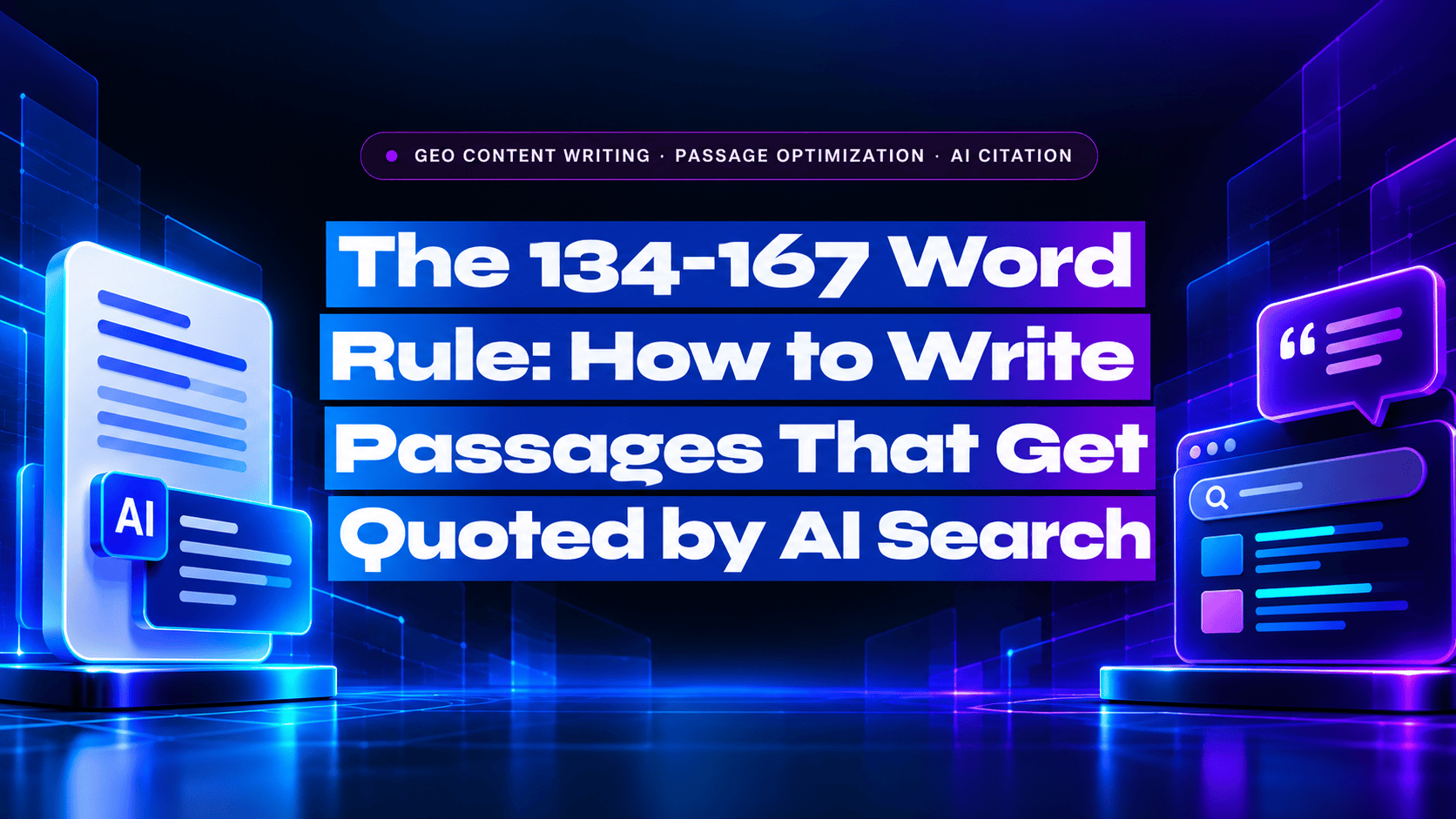
The 134-167 Word Rule: How to Write Passages That Get Quoted by AI Search
Industry analyses of AI Overview citations point to a practical passage length of about 134 to 167 words. It is a useful editing target, not a Google requirement. Long enough to be credible and complete. Short enough to be extracted cleanly. Here is how to write every passage on your site to meet this standard.
134-167
Optimal word count per citable AI passage
40-60
Words: optimal AEO direct-answer block
3.2x
Reported lift for pages with FAQPage schema (one industry study)
1st 2
Sentences: where the answer must be stated
Why Passage Length Matters for AI Citation
AI retrieval systems don’t index whole pages, they identify and extract specific passages that answer user queries. A passage needs to be long enough to provide credible, complete information that the AI can cite with confidence, but short enough to be extracted cleanly without requiring surrounding context to make sense. Industry analyses of AI citation patterns suggest the 134 to 167 word range as the sweet spot for GEO citation optimization.
A passage under 100 words often lacks the contextual depth that signals credibility to AI retrieval systems. A passage over 250 words often requires the AI to summarize or truncate rather than cite directly, reducing the chance that your specific content is what the AI surfaces. The 134 to 167 word target produces passages that AI systems can quote directly and completely, which is the highest-value citation outcome. Treat the range as a practical editing target: Google’s own guidance on generative AI features in Search says there is no ideal page length and no requirement to break content into tiny pieces, so write for readers first and use the range to keep each answer complete and self-contained.
💡 Two Distinct Targets: AEO vs GEO Passages
AEO (Answer Engine Optimization) passage: 40 to 60 words. This is the direct-definition answer block, the first one to two sentences under a question-formatted heading that states the answer completely and immediately. This is what gets extracted as a featured snippet or AI Overview summary box. GEO (Generative Engine Optimization) passage: 134 to 167 words. This is the full citable passage, the complete answer that AI models can quote or paraphrase in multi-source synthesized responses. A well-structured page has both: a 40 to 60 word AEO lead sentence, then a 134 to 167 word GEO passage expanding it.
The Anatomy of a Citable Passage
1. A Direct Question as the Heading
Every citable passage begins with a heading phrased as a specific question, the exact question your target buyer would ask an AI engine. “What is server-side rendering?” not “Rendering Types.” “How much does Shopify migration cost?” not “Migration Pricing.” AI systems use heading text to match passages to queries. The more precisely your heading matches the actual user query, the more likely your passage is retrieved. Our guide to getting featured in Google AI Overviews shows this heading pattern in practice.
2. The Answer in the First Two Sentences
State the answer, completely, in the first one to two sentences. Not a teaser. Not “In this section, we’ll cover…” The complete answer. AI systems extract the beginning of passages more frequently than the middle or end. A passage that buries the answer in sentence five will be passed over for a passage that leads with it.
3. Supporting Context (50-100 Additional Words)
After the direct answer, provide supporting context, specific data, examples, qualifications, or related details. This is what differentiates a citable GEO passage from a featured-snippet AEO block: the AI can cite you for the supporting context as well as the direct answer, giving your content a higher chance of appearing in multi-source synthesized responses that reference you for a specific data point or qualification.
4. Self-Contained Without Surrounding Context
The most critical citability requirement: the passage must make complete sense extracted without any surrounding content. Test every passage by reading it in isolation, if it requires the previous paragraph to understand, AI systems will skip it. If it stands alone as a complete, credible answer, it’s citable.
The Wrong Way vs the Right Way
| Wrong (not citable) | Right (citable) |
|---|---|
| Heading: “About Our Services” | Opening: “We offer a range of services designed to help your business grow in today’s digital landscape…” | Heading: “What does a Shopify migration agency do?” | Opening: “A Shopify migration agency moves your ecommerce store, products, customers, orders, and SEO, from your current platform to Shopify, typically in 6 to 16 weeks depending on store complexity.” |
| Heading: “Pricing” | Opening: “Our pricing depends on many factors. Contact us for a custom quote.” | Heading: “How much does Shopify migration cost?” | Opening: “Shopify migration costs range from $5,000 for a simple WooCommerce store under 500 SKUs to $250,000+ for a full Magento enterprise replatform, depending on store size, custom development required, and integration complexity.” |
| Passage requires reading the previous section to understand what “the platform” refers to | Passage names the platform explicitly in every sentence, no pronouns that require context to resolve |
Additional Citability Signals
- Cite your statistics with sources: “According to [Source], X% of…” is cited more frequently than “Studies show…” or unsourced claims. AI systems prefer content that itself cites sources, it signals the same rigor they apply to their own outputs.
- Use specific numbers over ranges where possible: “The average Shopify migration takes 8 weeks” is more citable than “Shopify migrations can take several weeks to months.” Specificity signals authority.
- Include a recency signal: A visible Last updated date and dated statistics signal freshness to AI systems that weight recent content for factual queries.
- FAQPage schema markup: One industry analysis found pages with FAQPage schema were about 3.2x more likely to appear in Google AI Overviews, although Google says structured data is not required for its generative AI search. The schema helps AI systems identify which passages are authoritative question-answer pairs.
- Author and organization schema: E-E-A-T signals via Person and Organization schema help AI systems assess passage credibility, an answer from a named expert in a recognized organization carries more citation weight than anonymous content.
Citable Passage Writing, FAQs
What content teams need to know about writing for AI retrieval.
How long should a passage be to get cited by AI search?
A practical target is a full, self-contained passage of about 134 to 167 words, opening with a 40 to 60 word direct answer, based on industry analyses of AI citations. Treat it as an editing guideline rather than a rule, because Google says there is no ideal length and recommends writing for your audience first.
What is the 134-167 word rule for AI search?
The 134-167 word rule is a practical guideline from industry analyses of AI Overview citations: a full, self-contained passage of about 134 to 167 words tends to be long enough to be credible and complete but short enough to be extracted cleanly. Passages under 100 words often lack depth, and passages over 250 words are more likely to be summarized than quoted. It is not an official rule, and Google’s AI search guidance says there is no ideal page length.
How is an AEO passage different from a GEO passage?
AEO passage: 40 to 60 words, the direct-definition answer block in the first one to two sentences under a question-formatted heading. This is what gets extracted as a featured snippet or AI Overview summary box. GEO passage: 134 to 167 words, the complete citable passage that AI models can quote or paraphrase in synthesized responses. A well-structured page has both: a 40 to 60 word AEO lead, then a 134 to 167 word GEO expansion with supporting data and context.
Why does the answer need to be in the first two sentences?
AI systems extract the beginning of passages more frequently than the middle or end. A passage that buries the answer in sentence five is passed over for a passage that leads with the complete answer. The “inverted pyramid” writing style, most important information first, supporting details after, is the natural format for AI-citable content. Never open a section with “In this section, we’ll explore…”, state the answer immediately.
What makes a passage self-contained for AI citation?
A self-contained passage makes complete sense when extracted without any surrounding content. Test: read the passage in isolation. If it requires the previous paragraph to understand what “it,” “the platform,” or “this approach” refers to, it’s not self-contained. Name everything explicitly in each passage. Use the subject noun, not a pronoun. Include the context (company name, platform name, timeframe) in every passage, even if it repeats from the previous section. AI systems may retrieve only your passage, not the surrounding page.
Does FAQPage schema help with AI search citations?
It can help, but it is not a guaranteed lever. FAQPage markup labels question-and-answer pairs clearly, and one industry analysis reported that pages with it were about 3.2x more likely to appear in Google AI Overviews. Google, however, states that structured data is not required for its generative AI search and that no special schema is needed, so add FAQ markup because it clarifies your content and keep the visible answers strong.
Does Google recommend a specific word count for AI Overviews?
No. Google’s guidance on generative AI features in Search says there is no ideal page length and no requirement to break content into tiny pieces. Use the 134 to 167 word range to keep answers complete and self-contained, not as a ranking requirement.
How do I write a citable passage?
Start with a question-style heading, state the complete answer in the first one or two sentences, add 50 to 100 words of specific supporting detail, name every entity explicitly so the passage stands alone, and cite sources for statistics. Our guide to getting featured in Google AI Overviews and our simple guide to generative engine optimization show the pattern in context.
Who can help rewrite my content for AI search?
A2Z Dev Center rewrites and structures content for AEO and GEO through its content marketing services and SEO services, including passage audits, schema, and citation tracking.
Need Help Writing Content That AI Search Engines Cite?
A2Z Dev Center builds AEO and GEO content strategies through our content marketing services for B2B and eCommerce brands, AI visibility audits, content optimization, technical GEO setup, and ongoing citation tracking.
Get GEO Content Audit →
Schedule a call
Talk to a subject-matter expert
Web development, SEO, or digital marketing — tell us about your project and we'll get back within one business day. No obligation.
- Free scope & strategy session
- A senior specialist, not a sales rep
- Your details stay confidential