
SEO
Summarize this blog post with:
Most businesses understand that content matters for SEO. What fewer understand is why some content earns first-page rankings and consistent organic traffic while other content, published on the same site with equal effort, sits on page four and never moves.
The difference is almost never writing quality in the traditional sense. It is strategic alignment. Content that ranks well in 2026 is built around a specific search intent, structured to satisfy what the searcher actually needs, optimized with the right technical signals, and authoritative enough that search engines trust it as a genuinely useful resource. That combination requires a specific set of skills that sits at the intersection of editorial writing, SEO strategy, and audience psychology.
This is what professional SEO content writing services actually deliver, and understanding the components helps businesses evaluate whether their current content program is built to rank or just built to publish.
Quick Answer: How Do SEO Content Writing Services Drive Rankings?
How do SEO content writing services help a website rank higher in search results?
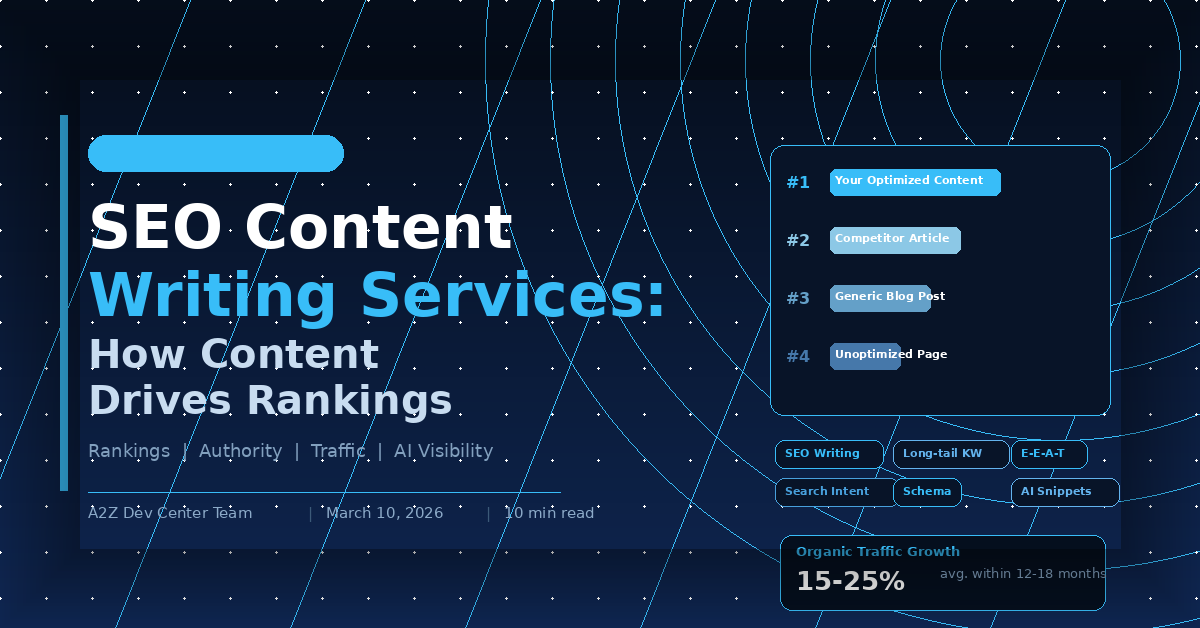
SEO content writing services drive rankings by combining keyword research, search intent analysis, on-page optimization, E-E-A-T signals, and structured content architecture into every piece of content produced. This approach ensures that each article targets a specific keyword with the right intent, covers the topic with enough depth to satisfy search engine quality thresholds, and includes the technical signals including schema markup, internal linking, and optimized metadata that search engines use to evaluate and rank content. Businesses using professional SEO content writing services consistently see 15 to 25% organic traffic improvements within 12 to 18 months of consistent program execution.
Key Takeaways
- SEO content writing is not the same as regular content writing. It combines editorial quality with keyword targeting, intent matching, technical optimization, and authority signals in every piece produced
- Search intent is the most important ranking factor that most content programs get wrong. Content that does not match the searcher’s actual goal will not rank regardless of keyword inclusion or word count
- E-E-A-T (Experience, Expertise, Authoritativeness, Trustworthiness) has become a primary content quality signal for Google in 2026, and content that lacks demonstrable expertise is consistently outranked by content that shows it
- AI search optimization is now a parallel requirement alongside traditional SEO. Content structured for AI answer engines like Google AI Overviews, Perplexity, and ChatGPT reaches audiences that traditional blue-link rankings miss
- Technical content optimization including schema markup, heading structure, internal linking, and meta data is as important as the content itself for earning and maintaining rankings
- Local SEO content writing targeting specific geographic markets captures high-intent searches that generic national content cannot address
What SEO Content Writing Services Actually Include
The term SEO content writing services covers a range of activities that vary significantly in quality and scope between providers. Understanding what a complete, professional service includes helps businesses evaluate what they are actually buying.
Keyword research and mapping is where every piece of content starts in a properly run SEO content program. Before any writing begins, the target keyword, its search volume, its ranking difficulty, the intent behind it, and the content gap it represents in the current site architecture are all defined. A writer working without this research is optimizing for nothing specific.
Search intent analysis determines what type of content the searcher actually wants to find. A query like “content writing for SEO” might be searched by someone wanting a definition, someone comparing service providers, or someone looking for a how-to guide. Each intent requires a different content structure, format, and depth. Content that mismatches the dominant intent behind a keyword will not rank well even if it is technically optimized.
On-page optimization covers every technical element of the content that affects how search engines evaluate and index it. This includes the title tag and meta description that appear in search results, the H1 and subheading structure that communicates content organization, keyword placement in the opening paragraph and throughout the body, image alt text, internal linking to related content, and word count benchmarked against what is currently ranking for the target term.
Content depth and comprehensiveness refers to how thoroughly the content covers its topic relative to competing pages. Search engines evaluate whether a piece of content satisfies the searcher’s full information need or leaves significant questions unanswered. A content piece that covers a topic more comprehensively than competing pages has a structural ranking advantage. The content marketing services framework covers how content depth requirements are determined as part of a full-program production process.
Understanding Search Intent: The Ranking Factor Most Content Gets Wrong
Search intent is the actual goal behind a search query. It is the most important factor in content ranking and the most frequently misunderstood in content programs that produce a lot of content but earn limited organic traffic.
Google classifies search intent into four primary categories. Informational intent covers queries where the searcher wants to learn something. Navigational intent covers queries where the searcher wants to find a specific website or page. Commercial investigation intent covers queries where the searcher is comparing options before making a decision. Transactional intent covers queries where the searcher is ready to take an action such as making a purchase or requesting a service.
Each intent type requires a different content format and structure. Informational queries perform best with comprehensive guides, how-to articles, and educational content that answers the question completely. Commercial investigation queries perform best with comparison articles, reviews, and feature breakdowns. Transactional queries perform best with optimized service and product pages with clear conversion paths.
The mismatch happens when a business creates a blog article targeting a transactional keyword, or a product page targeting an informational keyword. In both cases, the content format does not match what the searcher is looking for, and search engines surface the content that does match regardless of how well the mismatched content is written.
Auditing existing content for intent alignment is one of the highest-ROI activities in any SEO content program. Pieces that are well-written but poorly ranked are frequently mismatched with the dominant intent behind their target keyword. Reformatting or reorienting the content to match the correct intent often produces ranking improvements without requiring new content creation. The SEO service provider context covers how intent audits fit into a full technical and content SEO program.
E-E-A-T: Why Demonstrable Expertise Now Drives Rankings
Google’s E-E-A-T framework, which stands for Experience, Expertise, Authoritativeness, and Trustworthiness, has become one of the most significant content quality signals in 2026, particularly for topics where accuracy and credibility matter.
Experience refers to first-hand knowledge demonstrated in the content. A guide on content marketing strategy written by someone who has actually built and managed content programs demonstrates experience in ways that a generically researched article does not. This signal is increasingly difficult to fake at scale, which is why AI-generated content that lacks genuine perspective is systematically underperforming content written with real expertise.
Expertise refers to demonstrated subject matter knowledge. Author credentials, specific technical accuracy, depth of coverage, and alignment with established knowledge in a field all signal expertise to search engines. Content that contains verifiable facts, cites credible sources, and covers nuanced aspects of a topic that only genuine experts would address consistently outperforms surface-level content.
Authoritativeness refers to the reputation of the content source relative to the topic. A website with a history of publishing high-quality content on a specific subject earns authoritativeness signals that newer or broader sites lack. Building topical authority through consistent, high-quality coverage of a defined subject area is the mechanism that earns this signal over time.
Trustworthiness covers the full range of signals that indicate a site and its content can be relied upon. This includes accurate information, transparent authorship, proper sourcing, up-to-date content that reflects current knowledge, and a website that operates with integrity. For businesses offering professional services, trustworthiness signals include client references, case studies, and specific evidence of results rather than generic claims.
Incorporating genuine E-E-A-T signals into an SEO content writing program means publishing content under named authors with real credentials, citing specific data and sources, updating content regularly as information changes, and building the kind of demonstrated expertise that comes from genuine industry experience. The how to build a brand people actually remember online guide covers the brand authority signals that reinforce E-E-A-T at the domain level.
SEO Content Writing for AI Search: The 2026 Requirement
Traditional SEO optimized content to rank in the ten blue links of a Google search results page. In 2026, a significant portion of search queries are answered directly by AI-generated summaries that appear above or instead of traditional results. Optimizing content to be cited in these AI answers requires a specific structural approach alongside traditional on-page SEO.
Google AI Overviews, Perplexity, ChatGPT, and other AI answer engines extract answers from content that is clearly structured, factually specific, and directly addresses the query being asked. Content formatted with clear question-based headings, concise direct answers at the start of each section, specific data points and statistics, and FAQ sections with schema markup is systematically more likely to be cited in AI answers than content structured as flowing narrative.
This is not a replacement for traditional SEO. It is an additional optimization layer that increases content reach across both traditional search and AI-driven discovery. The connection between AI-driven SEO and how tools like ChatGPT are reshaping search optimization explains this shift in detail, including specific structural changes that improve AI citation probability.
Schema markup is a technical component of AI search optimization that many content programs overlook. FAQ schema, article schema, and how-to schema all provide structured data that AI engines use to understand and extract content. Adding appropriate schema to every piece of content produced through an SEO content writing service is a baseline technical requirement in 2026.
Keyword Strategy: Beyond Single Keyword Targeting
Effective SEO content writing services in 2026 do not target single keywords in isolation. They target keyword clusters that reflect the full range of ways a target audience searches for information related to a specific topic.
A single article optimized for “SEO content writing services” should also naturally incorporate semantically related terms like “SEO copywriting services,” “content writing for SEO,” “organic content strategy,” and “search optimized content.” These semantic variations reflect different ways the same audience describes the same need, and content that addresses all of them ranks for a broader set of queries than content narrowly focused on a single exact match term.
Long-tail keyword incorporation through FAQ sections and specific subheadings captures the detailed question-format queries that account for a significant share of total search volume in most content categories. A featured snippet or People Also Ask result for a long-tail question-format query can drive meaningful traffic that never appears in rankings for the primary keyword target. Professional SEO content writing services build this long-tail targeting into the content structure from the beginning rather than adding it as an afterthought.
Keyword density and placement follows specific guidelines in professional SEO content writing. The primary keyword appears in the title tag, the H1 heading, the opening paragraph, at least one H2 subheading, and naturally throughout the body. Secondary keywords appear in supporting subheadings and body paragraphs. Neither the primary nor secondary keywords are forced into positions where they disrupt natural reading flow, which is the line between optimization and keyword stuffing that genuinely damages both user experience and rankings.
Technical On-Page Elements That Support Content Rankings
Even excellent content with precise keyword targeting and genuine E-E-A-T signals can be held back by weak technical on-page execution. Professional SEO content writing services address both the content and the technical layer simultaneously.
Title tags and meta descriptions are the first impression of content in search results. A title tag that includes the primary keyword, communicates a specific benefit, and fits within the character limit that Google displays without truncation earns higher click-through rates from the same ranking position. A meta description that serves as a genuine answer preview increases clicks in a way that a generic summary does not.
Heading structure using H1, H2, and H3 tags communicates the organizational architecture of the content to search engines and readers alike. A clear heading hierarchy with keyword-relevant subheadings helps both search engine crawlers understand the content’s coverage and readers navigate to the specific information they need. Content with a logical heading structure ranks better and earns longer session durations than content presented as undifferentiated blocks of text.
Internal linking connects each piece of content to related content within the same site, building a topical authority network that distributes ranking signals across the cluster. Professional SEO content writing services include internal link placement as part of every piece produced, not as a separate activity. A new article that links to three related articles and receives links from three existing articles is better integrated into the site’s authority architecture than an isolated piece with no connections.
Page performance signals including load speed, mobile usability, and Core Web Vitals affect how content is ranked independently of its quality. The best written, most thoroughly optimized content underperforms on a technically poor website. Content programs built on websites with unresolved Core Web Vitals issues are fighting an uphill battle regardless of content quality.
Local SEO Content Writing: Capturing Geographic Intent
For businesses serving regional markets, SEO content writing services that incorporate local optimization signals capture a layer of search intent that generic national content cannot address. Local search queries convert at significantly higher rates than generic informational queries because local searchers are typically in an active buying or evaluation phase.
Local SEO content writing includes creating location-specific landing pages optimized for city and regional keyword targets, incorporating geographic intent signals naturally into service and informational content, and building topic clusters that address questions specific to the local market. A professional services business in Michigan benefits from content that speaks to the specific context of serving clients in Detroit, Ann Arbor, Grand Rapids, and Sterling Heights rather than only targeting generic national terms.
The local SEO services in Michigan context covers how local content optimization integrates with technical local SEO signals including Google Business Profile, local citations, and geographic schema markup to build comprehensive local search visibility. Content is one component of a complete local SEO program, and it performs best when coordinated with the technical and off-page elements that reinforce geographic relevance signals. For businesses in specific Michigan markets, the digital marketing agency in Michigan overview explains how content, local SEO, and broader digital marketing work together as an integrated program.
Measuring Whether SEO Content Writing Is Working
The measurement framework for SEO content writing services connects content activity to the organic visibility and business outcomes that justify the investment.
Keyword ranking tracking monitors the position of target keywords over time, typically weekly. Ranking improvements are a leading indicator that optimization is working and a signal to continue or intensify investment in a topic area. Ranking stagnation is a signal to review intent alignment, content depth, and competitive gap analysis before concluding that a topic is not viable.
Organic traffic measurement by content piece and content cluster shows which topics are generating discovery traffic and at what volume. Traffic trend analysis over three to six month windows is more meaningful than week-to-week fluctuations, which are affected by crawl timing, algorithm updates, and seasonal variation.
Engagement metrics including average session duration, pages per session, and scroll depth on content pages indicate whether visitors who arrive through organic search are finding the content useful. High traffic with low engagement is a signal of intent mismatch or content quality problems. High engagement with moderate traffic suggests good content quality with room to improve distribution and ranking.
Conversion tracking connects organic content visits to business outcomes including form fills, demo requests, email signups, and for eCommerce, purchase events influenced by content touchpoints. This connection is what makes SEO content writing services a revenue driver rather than a traffic generation activity, and it is what makes the investment defensible to business leadership over the long term.
SEO Content Writing vs. Regular Content Writing: Key Differences
| Factor | Regular Content Writing | SEO Content Writing Services |
|---|---|---|
| Keyword targeting | Optional or added after writing | Defined before writing begins |
| Search intent alignment | Rarely analyzed | Primary structural decision |
| On-page optimization | Usually not included | Built into every piece |
| E-E-A-T signals | Inconsistent | Deliberately incorporated |
| AI search optimization | Not considered | Schema and structure included |
| Internal linking | Occasional | Planned and placed systematically |
| Performance measurement | Traffic only | Rankings, engagement, conversions |
| Content depth benchmark | Writer judgment | Competitive gap analysis |
Frequently Asked Questions
Schedule a call
Talk to a subject-matter expert
Web development, SEO, or digital marketing — tell us about your project and we'll get back within one business day. No obligation.
- Free scope & strategy session
- A senior specialist, not a sales rep
- Your details stay confidential