SEO
Summarize this blog post with:
Dearborn, Troy, Warren: Why Metro Detroit Businesses Need Suburb-Level SEO, Not Just Detroit City
The Metro Detroit Difference: Metro Detroit local SEO content almost always lists the same eight to twelve suburbs in the same sentence, Dearborn, Troy, Warren, Livonia, Sterling Heights, Royal Oak, Southfield, and a few others, treating them as interchangeable extensions of Detroit, when Dearborn, Troy, and Warren in particular have economic identities distinct enough that a single “Metro Detroit” strategy serves none of them well. A business in Dearborn, a business in Troy, and a business in Warren are not competing for the same searches, even when they’re in the same broad industry.
This guide takes three Metro Detroit suburbs, Dearborn, Troy, and Warren, and shows what makes each one’s local search landscape genuinely different, then generalizes that into a framework you can apply to whichever suburb your business is actually in.
The Short Version
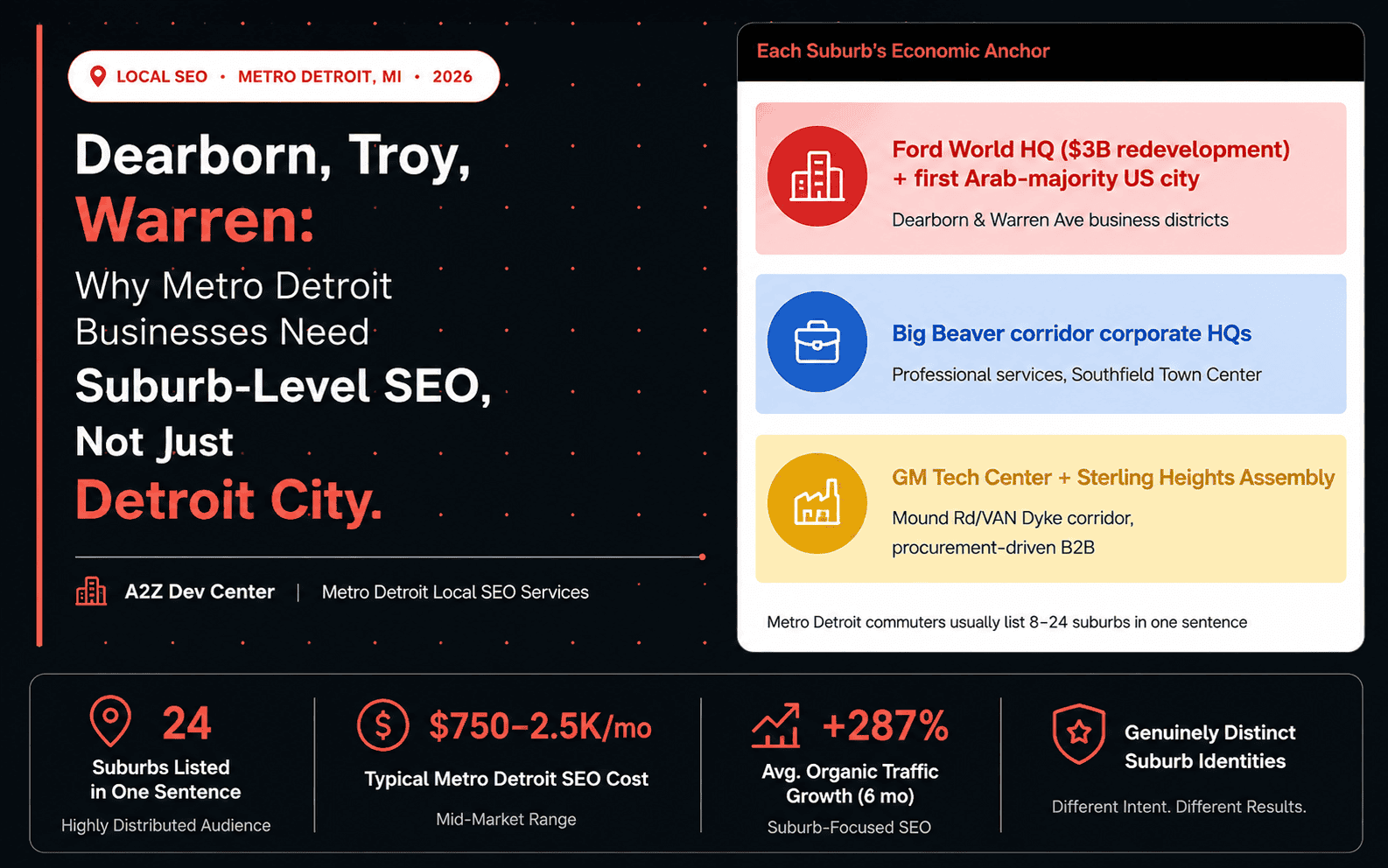
✓Every Metro Detroit suburb has one or two defining economic anchors that shape how people search for businesses there. Dearborn has Ford World Headquarters and the largest Arab American community in the US. Troy has the Big Beaver corporate corridor. Warren has the GM Tech Center and a procurement-driven B2B search pattern.
✓Most Metro Detroit SEO content lists 8 to 24 suburbs in a single sentence without differentiating any of them, the most extreme example found lists 24 cities in one run-on sentence, and treats “Dearborn” identically to “Southfield” or “Pontiac.”
✓SEO costs in this market typically run $750 to $2,500 per month depending on scope, competition, and geography, and well-executed local SEO can produce significant results, average client gains of +287% organic traffic and +52 new page-1 rankings over 6 months have been reported in this market.
A2Z Dev Center’s Metro Detroit local SEO services and Michigan digital marketing services apply suburb-specific strategy rather than a generic Metro Detroit template.
The “Metro Detroit” List Problem
⚠️ The Most Extreme Example Found: “Serving Metro Detroit and Michigan businesses in Ann Arbor, Auburn Hills, Birmingham, Bloomfield Hills, Clinton Township, Detroit, Fair Haven, Farmington Hills, Grand Rapids, Grosse Pointe, Lansing, Livonia, North Macomb County, Novi, Oak Park, Pontiac, Port Huron, Redford, Rochester, Royal Oak, Saginaw, Southfield, Sterling Heights, Troy, Warren, and West Bloomfield.” 24 cities. One sentence. Zero differentiation between any of them, including cities (Grand Rapids, Lansing, Saginaw) that aren’t even part of Metro Detroit.
This isn’t an isolated example. Across Metro Detroit SEO content, the pattern repeats: “Dearborn, Livonia, Troy, Warren, and throughout Metro Detroit,” “Detroit, Dearborn, Royal Oak, Troy, Southfield,” “Royal Oak Troy Berkley Southfield Ferndale Birmingham Warren Dearborn Sterling Heights Livonia.” Each suburb gets named, and each gets treated identically. The implicit message is that “Metro Detroit local SEO” is one thing, and your suburb is just where your address happens to be.
Every Suburb Has Economic Anchors That Determine How People Search
One Metro Detroit SEO provider gets closer to the right idea than the rest: they describe building visibility for Warren and Sterling Heights businesses around “the Mound Road and Van Dyke Avenue corridors” and “procurement managers searching for suppliers near the GM Tech Center or the Sterling Heights Assembly Plant,” while describing Troy and Southfield businesses around “the Big Beaver corridor” and “professional firms in Southfield Town Center.” This is the right instinct, applied to only two of the dozens of suburbs in the region, and never generalized into something other businesses could apply to their own city.
Generalized, the framework is this: identify the one or two things that define your suburb’s economy, the major employer, the dominant industry, the demographic character, the commercial corridor, and let that determine your keyword strategy, content angles, and the audience your Google Business Profile and service descriptions should speak to. “Local SEO for [your suburb]” is generic. “Local SEO for a business near the GM Tech Center serving Tier 1 automotive suppliers” is specific, and specific content wins underserved searches. Here’s the framework applied to three suburbs with genuinely different anchors.
Dearborn: Ford World Headquarters and the First Arab-Majority City in America
Anchor 1: Ford Motor Company. Ford World Headquarters is located in Dearborn and is undergoing a $3 billion, multi-year redevelopment as part of Ford’s 10-year transformation plan, per the Dearborn Area Chamber. This creates sustained B2B demand around the Ford campus, contractors, professional services, hospitality for visiting Ford personnel, and businesses near the Michigan Avenue corridor connecting Detroit and Dearborn. Carhartt is also headquartered in Dearborn, adding a second major corporate anchor.
Anchor 2: The Arab American Community. Dearborn became the first Arab-majority city in the United States, with roughly 55% of its approximately 110,000 residents claiming Middle Eastern or North African ancestry, per census data cited by FlaglerLive and The Conversation. The Dix-Vernor business district specifically is described by the City of Dearborn as predominantly Lebanese, Iraqi, Palestinian, Yemeni, Jordanian, and Syrian American-owned, drawing visitors not just from Dearborn but from Windsor, Flint, and Grand Rapids for groceries, food, and goods from the Arab world.
What this means for SEO. A Dearborn business serving the Arab American community has a genuinely distinct local search opportunity that zero generic “Metro Detroit” SEO content addresses: content and keywords that reflect this community specifically (potentially including bilingual content where relevant), and an awareness that “Dearborn” searches for certain categories (Middle Eastern food, cultural goods, community services) draw from a wider regional radius than typical suburb-level searches. A B2B business near the Ford campus, separately, should structure content around the Ford/automotive corporate ecosystem the way the Warren example below does for GM.
Troy: The Big Beaver Corporate Corridor
Anchor: Corporate Headquarters Density. Troy, alongside neighboring Southfield, is characterized by the Big Beaver corridor’s concentration of corporate headquarters and the professional firms clustered around Southfield Town Center. This is fundamentally a B2B and professional-services search environment: corporate decision-makers, professional service firms (legal, accounting, consulting), and the businesses that serve corporate campuses (catering, facilities, IT services, commercial real estate).
What this means for SEO. A Troy business in a professional services category should structure content around serving corporate clients along the Big Beaver corridor specifically, mentioning proximity to corporate campuses, experience with B2B/enterprise clients, and professional-tier service descriptions. This is a fundamentally different search audience than a residential service business (a Troy plumber, for example, who should focus on neighborhood-level residential content rather than corporate-corridor framing). The same city, two genuinely different SEO approaches depending on which audience the business actually serves.
Warren: The GM Tech Center and Procurement-Driven B2B Search
Anchor: GM Tech Center and the Supply Chain. Warren is anchored by the GM Technical Center and sits along the Mound Road and Van Dyke Avenue corridors connecting to Sterling Heights’ automotive manufacturing base, including the Sterling Heights Assembly Plant. The search behavior this creates is procurement-driven: per Metro Detroit SEO market research, “procurement managers searching for suppliers near the GM Tech Center or the Sterling Heights Assembly Plant… when a major contract is on the line” represents a distinct B2B search pattern.
What this means for SEO. A Warren business serving the automotive supply chain (industrial services, equipment, logistics, engineering) should create content that speaks directly to procurement-driven searches: corridor mentions (Mound Road, Van Dyke Avenue), proximity to the GM Tech Center, and case studies or service descriptions framed around major-contract, supplier-relationship language rather than generic “best [service] near me” consumer framing. This mirrors the Tier 1/2/3 supplier angle relevant to neighboring Sterling Heights, but with Warren’s specific GM Tech Center anchor as the reference point.
“Detroit” vs “[Your Suburb]”: The Keyword Decision at Metro Scale
“Detroit” / “Metro Detroit” Keywords
Maximum competition. Detroit is an even more dominant brand than “Grand Rapids” is for West Michigan. Every agency targets “Detroit” or “Metro Detroit” broadly, often alongside 8-24 other city names in the same sentence. This is the most crowded possible search territory.
“[Your Suburb]” Keywords
Proportionally more underserved. Because “Detroit” dominance is even stronger than “Grand Rapids” dominance in West Michigan, suburb-specific terms (and especially suburb-plus-anchor terms like “near GM Tech Center” or “Dix-Vernor”) are proportionally even more underserved relative to their search volume.
The practical guidance follows the same shape as the two-tier approach useful in other Michigan markets: maintain broad relevance for “Detroit” and “Metro Detroit” terms where genuinely applicable, but invest specifically in suburb-plus-anchor content, “[your suburb] near [your anchor]”, since this is where the framework above creates real differentiation. A Warren business that only targets “Warren MI [service]” is still competing in an undifferentiated pool; a Warren business that targets “[service] near GM Tech Center” or “[service] Van Dyke Avenue corridor” is targeting something almost nobody else has written content for.
How AI Search Changes Vendor and Service Discovery Across Metro Detroit Suburbs
The procurement-driven B2B search pattern described for Warren is exactly the kind of search increasingly happening through AI tools like ChatGPT and Perplexity rather than traditional search, Generative Engine Optimization (GEO). A procurement manager researching suppliers “near the GM Tech Center” or a corporate facilities manager in the Big Beaver corridor researching vendors increasingly starts that research with an AI query. The suburb-anchor framework in this guide directly supports AI visibility as well as traditional search: genuinely specific content (Dearborn’s Dix-Vernor district, Troy’s Big Beaver corridor, Warren’s GM Tech Center proximity) gives AI systems concrete, citable detail that generic “Metro Detroit” content cannot provide. The same specificity that wins underserved traditional searches is what AI systems can confidently extract and cite.
For Metro Detroit businesses ready to move beyond the generic suburb-list approach, A2Z Dev Center’s Metro Detroit local SEO services apply this suburb-identity framework to whichever city your business operates in, and our Michigan digital marketing services extend this approach across the broader state for businesses operating in multiple Michigan markets.
Frequently Asked Questions
Everything Metro Detroit business owners need to know about suburb-level local SEO.
Related reading: hyper-local SEO for Detroit neighborhoods.
Schedule a call
Talk to a subject-matter expert
Web development, SEO, or digital marketing — tell us about your project and we'll get back within one business day. No obligation.
- Free scope & strategy session
- A senior specialist, not a sales rep
- Your details stay confidential