
AI
Summarize this blog post with:
AEO · GEO · Platform Strategy · ChatGPT · Perplexity · Google AIO
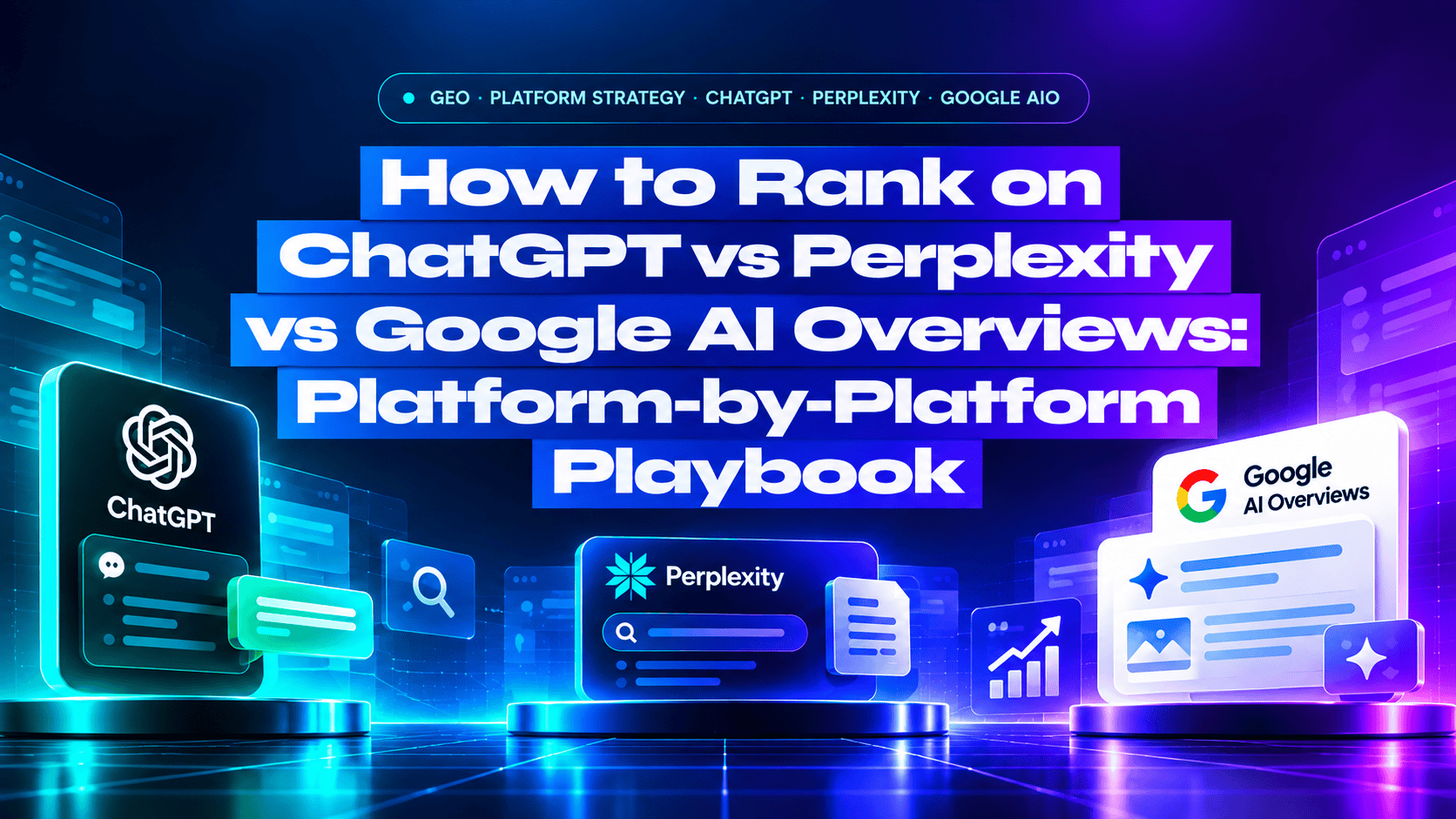
How to Rank on ChatGPT vs Perplexity vs Google AI Overviews: Platform-by-Platform Playbook
ChatGPT cites brands at 0.59%. Perplexity at 13.05%. Google AI Overviews at 59.8% for brand domains. Three platforms, three architectures, three completely different optimization strategies. A blended approach misses all three.
0.59%
ChatGPT brand citation rate, mention-heavy, citation-light
13.05%
Perplexity brand citation rate, search-first with links
59.8%
Google AIO brand domain citation rate
48%
Google queries triggering AI Overviews
Why Platform-Specific Strategy Matters
These three platforms use fundamentally different retrieval architectures, draw from different source types, and measure success differently. A single AI search optimization strategy can’t serve all three, and averaging your tracking numbers across them into one score tells you nothing useful about where to improve. Each platform requires its own optimization approach and its own measurement cadence if you want to increase AI search visibility consistently.
| Platform | Architecture | Primary Sources | Citation Rate | Traffic Generated |
|---|---|---|---|---|
| ChatGPT | Training data + ChatGPT Search (web-enabled) | Wikipedia, broad web training data, ChatGPT Search (when enabled) | 0.59% (brand citation) | Low, few source links in standard mode |
| Perplexity | Real-time web retrieval + citation engine | Reddit, industry publications, news, your website directly | 13.05% (brand citation) | High, direct links in every answer |
| Google AI Overviews | Google index + AI synthesis | Google-indexed pages with high domain authority | 59.8% (brand domain) | Medium, some clicks through AIO citation chips |
Citation rate data: Otterly.ai’s 2026 AI Citations Report, based on over 1 million AI citations analyzed across ChatGPT, Perplexity, and Google AI Overviews.
ChatGPT: The Training Data and Mention Strategy
If you’re wondering how to optimize content for ChatGPT citations, start here: ChatGPT’s standard mode draws from training data, not live web retrieval. This means your optimization target is not individual pages, it’s your brand’s presence across the entire web corpus that was included in OpenAI’s training data. Brands that appear frequently and positively in training data sources (Wikipedia, Reddit, news articles, industry publications) are more likely to be mentioned in ChatGPT responses.
What to optimize: Third-party brand mentions across Wikipedia, Reddit, and industry publications. Brand search volume (the strongest predictor of ChatGPT mentions). Original research and data that gets cited across the web. ChatGPT Search (web-enabled mode) does retrieve live pages, so your website’s citability matters for users with Search enabled. Allow GPTBot in robots.txt. Server-side render your content.
Measurement: Mention rate (not citation rate) is the primary ChatGPT metric, how often your brand appears in responses, regardless of whether a link is included. Run brand-direct and category-level prompts monthly in incognito mode. Track mention rate and sentiment trends over time.
Perplexity: The Highest-Value Citation Platform
If you want to know how to get cited by Perplexity, understand its architecture first: Perplexity is a search-first AI, it retrieves real-time web content and cites every claim with visible footnote links. At a 13.05% brand citation rate (22x higher than ChatGPT), Perplexity is the most direct path from content optimization to measurable AI referral traffic. Perplexity citations appear in GA4 as perplexity.ai referral traffic, the most trackable AI visibility signal available.
What to optimize: Direct Perplexity crawlability, server-side rendered content, allow PerplexityBot in robots.txt. Reddit presence is a primary Perplexity source, active Reddit participation in relevant communities generates significant Perplexity citation. Industry publication coverage. Content that directly answers specific questions with citable 134 to 167 word passages. Update your content frequently, Perplexity weights recency.
Measurement: Citation rate in Perplexity responses plus referral traffic from perplexity.ai in GA4. Run your target prompt set on Perplexity monthly, logging whether your brand is cited (with link) and in what position. Track perplexity.ai sessions in GA4 as a direct revenue-attribution metric.
Google AI Overviews: The Domain Authority Play
Learning how to rank in Google AI Overviews starts with understanding the base layer: Google AI Overviews run on top of Google’s existing index, they cite pages that Google has already indexed and trusted. That’s also the short answer for how to appear in Google AI Overviews at all, since AIO cannot cite a page Google hasn’t already crawled and trusted. At 59.8% brand domain citation rate (the highest of the three platforms), Google AIO is the most accessible AI surface for brands with existing SEO foundations. If you rank well on Google, you’re already eligible for AIO citation. FAQPage schema markup increases AIO eligibility 3.2x.
What to optimize: Standard Google SEO (your AIO eligibility is your Google index authority). FAQPage schema on all question-structured content. E-E-A-T signals (authorship, organization schema, date, citations). Content freshness, AIO prefers recently updated pages. Structured AEO passages with direct answers in the first two sentences.
Measurement: Google Search Console “AI Overviews” report (where available). Track Search Console for brand query impressions and clicks. Monitor AIO appearances manually for your target keywords. Google Analytics segment for organic sessions from AIO clicks (distinguished by #text= URL fragments).
The Unified 30-60-90 Day Plan
- Days 1–30 (Technical foundation): Verify robots.txt allows GPTBot, ClaudeBot, PerplexityBot. Check page source for CSR rendering issues. Add FAQPage schema to key content pages. Add Organization and Author schema. Create llms.txt. Submit XML sitemap.
- Days 31–60 (Content layer): Audit top 20 content pages for citable passage structure. Rewrite intros to answer questions in first 2 sentences. Add 134 to 167 word citable passages to each page. Structure heading hierarchy as questions. Add internal links from supporting pages to key topic hubs.
- Days 61–90 (Off-site layer): Begin Reddit participation in 3 relevant subreddits. Audit G2/Capterra profile and launch review request campaign. Identify 2 to 3 industry publications for contributed article outreach. Launch brand tracking dashboard: monthly prompt testing across all three platforms.
Platform Playbook, FAQs
Platform-specific optimization questions for ChatGPT, Perplexity, and Google AI Overviews.
Why is Perplexity’s citation rate so much higher than ChatGPT’s?
Architecture difference. Perplexity is search-first, it retrieves real-time web content for every query and cites every claim with visible footnote links. Citations are structural in Perplexity’s response format. ChatGPT draws primarily from training data in standard mode and doesn’t cite sources unless ChatGPT Search is active. The 0.59% vs 13.05% citation rate gap (22x) reflects this architectural difference, not content quality differences. A page well-cited by Perplexity may not even appear in a ChatGPT response and vice versa.
Should I optimize for ChatGPT or Perplexity first?
Perplexity first if you want measurable referral traffic, Perplexity citations are directly trackable in GA4 (perplexity.ai referral sessions) and generate real visits. ChatGPT first if brand awareness and mention rate in buyer conversations are the primary goal, ChatGPT has 900 million weekly active users and shapes brand perception at scale even without generating many clicks. Most strategies should target Perplexity for traffic and ChatGPT for brand presence simultaneously, as the optimization activities (citable content, third-party mentions) overlap significantly.
How does Google AI Overviews differ from featured snippets?
Featured snippets extract one source’s passage and display it directly. AI Overviews synthesize multiple sources into a generated paragraph with citation chips, not direct extractions. The optimization approach is similar (direct answers, question-structured headings, FAQPage schema) but AI Overviews pull from more sources simultaneously and often combine information from multiple pages. You can appear in an AI Overview for a query you don’t hold the featured snippet for, and vice versa. FAQPage schema increases AIO eligibility 3.2x (Frase research).
Does Google rank still matter for Google AI Overviews?
Yes, Google AI Overviews primarily cite pages that Google has already indexed and trusted. High domain authority and strong Google rankings are the primary eligibility signal for AIO citations. Ahrefs found 80%+ of AI-cited pages don’t rank for the specific query, but they do have domain authority. Your existing Google SEO foundation is the prerequisite for Google AIO eligibility. This is why Google AIO has the highest brand domain citation rate (59.8%), it rewards brands that have already built Google authority.
Can I track AI search traffic in Google Analytics?
Partially. Perplexity generates trackable referral traffic, look for perplexity.ai in GA4 Traffic Acquisition. ChatGPT links sometimes include utm_source=chatgpt.com. Google AI Overview clicks appear as organic traffic but may include #text= fragments in the page path. Brand search lift in Search Console (branded query volume increasing) is a strong indirect signal that AI visibility is driving awareness. The most reliable measurement is monthly manual prompt testing across all three platforms, logged in a tracking spreadsheet, the trend over 3 to 6 months is the actionable signal.
Why isn’t my content showing up in ChatGPT?
A few causes are most common. First, ChatGPT’s standard mode answers from training data with a knowledge cutoff, so recently published or recently updated content may not be in that snapshot yet. Second, GPTBot may be blocked in your robots.txt, which prevents both training-data inclusion and ChatGPT Search (web-enabled mode) from reading your pages. Third, ChatGPT favors brands with third-party mentions on Wikipedia, Reddit, and industry publications over brand-owned content alone, so a page with no outside citations is less likely to surface. Finally, if your site is heavily client-side rendered, confirm it’s server-side rendered or pre-rendered so crawlers can actually read the content.
Need a Platform-by-Platform AI Visibility Strategy?
A2Z Dev Center builds AEO and GEO strategies through our content marketing services, AI visibility audits, content optimization, citation tracking, and technical GEO setup. 16+ years in digital marketing.
Get Platform-Specific AI Strategy →Related reading: SEO vs AEO vs GEO explained.
Schedule a call
Talk to a subject-matter expert
Web development, SEO, or digital marketing — tell us about your project and we'll get back within one business day. No obligation.
- Free scope & strategy session
- A senior specialist, not a sales rep
- Your details stay confidential