
Hubspot
Summarize this blog post with:
THE CORE DISTINCTION IN 2026
HubSpot vs Salesforce is not a features comparison. It is a comparison of two fundamentally different operating models. Salesforce gives your engineering and RevOps teams maximum customization capability with a corresponding requirement for dedicated technical staff to build and maintain it. HubSpot gives your revenue teams a managed platform that most teams can operate with their existing headcount. The correct comparison is not “which has more features” but “which operating model fits your organization right now.”
THE SHORT VERSION
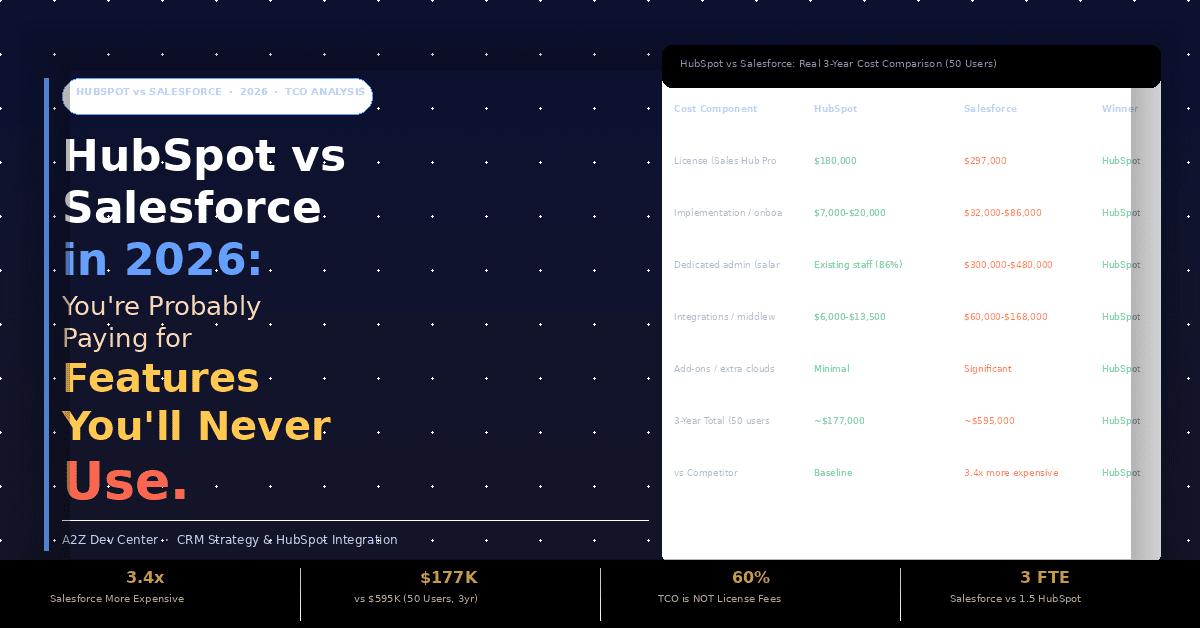
- For a 50-user deployment over 3 years, Salesforce costs 3.4x more than HubSpot. Not because of license fees. Because of implementation, dedicated admin headcount, integration complexity, and add-on costs that appear after you sign. The total comes to approximately $595,000 for Salesforce versus $177,000 for HubSpot at the Professional tier, per tech-insider.org’s April 2026 tested analysis.
- 60% of your year-one CRM spend will not be on software. It will be on implementation, admin time, integrations, apps, and support, per research by Rework cited in Six & Flow’s 2026 TCO model. The license fee comparison that most evaluations open with represents less than half the actual first-year investment.
- Most companies buying Salesforce at $15M-$40M ARR are purchasing an enterprise operating model they will not need for another 3 to 5 years. 70% of B2B SaaS companies under $25M ARR run HubSpot, and 85% over $50M ARR run Salesforce, according to GrowthSpree’s May 2026 benchmark data from their client portfolio. The decision is about matching platform complexity to organizational maturity, not buying the most powerful tool available.
- A2Z Dev Center’s digital marketing services include CRM platform evaluation, HubSpot implementation, and integration strategy for companies at every stage of the $5M to $100M ARR range. This HubSpot vs Salesforce pricing and platform evaluation guide reflects the framework we apply to every new client engagement before recommending a direction in this CRM comparison.
You are not comparing two CRMs. You are comparing two operating models. One of them is priced correctly for your organization. The other one is priced for an organization you will become in three to five years, and you will pay the enterprise operating costs in full while running a mid-market business. This guide shows you which is which, names the specific features most companies pay for but never touch, and gives you the revenue threshold framework that makes the HubSpot vs Salesforce decision clear.
What Features Are Most Companies Actually Paying for but Never Using?
Every competitor guide on HubSpot vs Salesforce pricing gives you a features table. None give you a feature utilization analysis: which of those features specific company types actually log into versus which ones sit idle while the license bill arrives every month. These are the most commonly purchased and consistently underutilized features on each platform, based on practitioner data from RevOps consultants and implementation agencies.
SALESFORCE FEATURES MOST MID-MARKET COMPANIES NEVER USE
Paying for these with Enterprise tier
- Territory management: Built for 50+ rep organizations with geographic or vertical-based territory structures. Most companies under 30 reps manage assignments manually in 10 minutes.
- Collaborative forecasting hierarchies: Multi-level quota rollup across manager tiers. Useful at VP/CRO level in large orgs. Most 10-30 rep teams use a single pipeline view.
- Marketing Cloud (Pardot/Account Engagement): Separate purchase, separate platform, separate admin. Most companies buying Sales Cloud never connect it to Marketing Cloud, running two disconnected systems.
- CPQ (Configure, Price, Quote): Separate license for complex product configuration and quoting. Critical for multi-product enterprises. Irrelevant for companies with under 20 SKUs.
- Complex custom objects at scale: The unlimited custom object depth is powerful for bespoke data models. Most mid-market teams never use more custom objects than HubSpot natively supports.
- Einstein AI (standard tier): The AI features in Enterprise require significant historical data and admin configuration to produce useful outputs. New deployments rarely activate this effectively in Year 1.
HUBSPOT FEATURES SALES-ONLY TEAMS OFTEN PAY FOR UNNECESSARILY
Marketing Hub if you run sales-only
- Marketing Hub Enterprise: If your team is sales-first with no in-house content marketing, a significant portion of the Marketing Hub capabilities (SEO tools, blog CMS, landing page testing) will sit unused.
- Service Hub if no customer success function: Service Hub’s ticketing, SLA management, and help desk features have zero value to teams without a dedicated support or customer success function.
- Advanced custom reporting beyond 3 dashboards: Most SMB and mid-market HubSpot users never saturate the reporting capabilities included in their tier before upgrading.
- A/B testing at scale: Requires sufficient email list volume to produce statistically significant results. Small lists produce inconclusive results regardless of tier.
The honest version of the HubSpot vs Salesforce evaluation starts by listing which of the features in the plan you are evaluating you have a specific, named use case for within the next 12 months. Not hypothetical future uses. Actual current needs with a named team member responsible for them. Most mid-market evaluations find that the features justifying the Salesforce Enterprise price point are 1 to 3 years away from being needed. Our HubSpot integration guide maps the specific integrations that actually drive revenue recovery in a HubSpot environment and helps identify which platform’s native feature set covers the highest-priority business needs without requiring premium tier upgrades.
What Is the Real Total Cost of Salesforce vs HubSpot? (Not the License Fee)
The CRM comparison that most evaluations open with is a license fee comparison. License fees are approximately 40% of the real first-year cost of either platform, per research by Rework cited in Six & Flow’s 2026 CRM TCO analysis. The remaining 60% is implementation, admin time, integrations, apps, and support. Here is what those numbers actually look like for a 50-user deployment.
| COST COMPONENT | HUBSPOT (PRO) | SALESFORCE (ENT) | WINNER |
|---|---|---|---|
| License (3 years) | ~$180,000 | ~$297,000 | HubSpot |
| Implementation / onboarding | $7K-$20K | $32K-$86K | HubSpot |
| Dedicated admin (3 years) | Existing staff (86% of teams) | $300K-$480K salary | HubSpot |
| Integrations / middleware | $6K-$13.5K | $60K-$168K | HubSpot |
| 3-Year Total (50 users) | ~$177,000 | ~$595,000 | 3.4x gap |
These numbers come from tech-insider.org’s April 2026 analysis that tested both platforms across five business scenarios. They are corroborated by Avidly Agency’s February 2026 pricing analysis for mid-market companies (2x to 3x over 3 years) and Software Pricing Guide’s 2026 comparison (2.4x higher 5-year Salesforce TCO) cited by Six & Flow. The TCO gap is consistent across multiple independent sources.
The 73% CRM implementation failure stat: 73% of enterprise CRM implementations fail to meet ROI expectations within 18 months, per valasysmartech’s analysis. The primary cause is hidden costs that were not included in the original business case. An evaluation that opens with license fees and excludes implementation, admin headcount, and integration costs is the business case structure that produces this failure rate. Our HubSpot CRM migration roadmap addresses this directly by mapping every cost category before a single record moves.
The specific financial impact of the Salesforce vs HubSpot TCO gap at mid-market depends heavily on whether you need the custom web application development and deep custom object architecture that Salesforce provides. A financial services firm documented $250,000 in Salesforce integration costs over three years. A SaaS company achieved equivalent functionality on HubSpot for $150,000, per valasysmartech’s CRM B2B enterprise comparison. The difference is not platform quality. It is platform complexity matching organizational need.
The Hidden Headcount Cost: Why Salesforce Doubles Your Staffing Requirements
The largest single cost differentiator between HubSpot and Salesforce is not on either platform’s pricing page. It is the people required to run the environment well after implementation. This is the variable that makes the Salesforce vs HubSpot TCO gap what it is, and it is missing from every competitor comparison on this topic.
SALESFORCE STAFFING REQUIREMENT
3 FTE
mid-market / 6+ FTE enterprise
Mature Salesforce deployments require dedicated administrators, developers, solution architects, and integration specialists. Mid-market environments typically need approximately 3 FTE to run well: 1 Salesforce admin ($100K-$160K/year US), plus development and integration support. Enterprise deployments expand to 6 or more FTE once architecture, development, and integration oversight are included, per Six & Flow’s 2026 headcount modeling across their client portfolio.
HUBSPOT STAFFING REQUIREMENT
1.5 FTE
mid-market / 3-4 FTE enterprise
86% of HubSpot teams manage the platform with existing staff, per Whitehat SEO’s 2026 analysis. Mid-market HubSpot environments are operated with 1.5 to 2 blended FTE across RevOps, marketing operations, and sales operations. Enterprise HubSpot requires 3 to 4 FTE versus Salesforce’s 6 or more. The HubSpot ease of setup score of 8.4 versus Salesforce’s 7.2 on G2 (across 2,200+ reviews each) reflects this structural difference in day-to-day management burden.
At US mid-market compensation rates, a dedicated Salesforce administrator runs $100,000 to $160,000 per year in salary alone. Over three years, that is $300,000 to $480,000 in admin cost before any development, architecture, or integration specialist costs are added. Six & Flow’s 2026 TCO model shows that the 21% gap between HubSpot and Salesforce five-year TCO is driven primarily by staffing and ecosystem layers, not software fees. The model assumes comparable skill-level rates for both platforms. The difference is the number of roles required, not the seniority of those roles.
The staffing test for your organization: Before completing your HubSpot vs Salesforce evaluation, answer this question: does your organization currently have a dedicated Salesforce admin, or will you hire one? If neither, your Salesforce implementation will either underperform (because no one is managing it optimally) or you will rely on expensive external consultants to fill that gap. Both outcomes are more expensive than HubSpot’s bundled ease-of-use model for organizations that do not yet need Salesforce’s depth.
The Revenue Threshold That Determines Your HubSpot vs Salesforce Decision
The most useful output of a HubSpot vs Salesforce evaluation is not a features scorecard. It is identifying which revenue stage you are at and which platform’s operating model matches it. GrowthSpree’s May 2026 benchmark from their B2B SaaS client portfolio gives the clearest empirical data on this.
Under $20M ARR
HubSpot
70% of B2B SaaS ABM programs at this stage run HubSpot. Built marketing-first, a 4-person RevOps team can run a $10M-$20M ARR pipeline on HubSpot without dedicated admin overhead. $36K-$72K/year for a 25-seat team vs $84K-$168K for Salesforce at equivalent scope.
$20M-$50M ARR
Depends on 3 variables
50/50 split at this stage. The three variables that determine direction: (1) ACV mix, high-ACV enterprise deals with complex multi-stakeholder processes favor Salesforce depth; (2) RevOps headcount, if you have 3+ dedicated RevOps, Salesforce is manageable; (3) CRM data complexity, if you need multi-object relationships beyond HubSpot’s native model, Salesforce earns its cost.
Over $50M ARR
Salesforce
85% of B2B SaaS ABM programs at this stage run Salesforce. Multi-product, multi-region, and enterprise ABM complexity at this scale typically requires Salesforce’s customization ceiling. The TCO premium is justified by the operational complexity it enables that HubSpot cannot match natively.
The expensive HubSpot vs Salesforce pricing mistake is choosing Salesforce when HubSpot would suffice for the next 3 to 5 years, and paying the enterprise operating costs in full while running a growth-stage business. The second expensive mistake is choosing HubSpot at $40M ARR with complex multi-buying-committee enterprise sales and then re-platforming to Salesforce within 18 months, incurring migration costs on top of the initial implementation. Matching the platform to the current organizational stage avoids both errors. For context on what a platform migration actually costs when the wrong choice was made, our HubSpot CRM migration roadmap documents the full scope of work and the realistic timeline for moving from one platform to the other.
HubSpot Breeze vs Salesforce Agentforce: The 2026 AI Layer
In 2026, both platforms shipped significant AI capabilities that change the competitive calculus for teams where automation depth is a primary selection criterion. The fundamental difference in architecture, pricing philosophy, and implementation complexity from the sections above still applies. But the AI story has changed enough to address directly.
Salesforce Agentforce
Enterprise AI Platform- 18,500 customers with Agentforce deployed as of May 2026
- 3 billion monthly workflows across the Agentforce customer base
- Automates prospecting, call summaries, and pipeline updates natively
- Data Cloud integration pulls first-party data for AI and automation
- Best-in-class for 1:1 enterprise ABM with custom orchestration
- Requires Salesforce admin expertise to configure and maintain agents
- Full capability requires Einstein + Agentforce licenses on top of base CRM
HubSpot Breeze AI
Integrated Across All Hubs- Breeze AI available across Marketing, Sales, Service, and Content Hubs
- Included in the free CRM tier (basic features), no separate AI license
- AI-powered prospecting, email drafting, and deal summary built into workflows
- Content Agent, Prospecting Agent, and Customer Agent available
- Designed for teams without dedicated AI/data engineering resources
- Sufficient for 1:many and 1:few ABM programs under $100K ACV
- DigitalApplied March 2026: “The capability gap has narrowed, but implementation complexity remains decisive”
The AI layer does not resolve the underlying operating model difference. A team without Salesforce admin expertise will not get meaningful value from Agentforce without significant configuration investment. HubSpot’s Breeze AI is designed to deliver useful output to existing team members without specialized AI administration. For teams at the $20M to $50M ARR range evaluating the platforms partly on AI capability, the relevant question is not “which AI is more powerful” but “which AI will my current team actually use effectively.” Our work connecting performance marketing attribution to CRM data routinely shows that unused AI features cost organizations more in implementation time than they deliver in output, regardless of which platform houses them.
The HubSpot vs Salesforce Overpaying Diagnostic
Run this CRM comparison calculation before your next renewal or evaluation meeting. It takes 10 minutes and produces a directional answer that the license fee comparison never provides.
The HubSpot vs Salesforce pricing comparison only becomes straightforward when you include all four cost categories: license, implementation, headcount, and integrations. HubSpot’s content marketing integration capabilities make it particularly well-suited for marketing-led growth companies where the CRM’s role is to close the loop between content activity and pipeline contribution, a function it handles natively without requiring the Marketing Cloud add-on that Salesforce requires for equivalent functionality.
Frequently Asked Questions
The Right CRM Decision Starts With Matching Platform to Stage,
Not Buying the Most Powerful Option.
A2Z Dev Center runs CRM platform evaluations that apply the revenue threshold framework, feature utilization analysis, and full TCO modeling from this guide to your specific team size and sales process. We tell you which direction the data points before any implementation scope is committed.
Book a Free CRM Consultation
Schedule a call
Talk to a subject-matter expert
Web development, SEO, or digital marketing — tell us about your project and we'll get back within one business day. No obligation.
- Free scope & strategy session
- A senior specialist, not a sales rep
- Your details stay confidential
