
Digital Marketing
Summarize this blog post with:
AEO · GEO · SEO · Search Strategy
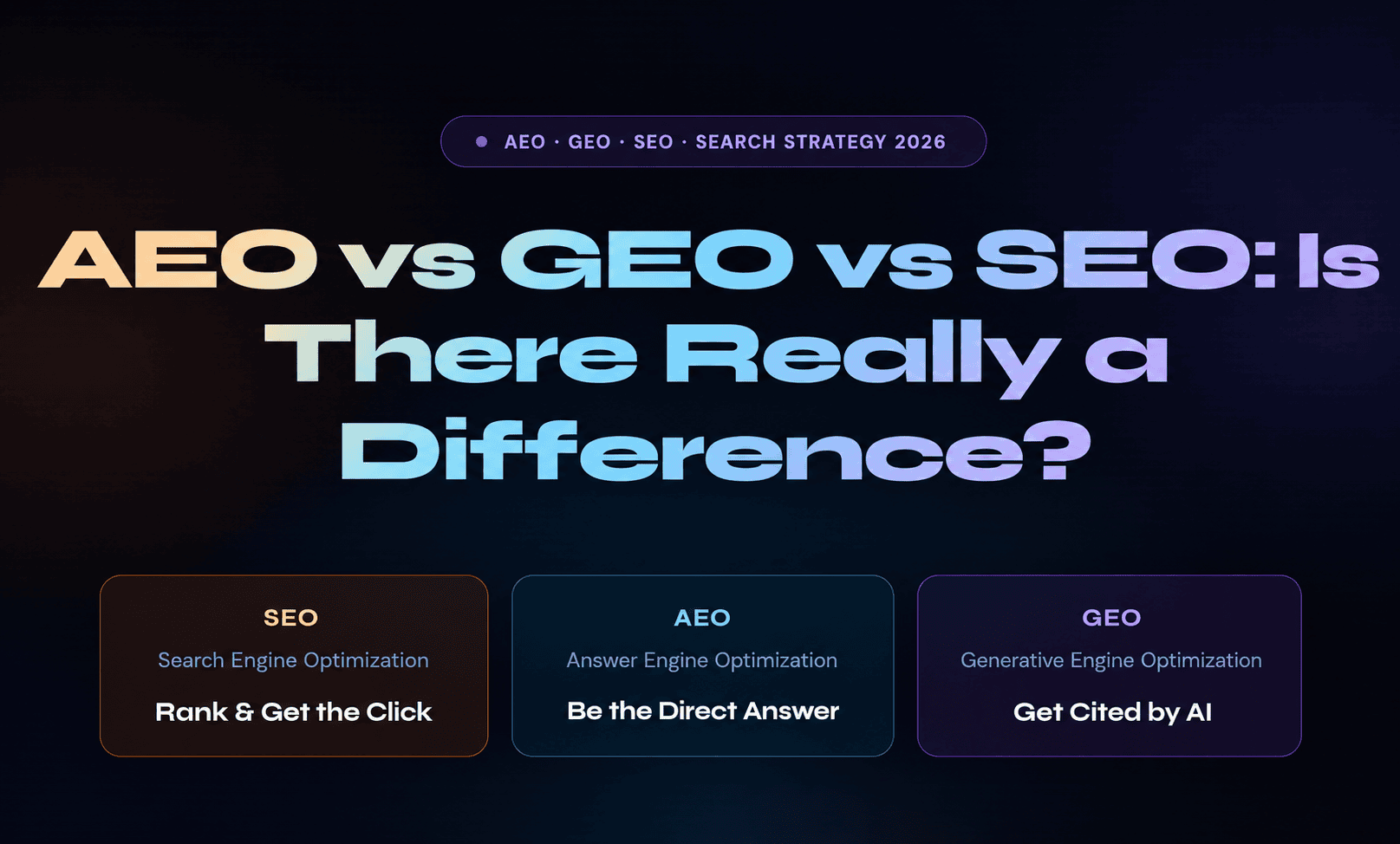
AEO vs GEO vs SEO: Is There Really a Difference?
Three acronyms. One overlapping foundation. Genuinely different success metrics, platforms, and optimization units. Here is the clearest breakdown of what each discipline actually means, and how to run all three as a unified strategy.
SEO
Search Engine Optimization
Rank & Get the Click
AEO
Answer Engine Optimization
Be the Direct Answer
GEO
Generative Engine Optimization
Get Cited by AI
The One-Line Version of Each
SEO gets you on the results list and earns the click. AEO makes your content the answer that displays before any click happens. GEO makes your brand and content a cited source inside AI-generated answers. Different surfaces, different success metrics, same underlying content quality requirement.
In SparkToro’s latest US study, about 68% of Google searches ended without a click. BrightEdge found AI Overviews on roughly 48% of the commercial and informational queries it tracks, though other studies report lower rates. OpenAI says ChatGPT has more than 900 million weekly active users. These are not signals that SEO is dying, they are signals that SEO alone is no longer sufficient to capture the full search surface where buyers form opinions and build shortlists.
What Each Discipline Actually Targets
SEO, Search Engine Optimization
SEO is the practice of improving website visibility in traditional search engine results pages (SERPs), primarily Google and Bing. The goal is organic traffic through clicks. Success metrics are ranking position, organic sessions, and click-through rate. SEO involves technical website health (Core Web Vitals, crawlability, indexation), on-page optimization (keyword research, content relevance, heading structure), and off-page authority (backlinks, brand mentions, domain authority).
SEO remains the foundation that AEO and GEO are built on, and Google’s own guidance on generative AI features says standard SEO fundamentals still apply. Our technical SEO audit checklist covers the foundation checks. A site with no SEO authority has almost no chance of being cited in AI Overviews or Perplexity, AI systems heavily favor pages from sites that Google has already validated as authoritative through its own ranking signals.
AEO, Answer Engine Optimization
AEO is the practice of structuring content to be selected as the direct answer to a user query, appearing in featured snippets, People Also Ask boxes, voice search readouts, knowledge panel content, and the summary boxes in Google AI Overviews. AEO is extraction-centric: the engine identifies one authoritative passage and surfaces it directly. The user reads the extracted text without necessarily clicking through. The optimization unit is a single well-structured passage.
AEO content follows a specific structure: a direct question as the heading, a clear definition or answer in the first one to two sentences, then expanded context. Lists, tables, and numbered steps are favored by answer engines because they lift cleanly as structured excerpts. FAQPage schema markup improves eligibility for these surfaces without guaranteeing placement.
GEO, Generative Engine Optimization
GEO is the practice of making your content authoritative and citable enough to be referenced inside answers generated by large language models, ChatGPT, Perplexity, Gemini, Claude, Google AI Mode. GEO is grounding-centric: the AI engine retrieves multiple sources, synthesizes them into a multi-sentence response, and cites the sources it used. The user reads a stitched-together answer that may quote, paraphrase, or reference your content. The optimization unit is a page that contributes citable sentences to a multi-source response.
GEO emerged 2022 to 2024 as ChatGPT, Perplexity, and AI Overviews entered mainstream use. Its signals differ meaningfully from AEO: brand presence on third-party sources (Reddit, Wikipedia, YouTube, industry publications), topical authority across a content cluster rather than a single page, and passage-level citability (clear quotable sentences that state facts completely without surrounding context).
Where They Are the Same, and Where They Diverge
SEO Unique Focus
- Keyword research and search intent
- Backlink building and domain authority
- Core Web Vitals and technical health
- Click-through rate optimization
- Ranking position on SERPs
- Internal linking architecture
AEO Unique Focus
- Featured snippet eligibility
- Question-structured headings
- Direct definition answers (first 2 sentences)
- FAQPage and HowTo schema
- People Also Ask box wins
- Voice search answer format
GEO Unique Focus
- Citation rate in AI-generated answers
- Third-party brand mentions (Reddit, Wikipedia)
- Passage-level citability (about 134-167 words as a practical target)
- robots.txt for AI crawlers
- llms.txt (optional, not confirmed by major AI providers)
- Topical authority across content cluster
The Full Comparison: SEO vs AEO vs GEO
| Dimension | SEO | AEO | GEO |
|---|---|---|---|
| Full name | Search Engine Optimization | Answer Engine Optimization | Generative Engine Optimization |
| Primary goal | Rank higher, get organic clicks | Be the direct extracted answer | Be cited inside AI-generated response |
| Platforms | Google, Bing, Yahoo | Featured snippets, voice search, AI Overview summary boxes | ChatGPT, Perplexity, Gemini, Claude, Google AI Mode |
| Success metric | Rankings, organic traffic, CTR | Snippet wins, voice answer share, PAA wins | Citation rate, brand mention rate, AI share of voice |
| Optimization unit | Full page | Single extractable passage | Citable page contributing to multi-source synthesis |
| User behavior | Clicks to your site | Reads answer on SERP (may not click) | Reads synthesized AI response (rarely clicks) |
| Content style | Keyword-optimized, comprehensive page | Direct Q&A structure, short precise answers | Structured, sourced, passage-dense authority content |
| Schema markup | All schema types | FAQPage, HowTo, Speakable | Article, Organization, Author, trust signals |
| Third-party signals | Backlinks | Backlinks (shared with SEO) | Brand mentions on Reddit, Wikipedia, YouTube, publications |
| Emerged | Mid-1990s | 2014-2016 (featured snippets era) | 2022-2024 (ChatGPT / Perplexity era) |
| Dependence on each other | All three share the same foundation, strong SEO enables AEO; strong AEO + SEO authority enables GEO citations | ||
Are AEO and GEO the Same Thing?
They are related but meaningfully different, and conflating them leads to a confused content program. The shared foundation (clean writing, structured data, topical authority, authorship signals) is real. But the success metrics and optimization units diverge:
AEO success = your passage was extracted and shown as the featured snippet or AI Overview summary box. The user saw your content displayed as the authoritative answer. Measured by: snippet rank tracking, PAA wins, voice answer testing.
GEO success = your page was retrieved and cited by an AI model assembling a multi-source response to a user query. The user saw your brand or site referenced in a synthesized answer. Measured by: citation rate on Perplexity, brand mention rate on ChatGPT, share of voice in AI responses to your target prompts.
The clearest distinction: AEO is about being the one answer. GEO is about being one of the cited sources in a synthesized answer. Both matter, but a brand that measures only featured snippet wins will miss its GEO performance entirely, and vice versa.
The Unified Strategy: Running All Three Together
How SEO, AEO, and GEO Stack as Layers
🟠 SEO
Foundation
Foundation
Technical health (Core Web Vitals, crawlability, indexation, site speed). Keyword research from real search demand. Backlink authority and domain trust. Internal linking across content clusters. Without this layer, AEO and GEO have no authority to build on.
🔵 AEO
Layer
Layer
Structure every page to answer specific questions directly. Use H2/H3 headings phrased as questions. Write a direct definition answer in the first 1 to 2 sentences under each heading. Use lists, tables, and numbered steps that engines can extract. Add FAQPage schema. Target featured snippets, PAA, and AI Overview summary boxes.
🟣 GEO
Layer
Layer
Build topical authority through content clusters, not single pages. Write citable passages of 134 to 167 words that AI models can quote without surrounding context. Include original data, statistics, case studies, and expert perspective. Get cited on Reddit, Wikipedia, YouTube, and industry publications. Configure robots.txt for AI crawlers: allow OAI-SearchBot, Claude-SearchBot, and PerplexityBot so AI search can retrieve your pages. Optionally add llms.txt. See our platform playbook for platform-specific tactics. Monitor citation rate monthly across ChatGPT, Perplexity, and Google AI Overviews.
Frequently Asked Questions
What marketers and content teams need to understand about the three search disciplines.
What is the difference between SEO, AEO, and GEO?
SEO ranks pages in traditional search results and earns organic clicks. AEO structures content to be selected as the direct answer in featured snippets, voice search, and AI Overview summary boxes, visibility even without a click. GEO makes content authoritative enough to be cited inside AI-generated responses from ChatGPT, Perplexity, and Gemini, brand presence in synthesized answers. The three disciplines are layers: SEO provides the domain authority that AEO and GEO are built on. A page that ranks through SEO has a higher chance of AEO selection. A site with strong SEO and AEO authority is far more likely to be cited in GEO responses. They run in parallel, not in sequence.
Are AEO and GEO the same thing?
Related but meaningfully different. AEO (extraction-centric): the engine picks one authoritative passage and surfaces it as a direct answer. Optimization unit: a single well-structured passage. Success metric: featured snippet wins, PAA wins, voice answer wins. GEO (grounding-centric): the AI retrieves multiple sources, synthesizes a multi-sentence answer, cites the sources. Optimization unit: a page that contributes citable sentences to a multi-source response. Success metric: citation rate in AI responses, brand mention rate, share of voice across ChatGPT/Perplexity/Google AIO. The shared foundation (clean writing, structured content, topical authority) is real, but measuring only snippet wins misses GEO performance entirely.
Does SEO still matter with AI search growing?
Yes, SEO is the foundation both AEO and GEO are built on. Nearly 60% of Google searches end without a click, yet Google processes 8 billion+ queries daily. AI Overviews trigger on 48% of queries, but they primarily cite pages Google has already indexed and trusted. Ahrefs found 80%+ of AI-cited pages don’t rank for the specific query, but they have domain authority. A site with no SEO foundation has almost no chance of AI citation. SEO provides the domain authority, indexation, and topical signal that makes AEO and GEO possible. Run all three in parallel.
What content gets cited by AI search engines?
Content that earns AI citations shares these signals: topical authority (comprehensive coverage of a topic across a cluster, not one page), structured Q&A format (direct answers to specific questions), citable passage density (134 to 167 word passages that state facts completely without context), cited sources and statistics, original data or unique perspective, and trust signals (authorship, date, organization schema, E-E-A-T). AI systems look for content that reads like a reliable reference source, not a keyword-optimized landing page or a generic “ultimate guide” that restates what everyone else has already written.
How do I optimize for AEO, GEO, and SEO at the same time?
SEO foundation: technical health, keyword research from real search demand, backlink authority, internal linking. AEO layer: question-structured H2/H3 headings, direct definition answers in first 2 sentences, lists and tables, FAQPage schema. GEO layer: content clusters for topical authority, 134 to 167 word citable passages, original data and expert perspective, third-party brand presence (Reddit, Wikipedia, YouTube, industry publications), robots.txt access for AI search crawlers (OAI-SearchBot, Claude-SearchBot, PerplexityBot), optional llms.txt, monthly citation rate tracking. The foundation activities, clean HTML, structured data, authoritative writing, topical depth, benefit all three simultaneously.
What does AEO stand for?
AEO stands for answer engine optimization: structuring content so search and AI systems can select it as the direct answer, for example in featured snippets, People Also Ask boxes, voice answers, and AI Overview summaries. Our guide to getting featured in Google AI Overviews shows the tactics.
What does GEO stand for?
GEO stands for generative engine optimization: making your brand and pages authoritative and citable enough to be referenced inside answers generated by AI systems such as ChatGPT, Perplexity, Gemini, and Claude. Read our simple guide to generative engine optimization for the basics.
Does Google treat AEO or GEO differently from SEO?
Google’s guidance on generative AI features in Search says the same SEO fundamentals apply, that no special markup or rewriting is required, and that you should create helpful content for people first. In practice, AEO and GEO are best treated as layers on top of strong SEO rather than separate replacements for it.
Who can build an SEO, AEO, and GEO strategy for my business?
A2Z Dev Center builds unified SEO, AEO, and GEO programs through its SEO services and content marketing services, covering technical foundations, answer-ready content, schema, and AI citation tracking.
Need an AEO + GEO + SEO Strategy Built for Your Business?
A2Z Dev Center builds unified search visibility strategies through our content marketing services covering traditional SEO, answer engine optimization, and generative engine optimization, so your brand appears across Google rankings, featured snippets, and AI-generated answers.
Get Free Search Strategy Audit →
Schedule a call
Talk to a subject-matter expert
Web development, SEO, or digital marketing — tell us about your project and we'll get back within one business day. No obligation.
- Free scope & strategy session
- A senior specialist, not a sales rep
- Your details stay confidential
Building this? Let's talk.
Get a Free Scope Call →